Real link Floer homology
Abstract: In this paper, we define real link Floer homology for strongly invertible and doubly periodic links in closed real $3$-manifolds with connected fixed sets, which generalizes real Heegaard Floer homology and real sutured Heegaard Floer homology. We give a combinatorial description of the theory in $S3$ via real grid diagrams and use it to investigate structural properties of the theory as well as properties of strongly invertible knots. A computer implementation was written by Zhenkun Li. An appendix including real grid homology for 50+ small knots is made jointly by Zhenkun Li and the author, from which we observe several interesting phenomenon.
- Monopole Floer Homology and Real Structures (2022)
- On the involutive Heegaard Floer homology of negative semi-definite plumbed 3-manifolds with $b_{1}=1$ (2021)
- Triple linking numbers and Heegaard Floer homology (2020)
- Instanton and the depth of taut foliations (2020)
- Heegaard Floer homology and cosmetic surgeries in $S^3$ (2019)
- A class of knots with simple $SU(2)$ representations (2015)
- Surgery obstructions and Heegaard Floer homology (2014)
- Real Heegaard Floer Homology (2025)
- A note on real Heegaard Floer homology and localization (2025)
- Absolute $\mathbb{Z}/2$ gradings in real Heegaard Floer homology (2026)
Summary
- The paper develops an equivariant extension of link Floer homology for real 3-manifolds, enriching classical invariants with symmetry-sensitive features.
- The paper introduces real grid diagrams and combinatorial methods to compute the new invariants, ensuring computational tractability in complex settings.
- The paper establishes effective bounds for equivariant unknotting numbers and slice genera while highlighting novel phenomena such as the failure of the Künneth theorem.
Real Link Floer Homology: Foundations, Structure, and Implications
Introduction and Motivation
The paper "Real link Floer homology" (2604.21240) introduces an equivariant extension of link Floer homology, termed real link Floer homology, for links in 3-manifolds equipped with orientation-preserving involutions—so-called real 3-manifolds. This construction targets two broad classes: strongly invertible and doubly periodic links, each with intricate symmetry properties under the involution. The theory generalizes recent advances in real Heegaard Floer homology [guth2025real], real sutured Floer homology [BGX], and real Bordered Floer homology [LOrealbordered], extracting new invariants sensitive to both link topology and group action.
The relevance of equivariant constructions arises from historical interest in symmetries of low-dimensional manifolds and knots. Classical invariants—Alexander polynomial, knot Floer homology, Khovanov homology—display limited sensitivity to involutive symmetries. Recent results on equivariant genus, unknotting number, and Seifert genus [hirasawa2023equivariant, MillerPowellequivslicegenera, borodzik2025khovanovhomologyequivariantsurfaces] indicate a need for more refined, symmetry-adapted Floer-theoretic tools. Real link Floer homology is developed with computational tractability (via real grid diagrams), connections to spectral sequences, skein exact sequences, and practical bounds for equivariant unknotting and slice genus.
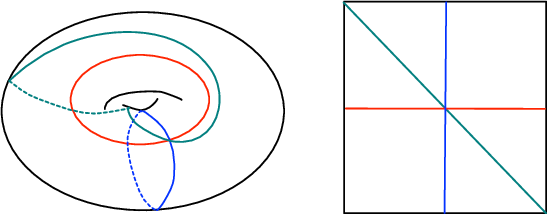
Figure 1: A genus one real Heegaard splitting of S3 illustrating the involution across a symmetry axis.
Definitions and Combinatorial Framework
The foundational definitions differentiate between strongly invertible and doubly periodic links, each class dependent on the interaction with the involution τ on Y3. The key notion is a real Heegaard diagram, which is a Heegaard diagram (Σ,α,β,O,X,R) equipped with an involution R satisfying compatibility with the link and involution on the ambient manifold. For a link L in (Y,τ), extra auxiliary data a (choice of orientation, labeling, half-axis, etc.) is essential to uniquely determine the real Floer invariant—this is a marked difference from classical invariants and underpins the sensitivity of real Floer groups to the specific symmetry.
A major constructive tool is real grid diagrams: toroidal grid diagrams on T2 with an involutive symmetry across a main diagonal, providing a concrete combinatorial model for real Heegaard diagrams of links in (S3,τ). These diagrams support a combinatorial definition of the chain complex underlying real link Floer homology, with differentials governed by enumerating "real rectangles," taking into account the symmetry.

Figure 2: Involutive Reidemeister moves on real grid diagrams accommodating equivariant isotopies.
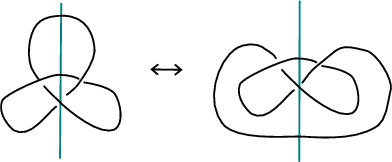
Figure 3: An example of an I-move, showcasing essential equivariant link deformation.
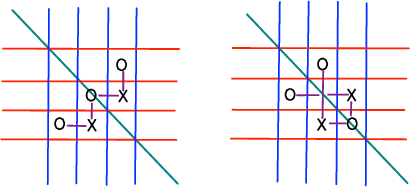
Figure 4: Realizing a classical RI move as a real commutation in the equivariant setting.
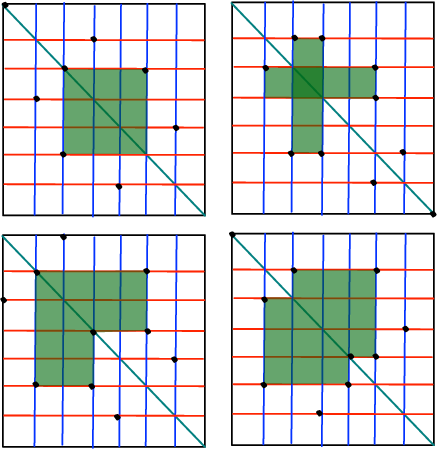
Figure 5: Examples of real rectangles—domains relevant to the differential—illustrating permissible moves under the involution.
Algebraic Structures and Invariants
Real link Floer homology, denoted τ0, is defined over suitably constructed polynomial rings tracking basepoint multiplicities of O and X marks invariant or swapped by the involution. The curvature of the differential is computed explicitly and reflects the underlying symmetry type—ensuring trivial differentials only after setting certain variables to zero, and requiring careful stabilization arguments for invariance.
Splitting by real τ1 structures and equipping (relative) Maslov and Alexander gradings, real link Floer groups admit a rich filtration structure. Invariants can be formulated as polynomial decategorifications (real Alexander polynomials), and certain numerical quantities (torsion order, real τ2-invariant) extracted. The dependence on auxiliary data is essential, and the theory displays a marked failure of classical properties such as the Künneth theorem for connected sums.
A major computational advantage is the combinatorial description: homology generators correspond to real grid states, with differentials computed via counts of real rectangles—generalizations of classical combinatorial grid homology adapted to the real setting.
Equivariant Knot Theory: Unknotting, Slice Genus, and Skein Theory
Unknotting and Torsion Bounds
Real link Floer homology is applied to define equivariant unknotting numbers and to bound these from below using algebraic torsion orders and real τ3 invariants. Given a strongly invertible knot τ4, the minimal number of equivariant crossing changes of types τ5 and τ6 needed to trivialize τ7 can be effectively bounded by the torsion order and real τ8 extracted from the real grid homology:
τ9
These bounds mirror classical results but are refined by equivariant considerations, leveraging explicit crossing change maps defined combinatorially on the chain complex.
Equivariant Slice Genus and Cobordism
Real grid homology supports spectral sequences relating classical and real Floer groups, and can be used to produce lower bounds for equivariant slice genus—the minimal genus of a slice surface preserved by the involution in the 4-ball Y30. Using a detailed analysis of Morse moves and handle decompositions compatible with symmetry, the author proves:
Y31
where Y32 is the minimal number of fixed critical points, controlling the equivariant complexity of a given slice surface Y33. This result gives effective lower bounds in a setting where classical invariants may vanish.

Figure 6: Equivariant saddle moves, depicting critical handle operations preserving involutive symmetry.

Figure 7: Elimination of fixed 1-handles—key to optimizing equivariant Morse functions in constructing minimal genus slice surfaces.
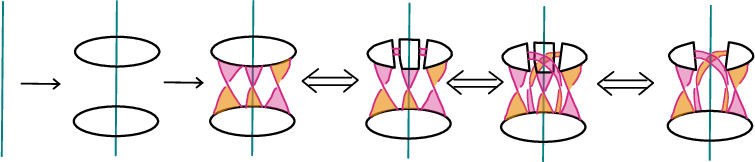
Figure 8: Sequence of moves eliminating fixed 1-handles in the handle decomposition of an equivariant slice surface for the trefoil.
Skein Exact Sequences and Decategorification
A comprehensive treatment of both oriented and unoriented real skein triples is given, paralleling and extending the role of skein exact triangles known in classical link Floer theory. Mapping cone models are constructed for oriented skein triples, and explicit long exact sequences are deduced in both the hat and minus flavors of real grid homology. As a consequence, the real Alexander polynomial satisfies an oriented skein relation analogous to the classical Alexander skein relation, with explicit normalization reflecting the symmetry:
Y34
These skein relations underline the utility of real Floer-theoretic invariants in distinguishing symmetric links and tracking their algebraic and geometric evolution under simple local modifications.
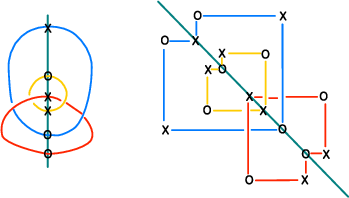
Figure 9: Examples of links and diagrams where the auxiliary data restriction is loosened, a situation critical for unoriented skein theory.
Computational Results and Phenomena
The feasibility of computations (see Appendix and included computer program) for knots with ≤7 crossings allows for extensive experimentation. Notably:
- Sensitivity to strong inversion: With the exception of Y35, real Alexander polynomials and real Floer groups systematically distinguish different strong inversions on knots with crossing number ≤7.
- Dependence on auxiliary data: Detailed examples are provided demonstrating that the choice of auxiliary data Y36 can change the Floer group even for the same knot and involution. This sharpens and extends the phenomena observed with refined Khovanov homology and distinguishes the real Floer setting.
- Failure of Künneth theorem: Explicit calculations show that connected sum formulas do not hold, in stark contrast to the classical theory—offering a new perspective on the structure of the equivariant concordance group.
Implications and Future Directions
Real link Floer homology provides a new arsenal of invariants for equivariant low-dimensional topology, blending classical Floer-theoretic techniques with equivariant Morse and handle theory. The following are key theoretical and practical implications:
- Enhanced sensitivity: Real Floer invariants can distinguish links and knots with the same classical invariants, including for amphichiral and slice knots where classical Y37 vanishes.
- Equivariant bounds: Practical applications to lower bounds for equivariant unknotting and slice genus offer tools for the study of 4-manifolds with symmetries, with implications for contact/symplectic topology and knot concordance.
- New phenomena: Failure of classical structure theorems (such as Künneth) highlights rich structural variation introduced by equivariance, suggesting deeper investigations into the algebraic structure of the equivariant concordance group and related cobordism theories.
- Spectral and computational links: The connections to spectral sequences, real Bordered Floer theory, and algorithmic grid computations make the theory amenable for both further abstraction and large-scale exploration—some phenomena can theoretically be extended to broader group actions or higher-dimensional settings.
Extensions involving the naturality of the theory, the definition and properties of the invariants under more general 4-dimensional cobordisms, and the comparison with equivariant Khovanov-type theories (especially with respect to Künneth principles and functoriality) remain outstanding research avenues. Real link Floer homology opens a path to further understanding the topological and geometric constraints imposed by symmetry in four- and three-manifold topology.
Conclusion
The construction and elaboration of real link Floer homology in (2604.21240) provide both a robust theoretical framework and practical computational techniques for analyzing knots and links in 3-manifolds endowed with orientation-preserving involutions. By incorporating auxiliary data, real grid diagrams, and symmetry-respecting differentials, the theory advances the study of equivariant knot theory, both enriching and diverging from existing Floer-theoretic and quantum invariants. Its applications to unknotting, slice genus, and skein theory—and the phenomena of auxiliary-data dependence and Künneth failure—establish new directions for research in low-dimensional and equivariant topology.
Paper to Video (Beta)
No one has generated a video about this paper yet.
Whiteboard
No one has generated a whiteboard explanation for this paper yet.
Paper Prompts
Sign up for free to create and run prompts on this paper using GPT-5.
Top Community Prompts
Open Problems
We haven't generated a list of open problems mentioned in this paper yet.
Continue Learning
- How does real link Floer homology improve our understanding of symmetry in 3-manifolds compared to classical invariants?
- What are the key challenges in extending Floer homology to the equivariant setting described in the paper?
- How do real grid diagrams facilitate the combinatorial computation of real Floer invariants?
- What implications does the failure of the Künneth theorem have on the structure of the equivariant concordance group?
- Find recent papers about equivariant knot theory.
Collections
Sign up for free to add this paper to one or more collections.