- The paper derives analytic, separable expressions for the Hadamard expansion and regularizes the Teukolsky Green function in Schwarzschild spacetime.
- It employs a multipolar mode decomposition combined with geometric techniques, including Euler angles and elliptic integrals, for precise evaluation.
- The results improve practical self-force computations and gravitational waveform modeling, offering enhanced accuracy away from the coincidence limit.
Calculation of a Regularized Teukolsky Green Function in Schwarzschild Spacetime
Introduction
The calculation of Green functions (GFs) for field perturbations in black hole spacetimes plays a central role in the study of self-force effects, quantum field theory in curved spacetime, and gravitational waveform modeling. The Bardeen-Press-Teukolsky (BPT) formalism provides the governing PDEs for perturbations of arbitrary spin in Schwarzschild and Kerr geometries. However, explicit computation of the retarded GF for these equations is complicated by the singular structure of the GF at spacetime coincidence, as well as global geometric obstructions to constructing closed-form solutions.
This work advances the calculation of the Teukolsky GF in Schwarzschild spacetime by deriving separable, analytic forms for all components of its Hadamard expansion, explicitly regularizing the GF structure, and providing detailed multipolar (ℓ-mode) decompositions for direct and "non-direct" parts. The results encompass generic spin fields, with special attention to the electromagnetic (s=−1) and gravitational (s=−2) cases, and provide regularized GFs suitable for practical applications in self-force calculations and waveform modeling.
Hadamard Structure and Separable Representation
The retarded GF for the BPT equation admits a Hadamard expansion in normal neighborhoods as:
sGret(x,x′)=sU(x,x′)δ+(σ)+sV(x,x′)θ+(−σ)
where σ is Synge's world function, sU the so-called "direct" Hadamard coefficient responsible for the singular support, and sV the smooth tail term. The direct part encodes the leading singular behavior at coincidence and along null geodesic connections.
A core innovation in this analysis is the full separation of variables exploiting the conformal structure of Schwarzschild spacetime. By recasting Schwarzschild as a direct product M2×S2 with a conformal factor, the direct part sU is decomposed as a product:
sU(x,x′)=sUˉ(xi,xi′)⋅sU˚(xA,xA′)
with s=−10 coordinates on s=−11 and s=−12 on s=−13.
Angular Factor on s=−14
A key result is the exact, geometric expression for the angular Hadamard factor in terms of s=−15 geodesics and Euler angles:
s=−16
where s=−17 is the angular separation, and s=−18 are the canonical Euler angles associated to the unique geodesic connecting s=−19 and s=−20.
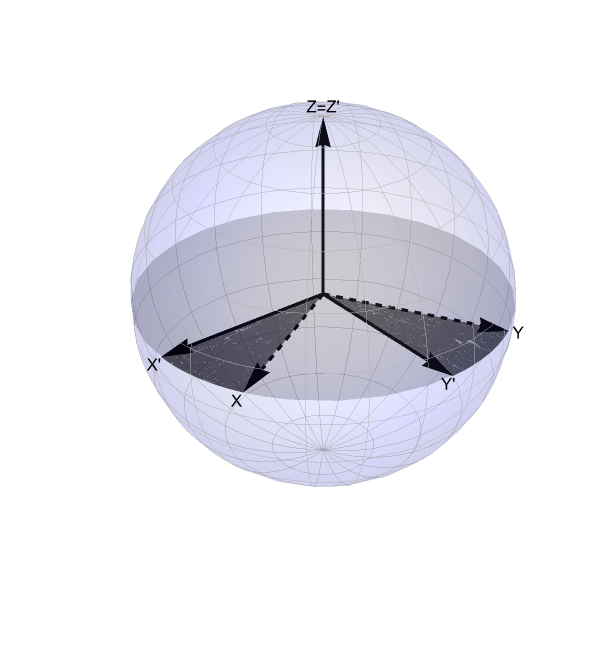
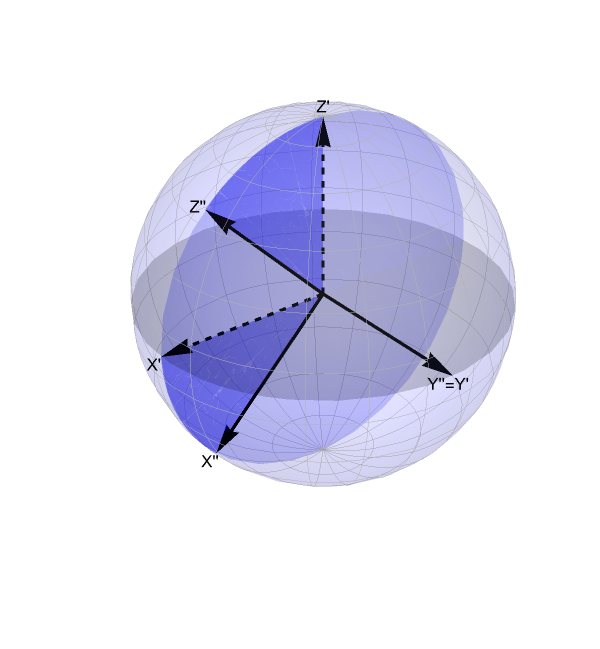
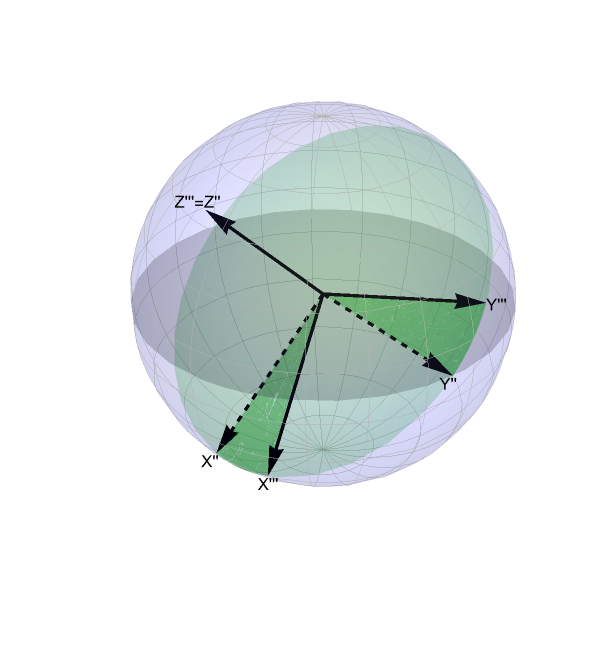 *Figure 1: Rotations and Euler angles defining the geometric relation between angular points on s=−21 in the construction of s=−22. *
This geometric construction elucidates the relationship between spin-weighted spherical harmonics, geodesic structure, and singularities in the direct part of the GF.
The s=−23 Factor and Elliptic Integrals
For s=−24 on s=−25, the paper derives expressions in terms of a transport integral along geodesics, encompassing an exponential factor (spin weight dependent) and the square root of the van Vleck determinant s=−26. Explicit representation for circular orbits, static worldlines, and generic proper time separation is provided, making crucial use of elliptic integrals for numerical evaluation.
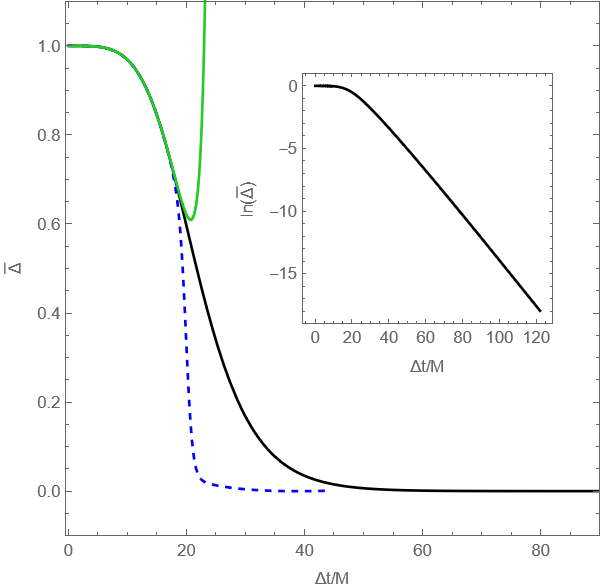
Figure 2: Plot of the van Vleck determinant s=−27 of s=−28 as a function of coordinate time s=−29 along a constant-radius trajectory (sGret(x,x′)=sU(x,x′)δ+(σ)+sV(x,x′)θ+(−σ)0).
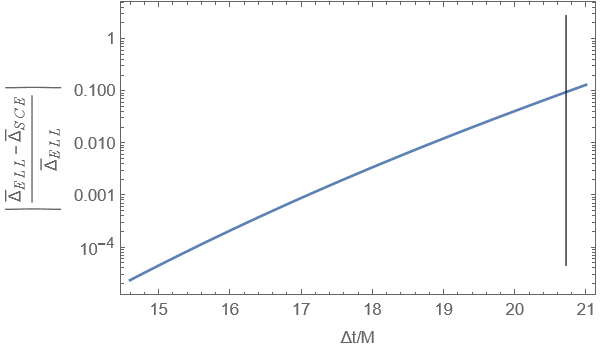
Figure 3: Log-plot of the relative error in the van Vleck determinant using various expansion techniques; the error remains below 10% up to sGret(x,x′)=sU(x,x′)δ+(σ)+sV(x,x′)θ+(−σ)1.
The thorough treatment includes small coordinate expansions, near-coincidence expansions, and mollified integrals. The van Vleck determinant, central to propagation and singularity structure, is shown to decay exponentially with time separation, as evidenced both analytically and numerically.
Multipolar Decomposition and Mode Regularization
sGret(x,x′)=sU(x,x′)δ+(σ)+sV(x,x′)θ+(−σ)2-Mode Structure and Singularities
The practical computation of GFs leverages decomposition into multipolar (sGret(x,x′)=sU(x,x′)δ+(σ)+sV(x,x′)θ+(−σ)3) modes via spin-weighted spherical harmonics (SWSHs). The direct part's angular structure permits analytic calculation of its sGret(x,x′)=sU(x,x′)δ+(σ)+sV(x,x′)θ+(−σ)4-modes, with explicit analytic expressions derived:
sGret(x,x′)=sU(x,x′)δ+(σ)+sV(x,x′)θ+(−σ)5
(with precise argument structure given in the full derivation).
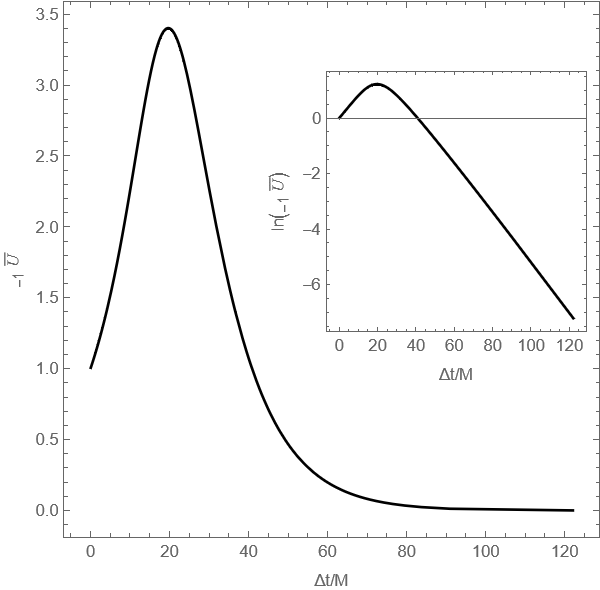
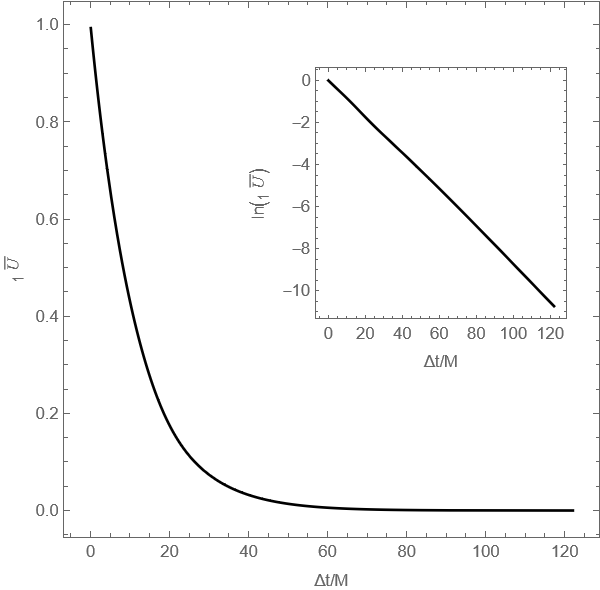
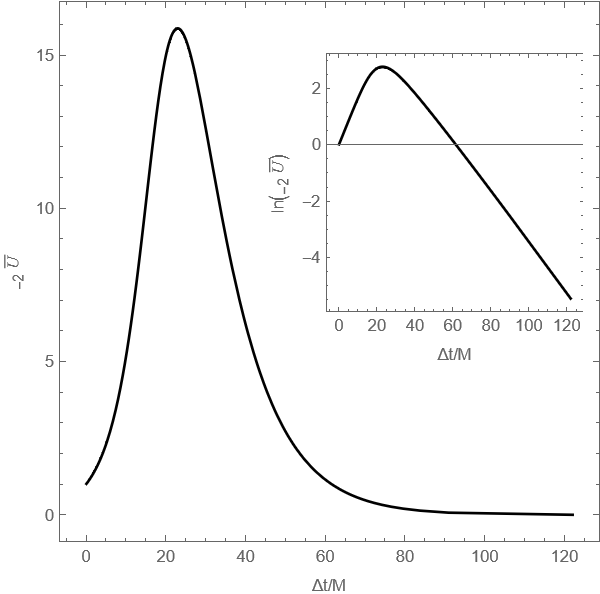
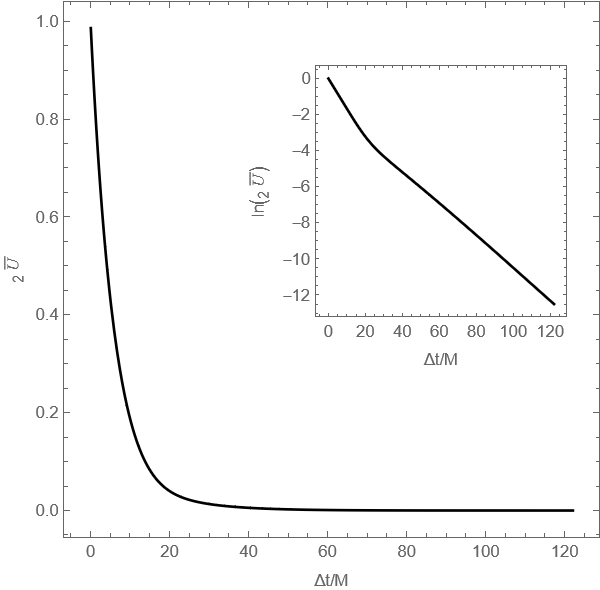
Figure 4: The coefficient sGret(x,x′)=sU(x,x′)δ+(σ)+sV(x,x′)θ+(−σ)6 along a trajectory of constant sGret(x,x′)=sU(x,x′)δ+(σ)+sV(x,x′)θ+(−σ)7 for sGret(x,x′)=sU(x,x′)δ+(σ)+sV(x,x′)θ+(−σ)8, showing exponential late-time decay.
Direct and Non-Direct Parts
The central technical result is a well-defined, regularized "non-direct" GF, constructed by subtracting the singular direct part from the full GF:
sGret(x,x′)=sU(x,x′)δ+(σ)+sV(x,x′)θ+(−σ)9
or, at the level of σ0-modes,
σ1
Comparison plots of σ2, σ3, and σ4 for various σ5 and σ6 are provided.
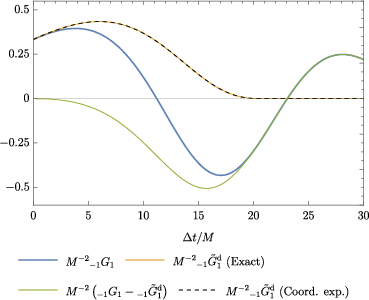
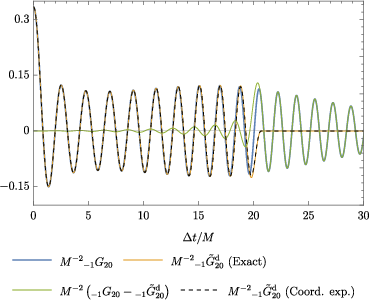
Figure 5: Plots of the σ7-modes σ8, σ9, and their difference for sU0 and sU1 (left) and sU2 (right) at sU3.
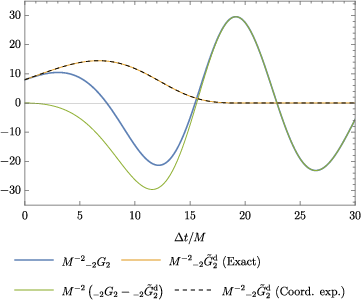
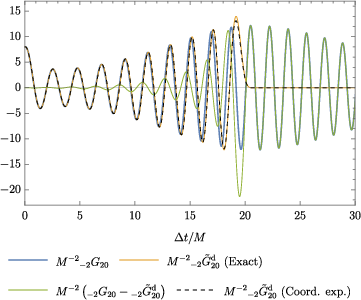
Figure 6: Plots of the sU4-modes for sU5 and sU6 (left) and sU7 (right) at sU8.
These comparisons highlight that the non-direct part provides a superior regular representation away from coincidence. For larger sU9, the support of the direct and full sV0-modes progressively overlaps, reflecting the increasing singularity localization characteristic of the mode-sum approach.
Long-Time Behavior and Excision Near Coincidence
It is established that the non-direct part is a substantially improved approximation everywhere except arbitrarily close to coincidence (sV1), where matching to a local expansion of the tail term sV2 (to be computed separately by small coordinate or covariant bitensor expansions) is still necessary.
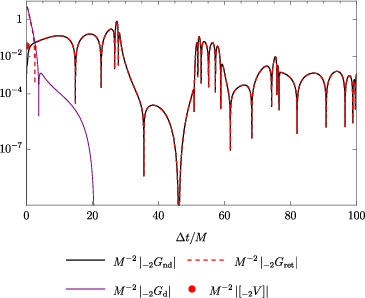
Figure 7: Log-plot of the BPT GF, its non-direct part, and direct part for a timelike circular geodesic at sV3.
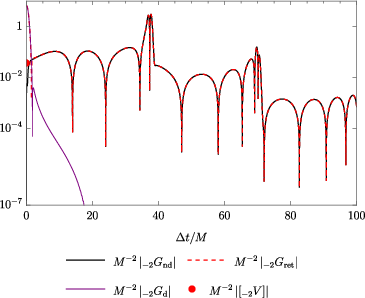
Figure 8: Log-plot of the BPT GF components for a static worldline at sV4.
These figures demonstrate that the region of practical, numerically accurate calculation of the regularized GF is extended significantly by subtraction of the direct part—e.g., from sV5 to sV6 in the circular case—though complete coincidence remains inaccessible exclusively via mode subtraction.
Implications and Future Directions
The regularized (non-direct) Teukolsky GF for electromagnetic and gravitational perturbations in Schwarzschild, made explicit and computationally accessible in this work, has several important applications:
- Self-force calculations: The regularized GF is directly suitable for computing self-force and self-field effects via worldline integration, minimizing contamination by mode-sum singularities.
- Gravitational waveform modeling: The analytic form and rapid evaluation of the direct modes is especially relevant for precise modeling of the early ringdown and prompt signal regime, where direct propagation dominates [CDOW13, (Oshita et al., 11 Sep 2025)].
- Quantum field theory: The detailed Hadamard structure is essential for renormalization procedures and quantum stress tensor calculations, where explicit knowledge of the singularity structure is important.
- Extensions: The techniques developed may be generalized to Kerr spacetime, as well as more complicated field equations. The coordinate systems and explicit geodesic expansions in sV7 also open new avenues for bitensor expansions and computational schemes.
For the region sV8, a regime not fully addressed by the present mode-sum subtraction approach, it is suggested that dedicated covariant or local expansions for the tail term be computed, potentially aided by the explicit structure and coordinates introduced here. No closed-form expansion for generic spin (sV9) tail coefficients is presently available, and this remains a notable target for further analysis.
Conclusion
This work provides a comprehensive, analytic, and separable representation of the direct and regularized retarded Green functions for the Bardeen-Press-Teukolsky equation in Schwarzschild spacetime for generic spin. The approach unifies geometric considerations with explicit mode decompositions and yields direct computational tools for gravitational and electromagnetic perturbation theory. Substantial improvement in the regularity and proximity-to-coincidence of numerically-tractable mode-sum Green functions is demonstrated.
The analytic results for the Hadamard coefficients, explicit Euler-angle geometric factors, and van Vleck determinant behavior will inform subsequent advances in black hole perturbation theory, self-force calculation, and quantum field computations. Future developments may extend this regularization methodology to the broader class of stationary axisymmetric backgrounds and higher-spin field equations, further enabling precision gravitational modeling in strong-field regimes.
References:
Casals, M., Nolan, B. C., Ottewill, A. C., & Wardell, B. "Regularized calculation of the retarded Green function in a Schwarzschild spacetime," Phys. Rev. D 100, 104037 (2019).
Aruquipa, D. Q., Casals, M., "Green functions of the Regge–Wheeler and Teukolsky equations in Schwarzschild spacetime," (Aruquipa et al., 8 Mar 2026).
Oshita, N., Ma, S., Chen, Y., Yang, H., "Probing Direct Waves in Black Hole Ringdowns," (Oshita et al., 11 Sep 2025).
Su, J., Khera, N., Casals, M., Ma, S., Chowdhuri, A., Yang, H., "Decomposition of Schwarzschild Green's Function," (Su et al., 29 Jan 2026).
CDOW13: Casals, M., Dolan, S., Ottewill, A. C., Wardell, B., Phys. Rev. D 88, 044022 (2013).