- The paper demonstrates that prefix parsing is reduced to ordinary parsing through a compact grammar transformation that increases grammar size by only a constant factor.
- It introduces an efficient next-token weight algorithm using lattice parsing and reverse-mode differentiation, achieving near the performance of standard parsing.
- Empirical evaluations confirm that the transformed grammar maintains comparable runtime scaling, proving its applicability in real-world NLP systems.
Authoritative Summary of "Prefix Parsing is Just Parsing" (2604.21191)
Motivation and Context
Prefix parsing, which determines whether an input prefix can be extended to a complete string generated by some grammar (and, in weighted/probabilistic cases, computes the prefix probability), is a foundational operation for context-free language modeling, incremental psycholinguistic analysis (e.g., surprisal), and syntactically constrained token generation in LLMs. Traditionally, prefix parsing has required elaborate modifications to standard parsing algorithms, leading to algorithmic complexity and implementation duplication. This paper rigorously demonstrates that prefix parsing can be reduced to ordinary parsing through a transformation of the input grammar, preserving algorithmic efficiency and enabling broad compatibility with optimized parsing engines.
The central theoretical contribution is the "prefix grammar transformation," an efficient reduction from prefix parsing to ordinary parsing. Given any weighted context-free grammar (WCFG), the transformation constructs a new grammar generating exactly the (weighted) set of prefixes of original strings. The transformed grammar is only a small constant factor larger than the input (bounded by 38 times the original grammar size plus 3), as formalized in Proposition 2. This enables any off-the-shelf parser—including those with subcubic asymptotic complexity or optimized for GPU/CPU—to function as a prefix parser with negligible additional overhead. Runtime complexity and grammar blow-up are analyzed for the two canonical algorithms, CKY and Earley; the overhead is absorbed almost entirely in grammar structure, leaving per-string runtime scaling unchanged.
The reduction is proven correct via a strengthened induction argument: the prefix grammar exactly computes the prefix language as defined by summing the probabilities/weights of all completions of a given prefix. The construction is also formally tied to WFST (weighted finite-state transducer) composition, showing that the prefix language is a composition of the original CFG with a two-state prefix transducer. This perspective generalizes beyond CFGs, offering potential for extending the reduction to other grammar frameworks (e.g. tree-adjoining grammars).
Efficient Next-Token Weight Vector Algorithms
A critical practical application is the computation of next-token weight vectors: for a given string $\str$, efficiently compute the prefix weights of all possible one-token extensions, yielding the conditional distribution over the next token. Naïvely, this would require ∣Σ∣ invocations of a prefix parser, which is computationally prohibitive. The authors develop an algorithm based on lattice parsing and reverse-mode algorithmic differentiation: by parsing a compact automaton representing all single-token extensions, and differentiating the aggregate sum over token parameters, one obtains the next-token vector at the same asymptotic runtime as prefix parsing. The key meta-theorem guarantees symbolic gradients of lattice parser evaluations can be computed within a constant-factor (at most 4×) of the original operation count. Empirical results confirm that the next-token algorithm is only ≈1.2× slower than prefix parsing, both being within constant-factor overheads compared to ordinary parsing.
Empirical Evaluation
Experiments on large grammars (e.g., WSJ 5000: >35,000 rules, 448 nonterminals) confirm theoretical predictions. Runtime for parsing, prefix parsing, and next-token vector algorithms all scale similarly with string length (≈N2), with prefix parsing ≈2.9× slower than parsing, and next-token vector ≈1.2× slower than prefix parsing—matching the theoretical grammar-size blowup and constant-factor bounds. The approach performs comparably to specialized prefix parsing implementations (e.g., EarleyX) but achieves superior efficiency constants due to optimizations.
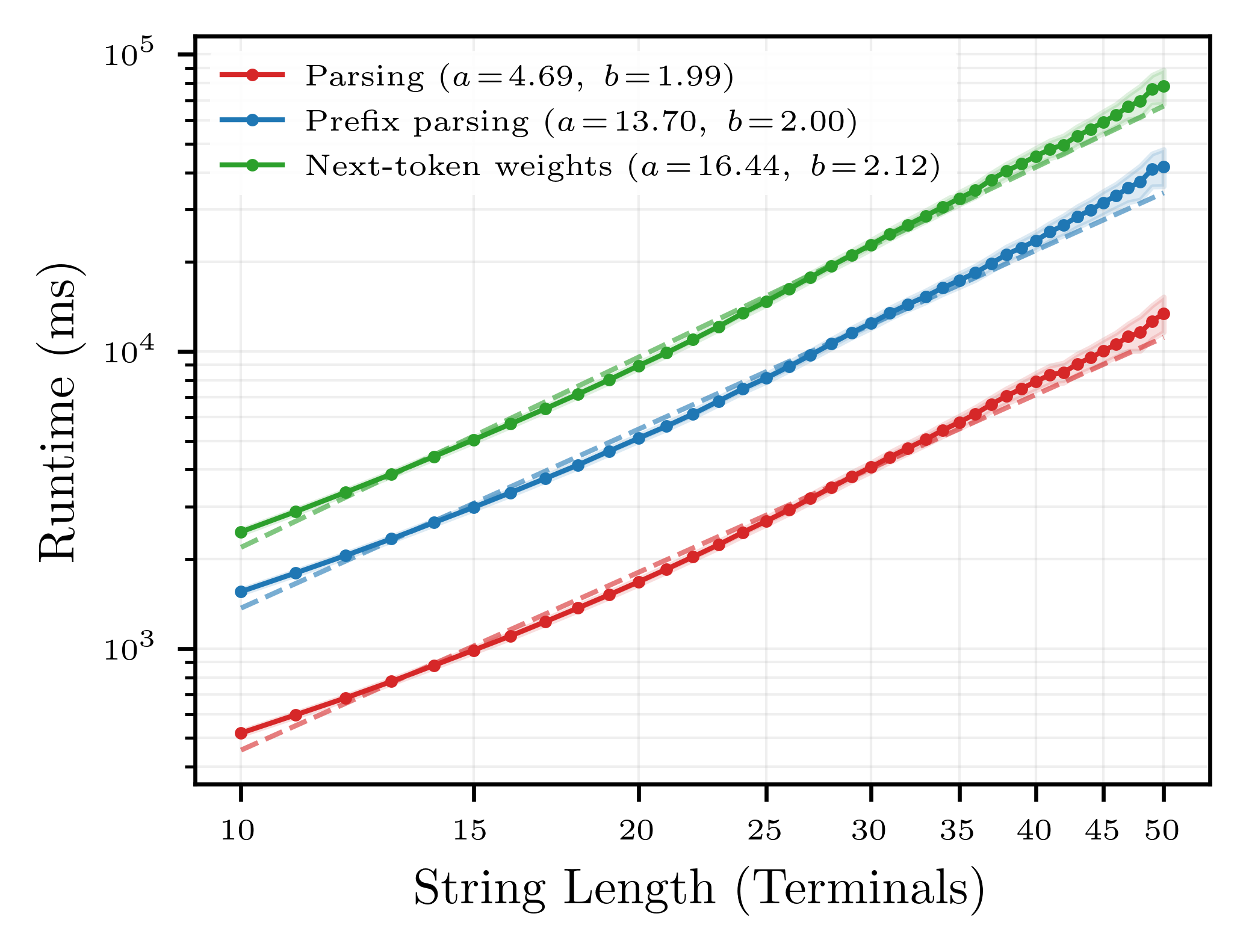
Figure 1: Comparative runtime scaling of parsing, prefix parsing, and next-token weight vector algorithms on WSJ 5000, demonstrating preserved input-length dependence and constant-factor overheads.
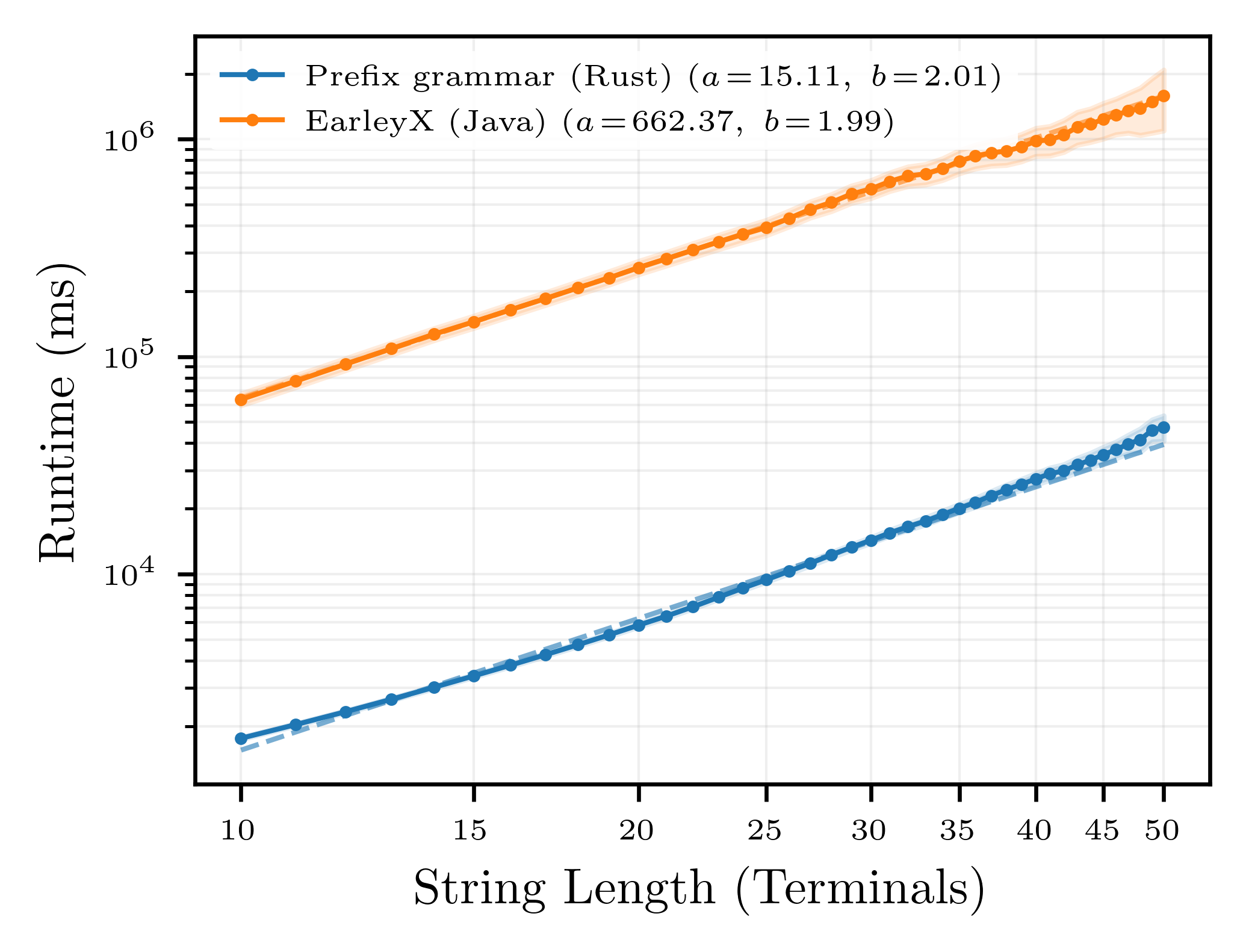
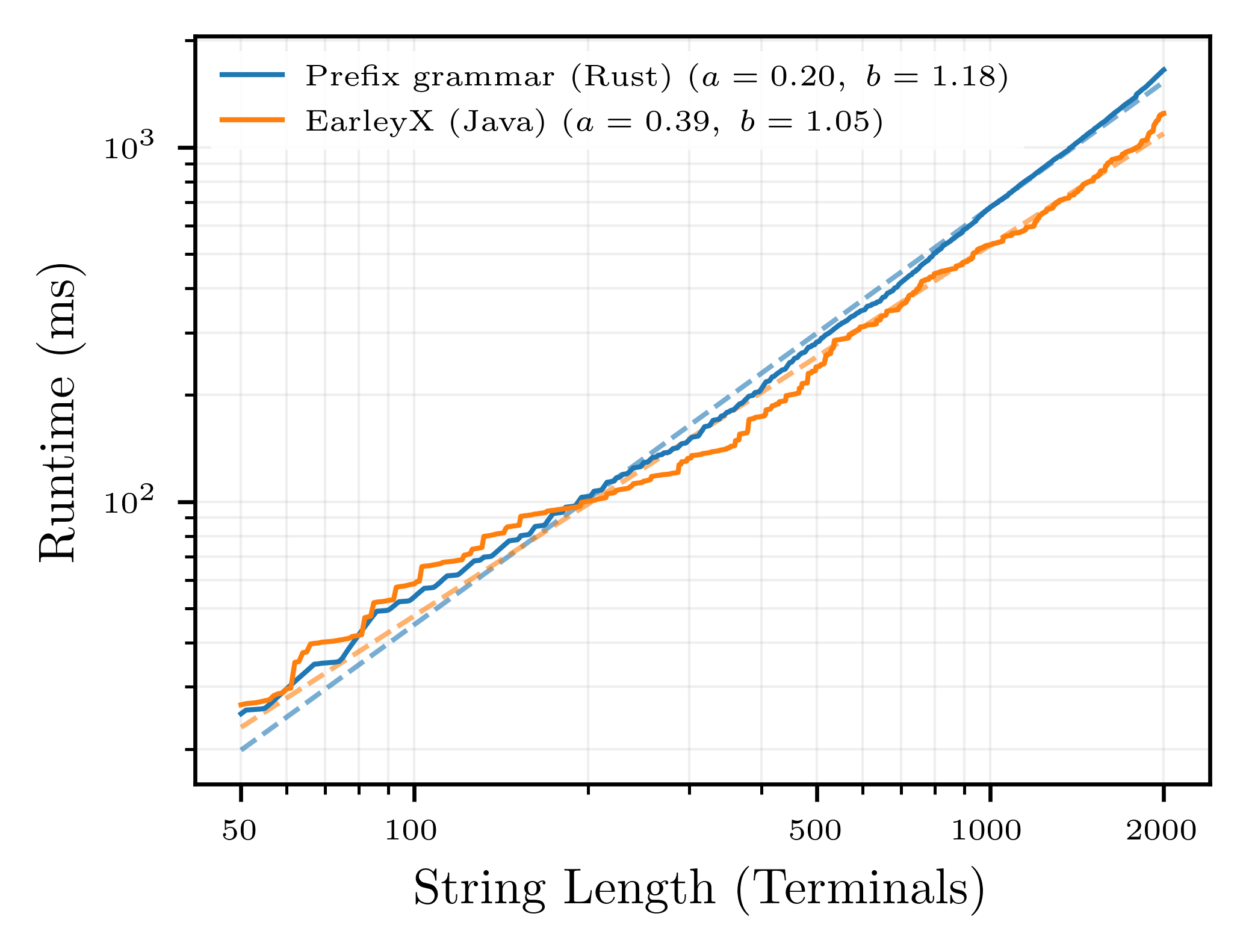
Figure 2: Prefix parser versus EarleyX performance on WSJ 5000 and Social Discourse grammars, showing near-identical complexity exponents but improved fitted coefficients.
Technical Implications
This work establishes:
- Prefix parsing for weighted CFGs (generalized to any commutative semiring) requires only a small grammar transformation, obviating the need for specialized prefix parser development.
- Prefix probabilities and next-token distributions central to language modeling and incremental processing become efficiently accessible through standard parsing engines, even at scale.
- The method is directly compatible with high-performance, hardware-optimized parsers and subcubic algorithms, broadening applicability in production NLP systems.
Strong numerical results demonstrate:
- Prefix parsing incurs only a multiplicative, grammar-size overhead compared to standard parsing.
- The next-token weight vector algorithm computes all token extensions in the same asymptotic time as a single prefix parsing call.
Contradictory or Non-Trivial Claims
The paper asserts—contradicting the common belief in the need for specialized algorithms—that prefix parsing is "just parsing," and that any correct parser can be converted into a prefix parser via grammar transformation. It further claims that next-token weights, typically seen as requiring expensive enumeration, can be obtained at essentially no asymptotic extra cost through algorithmic differentiation.
Limitations and Open Problems
The runtime guarantees depend on the worst-case grammar-size blowup after preprocessing, especially in CNF conversion and unary rule removal—though empirical results show these are often modest. Experiments are limited to CKY and Earley; extension to more exotic parsing algorithms or highly ambiguous grammars (e.g., context-sensitive) remains speculative.
Future Directions
- Generalizing the prefix grammar transformation to context-sensitive, mildly context-sensitive, or probabilistic tree-adjoining grammars using FST composition.
- Leveraging prefix parsing in constrained LLM decoding, incremental suprisal computation, and real-time syntactic control for LLMs.
- Integrating the next-token weight computation into structured prediction frameworks and token-level control applications.
Conclusion
The paper establishes a unified, theoretically rigorous, and empirically validated framework for prefix parsing and next-token weight computation in weighted context-free grammars: any ordinary parser suffices, following a compact grammar transformation. This eliminates the need for bespoke prefix parsers and unlocks practical, efficient, incremental processing for language modeling and syntactic control. The reduction has broad implications for both theoretical linguistics, computational psycholinguistics, and practical NLP systems.