- The paper presents a joint Bayesian inference pipeline that recovers lunar subsurface dielectric parameters and Galactic foreground properties from simulated LuSEE-Night voltage PSD data.
- The methodology leverages 3D finite element simulations and spectral mode analysis to model antenna-beam coupling and separate subsurface and foreground effects.
- Results demonstrate sub-percent to few-percent precision in grid-aligned tests, highlighting the need for denser parameter sampling for off-grid scenarios.
Joint Bayesian Estimation of Lunar Subsurface and Galactic Foregrounds with LuSEE-Night
Introduction
The Lunar Surface Electromagnetics Experiment (LuSEE-Night) is a forthcoming low-frequency radio astronomy payload destined for the radio-quiet lunar farside. Its scientific focus is access to the global redshifted 21-cm HI signal from the Cosmic Dawn and Dark Ages epochs—cosmic eras prohibitive to probe from terrestrial observatories due to severe radio frequency interference (RFI) and ionospheric opacity at frequencies below 30 MHz. Extraction of the 21-cm background is fundamentally limited by the overwhelming Galactic synchrotron foreground and, uniquely for lunar instruments, by uncertainty in the dielectric properties of the lunar subsurface, which modify the instrument beam and spectral calibration. The study develops and validates a joint Bayesian inference pipeline to simultaneously estimate lunar regolith dielectric parameters and spectral foreground properties using simulated LuSEE-Night voltage power spectral density (PSD) data, and investigates the feasibility, identifiability, and limitations of this approach.
Simulation Framework and Instrument Model
Precise modeling of the LuSEE-Night instrument response is essential, given the instrument’s wide-beam 3-meter monopole antennas are deployed directly on the regolith with no engineered ground plane. A 3D finite element electromagnetic simulation using Ansys HFSS treats the lunar surface as a two-layer lossy dielectric, parameterized by top and bottom layer dielectric constants and interface depth. Antenna gain, impedance, and far-field beam patterns are simulated for a 6×6×6 grid of dielectric parameter combinations (216 total), spanning values inferred for the Apollo 17 site.
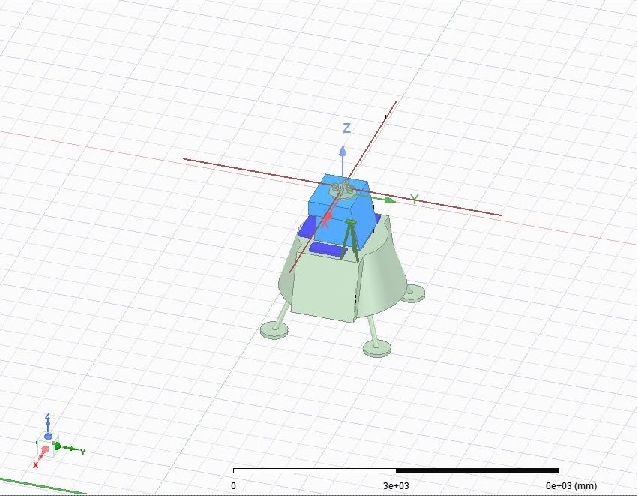
Figure 1: Model of LuSEE-Night instrument and lander in Ansys HFSS for antenna far-field beam simulation.
Layered impedance boundary conditions are implemented, directly affecting the frequency-dependent radiation pattern, especially in the region of antenna resonance at ∼30 MHz. The simulation approach acknowledges the non-trivial impact of regolith composition and stratification, and the essential coupling of beam systematics to subsurface unknowns.
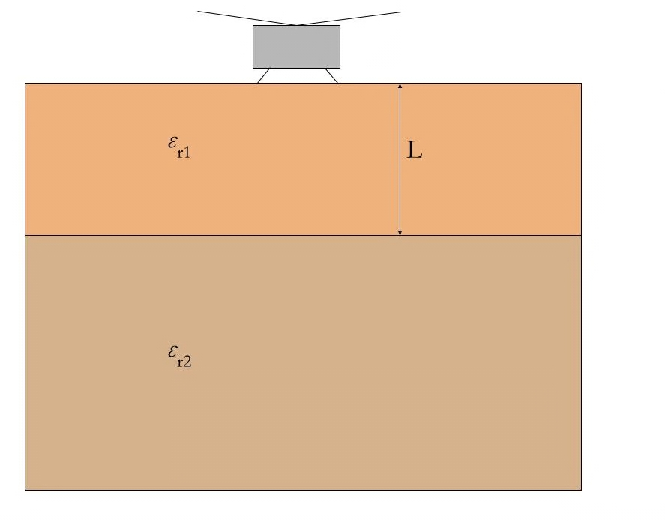
Figure 2: Schematic representation of lunar subsurface as a stratified two-layer dielectric.
The resulting simulated beams reveal substantial ground-coupling and strong subsurface-induced modulations, especially near resonance.
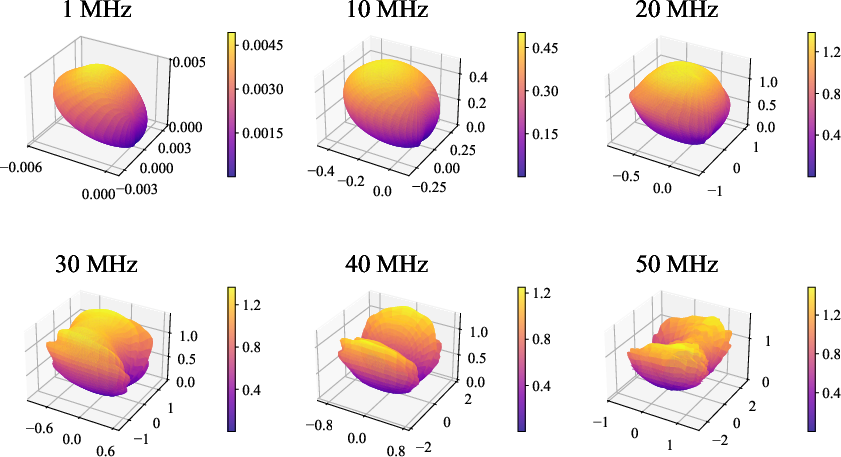
Figure 3: Simulated far-field linear gain patterns for a LuSEE-Night antenna monopole for varying frequencies with a representative subsurface parameter set.
The proportion of antenna power coupled to the ground (the "ground fraction") is computed over the model ensemble, with substantial sensitivity to the permittivity and thickness of the simulated regolith.
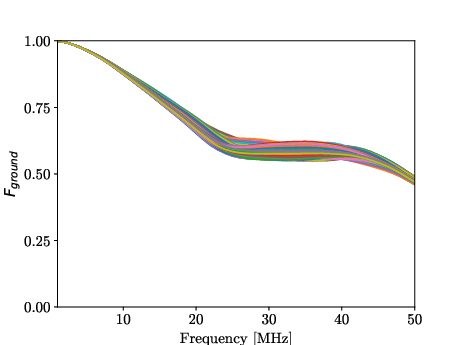
Figure 4: Frequency dependence of the ground fraction for all simulated lunar subsurface cases.
Galactic Foreground and Sky Model
Foreground simulations employ an Ultralong-wavelength Sky Model with Absorption (ULSA), with the frequency and spatial dependence expressed via a log-polynomial model parameterized by amplitude, spectral index, curvature, and offset terms, congruent with empirical constraints at decametric wavelengths.
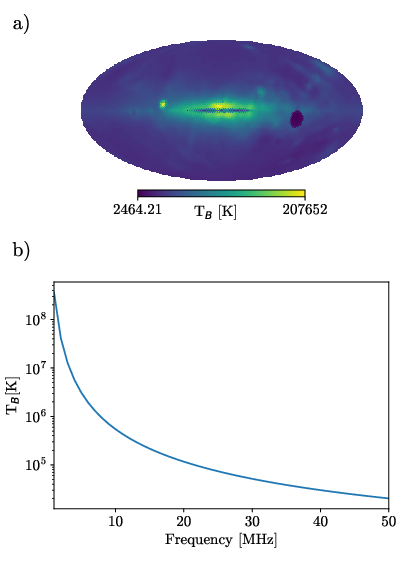
Figure 5: Example galactic foreground brightness temperature map at 25 MHz and corresponding spectral cut at a fixed sky location.
Foreground spectral structure is smooth and distinguished from instrumentally-induced spectral features, a critical consideration for component separation.
Synthetic Data Generation and Power Spectral Analysis
Simulated time-averaged observational data are produced by convolving the antenna beam models with the foreground sky, computing the observed antenna temperatures, and translating these to the expected voltage PSDs using frequency-dependent impedance and coupling factors. This forward model incorporates the full chain from lunar subsurface physics to electrical response, generating all auto- and cross-correlation products among the four monopoles.
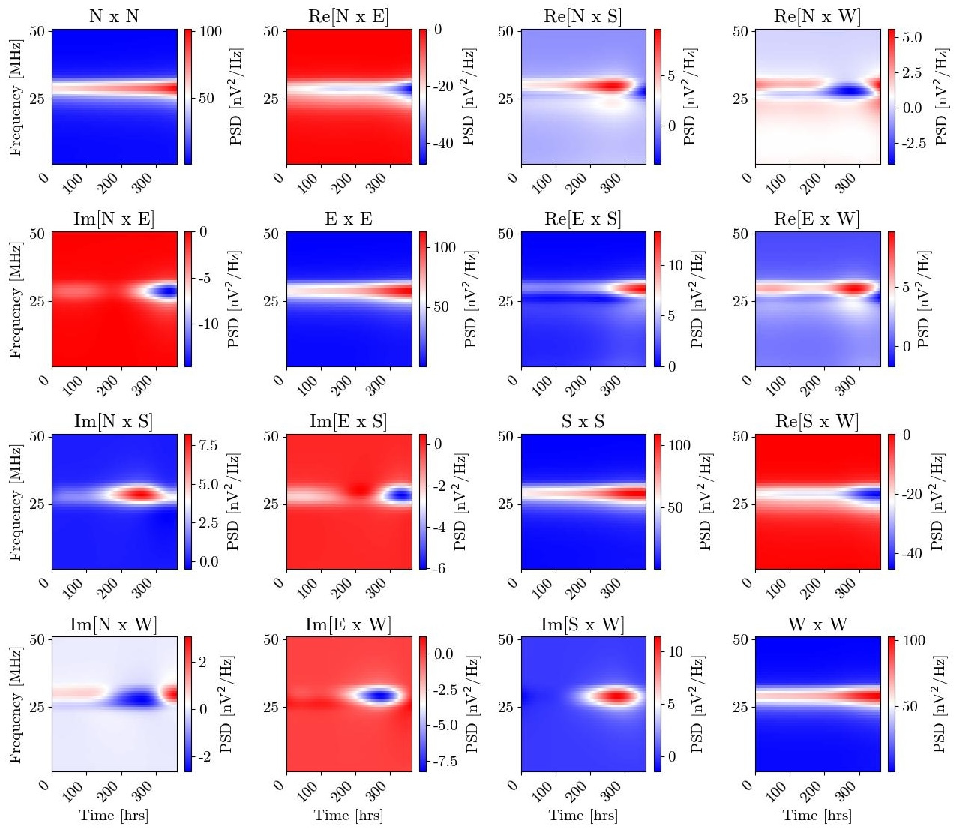
Figure 6: Simulated LuSEE-Night voltage PSDs for auto and cross correlations across all antenna pairs and time/frequency, given a representative set of physical parameters.
Spectral Mode Decomposition and Parameter Identifiability
A principle component analysis (PCA) or singular value decomposition (SVD) is performed independently on two ensembles: one varying only lunar subsurface parameters, the other varying only foreground parameters. The resulting eigenvalue spectra demonstrate that both types of variations are dominated by a small number of orthogonal modes.
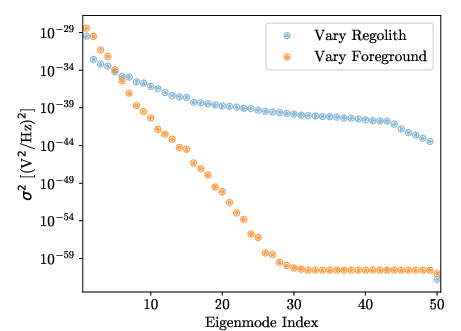
Figure 7: Eigenvalues of the covariance decompositions for subsurface (blue) and foreground (orange) parameter ensembles.
Foreground eigenmodes are spectrally smooth (large-scale slopes and curvatures), while subsurface eigenmodes manifest as localized, high-frequency structures centered on antenna resonance and its harmonics.
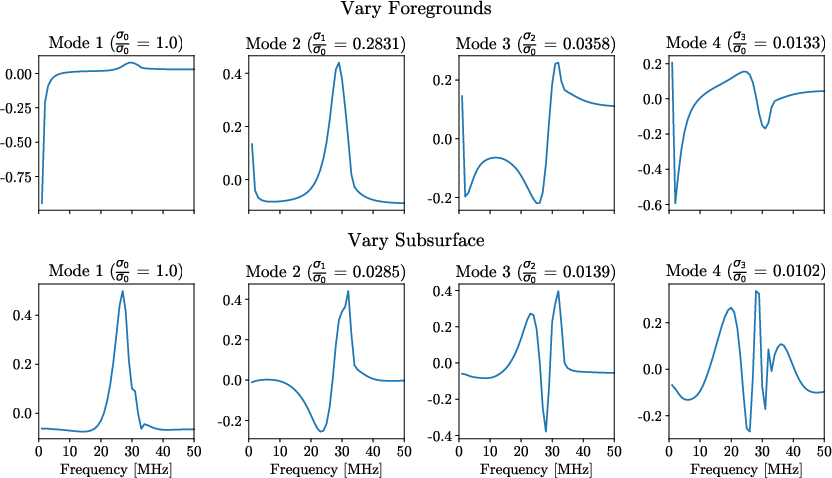
Figure 8: First four spectral eigenmodes for the simulated foreground and subsurface ensembles; foreground modes manifest low-frequency slopes while subsurface modes encode complex resonance features.
This mode orthogonality underpins the ability of Bayesian inference to jointly and robustly constrain both sets of parameters from the aggregated spectral data.
Bayesian Framework and Posterior Results
A Bayesian parameter estimation pipeline is constructed. A surrogate emulator efficiently interpolates the mapping from the 7D parameter space (three subsurface, four foreground parameters) to observable PSDs, obviating the computational expense of repeatedly running full-scale HFSS simulations during sampling. Radial basis functions are used to interpolate between grid points; emulator fidelity is separately validated.
MCMC-based sampling (using Preconditioned Monte Carlo, PMC) with appropriate wide, physically-motivated priors demonstrates that the pipeline is able to recover all input parameters to sub-percent to several percent precision for noiseless grid-aligned simulated data.
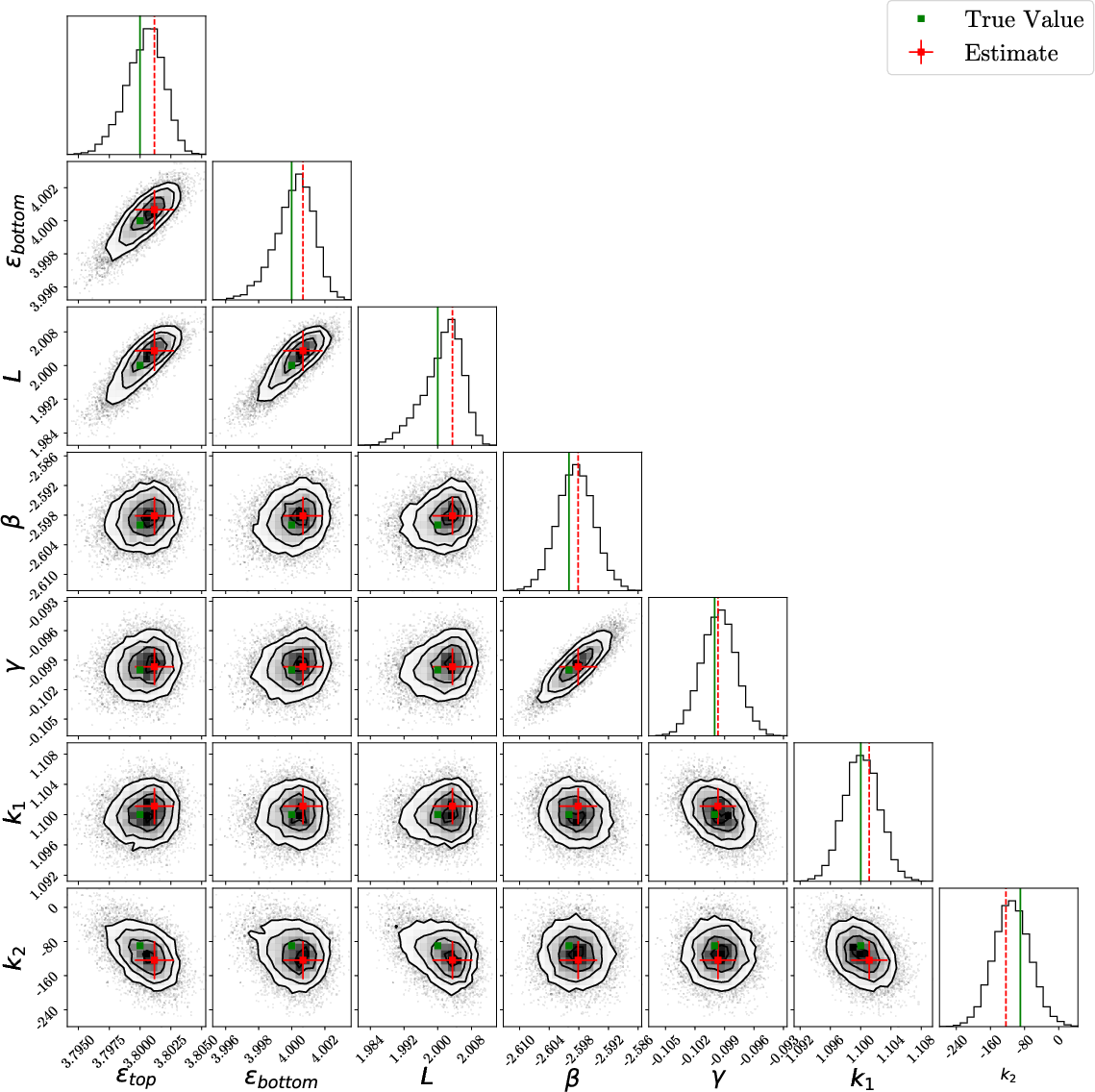
Figure 9: Posterior credible regions for joint fits to simulated LuSEE-Night data, showing constraints for all subsurface and foreground parameters.
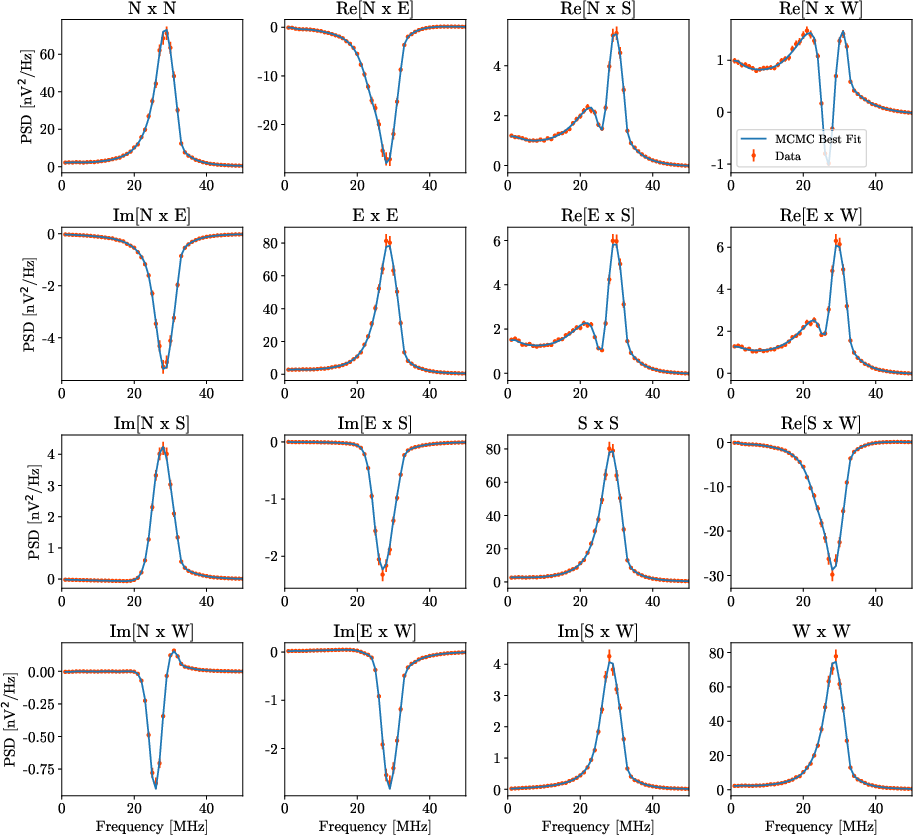
Figure 10: Posterior predictive check for the emulator fit versus mock data, showing recovered model lies within uncertainties across all frequency bins and products.
Biases and fit degradation are observed when the true parameters lie between grid points, underscoring the need for more densely sampled surrogate models.
Emulator Robustness and Limitations
Comparative evaluation of emulator accuracy shows that interpolation error grows with distance from the simulation grid, peaking near the antenna resonance. For typical off-grid cases, errors can reach or exceed the nominal measurement noise, limiting the reliability of the inference for real data unless grid density is improved.
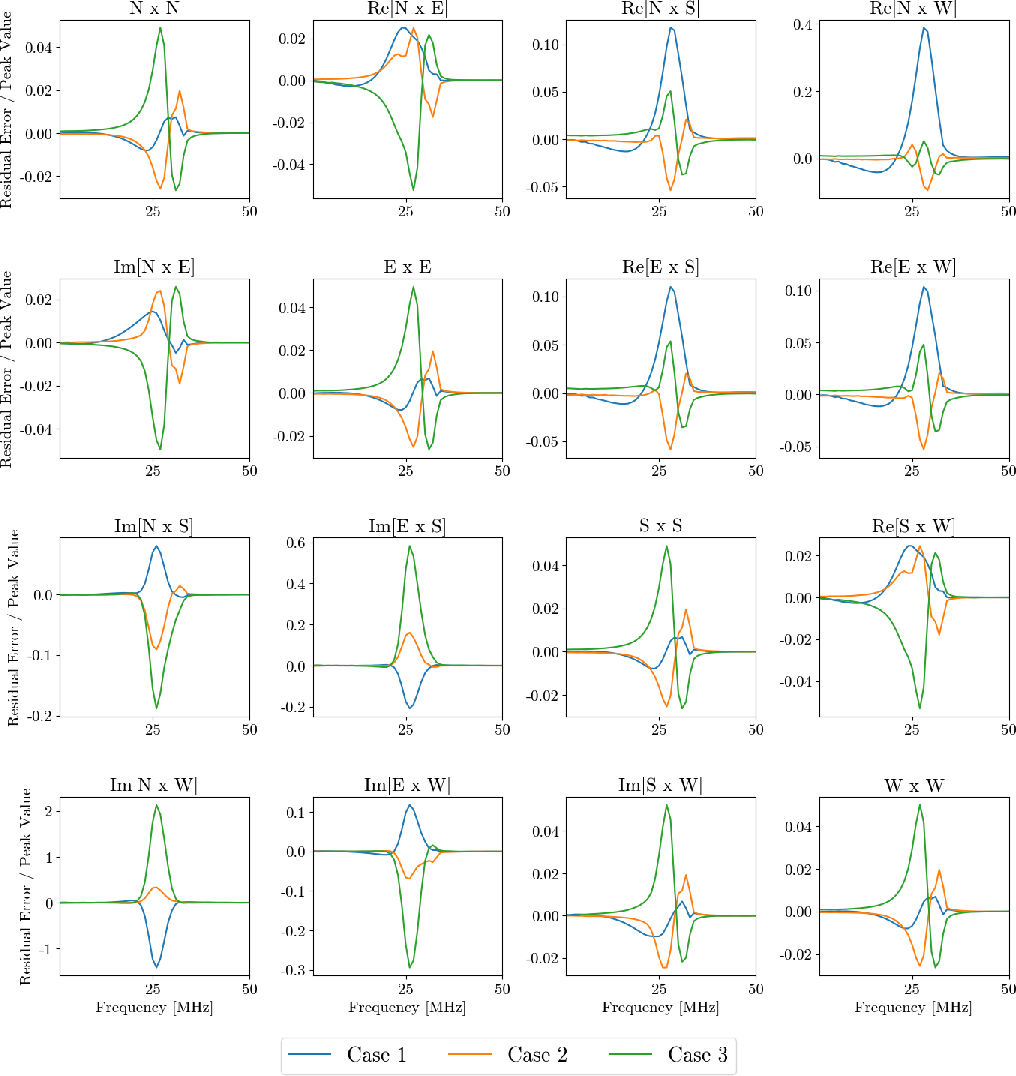
Figure 11: Residuals between emulator outputs and full simulations for off-grid subsurface parameter points, shown as a fraction of signal amplitude.
Discussion and Implications
Numerically, the pipeline achieves parameter recovery at the sub-percent to few percent level when all modeling assumptions (foreground spectral smoothness, two-layer regolith, uncorrelated Gaussian noise, perfect knowledge of sky spatial structure) are satisfied. The most significant limitation is the coarseness of the simulation grid, which limits both the interpolative accuracy of the emulator and the precision of inference for arbitrary parameters.
Key claims:
- The spectral degeneracy between lunar subsurface and galactic foreground parameter effects is weak, enabling robust joint estimation.
- Subsurface-induced effects are spectrally localized (chromatic, resonant), whereas Galactic foregrounds induce smooth, broadband spectral features.
- Joint estimation is demonstrably feasible in simulated data and should be robust to foreground modeling errors, provided spectral orthogonality persists in real measurements (e.g., departures from power-law sky or more complex regolith structure do not introduce confounding features).
- The sensitivity of the voltage PSDs to both subsurface parameters and beam systematics motivates incorporating both in global 21-cm pipelines for all lunar and even terrestrial pathfinder experiments.
The practical impact is that lunar-based 21-cm experiments must treat beam-regolith coupling as a first-class calibration unknown; inference pipelines should be developed to operate in the space of voltage PSDs, not antenna temperature, due to the nonlinearity and degeneracy induced by impedance and beam inter-dependence.
On the theoretical side, these results suggest that, so long as the response of the instrument can be parameterized with sufficient fidelity and the simulation grid can be densely sampled, the core science case for global 21-cm detection from the lunar surface remains viable and quantifiable. There will be an unavoidable calibration floor set by subsurface uncertainties, but not an insurmountable degeneracy.
Future Directions
The study indicates several outstanding challenges, notably the need for denser parameter sampling (e.g., via Latin hypercube methods), more sophisticated regolith models (multi-layer, frequency dependence, physical measurements at the landing site), and integration with physically motivated foreground models that account for free-free absorption and spatial structure at ultra-low frequencies. Analytical models for antenna–ground coupling, as opposed to pure numerical simulation, could further improve inference robustness and extrapolability.
For terrestrial global 21-cm experiments, particularly those without engineered ground planes, these results provide a template for integrating electromagnetic and sky modeling uncertainties into cosmological parameter inference.
Conclusion
This work provides a comprehensive simulation-based demonstration that joint Bayesian inference of lunar subsurface dielectric properties and Galactic foreground spectral parameters is feasible for the LuSEE-Night instrument using physically realistic voltage power spectral measurements. Subsurface and foreground spectral features are sufficiently orthogonal in frequency space to allow for simultaneous and unbiased estimation with well-characterized uncertainties, provided the emulator captures the mapping with adequate fidelity. These results support the viability of precision global 21-cm cosmology from the lunar surface, subject to appropriate treatment of beam and subsurface systematics, and set the requirements for future forward modeling and experimental deployments.
(2604.21170)