Percolation Critical Probability of Aperiodic Smith Hat tile(1, 3)
Published 23 Apr 2026 in cond-mat.stat-mech and physics.data-an | (2604.21165v1)
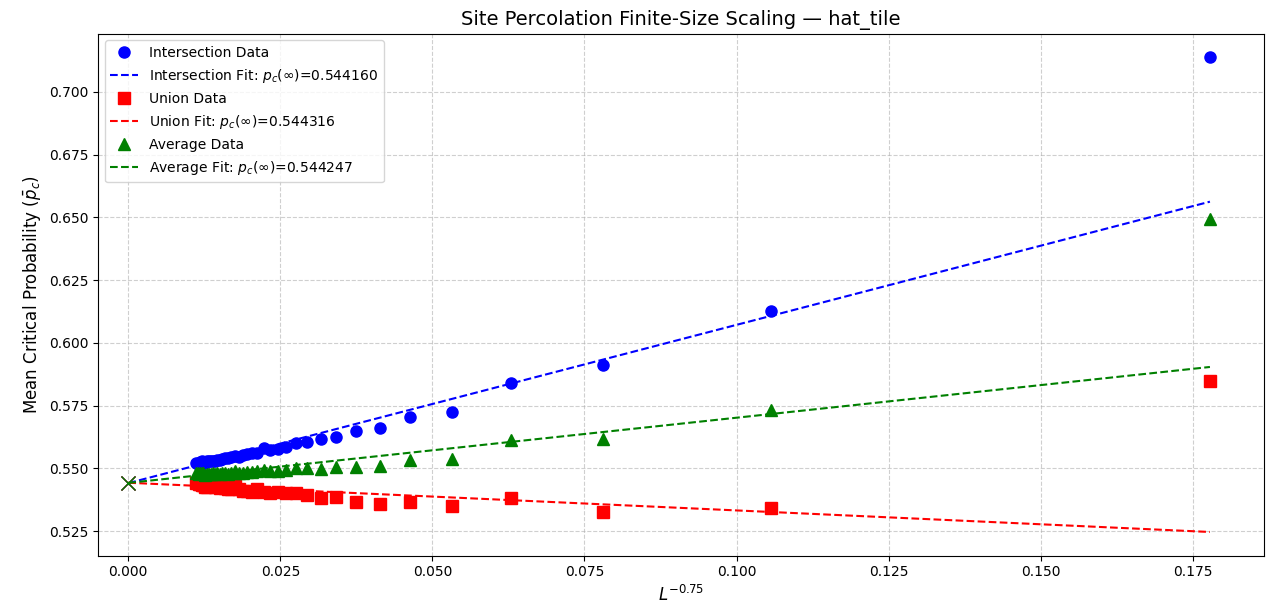
Abstract: The Smith Hat tile is the first known aperiodic monotile, having been discovered in 2023. The simple structure, constructed using only 8 kites, is unique and well motivated for analysis within percolation theory. The primary goal of this paper is to discover the critical threshold pc in both site and bond Bernoulli structures using Monte Carlo simulation for the Smith hat tile(1,3). Our findings are site and bond values of pc<sup>s</sup>=0.822725±0.000044 and pc<sup>b</sup>=0.798161±0.000044 for edge percolation and 0.544247±0.000101 for site percolation on the dual graph.
The paper provides the first Monte Carlo estimates of critical percolation thresholds for the aperiodic Smith Hat tile (1,√3), revealing high site and bond values.
It employs finite-size scaling and weighted least squares regression to extrapolate threshold values, with convergence validated against periodic lattice benchmarks.
The study highlights unique connectivity constraints in aperiodic tilings, offering insights for network robustness and quasicrystalline material modeling.
Percolation Critical Probability in the Aperiodic Smith Hat Tile (1,3)
Introduction
The discovery of the Smith Hat tile provided the first solution to the long-standing "Einstein problem," demonstrating a single monotile capable of aperiodically tiling the plane. This presents new theoretical and practical challenges in statistical physics, particularly relating to connectivity phenomena in random media. A critical investigation focuses on percolation theory, which characterizes the phase transition between disconnected and globally connected regimes parameterized by the critical probability pc. For periodic lattices, analytic results and high-precision numerical values for pc are well-established, but aperiodic tilings lack translational symmetry, complicating such analysis. The present study addresses this gap, providing the first Monte Carlo estimates of site and bond critical probabilities for the Smith Hat tile (1,3), utilizing finite-size scaling and weighted least squares regression for asymptotic extrapolation.
The Smith Hat Geometry and Graph Construction
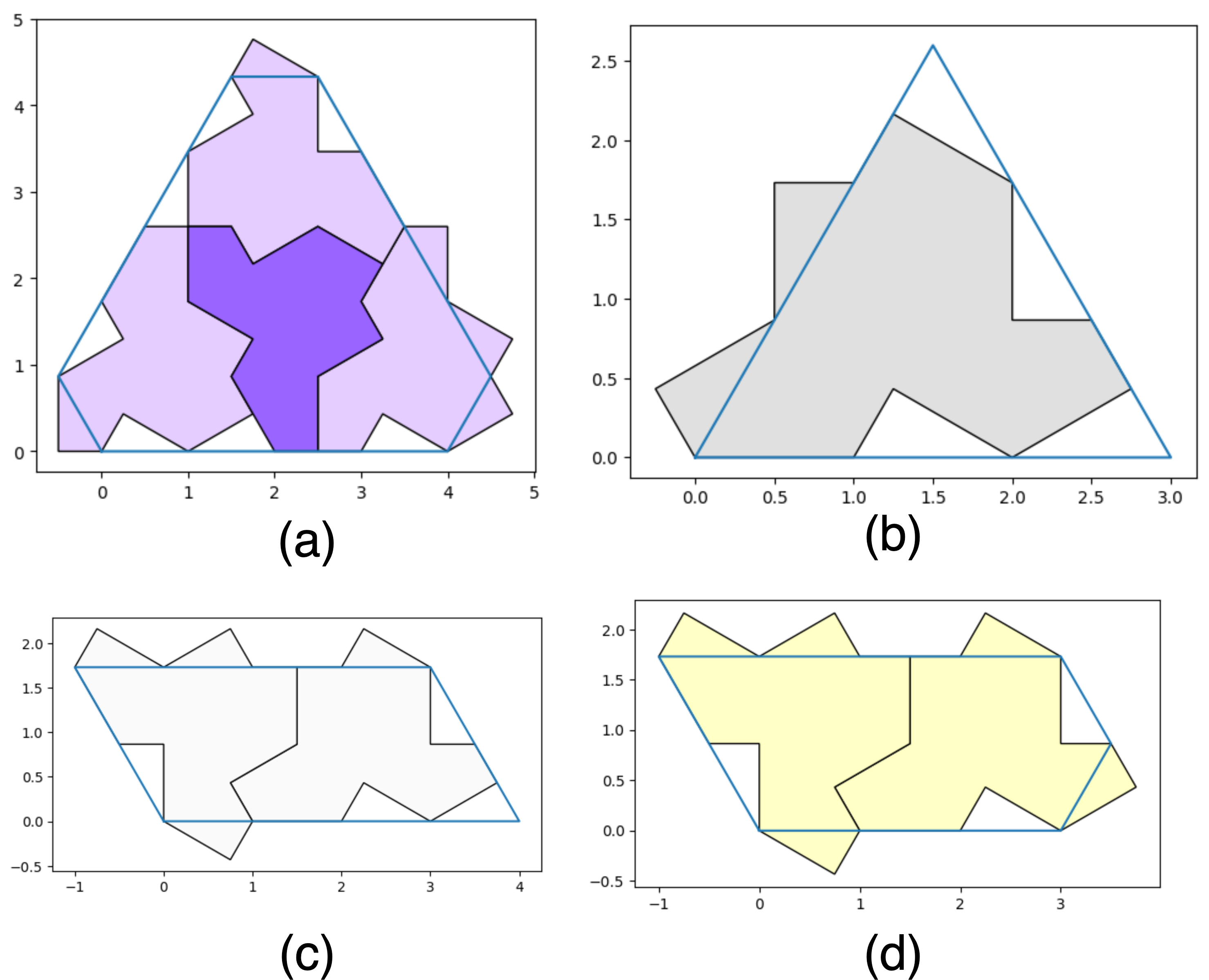
The Smith Hat prototile forms the basis for an aperiodic tiling, with four types of metatiles—H, T, P, and F—clustered combinations of the fundamental shape. Substitution rules generate hierarchical patches exhibiting global aperiodicity yet local order. Extraction of graph structures for percolation simulation employs two approaches: edge percolation, where vertices and edges of the tiling are nodes and links; and tile percolation, treating each tile as a node and adjacency defined by tile contact.
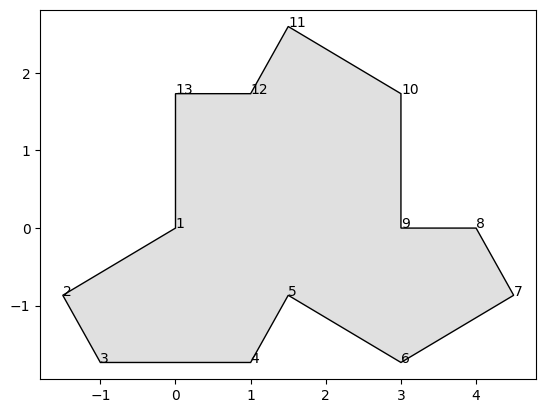
Figure 1: The Smith Hat prototile representing the fundamental unit for aperiodic monotiling.
Figure 2: The four metatile clusters (H, T, P, F) delineate local geometrical configurations critical for graph generation.
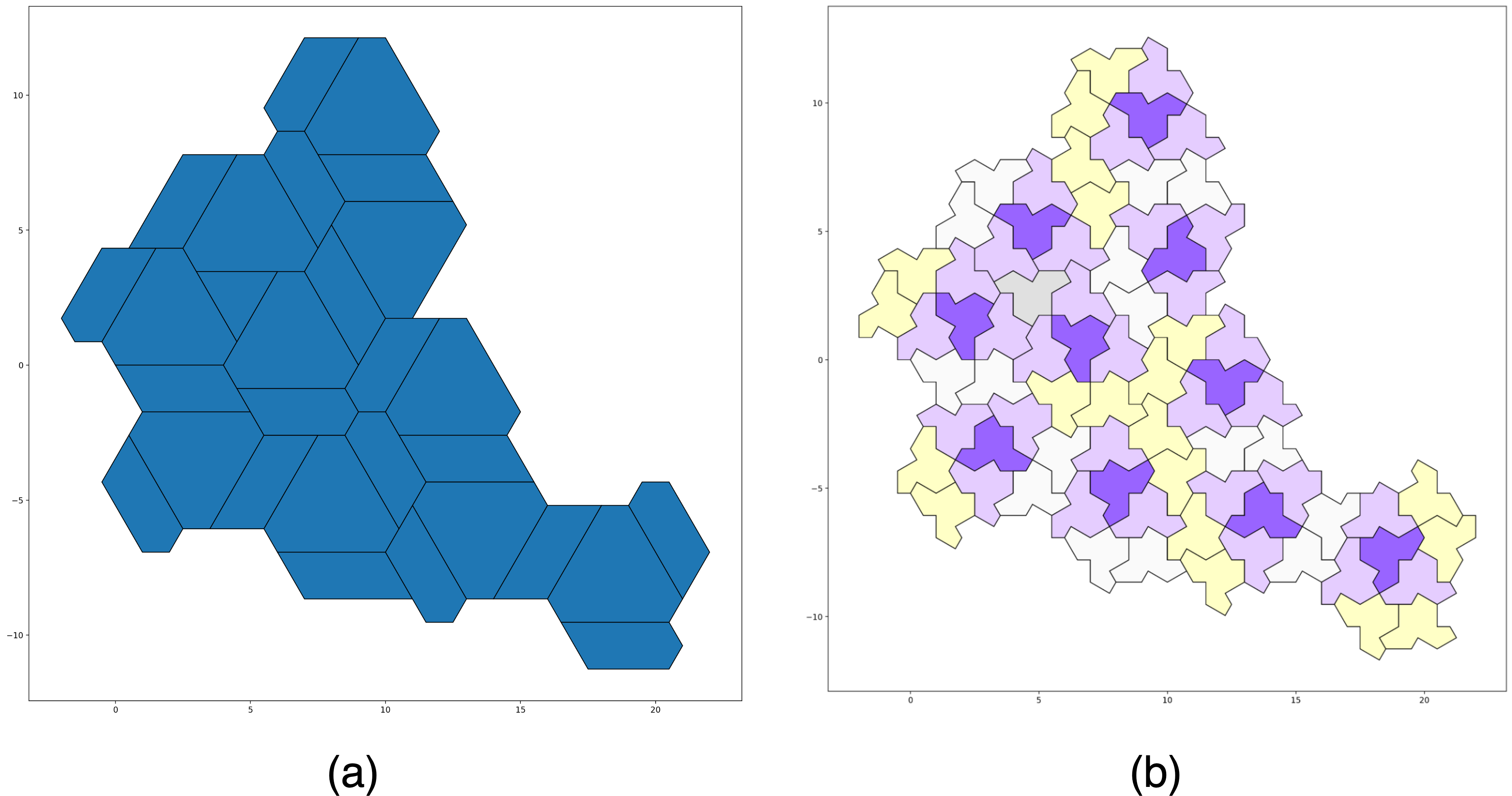
Figure 3: Depiction of a patch obtained by substitution; each metatile is dissected to illustrate combinatorial structure and tiling hierarchy.
Monte Carlo Simulation Methodology
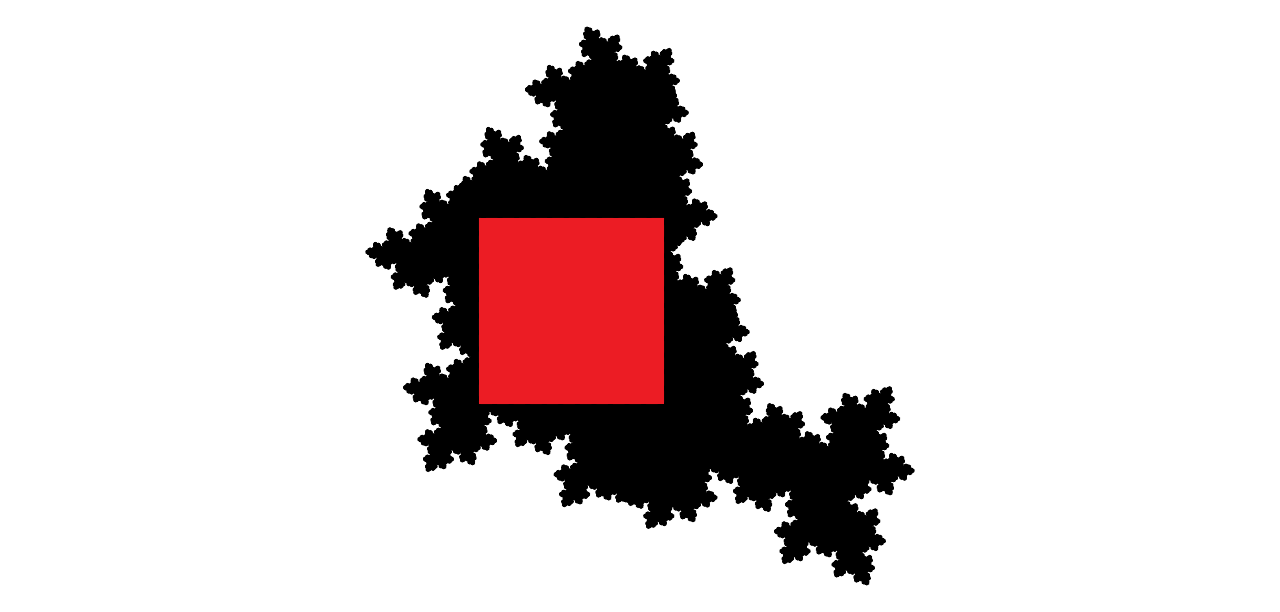
Percolation thresholds are assessed via Monte Carlo simulations on finite but increasingly large patches, with the system size described by square frames centered optimally within the generated tiling. The methodology distinguishes between rightward and downward percolation, intersection (simultaneous percolation along both axes), union (percolation along either axis), and their averages—justified due to demonstrated macroscopic isotropy [Rieger & Danescu, 2024]. Finite-size scaling and universal hypotheses from critical phenomena guide extrapolation to the thermodynamic limit, with ν=4/3 as the critical exponent.
Figure 4: The simulation frame (red square) centered on a large Smith Hat patch, maximizing sampling fidelity for percolation thresholds.
Numerical Results: Critical Thresholds and Confidence Intervals
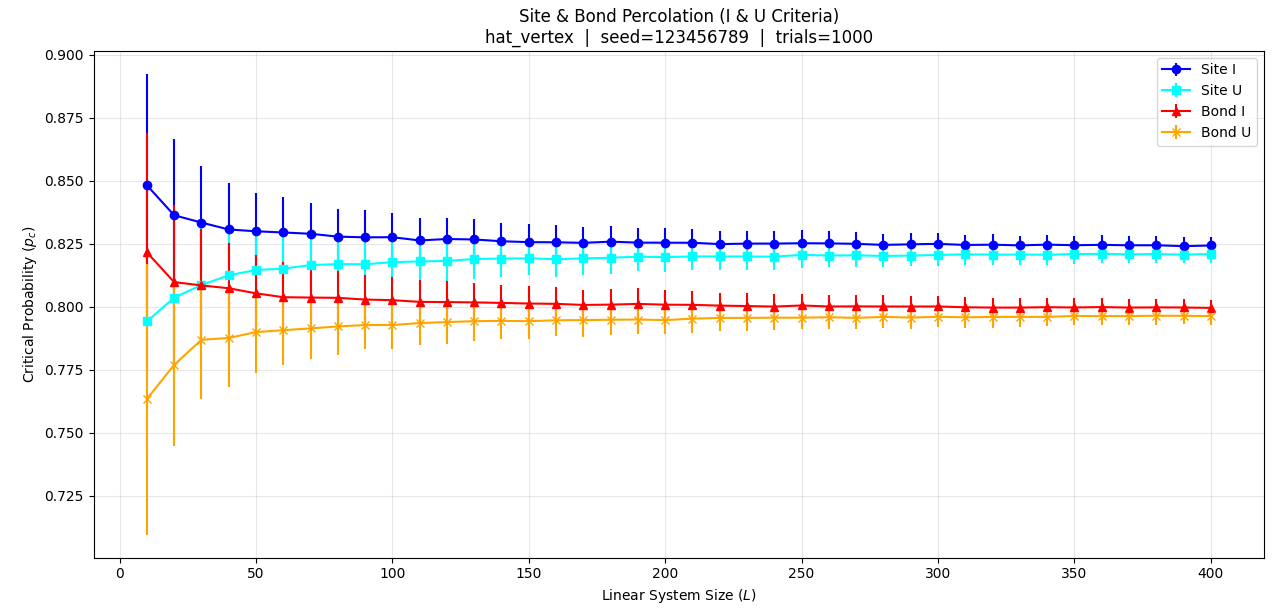
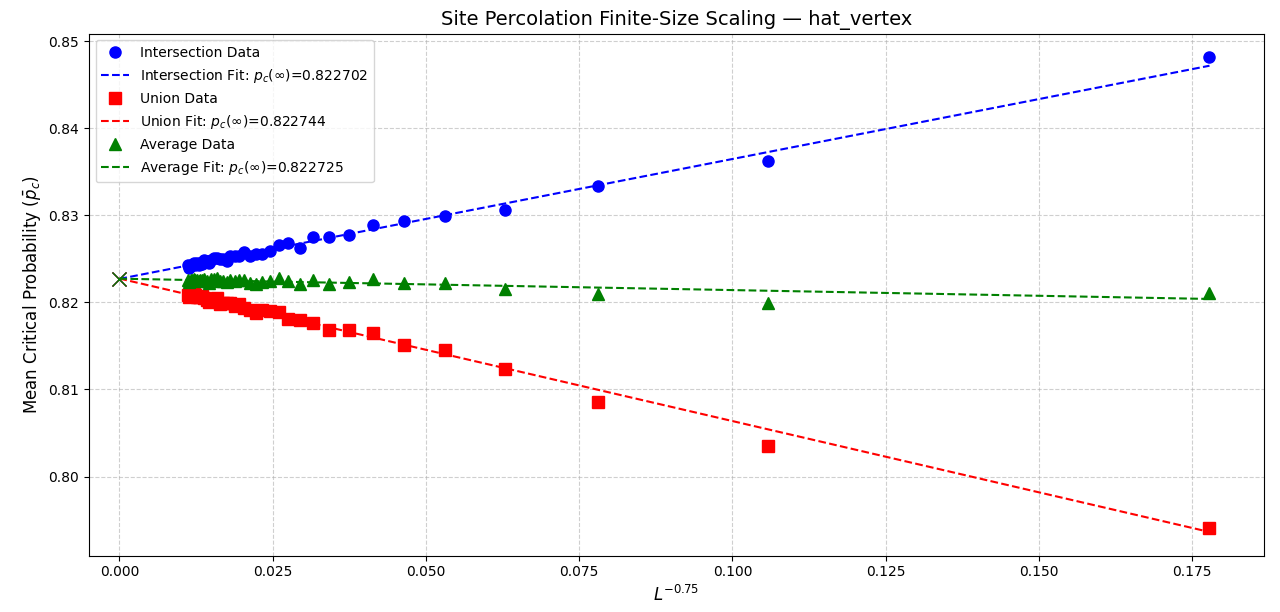
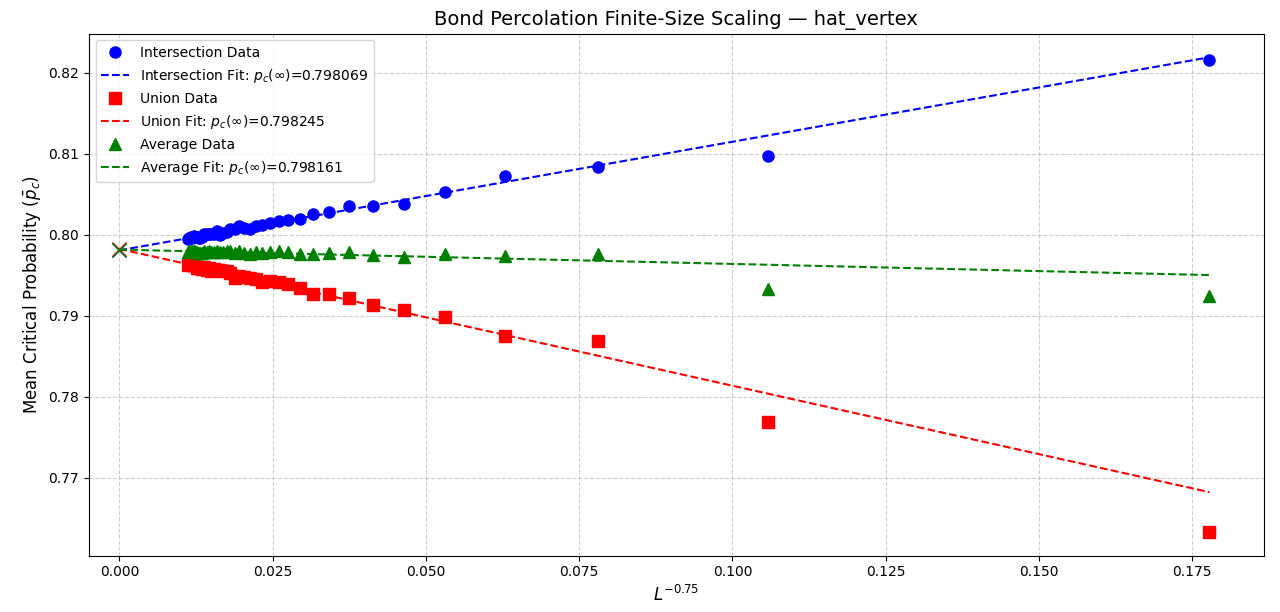
Monte Carlo results for the Smith Hat (1,3) tiling demonstrate convergence of percolation probabilities for increasing system sizes, supporting asymptotic threshold estimates. Edge percolation yields pc0 for site percolation and pc1 for bond percolation, both markedly higher than thresholds in known 2D periodic lattices.
Figure 5: Mean and 95% CI for site and bond percolation critical probabilities from Monte Carlo simulations over various system sizes.
Figure 6: Site percolation convergence indicating tight bounds and monotonic behavior for extrapolated pc2.
Figure 7: Bond percolation convergence revealing similar linear scaling and consistent intersection of extrapolated thresholds.
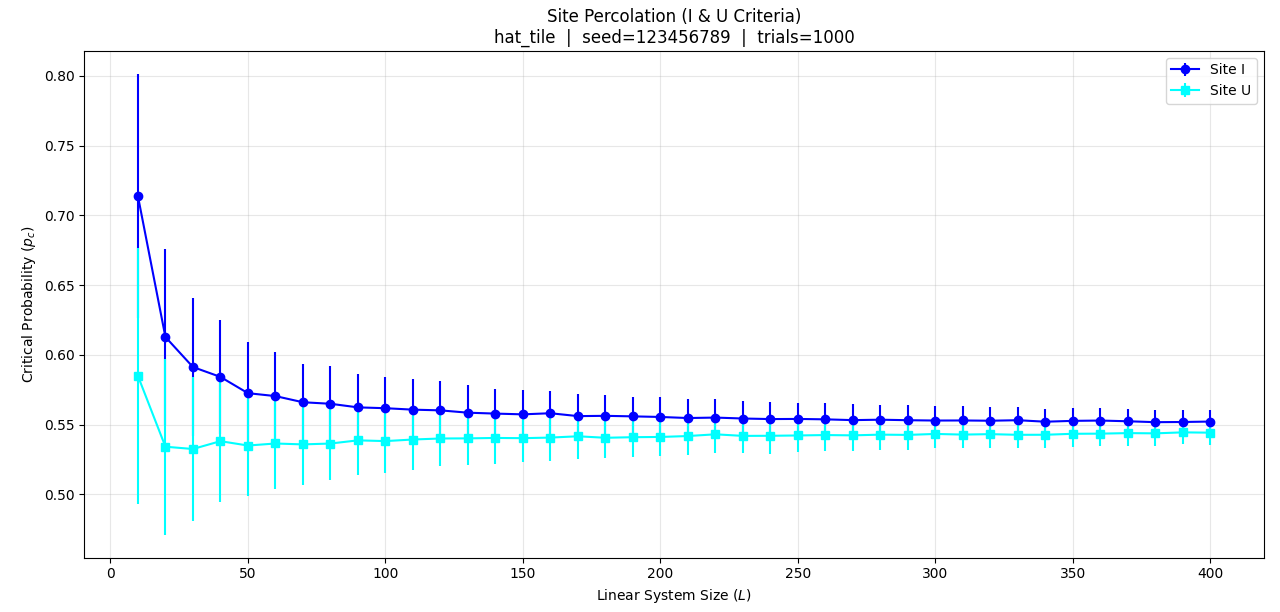
Notably, for tile-based site percolation, pc3, well within the expected range for dual graphs and in harmony with derived bond values via duality. These results directly imply that the Smith Hat aperiodic geometry exhibits strong local connectivity constraints due to its low average coordination number (∼2.3).
Figure 8: Site percolation results for tile graph structure, showing consistency with a duality-based percolation threshold.
Figure 9: Visualization of site percolation cluster formation dynamics under tile-based simulations.
Discussion: Implications and Comparative Analysis
The reported pc4 and pc5 for edge percolation are among the highest for studied 2D lattices, aligning with theoretical expectations that percolation thresholds are inversely related to coordination number. The absence of fixed coordination in aperiodic structures—replaced by a patch-dependent local environment—renders analytical pursuits challenging. These results confirm that aperiodic monotiles such as the Smith Hat impose exceptional constraints on global connectivity. The numerical precision achieved is validated against analytical benchmarks for square, triangular, and Penrose tilings, establishing methodological rigor.
Practical implications concern the robustness of networks modeled by such aperiodic graphs: the high pc6 implies enhanced tolerance to random node or bond failures before global connectivity collapses. Consequently, transport properties, electrical networks, and even quasicrystalline material analogues benefit from the structural features revealed here.
Limitations and Future Research
Computational bottlenecks (sequential algorithms, limited trial counts) restrict numerical precision but do not undermine qualitative outcomes. The assumption of isotropy and universal critical exponent is strongly supported by numerical convergence and parallels with prior results, though full analytical proofs for the Smith Hat geometry remain an open problem. Extension to other Hat tile variants, rigorous determination of critical exponents, and investigation of scaling relations constitute promising directions.
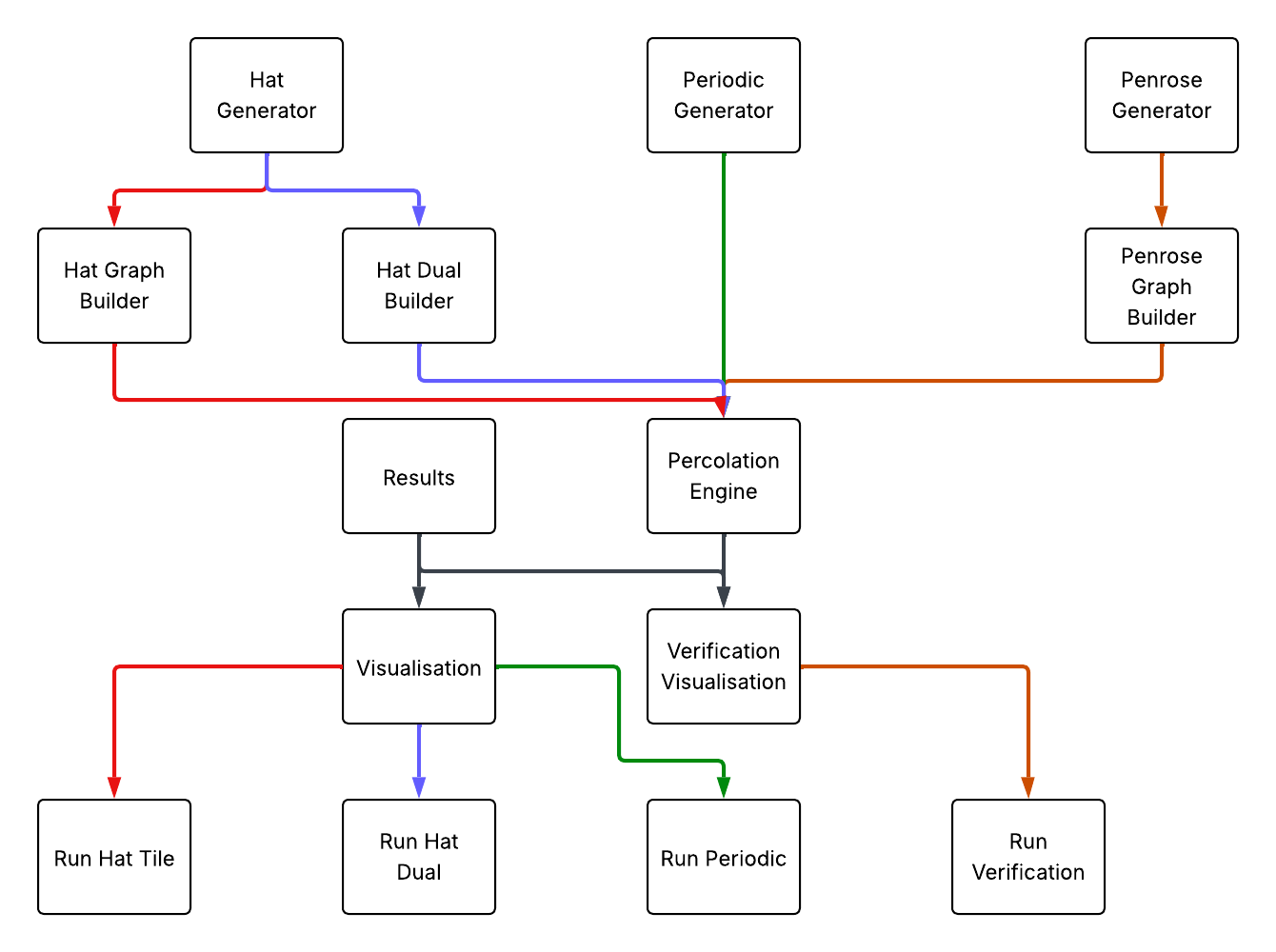
Figure 10: Flowchart of the algorithmic components and module interdependencies for the simulation pipeline.
Conclusion
This work provides the first quantitative benchmarks for the percolation critical probabilities of the Smith Hat pc7 aperiodic monotile. The results are characterized by high occupation thresholds for site and bond percolation, establishing novel bounds on connectivity in aperiodic tilings. These findings set the stage for future analytical and numerical studies targeting universality, critical behavior, and practical applications in complex network design and quasicrystalline modeling.