- The paper presents an extension of the ME method from quadratic to general L-smooth, μ-strongly convex functions using a two-gradient evaluation strategy.
- It leverages a two-dimensional subproblem to exploit the local geometry of level sets, yielding improved per-iteration descent compared to classical gradient descent.
- Empirical evaluations confirm that ME achieves sharper convergence rates and reduced gradient evaluations, especially when gradients are linearly independent.
The Method of Ellipcenters for Strongly Convex Functions
Extension of the Method of Ellipcenters to General Strongly Convex Settings
The Method of Ellipcenters (ME), introduced for unconstrained minimization of strongly convex quadratic functions, is extended to encompass L-smooth, μ-strongly convex functions. The method iteratively computes the minimizer of f over a plane spanned by two gradients evaluated at special companion points lying on the same level set. For general f, this involves two gradient evaluations per iteration: at the current iterate xk and a companion point yk=xk−tk∇f(xk), where tk>0 is chosen so that f(yk)=f(xk) is maintained, guaranteeing that yk always exists and is unique.
The generated affine plane Πk={xk+α∇f(xk)+β∇f(yk):(α,β)∈R2} is the search domain for each iterate. If the gradients μ0 and μ1 are linearly dependent, ME reverts to a segment search, otherwise one solves a two-dimensional subproblem for the minimum over μ2. The method is analogous to the ellipsoidal structure of quadratic levels sets, but for general μ3 relies on the smooth, strictly convex shape of level sets and their local geometry.
Theoretical Properties and Convergence Analysis
Existence, Uniqueness, and Computation
Rigorous arguments are presented demonstrating that the companion point μ4 exists and is unique for any differentiable, strongly convex μ5 at every non-stationary μ6, with at most two points on a line sharing the same objective value. For general μ7, a bisection search provides the required step size μ8. For quadratic μ9, a closed-form is available.
Fundamental Descent Property
Central to ME’s improved convergence is the exploitation of the Baillon--Haddad inequality:
f0
where f1 is the Lipschitz constant of the gradient. The two-dimensional nature of the update ensures that f2 is orthogonal to both f3 and f4 in the linearly independent (LI) case, thereby annihilating cross terms and enforcing sharper descent than gradient descent. This structure is nontrivial and does not occur in vanilla gradient methods.
Linear Convergence and Per-step Rate Improvements
ME is shown to achieve the classical gradient descent with exact line search rate, f5, for f6-smooth f7-strongly convex f8, where f9 is the condition number:
f0
In the LI case, a further per-step improvement is rigorously established. The method’s per-step contraction factor is
f1
where f2 is the angle between f3 and f4. The strict improvement f5 is achieved whenever the two gradients are not parallel, and a uniform gap is present if the directional angle is bounded away from zero for all f6. Notably, ME always dominates the function value achieved by gradient descent with exact line search, step-for-step.
If both gradients are parallel, the method reverts to an exact linesearch, matching the classical rate. In dimension two, ME achieves the solution in at most two iterations due to the planar span.
Empirical Evaluation
Extensive numerical experiments are provided to validate the theoretical convergence rates on non-quadratic, regularized logistic loss minimization tasks. In these experiments, ME outperforms classical gradient descent, gradient descent with exact line search, and Nesterov's accelerated gradient (Fast-GD) in terms of gradient evaluations, particularly at moderate condition numbers.
Terminal suboptimality with ME matches or surpasses all competitors and the per-iteration empirical contraction closely tracks, and often exceeds, the theoretical worst-case bounds. Importantly, the linearly independent condition for the two gradients is always satisfied in practical experiments, ensuring the improved rate guarantee applies uniformly.
Convergence behavior is illustrated by plotting the logarithm of suboptimality versus gradient evaluations.
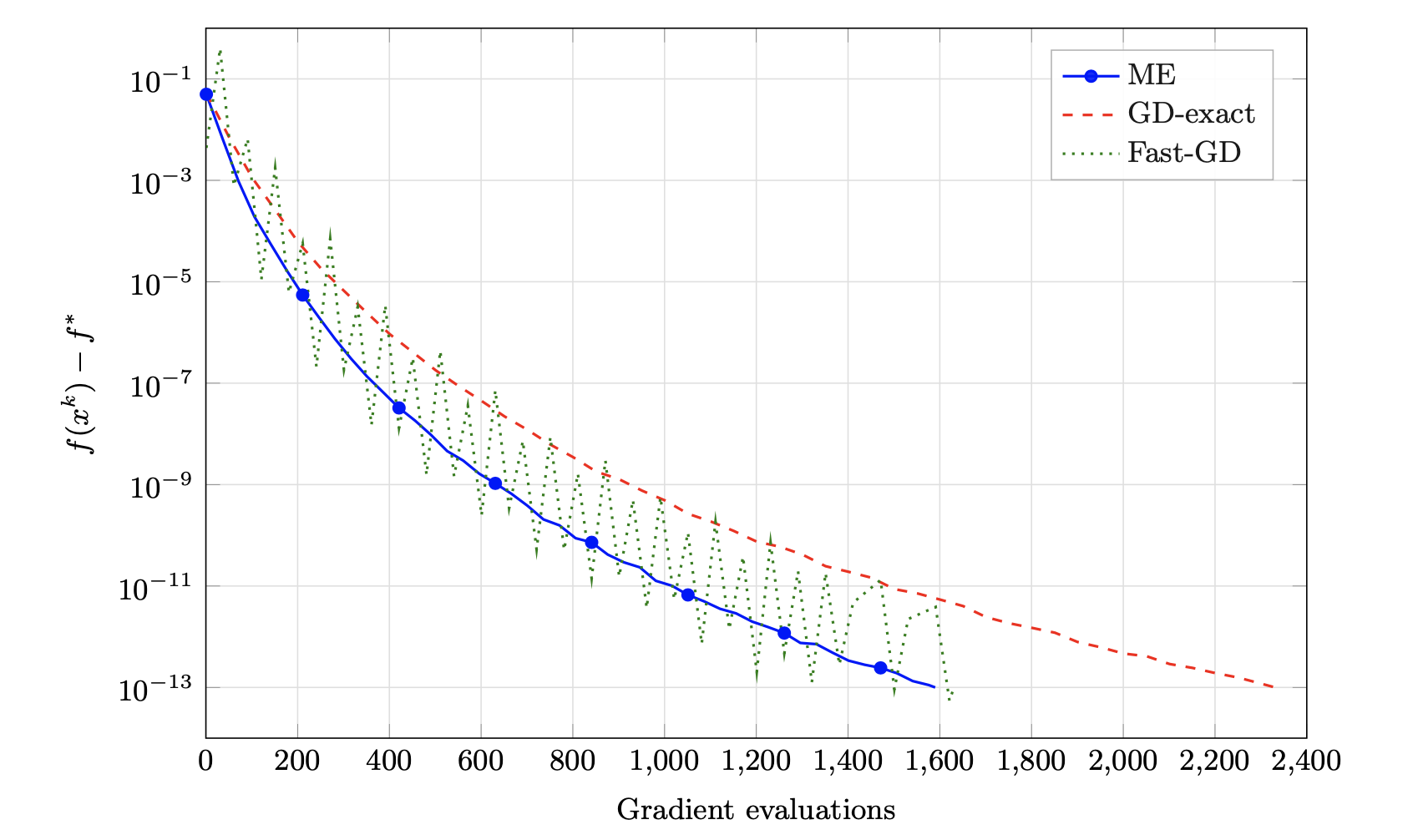
Figure 1: Convergence on regularized logistic regression showing ME requires fewer gradient evaluations than GD-exact, closely matching the theoretical per-step improvement.
Practical and Theoretical Implications
The extension of ME broadens its applicability to any differentiable, strongly convex, and gradient-Lipschitz objective. The method inherits from both conjugate gradient and two-step acceleration principles without recourse to higher-order information or acceleration coefficients. The per-iteration work is more involved than gradient descent but requires only two gradient evaluations and a bisection.
Strong empirical and theoretical superiority in terms of function value contraction is demonstrated stepwise, exceeding the performance of methods based upon exact linesearch when gradient independence holds. In dimension two, this yields trivialization of the problem, solving in two steps for all f7-smooth, f8-strongly convex f9.
Open Problems and Future Directions
The most prominent theoretical gap relates to the convergence rate in iterate distance for general xk0, which still lags the optimal rate achieved for quadratics. Development of geometric Lyapunov functions tailored to the evolving plane geometry may close this gap.
Other open directions include efficient algorithms for the two-dimensional plane minimization subproblem (potentially using curvature information or surrogate quadratic fits); extension to composite and nonsmooth optimization by defining analogs of the companion point; and generalization to block or stochastic variants by selecting planes using other directional information.
Conclusion
The paper rigorously extends the Method of Ellipcenters from strongly convex quadratics to general xk1-smooth, xk2-strong convex functions, establishing sharp per-iteration descent bounds, demonstrating functional value contraction at or above classical exact-linesearch rates, and guaranteeing at most two iterations to solution in dimension two. Numerical results on nontrivial objectives robustly confirm the theoretical predictions, and the method's stepwise dominance invites further study into higher-order and nonsmooth variants, as well as enhanced initialization and solution techniques for the internal step.
Reference: "The Method of Ellipcenters for Strongly Convex Functions" (2604.21132)