A Nearest-Neighbor Hard-Core Model on a Penrose Graph
Abstract: We prove that the maximal graph-density of an independent set in a Penrose P3 tiling considered as a planar non-directed graph is equal to (57−255)/2≈0.54915 despite the fact that the graph is bipartite. Accordingly, the extreme Gibbs measure of the nearest-neighbor hard core particle model on this graph is unique for sufficiently large values of the particle activity. This invalidates a natural expectation to observe the coexistence of even and odd phases.
- Classical Dimers on Penrose Tilings (2019)
- Spatial mixing and approximation algorithms for graphs with bounded connective constant (2013)
- The hard-core model on random graphs revisited (2013)
- Phase Coexistence and Slow Mixing for the Hard-Core Model on Z^2 (2012)
- Improved Inapproximability Results for Counting Independent Sets in the Hard-Core Model (2011)
- Tranlation-invariant Gibbs measures for the Hard-Core model with a countable set of spin values (2023)
- High-density hard-core model on triangular and hexagonal lattices (2018)
- Uniqueness of Gibbs Measures for Continuous Hardcore Models (2017)
- On four state Hard Core Models on the Cayley Tree (2012)
- Sampling independent sets in the discrete torus (2010)
Summary
- The paper proves that for high activity, the hard-core model on the Penrose P3 graph exhibits a unique Gibbs measure, contradicting conventional phase coexistence in bipartite systems.
- It employs explicit coarse-graining with pattern partitioning and polymer expansion techniques to rigorously analyze the statistical mechanics of an aperiodic tiling.
- The study establishes a maximal vertex occupation density of approximately 0.54915, highlighting the impact of local inhomogeneity in the graph.
Nearest-Neighbor Hard-Core Model on the Penrose P3 Graph
Introduction and Problem Statement
The paper "A Nearest-Neighbor Hard-Core Model on a Penrose Graph" (2604.21086) addresses the hard-core lattice gas model on the infinite bipartite planar graph derived from the Penrose P3 tiling. The motivation stems from the investigation into the high-activity phase diagram of hard-core models on non-periodic graphs and the conditions under which Gibbs measure uniqueness or phase coexistence can be expected, especially in the context of aperiodic and self-similar structures such as the Penrose graph.
Formally, the model considers admissible configurations ϕ∈{0,1}V, where vertices occupied by particles (i.e., ϕ(v)=1) must not be adjacent, implementing the usual hard-core exclusion. The Hamiltonian is H(ϕ):=−log(u)∑vϕ(v), with u>0 the activity (fugacity) parameter. For bipartite, regular, or uniformly recurrent graphs, classical results suggest the possibility of phase coexistence at high activity, manifested as multiple extreme Gibbs measures corresponding to occupation preference on even or odd sublattices. However, the Penrose graph—being a quasiperiodic, bipartite but highly inhomogeneous planar structure—brings novel challenges and defies several expectations rooted in lattice models.
Structural Features of the Penrose P3 Tiling
The Penrose P3 tiling is constructed from two types of decorated rhombi—thin and thick—which cover R2 non-periodically, enforcing local matching rules that produce a carefully constrained aperiodic structure. The resulting Penrose graph is bipartite, with local environments varying substantially in terms of local vertex degree (ranging from 3 to 7) and pattern repetition.
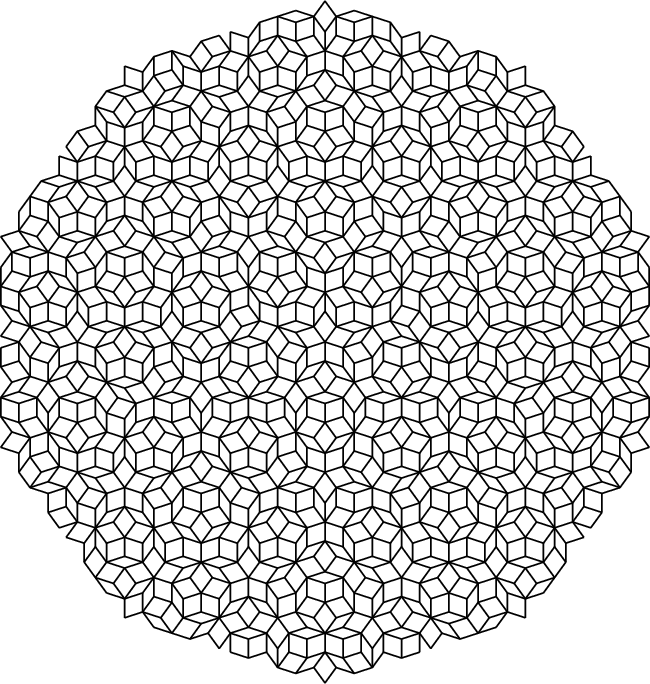
Figure 1: A fragment of a P3 tiling, demonstrating the fundamental bipartite, aperiodic structure generated by matching thin and thick rhombi.
Despite the bipartite nature and the even/odd vertex partition being of equal global density, the inherent local inhomogeneity and absence of translation symmetry play a crucial role in the statistical mechanics of the corresponding hard-core model.
Main Results: Uniqueness of the Gibbs Measure and Maximal Density
The core result of the paper is the proof that, for sufficiently high activity u>u, the hard-core model on the Penrose P3 graph admits exactly one unique Gibbs measure—contradicting the expected phase coexistence based on bipartite, symmetric models. Furthermore, the extremal Gibbs state is constructed explicitly and shown to have a vertex occupation density strictly greater than $1/2$, given by (57−255)/2≈0.54915.
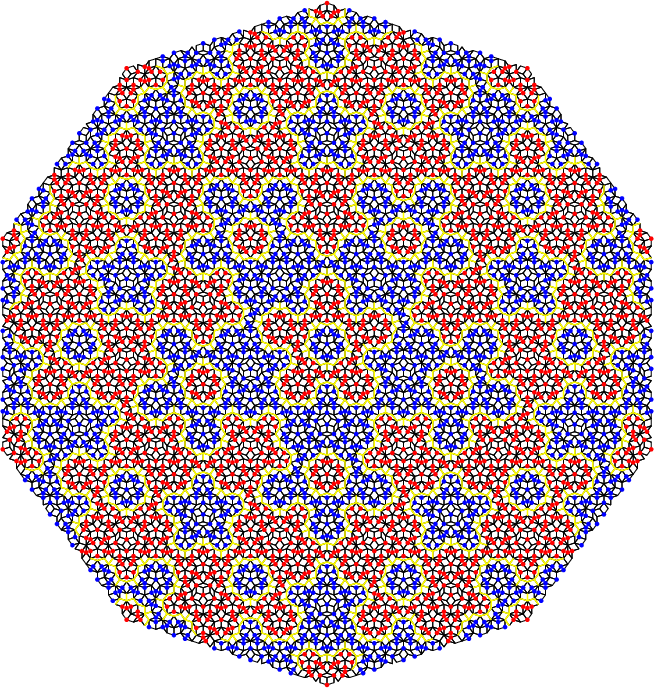
Figure 2: A fragment of the ground state for a P3 tiling, highlighting the patches of full parity occupancy separated by boundaries of vacant edges.
The structure of the ground state is essentially a tiling by larger patterns, each supporting a locally optimal configuration (a perfect configuration), and these patterns are separated by loops of vacant bonds that act as boundaries between regions of different parity occupation. The uniquely maximizing independent set is thus obtained not by globally choosing all even or all odd sites (as on the square lattice), but by a more intricate patchwork of locally maximal occupancy, resulting in density exceeding $1/2$.
Notably, the uniqueness threshold for the activity parameter u is proven (though with a highly nonoptimal bound; the paper uses ϕ(v)=10 for technical convenience), and it is shown that the high-activity, low-temperature regime can be analyzed by means of absolutely convergent polymer expansions.
Patch Patterns, Self-Similarity, and Coarse-Graining
To analyze the extremal configurations and the structure of defects, the authors deploy an explicit decomposition of the Penrose P3 tiling into a finite collection of larger “basic” patterns, each with fixed local topology. These patterns—labeled as “urchin,” “starfish,” “snail,” “turtle,” and “bat”—form a partition of the graph which respects both the combinatorics of edge-sharing and the self-similarity inherent to the P3 structure.
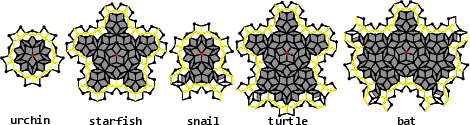
Figure 3: The five basic patterns into which the Penrose P3 tiling can be uniquely partitioned, forming the basis for coarse-graining the hard-core model.
A fundamental observation, established via combinatorial and geometric analysis, is that for each patch, the locally perfect configuration—maximizing the number of non-adjacent occupied vertices—is unique inside the patch interior and robust with respect to boundary conditions (see Figure 4).
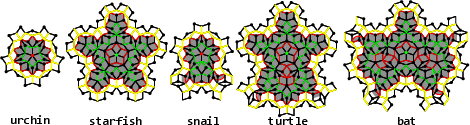
Figure 4: The five basic patterns with loops illustrating the maximal packing cycles in each pattern.
This enables the model to be rigorously mapped (via a coarse-graining procedure) onto a new “supertiling” graph, with vertices corresponding to patterns and effective spins describing locally admissible particle arrangements. The supertiling inherits mutual local derivability from the P3 tiling and has bounded degree, allowing the direct application of convergent cluster expansions for rigorous statistical mechanics analysis.
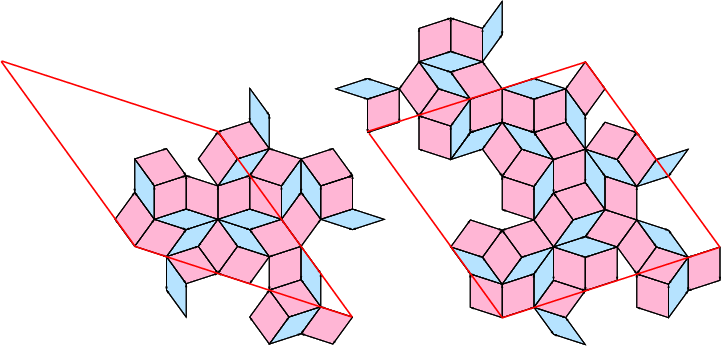
Figure 5: The level-4 supertiles, exemplifying the result of iterated substitution rules, crucial for the self-similar decomposition of the Penrose tiling.
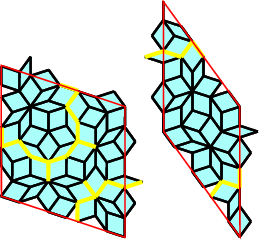
Figure 6: The level-4 equivalent supertiles, with yellow boundaries indicating patch interfaces for the pattern-based model reduction.
Polymer Expansion, Contour Representation, and Mathematical Rigor
A central technical contribution is the fully explicit application of the contour (polymer) expansion method from Pirogov-Sinai theory, adapted to the coarse-grained Penrose tiling supergraph. Here, the spin system on the pattern-vertex supergraph is tightly controlled: non-optimal pattern configurations are energetically suppressed by a gap scaling as ϕ(v)=11, and their contributions to the partition function are bounded by a sum over exponentially decaying weights.
The authors prove that for each “contour” (i.e., a connected cluster of patches deviating from the perfect configuration), the polymer weight decays fast enough to ensure absolute convergence of the expansion and uniqueness of the infinite-volume Gibbs state. The regularity and bounded degree of the supertiling graph are exploited critically here.
Combinatorics and Self-Similarity in the Penrose Graph
The approach relies on a detailed combinatorial decomposition of the Penrose graph, including construction of multi-level supertiles, partitioning via the extended 0-atlas, and the use of mutual local derivability. Subsequent mapping to patterns such as the RKTT tiling—delineated by specific cuts and aggregations—supports the explicit definition of patch-based coarse-graining and the computation of the maximal density in terms of the frequencies of the relevant patterns.
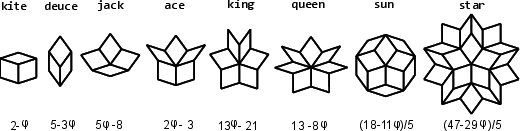
Figure 7: The extended 0-atlas of a geometrical P3 tiling, showing the prototypical configurations from which pattern frequencies and densities are computed.
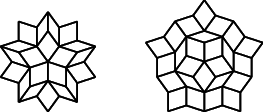
Figure 8: The coronas in a P3 tiling, illustrating the adjacency relations essential for renormalization and pattern superposition.
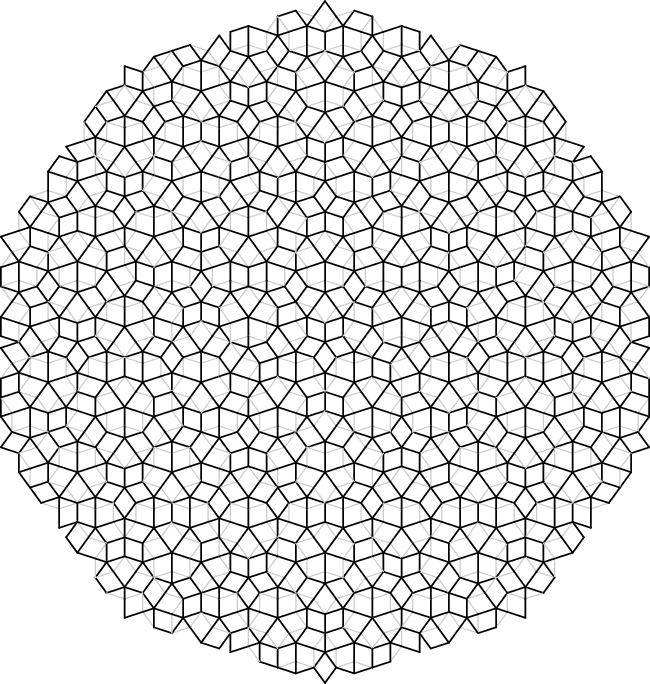
Figure 9: Superimposed P3 and RKTT tilings, demonstrating the translation from rhombic to pattern-based partition logic.
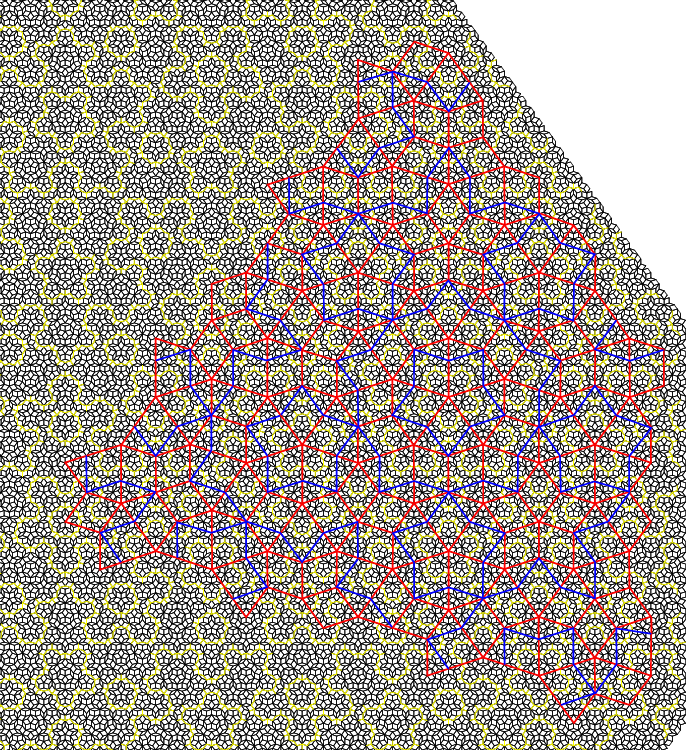
Figure 10: P3 and RKTT supertilings and patches with boundaries, visualizing the fine structure of patchwork and the interfaces dictating particle exclusion.
Implications and Future Directions
The primary implication is the existence of high-activity uniqueness of the Gibbs measure and the explicit construction of the maximally dense independent set for the Penrose P3 graph, invalidating uniform expectations from bipartite periodic graphs and highlighting the critical role of local inhomogeneity and aperiodic order. The result demonstrates that the loss of translational invariance and regularity profoundly alters the phase structure, leading to density enhancement and destabilization of global sublattice ordering.
From a practical and theoretical perspective, this suggests that similar coarse-graining and polymer expansion schemes may be effective for a broader class of hierarchical, linearly repetitive or self-similar aperiodic structures. Further work is merited to optimize the uniqueness threshold for ϕ(v)=12 and to analyze the intermediate phase diagram (moderate activity) not accessible to the current polymer expansion. The paradigm also has potential applications in combinatorial optimization, tiling theory, and the physics of quasicrystalline materials, where hard-core constraints and aperiodicity are fundamental.
In mathematical physics, the explicit construction of mutually locally derivable renormalization graphs and identification of perfect configurations paves the way for analogous investigations of different exclusion potentials and (possibly quantum) extensions in aperiodic systems.
Conclusion
The analysis of the nearest-neighbor hard-core model on the Penrose P3 graph rigorously establishes the uniqueness of the Gibbs measure for large activity and determines the exact maximal density of independent sets in this quasiperiodic, bipartite, but highly inhomogeneous graph. The employed coarse-graining via pattern partition, contour expansion, and detailed combinatorics of the Penrose tiling provides both the combinatorial and statistical mechanical underpinning of the result. The work illuminates the failure of sublattice phase coexistence in sufficiently complex aperiodic settings, highlighting the deep interplay between geometry, combinatorics, and equilibrium statistical mechanics.
Paper to Video (Beta)
No one has generated a video about this paper yet.
Whiteboard
No one has generated a whiteboard explanation for this paper yet.
Paper Prompts
Sign up for free to create and run prompts on this paper.
Top Community Prompts
Open Problems
We haven't generated a list of open problems mentioned in this paper yet.
Continue Learning
- How does the aperiodic structure of the Penrose P3 graph affect the behavior of the hard-core model?
- What are the key advantages of using coarse-graining and contour expansion methods in this analysis?
- How is the maximal vertex density derived, and what does it imply about the system's phase behavior?
- Can the analytical techniques used here be applied to other non-periodic or quasiperiodic tilings?
- Find recent papers about Gibbs measures in aperiodic tilings.
Tweets
Sign up for free to view the 1 tweet with 0 likes about this paper.