- The paper introduces a comprehensive taxonomy of non-inertial terrains for legged robots, defining challenges across maritime, ground, and aerospace applications.
- It presents hybrid modeling and state estimation strategies that blend full-order and reduced-order methods with data-driven techniques for robust control.
- It highlights open challenges in sensor fusion, control, and safety, urging future research to develop adaptive, benchmarked legged robotic systems.
Legged Robotics in Non-Inertial Environments: Technical Foundations and Open Problems
Introduction and Motivation
Legged robotic mobility has achieved robust performance on rigid, stationary ground; however, deployment in non-inertial environments, where the support surface itself undergoes motion, tilting, or acceleration, remains a largely unsolved problem. These environments are prevalent in sectors including ground transportation (buses, trains), maritime (ships, offshore platforms), and aerospace (aircraft), where the supporting surface introduces persistent, multidirectional, and time-varying disturbances that violate the foundational assumptions underlying classical robot modeling, estimation, and control. The survey "A Survey of Legged Robotics in Non-Inertial Environments: Past, Present, and Future" (2604.20990) provides a comprehensive analysis of this emerging frontier and systematically categorizes the technical challenges and current approaches in state estimation, modeling, and control for legged robots subjected to non-inertial ground.
Taxonomy and Application Domains
The paper establishes a general taxonomy of terrains, delineating the operational complexity of legged robots according to both surface deformability (rigid–deformable) and environmental motion (inertial–non-inertial). Non-inertial domains, distinct from zero-gravity or underwater contexts, typically involve platforms with pronounced 6-DoF motion and a spectrum spanning lightweight agents (boats, passively oscillating bridges) to heavy, exogenously-driven environments (ships, trains, aircraft).
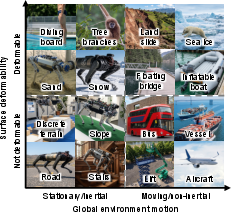
Figure 1: Terrain categorization by surface deformability and environment motion, illustrating the challenge space for legged robots.
Maritime, ground, and aerospace applications present unique disturbance profiles—maritime platforms feature low-frequency, high-amplitude oscillations; ground vehicles exhibit moderate-frequency vibrations and transient longitudinal acceleration; aerospace platforms combine small steady accelerations with broadband high-frequency vibration. This diversity translates to domain-specific requirements for robustness in robot perception, control, and mechanical/electrical design.
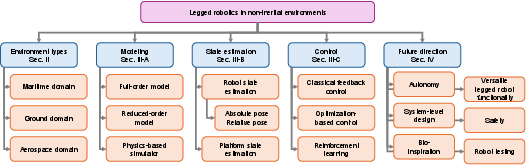
Figure 2: Overview and taxonomy of legged robotics operating in non-inertial environments.
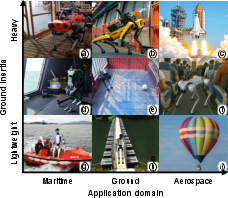
Figure 3: Representative non-inertial platforms across key application domains, including offshore oil platforms, ships, trains, aircraft, and dynamically moving bridges.
Modeling Frameworks
Full-Order and Reduced-Order Models
Locomotion on non-inertial terrain requires modeling both the robot and support-ground dynamics, either tightly coupled (for lightweight platforms where the robot significantly perturbs the substrate) or as time-varying boundary conditions and disturbances (for heavy/inert platforms). Full-order models maintain all physical DOFs, accommodating coupled dynamics and non-slipping contact constraints, but induce substantial computational cost and complexity. For computational efficiency, reduced-order abstractions, typically extensions of the Linear Inverted Pendulum (LIP) or the Angular Momentum LIP (ALIP), have been formulated to include surface motion, yielding linear time-varying systems in the case of heavy platforms, and coupled robot-environment dynamics for lightweight platforms.
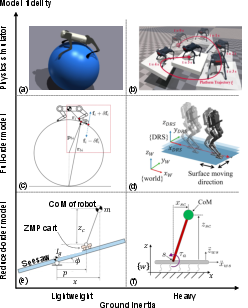
Figure 4: Canonical legged robot models for non-inertial environments—rigid-ground, floating ball, actuated plates, massless wheels, and actuated Bongo/Segway analogues.
Physics-based simulation (e.g., MuJoCo, IsaacLab, VRX) is essential for both controller development and policy training; non-inertial effects are incorporated via explicit environmental motion models.
Limitations and Open Modeling Questions
Present analytical models are restrictive—reduced-order models neglect foot slippage, complex multi-contact scenarios, and high-frequency platform dynamics. For coupled dynamics, realistic 6-DoF disturbance and robot-induced ground motion remain underrepresented. There is a critical need for hybrid data-driven approaches (learned world models conditioned on both platform and robot state-action history) and explicit reference-frame selection strategies for robust estimation and control design.
State Estimation Paradigms
State estimation for legged robots in non-inertial environments is fundamentally more challenging due to the breakdown of stationary contact assumptions and the partial observability of platform motion. The literature is divided between relative estimation (robot to platform), absolute estimation (robot to inertial world), and direct estimation of platform states significant for robot stability (e.g., time-varying roll, pitch, angular/linear acceleration).
Recent methods exploit dual-IMU (robot and platform) setups and invariant (InEKF) filtering, providing formal observability in certain configurations, but practical implementations may lack platform-inertial measurements. Data-driven visual-inertial fusion and proprioceptive estimators enable slip-aware and contact-dynamics-aware state estimation, though experiments are largely restricted to artificial treadmill perturbations. The development of benchmark datasets and robust long-horizon estimation frameworks remains an open research bottleneck.
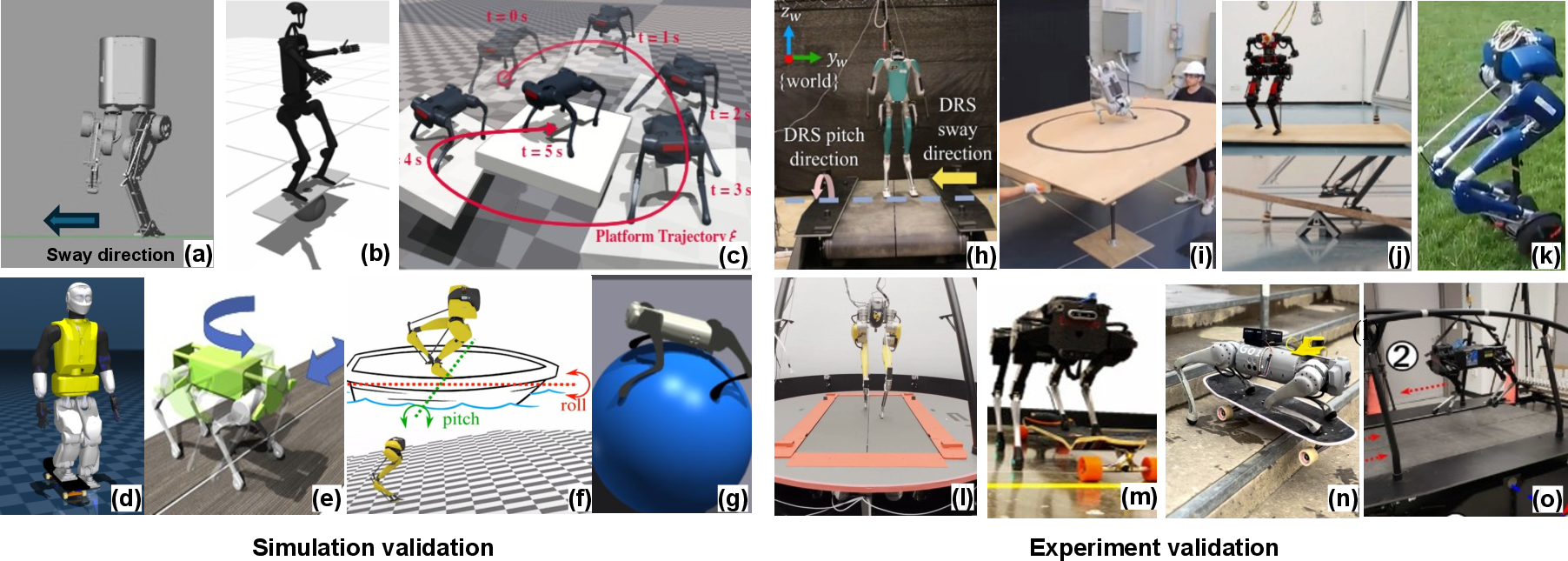
Figure 5: Overview of experimental platforms and simulation studies—delineation between studies primarily validated in simulation versus those with hardware deployment on non-inertial platforms.
Control and Planning Architectures
Classical and Optimization-Based Control
Control architectures are segmented into three principal categories based on knowledge of the platform motion: (i) explicit compensation based on measured/known ground motion, (ii) robust control under bounded disturbances, and (iii) fully disturbance-adaptive strategies for unknown, multidirectional, and aperiodic platform motion.
Classical feedback controllers, often built atop reduced-order models, enable analytic Lyapunov-based guarantees under modeled disturbances and have demonstrated success in walking and balancing tasks on controlled non-inertial testbeds. Optimization-based controllers (convex/robust MPC, trajectory optimization) extend these capabilities by ensuring feasibility and performance under state and input constraints, with some demonstrated margin under real vehicle, maritime, and treadmill oscillation profiles. However, current optimization-based pipelines are limited by the need for platform motion bounding or periodicity assumptions.
Learning-Based Approaches
Reinforcement learning, leveraging scalable simulators, demonstrates improved robustness to time-varying disturbances (e.g., higher tolerances to oscillation frequency and amplitude compared with model-based control [bermudez2025comparative]). Recent RL-based frameworks integrate hybrid mode detection and platform-state estimation, allowing for adaptation during contact breaks and for tasks such as skateboarding or balancing atop dynamically unstable objects. Direct sim-to-real transfer and hierarchical RL architectures (e.g., DrEureka, DHAL, LAS-MP) show significantly increased operational envelopes in frequency and amplitude of platform disturbance.
Fundamental Challenges
All architectures face critical issues: robust feasibility under large uncertainty (tradeoff between constraint satisfaction and over-conservatism in robust/tube-based MPC), explicit constraint handling given the likelihood of foot slip or platform-induced contact loss, and the lack of formal guarantees or systematic generalization in RL policies. Adversarial testing reveals that SOTA RL locomotion policies may be vulnerable to carefully constructed disturbance sequences [shi_rethinking_2024].
Broader Challenges and Future Directions
Autonomy, Perception, and Planning
Enabling autonomous legged mobility in non-inertial environments demands seamless integration of perception—dynamic scene understanding and anticipation of platform motion (using world models or VLA architectures)—as well as adaptive high-level planning that regards disturbance as a first-class constraint in task sequencing and trajectory generation.
System-Level Design
Sensor fusion (high-bandwidth tactile, event cameras, multi-modal fusion), actuator and mechanism innovations (quasi-direct drives, series/variable compliance, prehensile feet or hybrid actuation), and energy storage for compensation of cyclical disturbances are critical for robustness and energy efficiency. Mechanism design that increases the feasible contact space (e.g., electromagnetic feet, claws, jammed granular contacts) is needed for non-prehensile and complex multi-contact interaction.
Bio-Inspiration
Human balancing stratagems on dynamic platforms—switching between ankle, hip, and stepping strategies, multisensory disturbance estimation, and frequency-dependent adaptation—indicate directions for robust estimation, adaptive control, and active compliance. The robotics community can benefit from deeper incorporation of these strategies, as well as from biomechanical analysis of human locomotion under persistent non-inertial perturbations.
Safety and Testing
Formal safety guarantees (control barrier/Lyapunov functions) for hybrid, high-dimensional, and time-varying systems have yet to mature. Latent safety filters parameterized in low-dimensional representations and data-driven certificates are promising, but generalization across disturbance classes and platforms is unsolved. There is a lack of accepted test protocols, metrics, and standardized benchmarks for non-inertial locomotion.
Conclusion
Legged robotics in non-inertial environments presents a multidimensional challenge—requiring advances in modeling (hybrid physical/data-driven world models), state estimation (coupled robot-environment inference under partial observability), and control (robust, adaptive, and learning-based architectures) to address real-world disturbances ubiquitous in logistics, transportation, and field robotics. Future progress hinges on system-level co-design, deeper integration of learning and model-based approaches, high-fidelity experimental validation, and the establishment of open benchmarks to ensure rigorous and fair comparison of algorithms. The emergence of new sensing, actuation, and perception architectures, informed by biological and environmental insight, will be central to achieving robust, versatile, and safe legged locomotion on dynamic, nonstationary ground (2604.20990).