- The paper demonstrates that using Formalism-B, which rotates decoherence into the matter basis, avoids unphysical spectral features seen in Formalism-A.
- It employs detailed simulations with realistic DUNE and P2SO configurations to reveal divergent oscillation probabilities and sensitivity limits for high decoherence values.
- The analysis underscores that accurate decoherence modeling is essential for reliably determining neutrino mass ordering, CP violation, and oscillation parameters.
Introduction
The paper "Impact of different neutrino decoherence formalisms at the future long-baseline Experiments" (2604.20977) offers a detailed comparative analysis of two principal quantum decoherence modeling approaches—Formalism-A and Formalism-B—in the context of next-generation accelerator-based long-baseline neutrino oscillation experiments, notably DUNE and Protvino-to-Super-ORCA (P2SO). Decoherence in neutrino oscillation is motivated by open quantum system effects, including possible Planck-scale phenomena, environmental interactions, and non-unitary dynamics, all of which potentially introduce exponential damping and/or frequency modifications in flavor transition probabilities. The precise treatment of the decoherence dissipator, especially in strongly matter-affected regimes such as DUNE and P2SO, underpins sensitivity claims for mass ordering, atmospheric mixing octant, and CP-violation.
The quantum kinetics of neutrino oscillations in open systems is formulated via the Lindblad equation, encapsulating dissipation through a matrix-valued dissipator D acting on the flavor or mass basis density matrix. The distinction between the two major formalisms lies primarily in the choice of basis for the dissipator:
- Formalism-A: Assumes the dissipator is diagonal and energy-independent in the matter mass basis (i.e., the eigenbasis of the Hamiltonian including matter effects), yielding simple exponential damping factors in oscillation probabilities.
- Formalism-B: Specifies the dissipator in the vacuum mass eigenstate basis and rotates it to the matter basis via a nontrivial unitary transformation. This prescription, advocated following deficiencies identified in Formalism-A, more accurately incorporates matter potential effects, altering not just amplitudes but also the interference structure of the probabilities.
Analytically, the two formalisms converge in the vacuum limit or for small decoherence parameter Γ, but diverge for large Γ and in significant matter effect scenarios.
Experimental Configurations and Simulation Framework
The study models DUNE and P2SO using realistic beam power, exposure, detector specifications, and systematic errors, employing GLoBES for event spectrum simulation and Poissonian χ2 calculations. Parameter scanning covers all relevant oscillation and decoherence parameters, with oscillation inputs drawn from NuFIT 6.1. Both vacuum and constant-density matter cases are analyzed for each formalism.
Results
Probability-Level Behavior
For small decoherence strengths (Γ≤10−23 GeV), appearance probabilities as functions of energy (for both neutrinos and antineutrinos) are nearly identical for the two formalisms in vacuum, with matter effects minimal. However, for larger Γ, especially in the presence of strong matter potential (as relevant for DUNE and P2SO), significant discrepancies arise. Notably, Formalism-A predicts a sharp anomalous probability peak near 11 GeV for high Γ, a feature absent in Formalism-B.
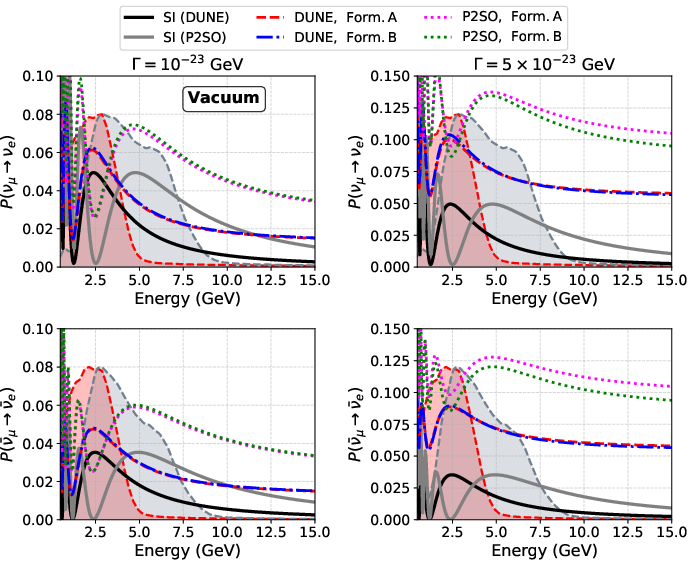
Figure 1: Appearance probabilities as a function of energy for DUNE and P2SO experiments in standard and decoherence scenarios in vacuum.
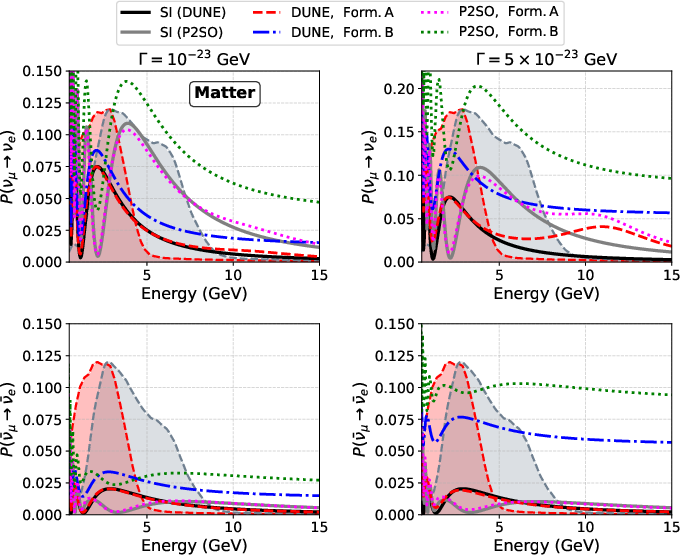
Figure 2: Appearance probabilities as a function of neutrino energy for DUNE and P2SO experiments in standard and in presence of decoherence in matter.
Sensitivity to Decoherence Parameters
Stringent upper bounds on the decoherence parameter Γ are extracted for both formalisms using simulated χ2 analyses. In the vacuum scenario, the differences between formalism constraints are minimal for DUNE and marginal for P2SO. Contrasts amplify in matter: Formalism-B achieves noticeably tighter (more restrictive) bounds, indicating greater sensitivity to decoherence effects due to the enhanced matter interaction modeling. The purported high-energy peak seen in Formalism-A does not impact sensitivity bounds due to its occurrence at Γ values already excluded at Γ0.
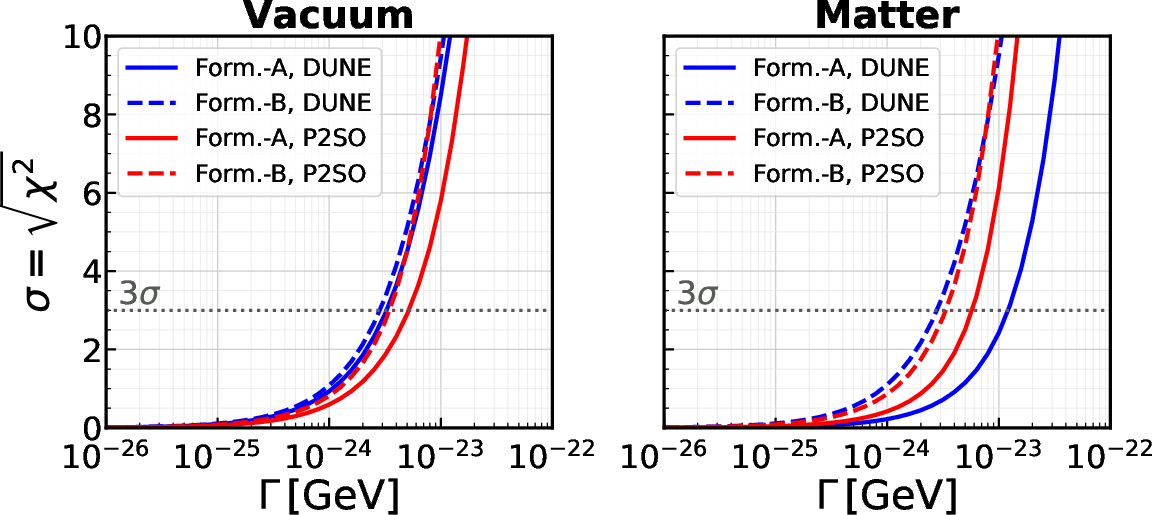
Figure 3: Constraints on the decoherence parameters for formalisms A and B in vacuum and matter at DUNE and P2SO.
Sensitivities to Oscillation Parameters
The impact of decoherence (modeled in each formalism) on discovery potentials for mass ordering, Γ1 octant, and leptonic CP violation is mapped as a function of Γ2.
- Mass Ordering: For low Γ3, both formalisms yield near-identical, standard-like sensitivities. At larger Γ4, sensitivity under Formalism-A increases, while under Formalism-B it initially decreases before rising at even higher values. The discrepancy is more pronounced at P2SO.
- Octant Determination: For small decoherence, formalism differences are negligible. Formalism-B exhibits non-monotonic sensitivity as Γ5 increases, with a minimum followed by an upturn; Formalism-A shows steady decline.
- CP Violation: For both formalisms, sensitivity matches the standard case for Γ6 GeV but diverges at larger decoherence, with Formalism-B showing partial recovery at high Γ7.
These trends are consistently more marked for P2SO due to its longer baseline and higher matter effect.
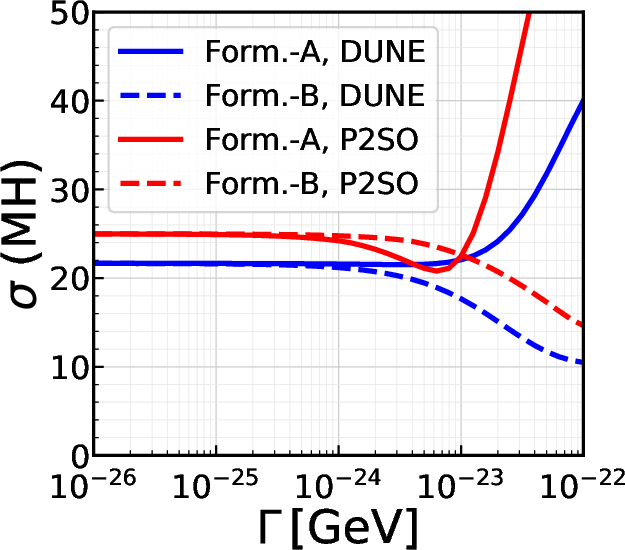
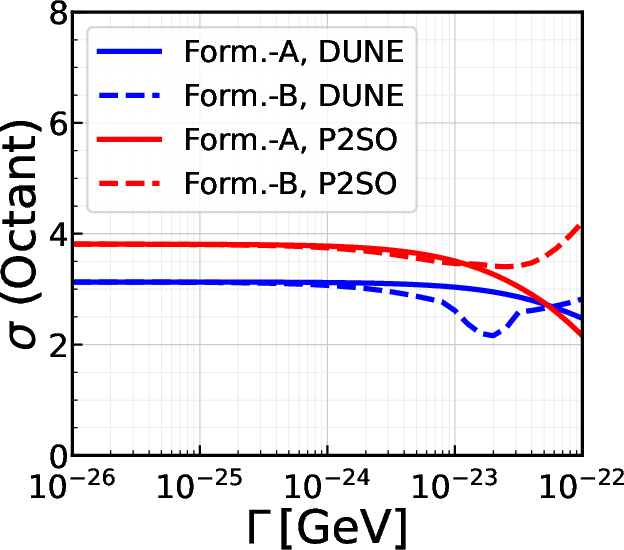
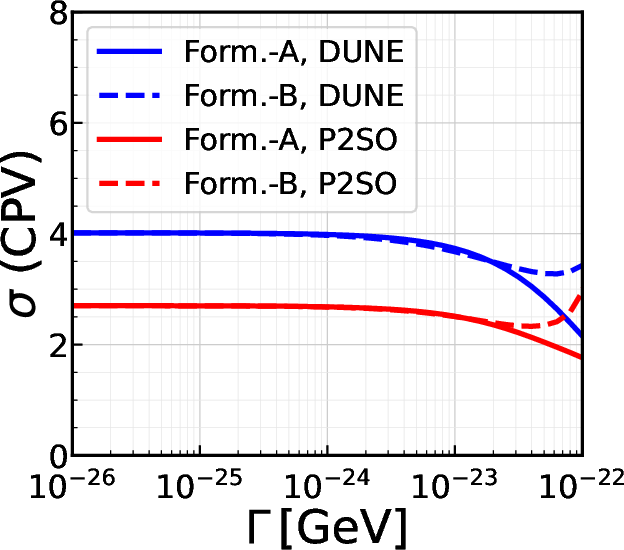
Figure 4: Dependence of mass ordering, octant, and CPV sensitivities on the decoherence parameter in Form.-A (solid) and Form.-B (dashed). DUNE (blue), P2SO (red).
Implications and Theoretical Consequences
The comparative analysis underscores that the choice of decoherence formalism is nontrivial for long-baseline accelerator experiments, especially in the presence of substantial matter potentials. Formalism-B, by rotating the dissipator into the correct basis, yields more conservative and physically justified sensitivity estimates, avoiding unphysical spectral features (such as spurious probability peaks) inherent to Formalism-A at large Γ8.
These results imply that previous bounds or claimed sensitivities to quantum decoherence in the literature—particularly those derived using Formalism-A in matter—should be revisited for robustness. The distinction also sets the stage for more realistic parameter estimation and new physics exclusion at next-generation facilities.
From a broader perspective, the methodology solidifies the necessity of open quantum system frameworks for precision neutrino phenomenology and highlights possible signatures of Planck-scale or stochastic environmental effects accessible through terrestrial experiments, contingent on the rigorous theoretical grounding of decoherence modeling.
Conclusion
This work presents an authoritative comparative assessment of two decoherence formalisms for long-baseline neutrino experiments, elucidating how the adopted modeling framework affects sensitivity predictions for both standard oscillation parameters and the decoherence scale itself. Key findings are:
- For weak decoherence, both formalisms agree regardless of matter effects, but for enhanced decoherence or strong matter interaction, results diverge appreciably.
- Constraints and physics reaches based on Formalism-B are more stringent and avoid the appearance of unphysical features.
- Choice of formalism critically impacts the interpretation of experimental data and the setting of new physics limits at DUNE, P2SO, and other similar experiments.
Future developments may involve refining decoherence operator parameterizations, probing energy-dependent decoherence models, and confronting results with high-statistics data from upcoming long-baseline campaigns.