- The paper reanalyzes 2009 COMPASS data using high-energy π⁻ and μ⁻ beams to constrain the ALP-photon coupling in a 0.2–600 MeV mass window.
- It employs detailed Monte Carlo simulations of Primakoff ALP production and merged diphoton signatures to isolate potential ALP signals from Standard Model backgrounds.
- The study establishes competitive exclusion limits down to gₐγγ ≈ 0.1 GeV⁻¹, bridging gaps between beam dump and collider experiments while setting a framework for future analyses.
Search for Axion-Like Particles Produced via the Primakoff Process at COMPASS
Introduction and Motivation
The search for Axion-Like Particles (ALPs) is a cornerstone in the exploration of physics Beyond the Standard Model (BSM), motivated by their theoretical prevalence in string-theory landscapes and their capacity to mediate interactions with the dark sector. The class of ALPs encompasses the QCD axion but generalizes mass-coupling relationships, opening a considerably larger parameter space. Experimental access to the ALP-photon coupling gaγγ remains a critical window both for dark matter searches and for probing new CP-violating phenomena in the strong sector.
This work utilizes the 2009 COMPASS dataset at the CERN SPS—the first reinterpretation of fixed-target Primakoff data with high-energy π− and μ− beams incident upon a nickel target for ALP searches in the 0.2≲ma≲600 MeV mass range (2604.20734). By connecting the signatures of ALP two-photon decays with the unresolved single-photon signals of Standard Model (SM) Primakoff Compton scattering, the analysis sets direct, model-independent constraints on gaγγ, bridging the gap between low-energy beam dump experiments and high-energy collider exclusions.
Primakoff Scattering in the COMPASS Experimental Framework
COMPASS measured Primakoff Compton scattering for both pion- and muon-induced reactions, exploiting the Z2 coherent enhancement in a high-Z nickel target:
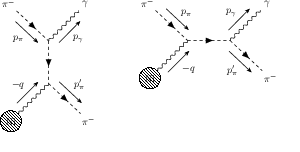
Figure 1: Primakoff Compton scattering of a π− on a nickel nucleus.
The SM background for the pion beam, π−Ni→π−Niγ, receives both Born (point-like) and polarizability corrections; the latter are fixed by chiral perturbation theory (ChPT) predictions, minimizing theory uncertainties. The muon channel, μ−Ni→μ−Niγ, is calculable at all orders in QED via the Bethe-Heitler formula or via the Equivalent Photon Approximation (EPA), rendering it a robust control sample.
Primakoff ALP Production and Experimental Signal
ALP production proceeds through the Primakoff mechanism, π−0, with subsequent decay π−1. The analysis exploits the strong Lorentz boost imparted to ALPs in the MeV mass regime at π−2 beam energy, causing the two decay photons to be highly collimated. Due to the π−3 granularity of the ECAL2 calorimeter and a π−4 flight path, these photons frequently result in a merged cluster, experimentally indistinguishable from a SM single-photon event:
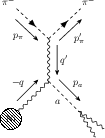
Figure 2: Primakoff ALP production in π−5.
This strategy provides a clean handle on ALP-induced contamination of the SM Compton signal, allowing exclusion based solely on deviations in the observed calorimeter cluster spectrum.
Analysis Methodology and Theoretical Ratios
The reinterpretation is formulated in terms of the experimentally published ratio
π−6
where π−7 and “Born” denotes SM MC prediction neglecting polarizabilities. Theoretical predictions incorporate ALP contamination via the sum
π−8
where π−9 models (a) ALP decay before ECAL2, (b) probability for merged photon clusters (from both asymmetric energy sharing and geometric overlap), and (c) the relative survival probability against μ−0 conversions. A dedicated Monte Carlo simulates photon merging with a conservative, single-cell criterion for unresolved clusters. The exclusion analysis uses a profile likelihood approach in binned μ−1-space for both beams.
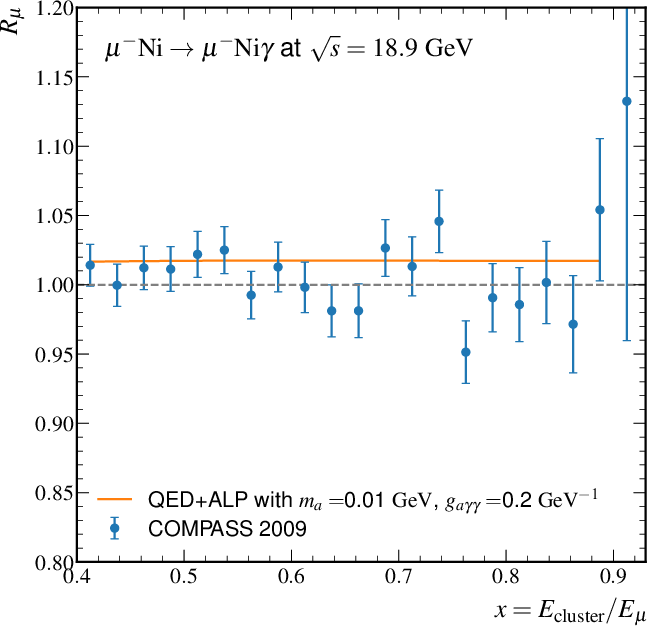
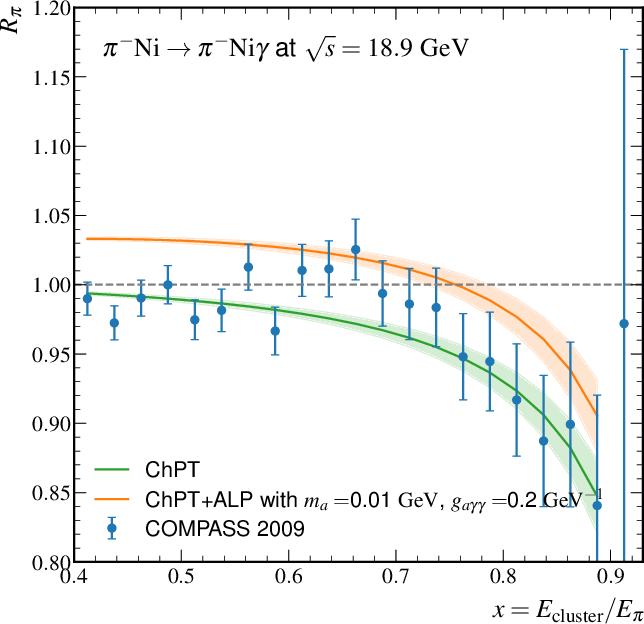
Figure 3: Comparison of the measured ratio μ−2 with the SM expectation and the expected deviation for representative ALP parameters. The pion case includes ChPT pion polarizability; uncertainties sum statistical and systematic errors.
Results: Exclusion Limits on ALP-Photon Coupling
The exclusion limits at 95% C.L. are determined as a function of μ−3 and μ−4. The μ−5-induced limits dominate, due to higher sensitivity from suppressed SM background, with exclusion sensitivity extending from μ−6 for μ−7.
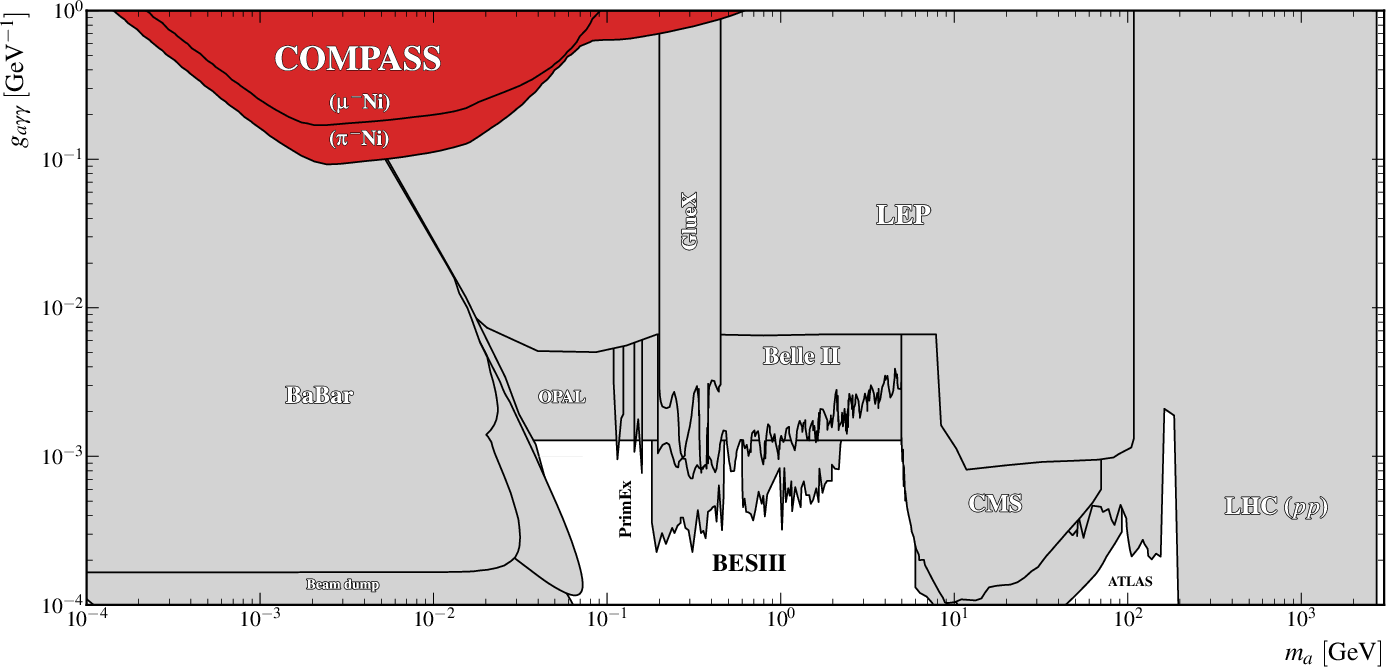
Figure 4: The μ−8~C.L. exclusion limits on the ALP-photon coupling as a function of ALP mass, compared to existing experimental constraints.
Key features:
- Low-mass (μ−9) loss of sensitivity is a consequence of large ALP decay lengths, suppressing the probability of decay upstream of ECAL2.
- High-mass limit degradation results from increased transverse diphoton separation, overwhelming the geometric merging probability.
- The high-mass tail in the exclusion region persists due to the asymmetric energy-sharing regime for ALP decays, where only one photon is above threshold; this effect is absent for muon-induced bremsstrahlung due to increased SM background.
Implications and Future Directions
The presented reinterpretation methodology closes a parameter space gap between previous beam-dump exclusions and high-energy colliders, yielding robust, direct constraints through a minimal and conservative acceptance model. While corresponding LEP/LHC reinterpretations are overall stronger, the result’s independence of large detector systematics and sensitivity to collimated diphoton topologies is a distinct benefit.
The framework directly extrapolates to the higher-statistics 2012 COMPASS dataset and will be highly relevant for analogous AMBER facility measurements, such as Primakoff kaon polarizability runs. Extensions to searches for resolved 0.2≲ma≲600 MeV0 states, such as via Primakoff 0.2≲ma≲600 MeV1 production, are actively pursued and will probe higher ALP mass, lower-coupling regimes.
Conclusion
This analysis establishes competitive exclusion limits on photophilic ALPs in the previously inaccessible 0.2≲ma≲600 MeV2–0.2≲ma≲600 MeV3 mass window, with 0.2≲ma≲600 MeV4 down to 0.2≲ma≲600 MeV5. By leveraging high-energy, high-intensity fixed-target data and detailed topological modeling of electromagnetic calorimeter response, the reinterpretation offers methodology applicable to future datasets and broader experimental programs targeting axion-like particles.