- The paper presents a pilot-less SSC approach that maps information into sparse vectors using a Zadoff-Chu quasi-orthogonal dictionary to address low-SNR challenges.
- The method reduces decoding complexity and pilot overhead by embedding root indicators and employing stop-feedback to optimize spectral efficiency.
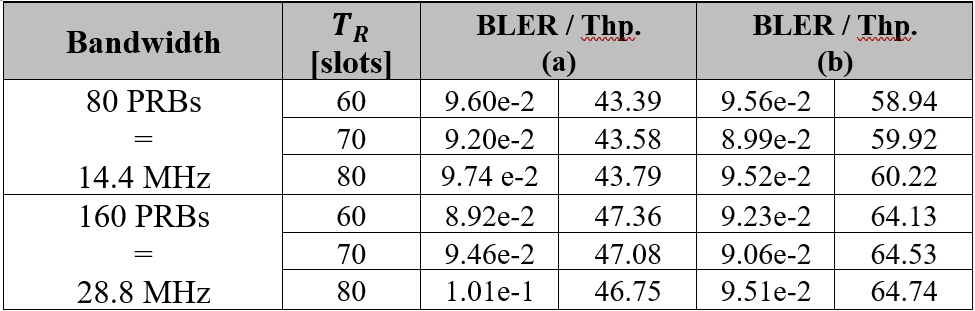
- Experimental results demonstrate up to 1 dB SNR gain and a 54% throughput improvement over conventional MDC in wideband satellite uplink scenarios.
Wideband Direct Satellite Uplink via Pilot-less Sparse Superposition Codes
Introduction and System Motivation
This work addresses a critical bottleneck in direct-to-satellite uplink for non-terrestrial networks (NTN): the limited link budget inherent in such systems due to low user equipment (UE) transmit power, large propagation distances, and aggressive mobility. These conditions result in very low received SNR, limiting efficient exploitation of available bandwidth and ultimately constraining user throughput. Traditional approaches, including pilot-based schemes for channel estimation and multicarrier OFDM systems, either fail to scale in wideband low-SNR environments or incur excessive complexity and pilot overhead, especially when channel coherence is poor. Notably, the 5G NTN standard circumvents frequent HARQ feedback, instead relying on blind repetition but remains burdened by pilot-related inefficiencies.
To overcome these limitations, the paper proposes a non-coherent, pilot-less coded modulation solution using Sparse Superposition Coding (SSC) coupled with a Zadoff-Chu Quasi-Orthogonal dictionary (ZC-QO-SSC). This method is engineered to reduce complexity while achieving high spectral efficiency and robustness at extremely low SNRs, and it introduces mechanisms for encoding, decoding, multi-codeword repetition, and feedback optimization.
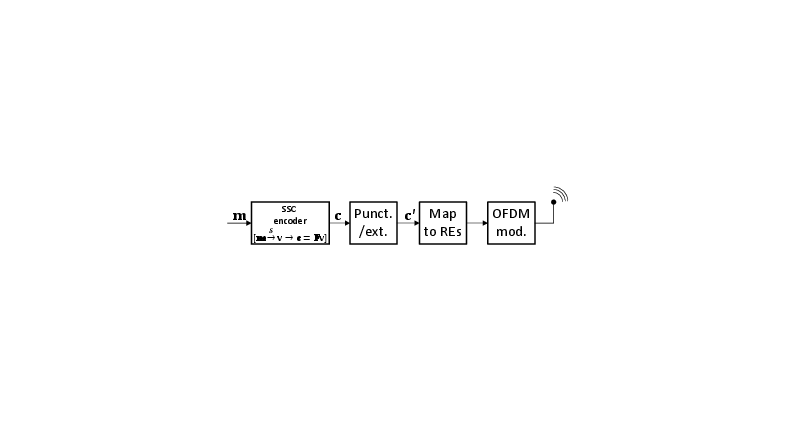
Figure 1: Block diagram of the SSC transmitter comprising message-to-sparse vector mapping, superposition encoding, and resource mapping to the OFDM grid.
Sparse Superposition Coding and ZC-QO Dictionary Design
SSC Encoding Principles
SSC operates by mapping an information payload into a sparse binary vector v with low Hamming weight. This vector chooses a superposition of a small subset (L out of N) of orthogonal dictionary vectors from a matrix F, forming a codeword spread over P complex symbols. Information bits are partitioned into L sections, each selecting an index within the corresponding section, yielding a potential message size of Ninfo=L⌊log2(N/L)⌋.
This encoding naturally suits wideband OFDM resource allocation, as the codeword can be punctured or extended for appropriate time-frequency mapping. The encoder is tractable as long as the dictionary size N remains manageable relative to the superposition order L and codeword length P.
Zadoff-Chu Quasi-Orthogonal Construction
The ZC-QO dictionary is structured by combining Zadoff-Chu sequences with different root indices and cyclic shifts to produce a collection of quasi-orthogonal subsets. Each subset consists of cyclic shifts (time/frequency translations) of a base ZC sequence parameterized by a root index. The cross-correlation between ZC sequences with distinct roots is tightly bounded, providing a controlled interference floor for non-coherent operation and multi-user scenarios.
The dictionary element assignment is
L0
where L1 (root index) and L2 (cyclic shift) decompose the column index L3.
Decoding Algorithms and Complexity Reduction
Standard Decoders and Scalability Issues
Classic SSC decoders employ matching pursuit algorithms, where each received symbol vector is correlated against all dictionary vectors, and the L4 largest responses are selected. This naive decoder scales as L5 per iteration, which for realistic wideband OFDM codeword lengths is computationally prohibitive. Even leveraging the structure of the ZC-QO dictionary, frequency-domain correlation reduces complexity only partially and does not suffice for dense wideband use.
Embedded Data Root Indication: Mechanism and Impact
This contribution proposes enhancing ZC-QO-SSC by embedding explicit root index indicators within the transmitted signal. In addition to the L6 data ZC sequences, L7 indicator sequences from a reserved orthogonal subset (fixed root index) are superposed, with their cyclic shifts mirroring those selected for the data roots. This dual-use of indicator ZC sequences achieves two critical objectives:
- Drastically reducing the decoding search space: The root indices corresponding to likely data-carrying subspaces are identified via low-complexity correlation with indicator root ZC sequences.
- Providing coarse global channel phase estimates: Indicator sequence correlations support rough channel estimation, enabling subsequent coherent combination or phase compensation for data sequence detection, despite the absence of pilots.
As the subsequent data decoding proceeds only within the identified orthogonal subspaces, overall decoding complexity drops to L8, where L9 is the number of indicator candidates explored—orders of magnitude below a full search.
Multi-Codeword Diversity, Repetition, and Stop-Feedback
Given the severe fading plaguing NTN uplinks, the framework supports per-codeword repetition (N0) across time, organized into uniformly distributed slots for time diversity. Unlike classic HARQ, these repetitions are sent in a planned, feedback-independent pattern to mitigate long satellite round trip delays. Importantly, once the ground receiver achieves successful decoding, a minimal stop-feedback (akin to a single-bit ACK) is transmitted, enabling the terminal to halt redundant repetitions. This mechanism generalizes the blind repetition techniques of 5G NTN and supports on-the-fly throughput/resource optimization.
The inclusion of indicator-based phase estimation allows for coherent combining of repetitions, leveraging non-coherent diversity gains without explicit channel knowledge.
A full Monte Carlo evaluation under 3GPP NTN-TDL-C LoS channel conditions (2 GHz, 15 kHz subcarrier, 80/160 PRB wideband, velocity 3 km/h, CNR -2.15 dB) substantiates key claims:
Implications and Future Directions
This methodology enables genuinely scalable, pilot-less, non-coherent coded modulation for wideband satellite uplink—an area where traditional bit-interleaved coded modulation and MDC approaches are unfit due to decoding complexity, pilot sensitivity, and spectral allocation inefficiency. In particular, the ZC-QO-SSC with root indication addresses both computational tractability and spectral efficiency at extreme low SNR, supporting multiuser and wideband direct access.
The approach opens several new avenues:
- Further increase in superposition order N2 and expansion to unsourced random access or massive access frameworks.
- Robustification of the stop-feedback under lossy or delayed feedback channels; potential tight integration with scheduling/allocation protocols.
- Analysis under varied channel models and extension to joint source-channel coding, PAPR constraints, and physical-layer security.
Conclusion
The ZC-QO-SSC scheme with embedded root indicators presents a practical architecture for non-coherent, pilot-less wideband satellite uplink, combining theoretical robustness, practical tractability, and substantial throughput gains over MDC baselines. The inclusion of per-codeword feedback and diversity mechanisms bridges the gap between blind repetition and adaptive HARQ for NTN, demonstrating a route to next-generation direct satellite access in ultra-low-SNR, wideband, coverage-limited deployments.