- The paper introduces an agentic framework that uses LLM-powered actors with structured personas to generate synthetic and realistic deliberation data.
- It employs a Poisson process and tool integration to simulate natural online participation and context-sensitive contributions, ensuring temporal authenticity.
- Evaluation on a pilot deployment showed near-human content realism, high discussion coherence, and actionable insights for computational discourse research.
CHORUS: An Agentic Framework for Generating Realistic Deliberation Data
Introduction
The scarcity of high-quality, large-scale deliberation data is a critical challenge in online discourse analysis, impacting research on argumentative exchange, participation dynamics, and benchmarking of computational pipelines. This arises from restrictive data access policies, user privacy concerns, and variable dataset quality. "CHORUS: An Agentic Framework for Generating Realistic Deliberation Data" (2604.20651) addresses these limitations by introducing a multi-agent simulation architecture that orchestrates LLM-powered actors, each with structured personas and context-sensitive memory, to generate deliberation data on interactive web platforms.
CHORUS differentiates itself by integrating three core innovations: persona-grounded behavioral modeling, temporally realistic participation via a Poisson process, and structured tool support for external resource integration. Evaluation on the Deliberate platform corroborates its effectiveness across realism, interactional coherence, and analytical utility, paving the way for synthetic deliberation corpora that are both scalable and ethically unobjectionable.
Framework Architecture and Methodology
Agentic Simulation with Persona-Driven Orchestration
CHORUS instantiates N LLM-powered actors, each assigned a persona ρi capturing biographical background, communicative preferences, core beliefs, and engagement patterns. These actors maintain awareness of both local and global discussion histories, thereby ensuring semantic consistency and behavioral fidelity throughout the simulation process. The agent-oriented architecture supports both contextually appropriate posting actions and responses, as well as selective engagement with existing content.
Temporal Dynamics via Poisson Process Modeling
To induce heterogeneity and realism in participation patterns, CHORUS utilizes actor-specific Poisson processes, parameterized by λipost and λiaction rates for post and action events. This probabilistic approach ensures irregular, bursty, and non-stationary activity similar to organic online discourse, as opposed to LLM-internal biases that can dominate otherwise.
The main simulation cycle is governed by a global priority queue Q, where event scheduling strictly follows sampled inter-arrival times, preserving temporal independence across actors and enabling emergent asynchronous interaction.
CHORUS actors are supported by a tool suite T, facilitating direct interaction with platform-specific APIs (e.g., posting, voting) and optional access to external resources (e.g., web search for evidence retrieval). This structure accommodates both standard content generation and specialized, information-augmented contributions, consistent with predefined persona profiles.
Post and Action Executions
Content generation (posting) and engagement (actions such as voting) are orchestrated to reflect both persona-intrinsic preferences and stochastic selectivity thresholds. Reply probability pireply governs propensity for responsive versus initiating behavior, while θiaction modulates engagement discriminability.
Actor Archetypes and Behavioral Diversity
A pilot deployment on the Deliberate platform comprised 10 actors distributed across four archetypes—Casual Users, Advocates, Skeptics, and a domain Expert. Each archetype is parameterized for realistic engagement density, posting style, and reply/information-seeking propensities. Notably, the Expert alone is provisioned with web search capabilities, ensuring evidence-backed participation, while Skeptics emphasize critical engagement patterns.
Quantitative Analysis of Simulation Dynamics
CHORUS generated deliberation activity over a 20-minute horizon, with precise control over temporal and behavioral diversity. The deployment yielded:
- Per-actor and aggregate activity analysis: Posting rates varied between 3–13 posts/min; voting actions ranged from 6–25 actions/min, consistently exceeding post volumes, mirroring authentic online platform dynamics.
- Engagement asymmetries: Advocates dominated contributions; Experts, though less frequent, produced higher-complexity and longer posts.
- Behavioral stratification: Skeptics exhibited the highest reply-to-comment ratios, reflecting high reactivity; Casual Users favored new comment initiation, with a low disposition for responsive turns.
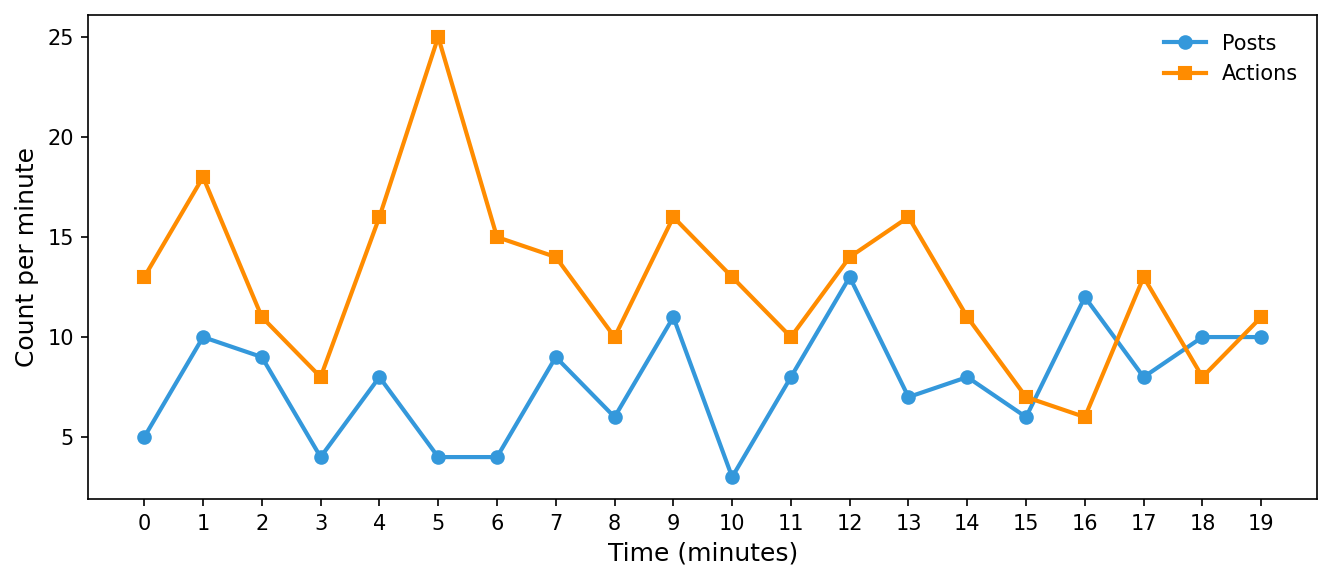
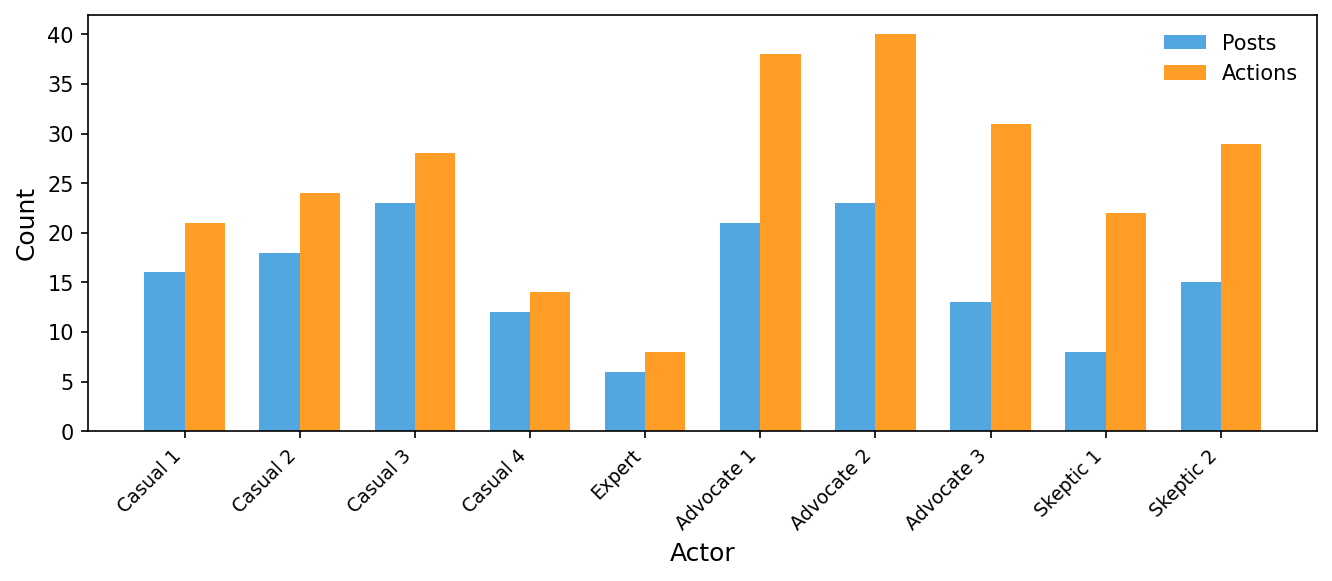
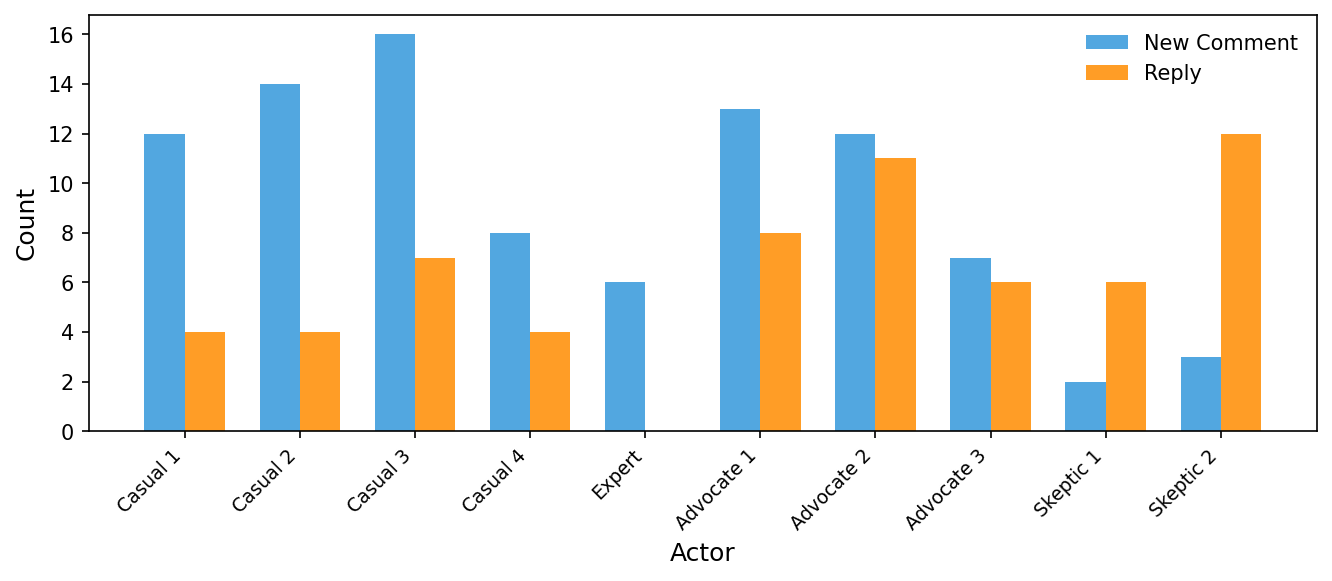
Figure 1: Simulated activity over T=20 minutes; (a) posts and actions per minute across all actors, (b) per-actor activity volumes, and (c) new comments versus replies per actor, for four persona archetypes.
Human Expert Evaluation
Thirty platform experts rated outputs across content realism, discussion coherence, and analytical utility (Likert-5). The results showed:
- Content Realism: 4.6/5—synthetic discourse is near-indistinguishable from human in tone, diversity, and argumentative style.
- Discussion Coherence: 4.1/5—multi-actor interactions, viewpoint diversity, and turn transitions are preserved, though minor limitations are noted in emergent discourse phenomena.
- Analytical Utility: 4.3/5—output is robust for downstream NLP (e.g., thematic trend extraction, consensus detection), validating the framework’s value for real-world computational analyses.
Implications and Future Directions
CHORUS represents a significant advance in the synthetic generation of deliberation corpora that exhibit both behavioral and temporal authenticity. Its deployment demonstrates that LLM-based, persona-driven agents with principled temporal modeling and tool integration can produce datasets suitable for platform demonstration, training, and analysis in the absence of real user data.
The framework offers practical value for benchmarking NLP pipelines, stress-testing moderation and consensus mechanisms, and ensuring data privacy by circumventing sensitive user collection. The theoretical implications include advancing the study of multi-agent discourse simulation, supporting research in deliberative democracy, collective argumentation, and participatory platform design.
Open research avenues include:
- Ablation and Component Isolation: Systematic quantification of the contributions of persona-grounding, Poisson modeling, and tool augmentation against baseline generations and ablated variants.
- Adversarial Persona Incorporation: Future development will extend to disruptive archetypes (e.g., polarizing, misinformation-generating agents) to stress-test platform resilience.
- Adaptive and Dynamic Personas: Refining actors to update behavioral policies in response to evolving discourse, surpassing static parameterizations.
- Cross-platform and cross-domain validation: Deployments across varying policy and civic domains to generalize findings, as well as comparisons with real-world deliberation datasets.
Conclusion
CHORUS establishes a robust, agentic framework for the generation of high-fidelity deliberation data aligned with real-world participatory discourse. Its ability to model behavioral, temporal, and interactional diversity through orchestrated LLM agents extends simulation-based research in computational social science and NLP. Continued development will further enhance both realism and analytical applicability, making CHORUS integral to the future of online discourse system evaluation and synthetic data generation.