- The paper demonstrates that local meson-meson current sum rules predict masses above 2 GeV, inconsistent with the experimental K(1690) value.
- The study employs a complete operator product expansion up to dimension eight and strict Borel stability and pole dominance criteria for robust mass extraction.
- The findings disfavor a molecular state interpretation, instead supporting a compact tetraquark configuration that calls for further nonlocal analysis.
QCD Sum Rule Analysis of Local Meson-Meson Currents for the K(1690) State
Introduction
The identification and structural interpretation of the newly observed K(1690) resonance—reported by the COMPASS Collaboration as a strange crypto-exotic meson with JP=0−—poses significant theoretical challenges due to its supernumerary character relative to conventional quark model expectations. This paper presents a comprehensive analysis of whether the K(1690) state can be dynamically generated from local meson-meson currents within the QCD sum rule (QCDSR) framework, systematically covering all relevant Dirac structures (0−⊗0+, 0+⊗0−, 1−⊗1+, 1+⊗1−, and tensor combinations).
The work’s primary motivation is testing the hypothesis that the K(1690) could be described as a loosely bound meson-meson molecular structure. Recent tetraquark QCDSR analyses exhibit compatibility with the observed mass, but the molecular interpretation, especially in the light-strange sector, demands direct scrutiny. The technical focus is the construction of a complete operator product expansion (OPE) to dimension eight, a meticulous account of QCD parameter dependencies, and rigorous application of OPE convergence and pole dominance criteria.
Construction of Local Meson-Meson Currents
The analysis adopts a set of local color-singlet interpolating currents representing generic meson-meson (molecule-like) configurations with the quantum numbers and flavor content appropriate to the K(1690): K(1690)0
Each current couples to K(1690)1 quantum numbers, capturing the essential Lorentz and color-singlet structures. These currents do not correspond to physical spatially extended molecules but act as local probes of such configurations in the correlator formalism.
The two-point correlators K(1690)2 are constructed for each current and matched via dispersive techniques to the corresponding hadronic resonance contributions, with ground states isolated from higher continuum via a continuum threshold K(1690)3 and Borel transformation to enhance pole dominance and OPE convergence.
Operator Product Expansion, Borel Analysis, and Stability Criteria
The OPE is carried out for each current up to dimension-eight condensate contributions. Spectral densities incorporate perturbative terms and successive nonperturbative contributions (quark, gluon, mixed, and four-quark condensates). Extraction of hadron masses follows from moment ratios of Borel-transformed spectral integrals: K(1690)4
where K(1690)5 and K(1690)6 are Borel-weighted moments of the spectral density truncated at K(1690)7.
Stability criteria are imposed as follows:
- OPE Convergence: Ratio of the highest-dimension term to the total OPE must be K(1690)8 over the Borel window.
- Pole Dominance: The pole contribution to the sum rule (ratio of truncated to total Borel moment) must exceed K(1690)9 for reliable ground state mass extraction.
These programmatic criteria are stringently applied for each current and parameter set, with central numerical inputs and systematic uncertainties sourced from standard references.
Numerical Results
The Borel stability analysis is illustrated for the JP=0−0 and JP=0−1 currents:
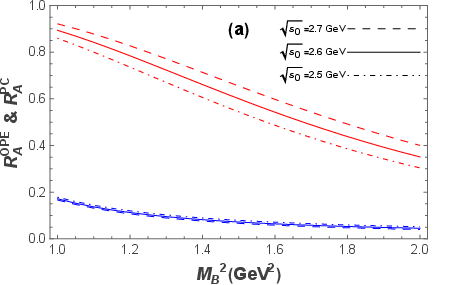
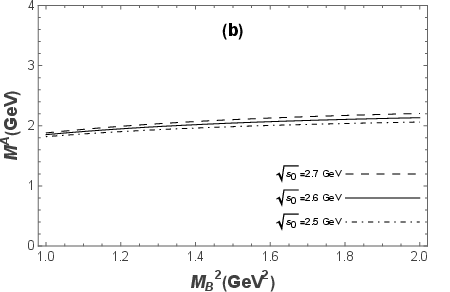
Figure 1: OPE convergence and pole dominance (JP=0−2, JP=0−3) and Borel mass dependence of JP=0−4 for various JP=0−5.
The relevant mass extractions yield:
- JP=0−6
- JP=0−7
Similar plateaus and stability are found for JP=0−8 and JP=0−9, with masses rising further above K(1690)0:
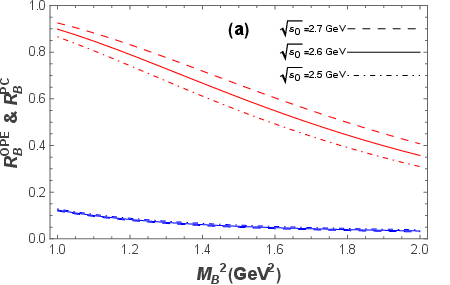
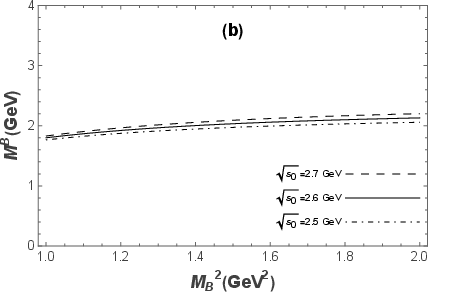
Figure 2: OPE and pole analysis for the K(1690)1 channel; right panel: mass vs. Borel parameter.
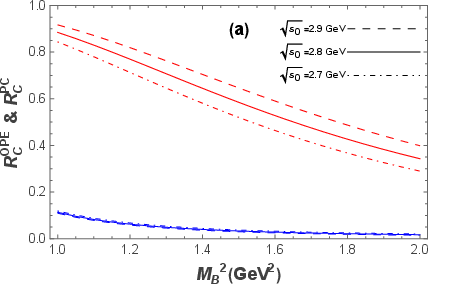
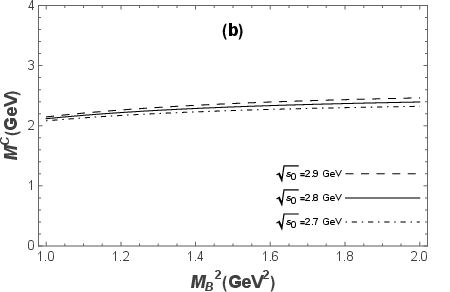
Figure 3: Stability analysis for the K(1690)2 current indicating mass significantly above K(1690)3.
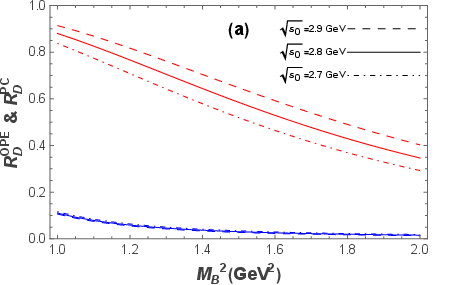
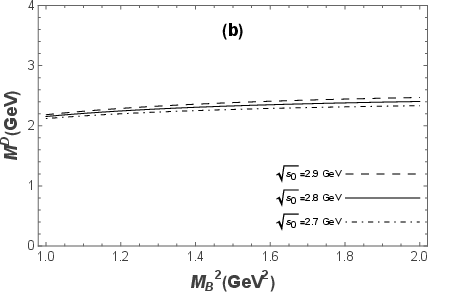
Figure 4: Consistent results for the K(1690)4 current confirm OPE and pole dominance.
Currents K(1690)5 and K(1690)6 fail to yield stable sum rules; OPE breakdown and lack of pole dominance render extracted masses unreliable in those channels.
Notably, masses from all Lorentz-allowed currents with good OPE and pole behavior cluster consistently well above K(1690)7—in stark contrast with the experimental mass K(1690)8. This systematic finding shows no sensitivity to reasonable variations of K(1690)9, Borel window, or input condensates.
Implications and Theoretical Interpretation
The analysis emphatically disfavors a molecular interpretation of 0−⊗0+0 as dynamically generated from local meson-meson-like currents. The mass gap between the QCDSR outputs and the physical resonance is robust against all parameter and current choices, indicating the dominant Fock component of the 0−⊗0+1 state does not couple strongly to short-distance molecular operators. By contrast, alternative QCDSR studies utilizing compact tetraquark (diquark-antidiquark) currents demonstrate mass predictions compatible with the observed value, suggesting the 0−⊗0+2 is more likely a compact multiquark configuration (2604.20439).
The result, within the limitations of local QCDSR, suggests that extended molecular components—potentially involving nonlocal interactions, threshold or coupled-channel effects—if present, are not captured by local interpolating operator analysis. Thus, future theoretical work should incorporate nonlocal, multi-hadron, and coupled-channel effects to fully address the molecular scenario in the nonperturbative regime.
Conclusion
This QCD sum rule investigation of local meson-meson interpolating currents with 0−⊗0+3, employing state-of-the-art OPE to dimension eight and strict stability criteria, reveals that all viable local molecular currents predict masses for the 0−⊗0+4 channel substantially higher than experiment. This behavior is uniform across all current structures and QCD parameter sets. The findings strongly suggest that the 0−⊗0+5 is not primarily a meson-meson molecular state as realized in local QCD sum rules but likely has a different dominant configuration, supporting a compact tetraquark interpretation within the sum rule methodology. Future studies should explore nonlocal and continuum-coupled extensions beyond the local correlator formalism to elucidate the full dynamics of light-strange exotic mesons.