G-birationally rigid cubic threefolds
Abstract: We classify pairs (X,G) consisting of a (possibly singular) cubic threefold X⊂P<sup>4 and a finite subgroup G⊂Aut(X) such that X is G-birationally rigid, i.e., X is a G-Mori fiber space (over a point), and X is not G-birational to any G-Mori fibre space that is not G-biregular to X.
- On $G$-birational rigidity of del Pezzo surfaces (2023)
- Explicit Birational Geometry of Fano threefold complete intersections (2023)
- Birational rigidity of $G$-del Pezzo threefolds of degree 2 (2022)
- Equivariant pliability of the projective space (2022)
- Automorphisms of threefolds that can be represented as an intersection of two quadrics (2018)
- G-birational superrigidity of del Pezzo surfaces of degree 2 and 3 (2018)
- Finite collineation groups and birational rigidity (2017)
- $G$-birational rigidity of the projective plane (2017)
- Automorphisms of singular three-dimensional cubic hypersurfaces (2016)
- On G-birational rigidity of projective spaces (2026)
Summary
- The paper establishes explicit, computable criteria for when a smooth cubic threefold with a finite group action is G-birationally rigid.
- It employs a blend of algebraic methods and computational tools (Magma/GAP) to analyze group actions and invariant substructures.
- The results offer a clear classification that serves as a blueprint for extending equivariant birational rigidity techniques to broader families of Fano threefolds.
G-Birational Rigidity of Cubic Threefolds: Classification and Methods
Introduction and Background
The paper "G-birationally rigid cubic threefolds" (2604.20426) addresses the equivariant birational geometry of cubic threefolds X⊂P4, focusing on the classification of finite group actions G⊂Aut(X) for which X exhibits G-birational rigidity. Here, G-birational rigidity requires X to be a G-Mori fiber space and for any G-Mori fiber space birationally G-equivalent to X to be G⊂Aut(X)0-biregular to G⊂Aut(X)1. The concept generalizes classical birational rigidity—an obstruction to rationality—into the equivariant framework, driven by problems on irrationality of Fano varieties over non-algebraically closed fields.
The main theorem establishes concrete, computable criteria for when a smooth cubic threefold G⊂Aut(X)2 paired with a finite group G⊂Aut(X)3 is G⊂Aut(X)4-birationally rigid, and, in fact, gives a full classification. The theoretical foundation is set by the Segre-Manin theorem for G⊂Aut(X)5-birational rigidity of cubic surfaces, expanded here to dimension three. Equivalence of three key conditions is established: the absence of G⊂Aut(X)6-invariant planes in G⊂Aut(X)7 (subject to certain group exclusions), G⊂Aut(X)8-birational superrigidity, and G⊂Aut(X)9-birational rigidity of X0.
Main Theorem and Classification Strategy
The main theorem asserts that for X1 a smooth cubic threefold and X2 finite, the following are equivalent:
- There is no X3-invariant plane in X4, and X5 is not isomorphic to any of X6, X7, or X8;
- X9 is G0-birationally superrigid;
- G1 is G2-birationally rigid.
The rationale is both algebraic (group representation-theoretic) and geometric (using Mori theory, log pairs, and singularity theory). In particular, the analysis is closely linked to the equivariant Minimal Model Program (MMP).
Group-theoretic analysis: Using known classifications (see [WeiYu2020]), the finite subgroups of G3 that can arise for a smooth cubic threefold are subgroups of one of six explicitly listed groups, notably the automorphism groups of the Fermat and Klein cubics and certain products/extensions involving symmetric and cyclic groups.
Birational geometry consideration: Central to the proof is Lemma~\ref{lemma:Pn-pencil} showing that the presence of a G4-invariant plane leads to the failure of G5-birational rigidity via the existence of a G6-equivariant Mori fiber structure with positive-dimensional base. The core rigidity arguments employ multiplier ideal sheaves, Nadel vanishing, canonical threshold techniques, and adjunction, leveraging the absence of small G7-orbits and G8-invariant low-degree subvarieties.
Explicit exclusion: The groups G9, G0, and G1 are excluded based on explicit birational constructions (via Sarkisov program) showing loss of G2-birational rigidity, also employing computations with Magma and GAP.
Strong Claims and Contradictory Examples
The classification provides both positive and negative results. For cubic threefolds with sufficiently large and irreducibly-acting finite symmetry groups, G3-birational rigidity and superrigidity hold with rare exceptions. Notably, for the excluded cases, there exist explicit G4-equivariant Sarkisov links to other Mori fiber spaces, violating rigidity. The numerical evidence, supported by explicit computations in the representation theory of group actions and the geometry of threefolds, is strong: small G5-orbits and G6-invariant low-degree curves are forbidden, and the locus of potential non-canonical centers for log pairs is systematically excluded.
Detailed Classification and Examples
A comprehensive classification is given (Corollary~\ref{corollary:main}) for all G7 pairs for which G8 is G9-birationally rigid, with explicit equations and structural descriptions for X0 in each case:
- Fermat cubic: X1 with X2 any subgroup as rendered in Figure 1, excluding the group X3 and ensuring the absence of X4-invariant planes;
- Klein cubic: X5 with X6 isomorphic to X7 or X8;
- Various symmetric cases: Other X9 with symmetry group G0 as detailed in the full list—including geometric conditions on the intersection with the ambient projective space and parameters (for instance, absence of G1-invariant planes).
For singular cubic threefolds with at most terminal singularities, an analogous G2-birational rigidity result holds for the Segre and certain nine-nodal cubics, with G3 acting transitively on the singular set.
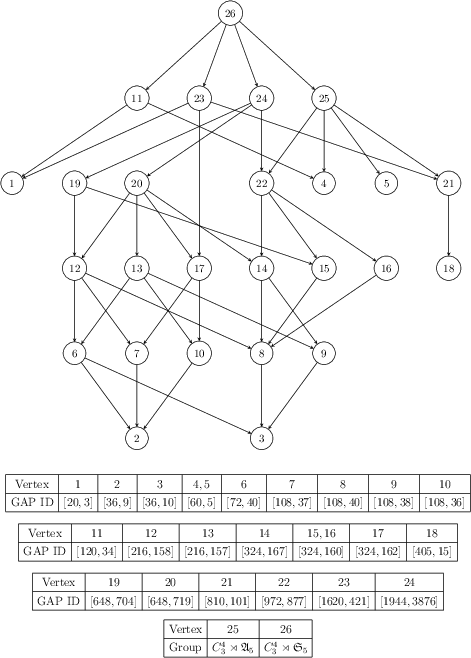
Figure 1: Plane free groups acting on the Fermat cubic threefold, visualizing group-theoretic inclusions and constraints on G4 relevant to birational rigidity.
Methods and Technical Core
At the technical heart of the proof lie several innovations and strong points:
- Representation-theoretic constraints: The G5-actions are scrutinized using character theory and explicit Magma/GAP computations. In particular, the absence of G6-invariant planes is translated into the absence of G7-dimensional subrepresentations in the action on G8.
- Neighborhood of rigidity: Exceptional birational maps violating rigidity are constructed for the excluded groups and for G9-invariant planes, providing strong negative results.
- Equivariant log canonical thresholds: The authors establish that no mobile G0-invariant linear system (with possible exceptions only in non-rigid cases) admits non-canonical centers, ruling out the possibility of G1-equivariant Sarkisov links to other Mori fiber spaces.
- Use of the multiplier ideal techniques and Nadel vanishing: These are pivotal in confirming the non-existence of non-trivial G2-fixed base loci arising from non-canonical pairs; particularly, for large G3 the combinatorics of small orbit lengths suffices to derive strong bounds.
Numerical and Computational Results
Strong numerical claims are obtained including the following:
- For G4-invariant orbits of points G5, G6 in the large symmetry case, enforced by representation theory and vanishing cohomology.
- Any G7-invariant curve of degree G8 is either forbidden or can only exist in explicitly handled (hence classified) configurations, preventing the formation of mobile linear systems with non-canonical singularities.
- For the exceptional cases (G9, G0, G1), existence of explicit G2-invariant pencils (in the sense of MMP/Mori theory) leads to G3-equivariant links violating rigidity, supporting the necessity of their exclusion.
Broader Implications and Future Work
Pragmatically, this classification offers a blueprint for understanding equivariant birational types of Fano threefolds under group actions and gives a clear birational rigidity landscape for cubic threefolds and their automorphism groups. The approach exploits the full power of computational and theoretical algebraic geometry, particularly representation-theoretic gaps and the machinery of the equivariant MMP.
The paper suggests that similar classification techniques and computational strategies should generalize to the broader family of del Pezzo threefolds, and the authors outline how this might proceed, based on existing partial results for degrees G4.
Figures and Visualization
Figure 1: Visualization of the lattice of plane-free subgroups acting on the Fermat cubic threefold, indicating subgroup inclusions (edges), and highlighting the structural role of these subgroups for the birational rigidity problem.
Conclusion
The work provides a comprehensive and technically rigorous determination of G5-birationally rigid cubic threefolds and the corresponding automorphism subgroups. The mathematical strategy—combining explicit algebraic geometry, group theory, and computational techniques—offers a robust template for subsequent work in equivariant birational geometry, especially in the context of classifying Mori fiber spaces with large or interesting symmetry. The results have significant implications for moduli theory, rationality considerations, and the further development of equivariant MMP in higher dimensions and for more general Fano varieties.
Paper to Video (Beta)
No one has generated a video about this paper yet.
Whiteboard
No one has generated a whiteboard explanation for this paper yet.
Paper Prompts
Sign up for free to create and run prompts on this paper.
Top Community Prompts
Open Problems
We haven't generated a list of open problems mentioned in this paper yet.
Continue Learning
- How do the authors extend classical birational rigidity concepts to an equivariant framework for cubic threefolds?
- What role do representation-theoretic constraints play in establishing the G-birational rigidity of cubic threefolds?
- How are computational tools like Magma and GAP utilized to support the classification of group actions in the paper?
- What implications do these rigidity results have for the broader rationality problem in Fano varieties?
- Find recent papers about equivariant Mori theory.
Tweets
Sign up for free to view the 1 tweet with 0 likes about this paper.

