The phase diagram of confining holographic theories on constant curvature manifolds in the presence of a $θ$-angle
Published 22 Apr 2026 in hep-th, gr-qc, and hep-ph | (2604.20418v1)
Abstract: Large families of confining holographic QFTs, described by Einstein-Dilaton gravity, are considered on constant-curvature manifolds in the presence of a $θ$-angle. The space of ground states of such theories is explored as a function of the UV parameters, namely the dimensionless curvature and the $θ$ angle. The free energy is computed, and the phase structure is determined. For constant negative curvature manifolds, we find solutions dual to single QFTs as well as solutions describing interfaces. The single QFTs exhibit an infinite family of saddle points, with the leading one dominating the gravitational path integral and no phase transitions present. For constant positive curvature manifolds, like de Sitter, the ($θ$-angle, curvature) phase diagram exhibits both first and second order phase transitions, as a function of the class of theories considered. We also show that when $θ=0$, a holographic Vafa-Witten-like theorem can be proven.
The paper demonstrates that confining holographic QFTs exhibit distinct IR behaviors (Types I, II, and III) driven by curvature and axion dynamics.
It employs an Einstein-dilaton-axion model to compute free energies and identify order parameters like topological susceptibility in first- and second-order transitions.
The study links bulk axion regularity and higher-dimensional embeddings to quantum phase diagrams, emphasizing the role of Efimov spirals in the phase structure.
The Phase Structure of Confining Holographic Theories on Curved Backgrounds with a θ-Angle
Introduction and Theoretical Framework
This work systematically investigates the structure of large-N, confining quantum field theories (QFTs) in curved spacetime via Einstein-dilaton-axion holographic models, with explicit consideration of a θ-angle implemented through a bulk axion field. The core motivation is to chart the equilibrium phase diagram as a function of two independent UV parameters: the dimensionless curvature R of the boundary manifold and the UV value of the axion, aUV, which encodes the θ-angle. The analysis elucidates how the infrared geometry and the axionic order parameter (topological susceptibility) demarcate quantum phases, highlights the occurrence and nature of phase transitions, and details their geometric and higher-dimensional (string/M-theory) origins.
Central is the coupling of a shift-symmetric bulk axion (dual to TrFF~) to a dilaton with a confining IR potential in (d+1) dimensions. The model’s universal action reads:
S=Mpd−1∫dd+1x−g[R−21(∂φ)2−21Y(φ)(∂a)2−V(φ)]
where Y(φ) governs the axion’s running kinetic term and N0 determines the IR confining regime via an exponential tail. For curved backgrounds, the bulk geometry is foliated by constant curvature N1-manifolds. The UV expansion matches to relevant couplings and the N2-angle; the axion’s subleading mode parametrizes the topological susceptibility.
The phase structure is sensitive to:
The IR asymptotics of N3
The axion’s backreaction via N4 (especially the dimensional uplift-motivated choice N5)
The sign and size of slice curvature (N6)
The solution’s singularity structure and its acceptability per Gubser’s criterion and higher-dimensional regularity.
IR Classification and Admissibility of Bulk Solutions
Three IR behaviors are robustly identified for positive curvature (N7):
Type I:N8, N9, singular but Gubser-good. Unique; present only at θ0.
Type II:θ1, θ2 nontrivial, one free axion parameter (vev), continuous family parameterized by θ3. The backreacted geometry is IR singular yet regular upon higher-dimensional uplift.
Type III: Regular endpoint at finite θ4 and θ5, θ6 constant but arbitrary. Admissible only for θ7; the topological susceptibility vanishes.
For negative curvature, Type III endpoints are forbidden; the IR is always of Type II or connects two AdS boundaries (UV-UV "Janus" solutions).
The axion is monotonic (by positivity of the kinetic term), and its IR boundary value is fixed by regularity conditions, providing discrete or continuous families of vacua labeled by θ8 and the corresponding vev of θ9.
The higher-dimensional origin (e.g. R0-form reductions on R1) maps axionic charge quantization and IR constraints to regularity conditions for wrapped brane configurations, and motivates specific forms for R2 and R3. The possibility of matching the holographic effective theory to string/M-theoretic embeddings is discussed.
Phase Diagram and Transitions for Positive Curvature
The space of solutions is mapped in the R4 plane, focusing on the competition between Type II (axion-supported) and Type III (constant axion) solutions. The bulk free energy is computed holographically (on-shell action with appropriate counterterms), and the dominant saddle is selected at each point in parameter space.
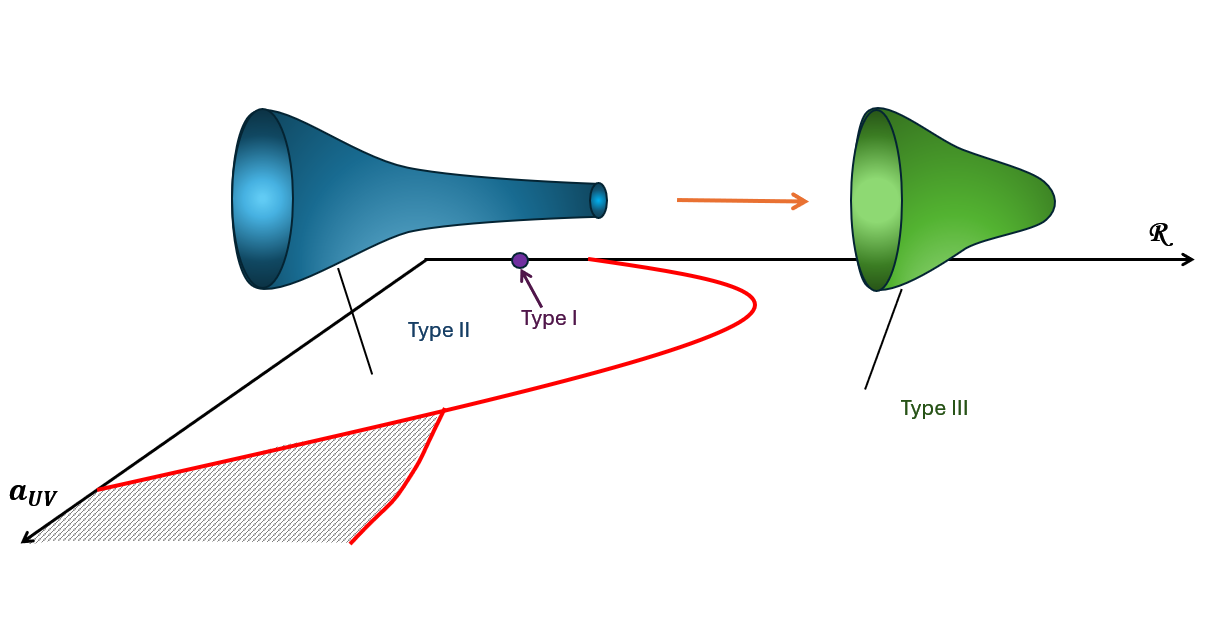
Critically, the asymptotic slope R5 of the dilaton potential controls the presence of so-called Efimov spirals in the phase diagram, which manifest as multi-branched structure in the R6-R7 plane (where R8 is the scalar vev):
Figure 1: Phase diagram with R9 above the Efimov bound. The red line indicates a first-order transition between Type II and III; shaded regions have no acceptable bulk solutions.
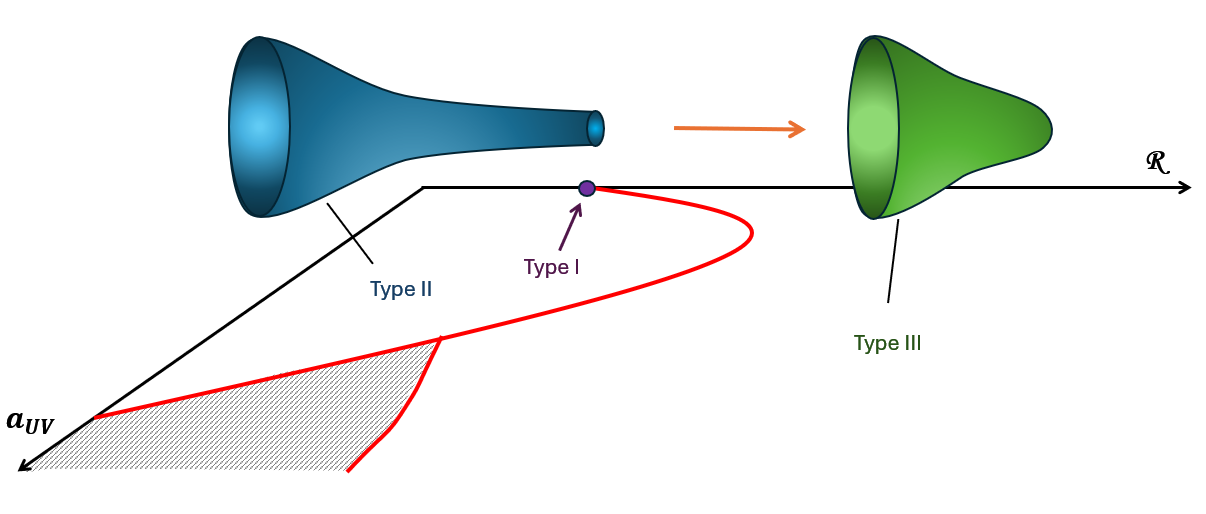
Figure 2: Phase diagram below the Efimov bound, with the transition line terminating on the Type I solution and a higher order transition.
Above the Efimov bound (aUV0), the phase diagram exhibits:
An infinite set of coexisting saddle points (Efimov regime) for fixed UV data.
A first-order phase transition between Type II and Type III as aUV1 or aUV2 varies, signaled by a discontinuity in the derivative of the free energy with respect to curvature. The order parameter is the topological susceptibility aUV3, which jumps across the boundary.
Type III phase (high curvature): vanishing susceptibility, constant axion, regular IR.
Type II phase (low curvature): nontrivial axion profile, nonzero susceptibility, axion backreaction.
Just below the Efimov bound, the spiral closes, the free energy curves merge smoothly, and the transition becomes second order; the multi-valuedness disappears and the QFT vacuum is unique for each set of couplings.
Strong numerical evidence is presented for these facts, including scans of the parameter space, explicit computation of free energies, and tracking of the susceptibility across the boundaries. For special parameter values, "holes" appear in the phase diagram (regions with no acceptable solutions), and the possibility that other bulk fields (not captured by truncation) or stringy corrections resolve these pathologies is discussed.
Negative Curvature and Interface Solutions
For negative curvature (aUV4), bulk solutions can connect two AdS UV boundaries (UV-UV/Janus) or a single asymptotic AdS boundary to an IR singularity (UV-IR). The main results are:
For UV-UV solutions, there exist infinite families with multiple "bounces" in the bulk scalar and axion profiles. The axion’s boundary values can independently be assigned on each boundary, and the free energy is always minimized by the solution with the fewest bounces.
Unlike positive curvature, no phase transition is present; the free energy is a smooth function over the source space, and no gap or discontinuous behavior is observed.
For negative curvature, an analog of the instanton gas is realized: the topological susceptibility remains nonzero and structure reflects the effective "magnetic" (not "electric") boundary conditions of the holographic theory—contrasting with expectations from classic AdS gauge theory analyses.
The connection to higher-dimensional smoothness is again critical; only those solutions upliftable to regular higher-dimensional geometries are physically admissible.
Holographic Vafa-Witten Theorem
A holographic realization of the Vafa-Witten theorem is furnished: the shift-symmetric axion guarantees that the free energy as a function of aUV5 is always minimized at aUV6, and the topological susceptibility must be even under aUV7. This is enforced by regularity conditions and the strict monotonicity of the axion in the bulk. The result generalizes to RR axions arising from higher-form reductions, as long as no bulk brane sources (D-instantons) are included.
Corrections to this statement, e.g. due to brane/instanton-induced topological sectors, are acknowledged as necessary ingredients for a fully nonperturbative analysis.
Bulk Axion Bound and Brane-Induced Phase Structure
A nontrivial finding is that, in the bottom-up holographic model (with only axion and dilaton), the space of UV axion sources is always compact, in contrast to the expected real line of aUV8-angles in field theory at large aUV9. This UV "axion range bound" suggests some missing dominant saddle points—possibly involving dynamical brane sources or stringy fields not present in the minimal model.
The implications are that:
Inclusion of such brane sources (in the higher-dimensional embedding) is necessary to recover the full physical θ0-space and resolve apparent pathologies (discontinuous transitions, missing phases) in the phase diagram.
The "swampland" restriction arises for certain potential choices; only models consistent with a known compactification admit physical QFT interpretations.
Implications, Extensions, and Outlook
The study rigorously characterizes the influence of curvature and θ1-angle on the vacuum structure of confining gauge theories through holography, identifies robust order parameters, and quantifies the nature of quantum phase transitions as a function of bulk potential data derived from higher-dimensional origins.
Implications:
Axion dynamics introduce a second order parameter (topological susceptibility), providing a sharp QFT diagnostic for bulk geometric transitions.
The presence (or absence) of Efimov oscillations and the effective potential’s IR exponent θ2 uniquely determine the possibility and order of phase transitions.
The detailed matching of boundary QFT order parameters with bulk geometric data is possible, promising applications to studies of CP violation, axion physics, and strong CP problem in confining gauge theories.
Future Directions include:
Explicit string/M-theory embeddings to clarify the status of the phase diagram in the "swampland" and extend the axion field range.
Inclusion of dynamical bulk brane sources to model D-instanton corrections, which should both enlarge the available moduli space and alter the quantum phase structure.
Extensions to more general topologies, inclusion of chemical potentials, flavors, and dynamical background fields.
Probing the interplay between axions, higher-dimensional moduli, and quantum criticality in the dual QFT.
Conclusion
The paper presents a comprehensive, technically precise mapping between confining holographic RG flows with axions and the phase structure of their dual QFTs on curved backgrounds with a θ3-angle. The work uniquely identifies the order parameter corresponding to the topological susceptibility, fully classifies regular bulk solution spaces, and establishes the geometric, thermodynamic, and higher-dimensional underpinnings of quantum phase transitions. The analysis sets the stage for further studies on the interplay of topology, curvature, and strong coupling in gauge/gravity duality.
“Emergent Mind helps me see which AI papers have caught fire online.”
Philip
Creator, AI Explained on YouTube
Sign up for free to explore the frontiers of research
Discover trending papers, chat with arXiv, and track the latest research shaping the future of science and technology.Discover trending papers, chat with arXiv, and more.