Vortex dipoles in expanding shell-shaped Bose-Einstein condensates
Published 22 Apr 2026 in cond-mat.quant-gas | (2604.20407v1)
Abstract: Releasing shell-shaped Bose-Einstein condensates from their confinement produces a spherically symmetric density distribution characterized by concentric ripples surrounding a central peak. Here we investigate how a vortex-antivortex dipole affects this dynamics, finding that increasing dipole separation progressively breaks the spherical symmetry and, correspondingly, the interplay of vortex physics and curvature produces a non-monotonic behavior of the cloud aspect ratio. These features can be used for preparing and detecting vortex dipoles in shell-shaped superfluids, as well as for analyzing their signatures in other thin superfluids with more general curved geometries.
The paper demonstrates that a vortex dipole in a shell-shaped BEC induces distinct anisotropic density profiles during expansion.
It employs numerical Gross-Pitaevskii simulations to correlate vortex separation with measurable changes in sphericity and aspect ratio.
The work provides experimentally feasible diagnostics for vortex detection in curved quantum fluids based on interference fringe patterns and central density variations.
Vortex Dipole Effects in Expanding Shell-Shaped Bose-Einstein Condensates
Introduction
The analysis of vortex excitations in shell-shaped Bose-Einstein condensates (BECs) presents a novel context for understanding quantum fluid dynamics in curved geometries. Unlike planar or simply connected three-dimensional systems, thin spherical shells impose topological constraints that enforce zero net vorticity in the incompressible regime, allowing only paired vortex-antivortex excitations. This paper investigates the effect of a vortex dipole configuration on the free expansion of a shell-shaped BEC, leveraging the interplay between curvature-induced dynamics and vortex physics to provide experimentally accessible observables for vortex identification.
System Description and Initial State Preparation
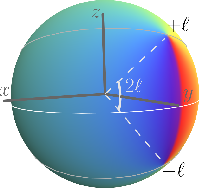
The shell-shaped BEC is realized using bosonic atoms confined within a radially shifted harmonic trap to form a thin, hollow spherical shell. The ground state is described by a factorized macroscopic wave function with a spherically uniform density. Vortex-antivortex excitations are introduced as point-like phase singularities located symmetrically at latitudes ±ℓ in the yz plane, parameterizing the dipole by their angular separation 2ℓ. The initial condensate phase profile is modeled through an analytical point-vortex dipole phase field on the sphere. The system is prepared in the weakly interacting regime (Nalr/(2πR2)≪1), ensuring the validity of the employed ansatz.
Figure 1: Phase field of a thin spherical superfluid shell hosting a vortex-antivortex dipole in the yz plane, with vortices at latitudes ±ℓ and fixed angular separation 2ℓ.
Upon instantaneous removal of the trapping potential, the condensate undergoes three-dimensional free expansion, which is numerically simulated by integrating the Gross-Pitaevskii equation using split-step methods.
Expansion Dynamics and Vortex Signature
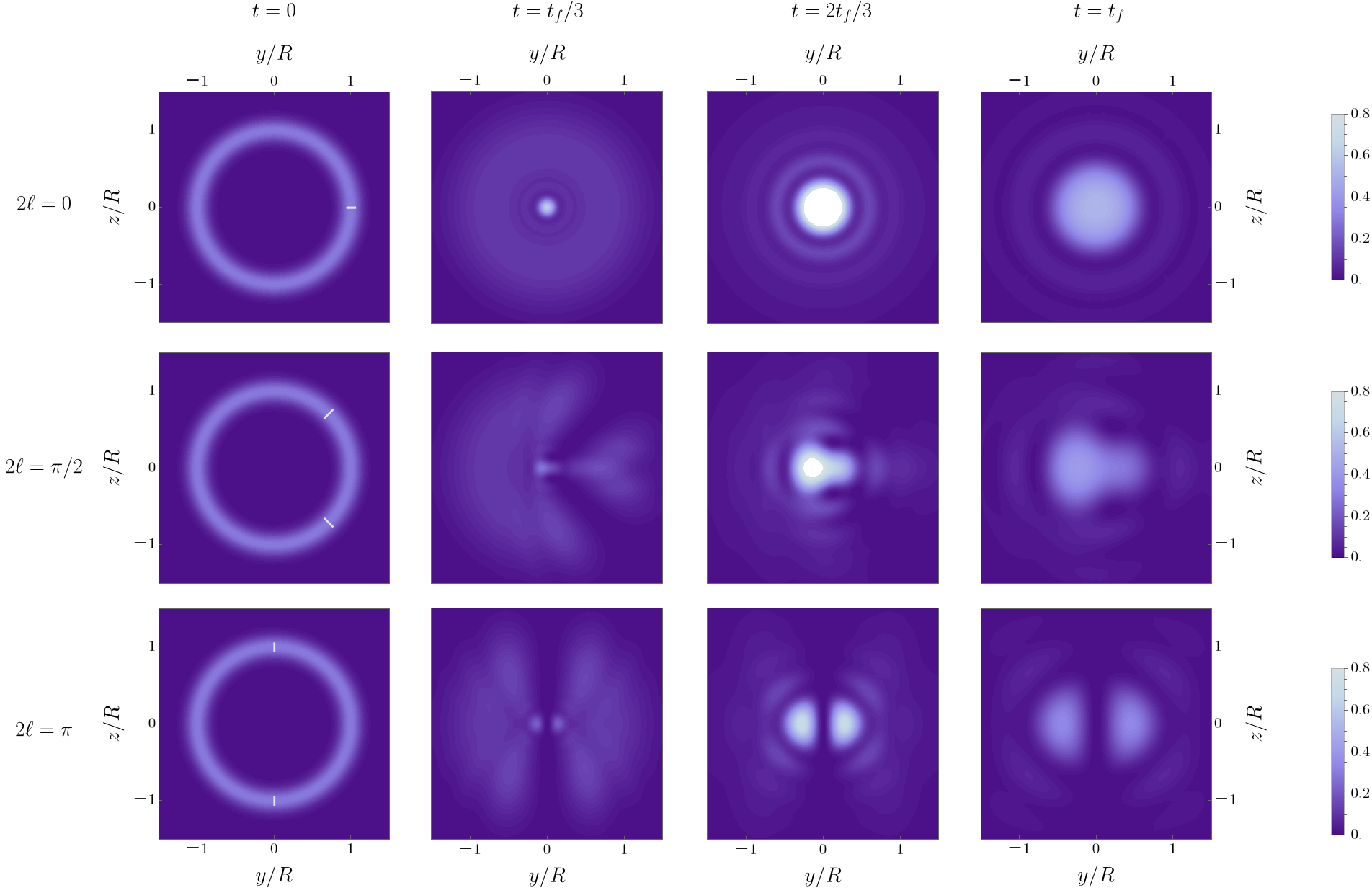
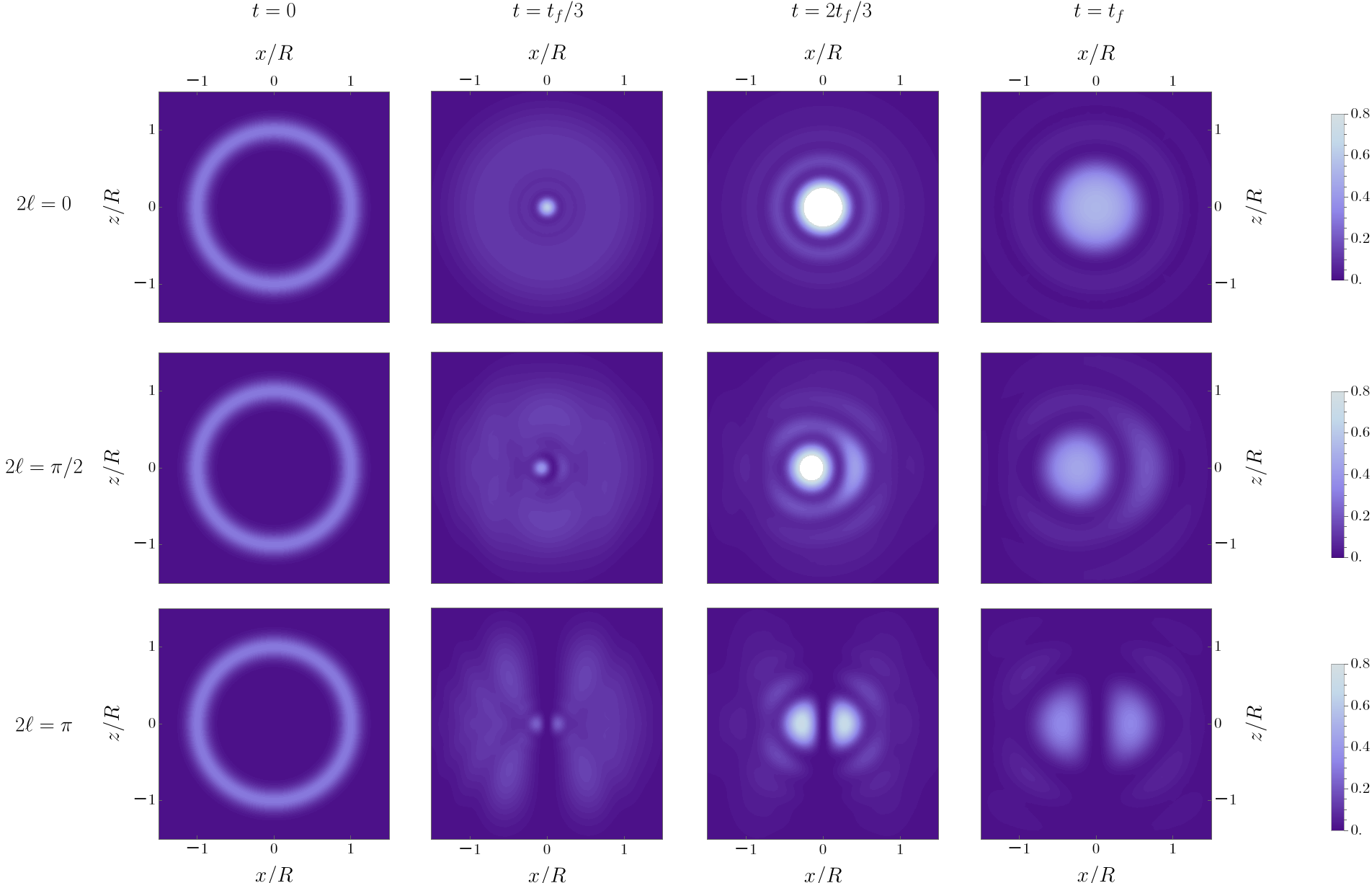
The presence of a vortex dipole produces characteristic effects in the density evolution during expansion. For coincident vortices (2ℓ=0), the condensate exhibits spherically symmetric interference fringes centered about the origin, corresponding to the annihilation of vorticity and subsequent uniform phase. For finite separations (0<2ℓ≤π), vortex cores expand into density holes, breaking the spherical symmetry and yielding pronounced, configuration-dependent anisotropies in the cloud profile.
Figure 2: Cuts of the normalized density during the free expansion for various dipole angular separations 2ℓ, highlighting the transition from spherical symmetry to pronounced anisotropy.
These patterns are fundamentally distinct from those observed in planar or cylindrical geometries; the vortex-induced anisotropy is modulated by the shell curvature, leading to observable, non-monotonic modifications of the expanded density distribution depending on yz0.
Quantitative Measures: Sphericity and Aspect Ratio
Sphericity
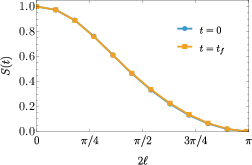
The sphericity yz1, defined as the occupation fraction of the spherically symmetric yz2 mode of the condensate wave function, provides a precise quantitative indicator for symmetry breaking induced by the vortex dipole. Simulations demonstrate that yz3 decreases rapidly with increasing yz4, directly correlating with increasing angular displacement of vortices from the equator. Notably, the nonlinear Gross-Pitaevskii evolution does not restore sphericity during expansion for the considered interaction strengths, implying that sphericity loss is an effective probe of the initial vortex configuration.
Figure 3: The spherically-symmetric component occupation yz5 versus yz6 at initial and final times; increasing yz7 leads to a sustained reduction in sphericity.
Aspect Ratio
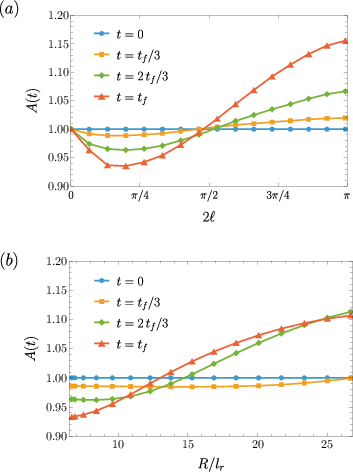
To further elucidate anisotropy, the aspect ratio yz8 is analyzed. The expansion-driven change in yz9 reveals non-monotonic behavior as a function of 2ℓ0. Vortices near the equator (large 2ℓ1) enhance expansion along the 2ℓ2 direction, increasing 2ℓ3, whereas those close to the poles (small 2ℓ4) favor 2ℓ5-expansion and reduce 2ℓ6. For thin shells (2ℓ7), the effect is diminished due to rapid shell expansion and increased kinetic energy. This geometric distinction, absent in planar analogs, offers a practical method to extract the vortex dipole configuration from absorption imaging.
Figure 4: (a) Aspect ratio 2ℓ8 as function of dipole separation 2ℓ9; (b) suppression of non-monotonicity with increasing shell thinness.
Additional analysis involving maximal central density within a given radius Nalr/(2πR2)≪10 confirms monotonic reduction with increasing Nalr/(2πR2)≪11 for sufficiently thick shells, supporting the use of central density measurements as a secondary indicator of vortex separation.
Implications and Future Directions
These results establish robust, experimentally relevant signatures for detecting vortex-antivortex dipoles in shell-shaped condensates based on expansion observables such as sphericity, aspect ratio, and central density. The approach highlights the critical role of curvature in modifying vortex dynamics and associated measurement protocols, and is applicable to a wide range of curved geometries with analytically accessible phase fields, including cylindrical, conical, toroidal, and ellipsoidal films.
Experimental adaptation is direct, leveraging routine absorption imaging following free expansion. The framework extends naturally to complex multi-vortex situations and to other curved surfaces, offering a route for systematic characterization of topological excitations in curved quantum fluids.
Figure 5: Density cuts in the Nalr/(2πR2)≪12 plane during expansion, illustrating symmetry differences contingent on dipole orientation and shell geometry.
Conclusion
The study provides a comprehensive analysis of the interplay between vortex dipole excitations and the free expansion of thin shell-shaped BECs, demonstrating that the geometric arrangement of vortices strongly determines the anisotropy and non-monotonicity of measurable density observables following trap release. These findings, rooted in first-principles numerical simulation and analytic vortex construction, underpin quantitative strategies for vortex detection and characterization in curved superfluid systems, and inform further study of topological effects in quantum fluids constrained by nontrivial geometry.