- The paper establishes a precise mapping between non-relativistic integrable models, such as the elliptic Calogero-Moser and Inozemtsev models, and the generalized Schur indices of 4d SCFTs.
- The paper utilizes methods including instanton calculus, matrix model expansions, and localization to compute eigenfunctions that encode the protected operator spectra.
- The paper reveals dualities and parameter correspondences between different SCFTs under RG flows, highlighting a universal structure in indices across class S and E-string compactifications.
Non-Relativistic Integrable Models and Generalized Schur Indices of 4d SCFTs
Introduction and Context
The paper "On non-relativistic integrable models and 4d SCFTs" (2604.19885) rigorously investigates the intertwining between non-relativistic quantum integrable systems and supersymmetric indices of four-dimensional SCFTs, particularly focusing on N=2 and N=1 theories arising from six-dimensional compactifications. The work centers on the generalized Schur limit of the 4d superconformal index and its relation to the non-relativistic (NR) elliptic Calogero-Moser and Inozemtsev models, extending prior results for the relativistic Ruijsenaars-Schneider (RS) model.
Supersymmetric partition functions, such as the 4d superconformal index, contain a hierarchy of degeneration limits (full, Coulomb, Macdonald, Hall-Littlewood, Schur, etc.), each isolating distinct operator sectors. The central object of study is the full index, dependent on (p,q,t), which encodes rich spectral data of N=2 SCFTs. Degeneration to the Schur limit (t=q) and its generalization, achieved by a non-relativistic scaling p→1 with suitable parameter tuning, yields a tractable and physically meaningful quantity computable for theories of class S (arising from 2d compactifications of 6d (2,0) theories).
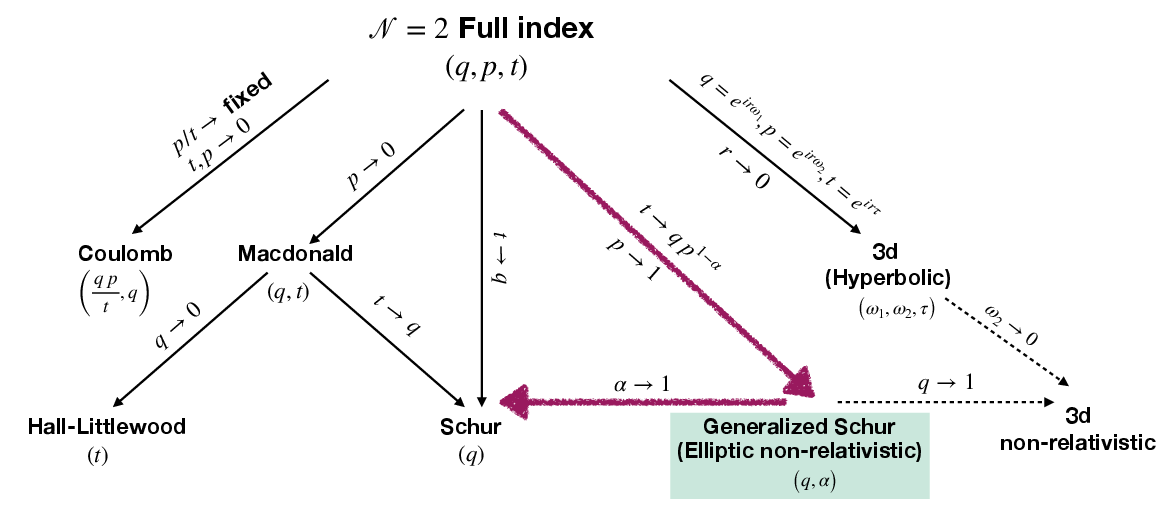
Figure 1: A partial map of general degeneration limits of the 4d N=2 superconformal index and their relations.
Generalized Schur Index and Integrable Model Correspondence
By considering the NR limit of the elliptic RS model, the generalized Schur index is formulated in terms of eigenfunctions of non-relativistic integrable models. For A1 class N=10, this leads directly to the Lamé equation, whose solutions—elliptic Jack polynomials and their deformations—admit an expansion of the index for arbitrary genus and puncture data.
A salient outcome is the explicit connection between the expansion coefficients of the index (structure constants) and solutions to joint eigensystems of the NR integrable model hierarchy. The gauge theory path integral formalism, in particular via instanton counting and N=11 defects, is shown to produce these eigenfunctions via localization, fixing quantizations through Gukov-Witten-type monodromy defects.
RG Flows and Surprising Parameter Relations
A central, nontrivial result of the paper is the identification of parameter mappings between generalized Schur indices of theories related by RG flows—sometimes even flows breaking the N=12 symmetry—manifested as nontrivial identities between sums of eigenfunctions of Calogero-Moser systems based on different root systems. This is most strikingly observed in the Deligne-Cvitanović series, for which the generalized Schur indices of e.g., the N=13 Minahan-Nemeschansky theory and N=14 N=15 conformal SQCD are related via N=16 rescaling determined by dual Coxeter numbers.
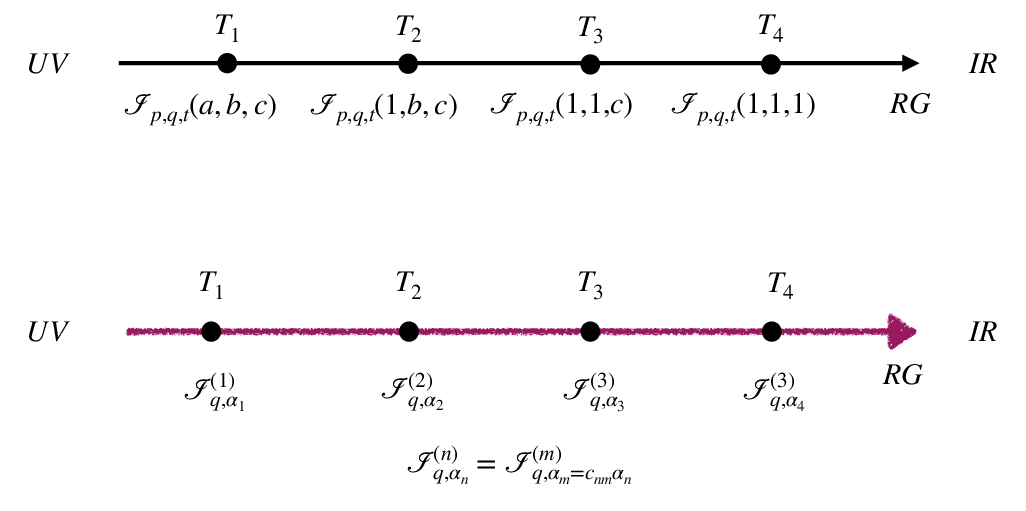
Figure 2: Schematic showing relations of indices under RG flows (with and without N=17 breaking) and their realizations as parameter maps in the associated NR integrable models.
This mapping predicts and matches explicit series expansions for various physically distinguished values of N=18, with integer coefficients corresponding to known Schur indices for exceptional and Argyres-Douglas theories.
From 4d N=19 Theories to the Inozemtsev Model
The approach generalizes to (p,q,t)0 SCFTs—particularly those emerging from Riemann surface compactifications with flux of the 6d (p,q,t)1 E-string theory—by considering the non-relativistic limit of the van Diejen model, yielding the Inozemtsev model. This model's multi-coupling structure, reflecting the flavor and flux data of the E-string theory, leads to generalized Schur-type indices expressible in terms of Inozemtsev eigenfunctions, with their domain of definition extending far beyond (p,q,t)2 heritage.
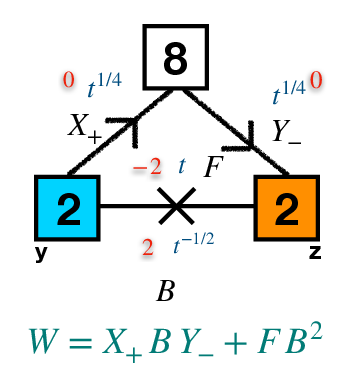
Figure 3: Quiver description (tube theory) for the simplest E-string compactification, encoding (p,q,t)3 charge assignments germane to the construction of the index in the NR limit.
Notably, the limits constructed remain well-defined under specific constraints on puncture data and background flux, and in special cases (e.g., particular values of couplings and flux), the indices of E-string compactifications become identical to those of certain class (p,q,t)4 models, highlighting a further layer of duality and universality.
Physical and Theoretical Implications
These findings have several important consequences:
- Index Universality and Operator Maps: Explicit parameter relations between indices of distinct SCFTs suggest deeper structural isomorphisms, potentially related to 6d tensor branch flows or universality of protected spectra under RG trajectories—even across central-charge changing flows and symmetry breaking.
- Modular Properties and Vertex Operator Algebras: The modular and monodromy properties of the generalized Schur index, and their conjectured satisfaction of MLDEs with parameter-dependent coefficients, indicate a hidden structure in 4d SCFTs akin to extended VOAs.
- Integrable Model Landscape: The non-relativistic integrable limits provide new tractable instances where modular functions and orthogonal polynomials (e.g., elliptic Jack, Koornwinder) encode SCFT data, with implications for the construction of IR dualities, higher-dimensional correspondences, and possibly the classification of non-Lagrangian fixed points.
- Computability and Free Fermion Realizations: For extremal values of couplings, many NR indices correspond to free models (fermions or bosons), rendering both physical spectra and protected operator counts accessible in closed form—improving analytic control over the index beyond what is possible for the full relativistic elliptic model.
Conclusions
This work establishes and elaborates a precise dictionary between non-relativistic limits of elliptic integrable systems (notably Calogero-Moser and Inozemtsev models) and generalized Schur limits of superconformal indices for a broad class of 4d SCFTs, including (p,q,t)5 class (p,q,t)6 theories and (p,q,t)7 models from E-string compactifications. The explicit mapping of indices under RG flows, and their realization via parameter maps in the NR integrable models, is substantiated by detailed spectral analysis, matrix model expansions, and instanton calculus.
These results suggest new avenues for the study of non-Lagrangian theories, RG flows connecting disparate SCFTs, and potential applications in the analytic bootstrap and modularity of protected spectra. Further investigation into generalizations for other 6d SCFTs, modular anomaly structures, and physical interpretations of parameterized index relations is warranted.
Reference: "On non-relativistic integrable models and 4d SCFTs" (2604.19885)

