- The paper demonstrates that supersymmetric-inspired deformations in the Lorentzian IIB matrix model enable spontaneous symmetry breaking, leading to an emergent (3+1)D expanding spacetime.
- It employs complex Langevin dynamics to overcome the sign problem and mitigate singular drift issues from near-zero eigenvalues of the fermionic Pfaffian.
- Methodological refinements, including Lorentz boost artifact removal and anisotropic mass deformations, yield a real, smooth spatial geometry supporting nonperturbative string cosmology.
Emergence of (3+1)-Dimensional Expanding Spacetime in the Lorentzian Type IIB Matrix Model via Complex Langevin Dynamics
Introduction and Motivation
The Lorentzian type IIB matrix model (also known as the IKKT matrix model) offers a nonperturbative formulation of superstring theory wherein spacetime itself is emergent from the eigenvalue distributions of large N×N matrices Aμ (μ=0,…,9). In this framework, both the geometric structure of spacetime and the properties of matter and gauge fields are expected to be dynamical outcomes dictated by matrix dynamics in the large-N limit. The model's path integral, however, is severely afflicted by the sign problem, a consequence of the oscillatory phase eiS with a Lorentzian signature action. Prior progress in the Euclideanized version demonstrated spontaneous breakdown of SO(10) to SO(3), but subtle issues—such as artifacts related to the treatment of fermionic Pfaffians and implicit equivalence between Lorentzian and Euclidean models—have impeded unambiguous demonstration of realistic spacetime emergence in the Lorentzian setting.
This paper presents systematic complex Langevin method (CLM) simulations of the Lorentzian type IIB matrix model, augmented with crucial Lorentz-invariant deformations inspired by supersymmetric (SUSY) constructions, and advances the understanding of dynamical spacetime dimensionality and its regularity.
The standard Lorentzian action is
S=Sb+Sf,
where Sb contains the commutator-squared bosonic Yang-Mills term and Sf the fermionic Majorana-Weyl term. After integrating out fermions, a nontrivial Pfaffian emerges, introducing sign and singular drift issues.
Direct simulation is stymied by:
- The wrong convergence problem in CLM due to singular drift from near-zero eigenvalues of the fermionic Pfaffian.
- A deep, exact equivalence of the Lorentzian and Euclidean models at γ=0 in the presence of contour deformations, yielding complexified but nonphysical "spacetimes".
To break this equivalence and obtain genuinely Lorentzian emergent structure, the authors introduce a Lorentz-invariant mass term:
Sγ=−2NγTr(AμAμ)
with Aμ0; this breaks the Euclidean-Lorentzian equivalence and produces qualitatively distinct (real) time and space in the large Aμ1 regime. The modified model admits smooth, nontrivial classical expanding solutions.
Additionally, to combat the singular drift problem in CLM (arising from the Pfaffian), a deformation inspired by the "polarized" type IIB matrix model and SUSY BMN-type mass terms is introduced, explicitly breaking SO(9,1) to SO(Aμ2,1).
Complex Langevin Simulation Framework
The CLM is implemented by:
- Complexifying the matrix degrees of freedom.
- Fixing gauge such that Aμ3 is diagonal, associating its eigenvalues with emergent "time".
- Implementing a change of variables (using the Aμ4-parametrization) to enforce eigenvalue ordering.
- Carefully tracking holomorphicity and suppressing excursions/drifts with stabilization procedures, dynamical stabilization of matrix Hermiticity, and implementation of noisy estimators for Pfaffian derivatives.
To assess SSB and spatial extension, two central observables are measured:
- The "moment of inertia" tensor Aμ5, whose eigenvalues reveal spacetime dimensionality at each time slice.
- The eigenvalue distribution Aμ6 of the spatial "radius" Aμ7, serving as a probe of spatial smoothness and reality.
Emergence of Real Expanding Spacetime
Bosonic Model
In simulations with only the bosonic action (fermion Pfaffian set to Aμ8), expanding configurations are found, but—after correcting for Lorentz boost artifacts—the full SO(9) symmetry remains unbroken, and no lower-dimensional spacetime emerges.
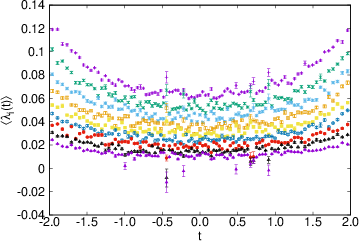
Figure 2: The expectation values of Aμ9 and μ=0,…,90 before boost correction in the bosonic model, showing apparent growth in a single spatial direction which is later identified as an artifact.
To excise Lorentz boost artifacts, the CLM configurations are post-processed with optimal Lorentz transformations minimizing μ=0,…,91. Post-correction, evidence for a unique expanding direction vanishes and all spatial directions become equivalent.
Post-boost correction, inclusion of fermions is essential. Since practical implementation of the full Pfaffian at small μ=0,…,92 is numerically limited by the singular drift problem, a SUSY-inspired anisotropic mass deformation is employed:
μ=0,…,93
where μ=0,…,94 energetically suppresses extra spatial directions, favoring lower-dimensional expansion.
Simulations with μ=0,…,95, μ=0,…,96, μ=0,…,97, μ=0,…,98, and μ=0,…,99 reveal robust spontaneous symmetry breaking from SO(N0) to SO(3) at late times. Three spatial directions exhibit polynomial growth, while the others remain small, establishing the emergence of (3+1)-dimensional spacetime.
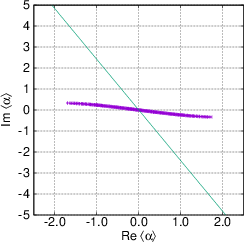
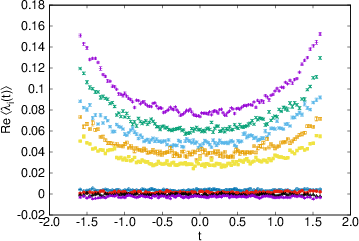
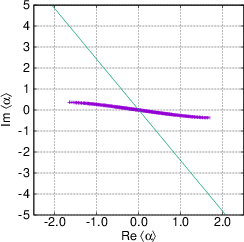
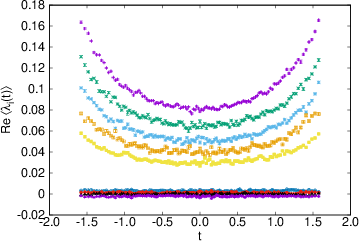
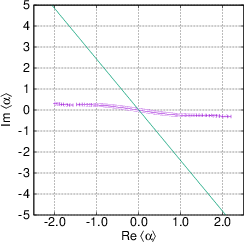
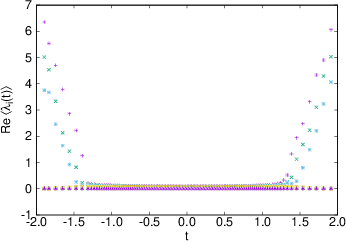
Figure 4: The expectation values of N1 for various N2, showing real time at late times and SSB onset only when SUSY and anisotropic mass deformations are implemented.
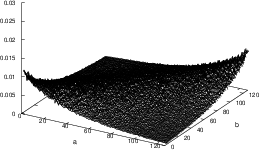
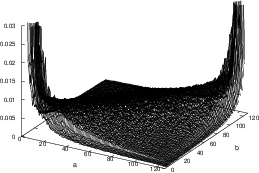
Figure 6: The absolute value of N3, illustrating the band-diagonal structure in the spatial matrices essential for extracting well-defined time evolution.
The spatial "phase" N4 is reduced by an order of magnitude compared to the Euclidean-equivalent (N5) scenario, and the distribution of N6 is dense—indicating a smooth, real spatial geometry as opposed to singular, discretized Pauli-like configurations found in earlier studies (2604.19836).
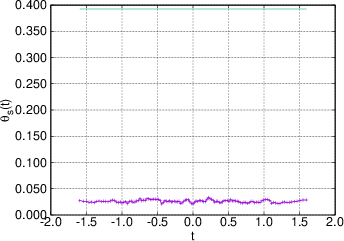
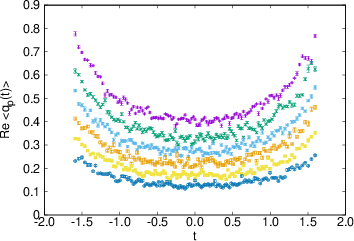
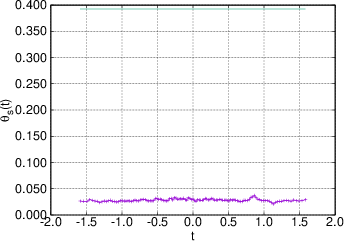
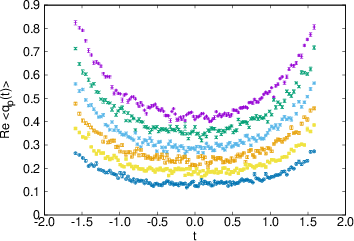
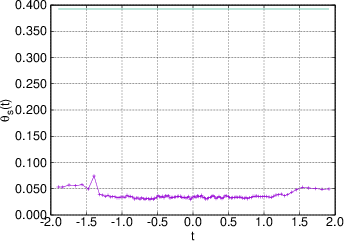
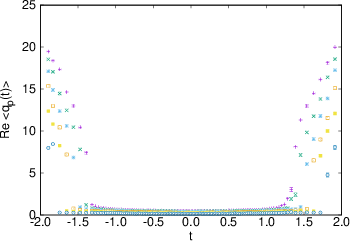
Figure 8: The spatial phase N7 as a function of time, confirming the transition to real, regular spatial domains in the Lorentzian regime.
Theoretical Implications and Future Directions
This work presents the first unambiguous, simulation-based evidence for dynamical emergence of a real (3+1)-dimensional, expanding, smooth Lorentzian spacetime phase in the type IIB matrix model with appropriate deformations. Crucially:
- Fermion dynamics and controlled anisotropy are necessary for spontaneous symmetry breaking of rotational symmetry, whereas the pure bosonic model retains full SO(9) invariance even with expansion.
- The reality and smoothness of both time and space are numerically established at large N8 and sizable positive N9.
The results strongly support dynamical emergence scenarios wherein the string landscape problem and compactification schemes may be avoided by intrinsic matrix model dynamics.
A number of important open directions remain:
- Fixing the Lorentz symmetry explicitly using Faddeev-Popov gauge-fixing, as explored in (Asano et al., 2024), and employing Lefschetz thimble techniques (Chou et al., 29 Jan 2025) to probe all possible saddle points and confirm the dominance of (3+1)-dimensional spacetime configurations.
- Studying the limiting behavior as eiS0 and small eiS1 in the presence of full SUSY-restoring deformations, to approach nonperturbative string theory most faithfully.
- Extending these numerical approaches to incorporate interactions and matter field sectors, graviton excitations, and cosmological scenarios.
Conclusion
This study demonstrates, via complex Langevin simulations up to eiS2, that the Lorentzian type IIB matrix model with carefully chosen mass and supersymmetric-inspired deformations dynamically generates an expanding, real, smooth (3+1)-dimensional spacetime phase. The analysis corrects prior misinterpretations related to Lorentz boost artifacts and underscores the necessity of both fermionic dynamics and explicit symmetry-breaking deformations for realizing realistic spacetime. These results affirm the viability of the type IIB matrix model as a framework for emergent nonperturbative string cosmology and chart a clear path for future explorations of quantum spacetime genesis in matrix models.