- The paper shows that first-player winning moves in Juniper Green are exactly the inessential vertices (D(G_n)) as defined by the Gallai-Edmonds decomposition.
- It employs polynomial-time blossom algorithms and graph matching theory to systematically identify and enumerate winning strategies.
- Empirical analysis reveals nontrivial fluctuations in the decomposition sets, linking number-theoretic properties with game outcomes.
The Gallai-Edmonds Decomposition and Winning Strategies in Juniper Green
Introduction to Juniper Green as a Combinatorial Graph Game
Juniper Green is a well-known combinatorial game played on the set [n]={1,2,...,n}. The gameplay is governed by factor or multiple relations, naturally representing the divisibility structure of [n] as a graph. The analysis of Juniper Green using graph-theoretic concepts not only formalizes the intuitive strategies for the game but also exposes deep connections to structural results in algebraic combinatorics, particularly the Gallai-Edmonds decomposition.
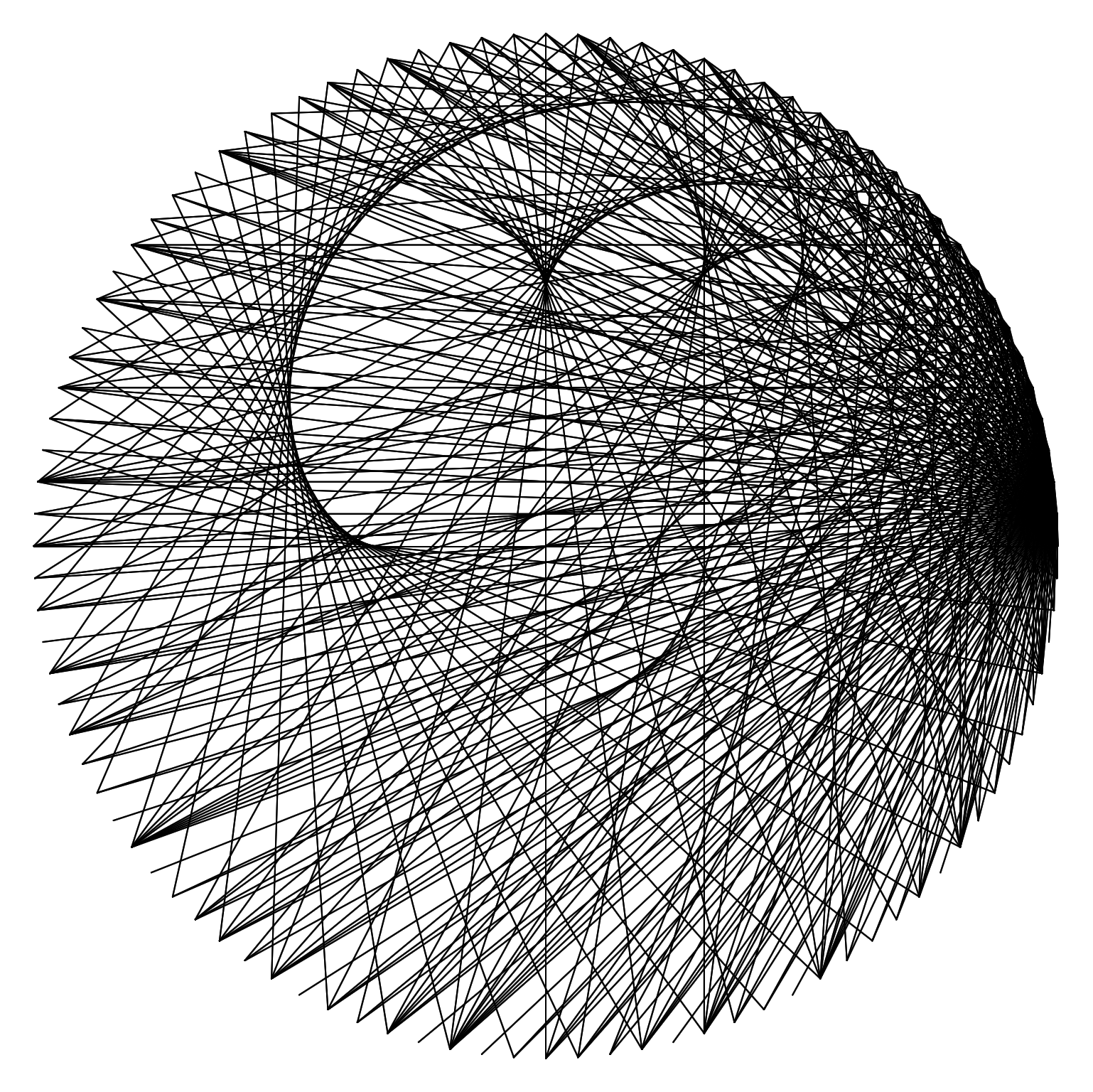
Figure 2: The divisibility graph on [n] for n=100, exhibiting the rich connectivity structure induced by divisibility relations.
From Game Strategy to the Structure of the Divisibility Graph
In Juniper Green, two players alternate in choosing unused numbers from [n], with the constraint that each chosen number must be a factor or a multiple of the previous selection. The loss condition is the inability to make a legal move. The divisibility graph Gn on V=[n] places an edge between i and j exactly when i∣j or [n]0. Thus, legal game moves become walks on [n]1; the game itself is a special case of Claude Berge's "snake in the box" game, where legal moves equate to moving along edges of a fixed undirected graph.
A trivial winning strategy is available for the first player by picking a "large" prime—specifically any [n]2. This limits the opponent's responses and can often immediately force a win by symmetry or a second prime selection, depending on the availability of primes in specific intervals. Lemoine's result rigorously confirms that for all [n]3, Player 1 can always force a win using this class of arguments.
The Gallai-Edmonds Decomposition: The Key to Winning Moves
The central contribution of the paper is the precise characterization of all first-player winning opening moves, formulated in terms of the Gallai-Edmonds decomposition of the divisibility graph [n]4. In the Gallai-Edmonds framework, vertices are classified as:
- [n]5: inessential vertices not covered by every maximum matching
- [n]6: essential vertices adjacent to inessential ones
- [n]7: essential vertices not adjacent to any inessential vertex
The main theorem establishes that the first-player winning moves in Juniper Green are exactly the elements of [n]8.
This result is deduced via application of Berge's theorem on "snake in the box," which links the existence of unmatched vertices in any maximum matching to the existence of a first-move win. The paper leverages the full structure of the Gallai-Edmonds decomposition, not just for theoretical completeness, but to explicitly enumerate optimal strategies.
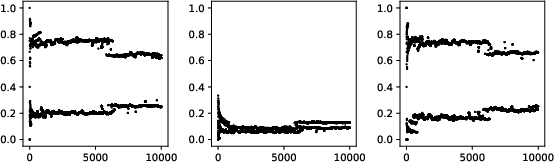
Figure 1: Proportions of [n]9, [n]0, and [n]1 as [n]2 varies, reflecting complex combinatorial fluctuations depending on the arithmetic structure of [n]3.
Investigating Patterns in the Gallai-Edmonds Decomposition of [n]4
Through extensive computation (using polynomial time blossom algorithms for matchings), the paper investigates the evolution of the Gallai-Edmonds sets as [n]5 increases. Empirical findings reveal several nontrivial phenomena:
- The cardinality of [n]6 remains consistently small across a wide range of [n]7.
- The sets [n]8 and [n]9 exhibit highly irregular, often dramatic, alternations in size, especially as n=1000 crosses through highly composite numbers or primes.
- The density of n=1001 elements is highest in the interval n=1002.
- There are apparently no members of n=1003 in the interval n=1004.
These features are visually evident from the comprehensive visualizations provided.
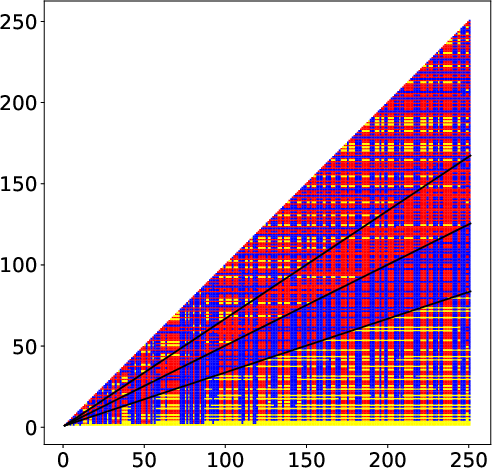
Figure 5: Membership plots for elements in n=1005 (red), n=1006 (yellow), and n=1007 (blue), with reference lines at n=1008, n=1009, and [n]0; structure in both horizontal and vertical bands is apparent.
Such intricate structuring raises interesting open questions about the influence of number-theoretic properties on the combinatorial decomposition, suggesting further potential connections to arithmetic graph theory and structural Ramsey-theoretic phenomena.
Theoretical and Practical Implications
By reducing optimal Juniper Green strategy computation to Gallai-Edmonds decomposition, the analysis transforms the problem from ad hoc enumeration to one of matching theory in graph combinatorics. Practically, the result enables algorithmic determination of all winning first moves for any [n]1 via standard maximum matching techniques. Theoretically, the work situates the entire class of divisibility-structured combinatorial games within the rich literature on matchings, opening avenues for further structural and asymptotic investigation, including—but not limited to—characterizing the explicit arithmetic description of [n]2.
The clear phase transitions seen in empirical plots call for more refined combinatorial analysis and analytic number theory to explain or predict thresholds, density, and band structure phenomena.
Conclusion
This analysis links the combinatorial structure of the Juniper Green game directly to one of the most fundamental decompositions in graph matching theory, offering a rigorous and complete characterization of winning strategies in terms of inessential vertices of the divisibility graph. Moreover, the paper exposes nontrivial, visually rich, and unexplained patterning in the Gallai-Edmonds decomposition as [n]3 grows, suggesting deep and surprising connections between combinatorial game theory, algebraic graph theory, and number theory. Future work may address the analytic description of the emerging structures, algorithmic questions related to efficient large-[n]4 decomposition, and potential generalizations to other divisor graphs and combinatorial games.