- The paper introduces a novel qubit encoding that leverages clock transitions in quadrupolar nuclear spins to achieve first-order insensitivity to environmental fluctuations.
- It employs a Z₂-symmetric nuclear-spin Hamiltonian to approximate the computational basis with high-fidelity spin cat states, exceeding 99% accuracy under certain conditions.
- Simulations reveal that passive dephasing suppression and effective electron-mediated two-qubit gates can yield coherence times up to 100 seconds and gate fidelities nearing 99%.
Spin Kerr-cat Qubits: Noise-Resilient Encoding in Quadrupolar Nuclear Spins
Overview and Motivation
The paper "Spin Kerr-cat qubits" (2604.19687) introduces a new qubit encoding for nuclear spins with spin quantum number I≥1, specifically targeting quadrupolar nuclei in silicon. This encoding leverages a clock transition in the nuclear spin spectrum originating from the quadrupolar interaction between the nucleus and the electric-field gradient (EFG) at its site. Clock transitions lead to first-order insensitivity to environmental fluctuations. The basis states of the spin Kerr-cat qubit are the two lowest eigenstates of a Z2-symmetric nuclear-spin Hamiltonian, well-approximated by spin cat states.
This approach exploits the inherent noise bias in nuclear spins, where T1 typically far exceeds T2∗. The methodology is passive, providing a hardware-level suppression of dephasing without any active quantum error correction or dynamical decoupling.
Quadrupole Hamiltonian and Clock Transitions
Quadrupolar nuclei possess an electric quadrupole moment, coupling to EFGs and generating a nuclear Hamiltonian with nonlinearity:
Hq=2Q[3I^z2+2η(I^+2+I^−2)−I^2]
where Q quantifies the quadrupole strength, and η is the asymmetry parameter. When the external magnetic field aligns with the principal axis of the EFG tensor (PAS), the Hamiltonian acquires a Z2 symmetry; its eigenstates become parity eigenstates under Π^=eiπI^z.
The interplay between Zeeman and quadrupolar terms results in avoided crossings for same-parity states and true crossings for opposite parity. Clock transitions occur at field strengths where the qubit splitting Δ between the two lowest states is locally maximal and first-order insensitive to magnetic-field fluctuations.
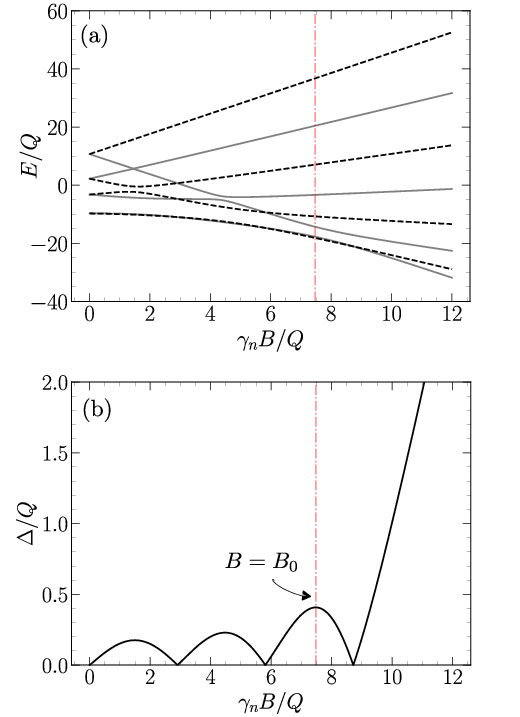
Figure 1: (a) Nuclear spectrum for Z20, Z21 with even/odd parity labeling. Avoided crossings occur only within parity sectors; clock transition is the red dot-dash line. (b) Minimal splitting between lowest parity doublet—a natural qubit operating point.
Spin Kerr-cat Basis States: Cat-State Approximation
The two computational basis states, Z22 and Z23, are the lowest eigenstates of Z24, both parity eigenstates, and are well approximated by spin cat states:
Z25
For Z26 and Z27, the fidelity between the true eigenstates and cat-state ansatz exceeds Z28. This is shown numerically and visualized with spin Wigner functions.
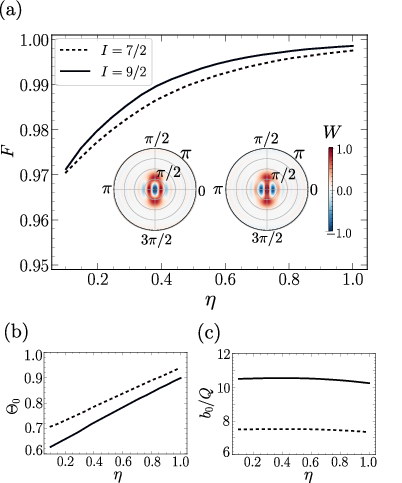
Figure 2: (a) Fidelity vs Z29 for cat-state approximation. (b) Polar angle T10 as a function of T11 defining cat states. (c) Magnetic field T12 (in units of T13) for clock transition.
The analogy with bosonic Kerr-cat qubits is technically rigorous: under Holstein-Primakoff, the quadrupole Hamiltonian maps to a squeezed Kerr oscillator for T14.
Decoherence Suppression Analysis
Dephasing
Operating at the clock transition ensures the qubit splitting is first-order insensitive to external field and EFG fluctuations. For T15 and quasistatic noise, the coherence decay is governed by second-order derivatives, resulting in a quadratic enhancement of T16:
T17
where T18 is a dimensionless coefficient extracted from numerics.
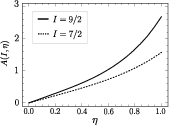
Figure 3: Coefficient T19 governing curvature of qubit splitting at the clock transition.
For experimentally realistic values (T2∗0 kHz, T2∗1 ms), the suppressed dephasing time can reach T2∗2 s.
Relaxation from Charge Fluctuators
Quadrupolar coupling introduces a new channel: fluctuations in the EFG tensor arising from nearby charge fluctuators (TLFs), breaking the Hamiltonian's symmetry and causing bit-flip (T2∗3) and leakage errors.
The perturbation scales as T2∗4 with distance T2∗5 between TLF and nucleus. For T2∗6 nm, the bit-flip time exceeds T2∗7 s for T2∗8 kHz, making charge-noise-induced relaxation highly subdominant unless fluctuators are extremely close.
Control, Readout, and Two-Qubit Gates
Single-qubit Gates
Standard NMR techniques suffice for T2∗9 and Hq=2Q[3I^z2+2η(I^+2+I^−2)−I^2]0 rotations, with selective AC magnetic fields. Rotating-wave approximation restricts transitions to the Kerr-cat subspace, yielding efficient qubit operations.
Entangling operations are implemented via the hyperfine interaction with a mobile electron. Loading an ancillary electron onto the donor generates an Ising-like coupling and enables a controlled-phase gate logic, up to single-spin rotations. The electron can mediate gates between spatially separated Kerr-cat qubits via shuttling.
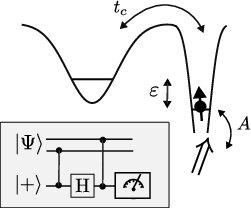
Figure 4: Electron tunneling schematic. Electron-nuclear hyperfine interaction generates a CZ gate between spin Kerr-cat qubits.
Gate Fidelity and Requirements
Numerical simulations show CZ gate fidelities reaching Hq=2Q[3I^z2+2η(I^+2+I^−2)−I^2]1 when Hq=2Q[3I^z2+2η(I^+2+I^−2)−I^2]2 is enhanced by a factor of Hq=2Q[3I^z2+2η(I^+2+I^−2)−I^2]3 over currently measured values, and Hq=2Q[3I^z2+2η(I^+2+I^−2)−I^2]4.
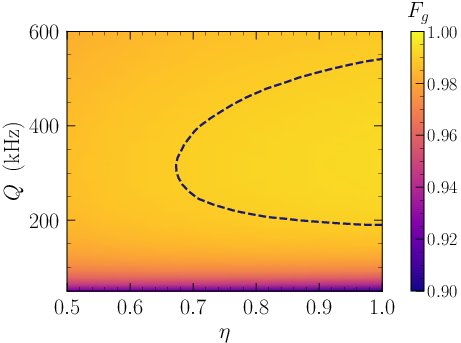
Figure 5: CZ gate fidelity contour vs Hq=2Q[3I^z2+2η(I^+2+I^−2)−I^2]5 and Hq=2Q[3I^z2+2η(I^+2+I^−2)−I^2]6; the Hq=2Q[3I^z2+2η(I^+2+I^−2)−I^2]7 boundary indicated by a dashed line.
Initialization and Readout
Initial state preparation involves measurement in the Hq=2Q[3I^z2+2η(I^+2+I^−2)−I^2]8 basis, rotation to a spin coherent state, and parity-projection using the electron-mediated entangling operation. Readout similarly leverages electron-spin measurement, mapping nuclear parity onto electron basis.
Practical Implications and Future Prospects
The encoding presented is highly promising for solid-state quantum computation where nuclear-spin coherence is critical. Passive suppression of dephasing at the hardware level, with no dynamical decoupling or QEC overhead, aligns with the architectural strengths of silicon-based donors.
For scalability, high uniformity in strain fields and deterministic donor placement will be required. The ability to tune Hq=2Q[3I^z2+2η(I^+2+I^−2)−I^2]9 and Q0 is necessary and could be facilitated via strain engineering or nanometer-scale actuators. Given the requirements on magnetic field alignment and EFG engineering, the method is best suited for systems where site-specific environmental control is feasible.
Future directions include deploying Kerr-cat qubits as quantum memories for electron-spin qubits, combining the advantages of long Q1 and fast manipulation. Further studies on combinatorial error channels and robust error correction tailored for this bias are warranted.
Conclusion
The spin Kerr-cat encoding for quadrupolar nuclear spins in silicon achieves first-order insensitivity to environmental fluctuations via clock transitions and parity symmetry. This approach enables dramatic suppression of dephasing, robust two-qubit gates, and highly efficient parity-based readout. Practical deployment will require precise engineering of EFGs and control of local environments, offering a scalable, noise-resilient architecture for solid-state quantum computing.

