- The paper develops a hybrid plasmonic-dielectric cavity architecture that lowers Q-factor requirements by over 40-fold while achieving >90% photon indistinguishability.
- It employs a nested system combining a plasmonic bowtie resonator with a Fabry–Perot cavity to enhance effective decay rates and photon extraction efficiency.
- The design, validated through numerical and FDTD simulations, offers a scalable route for robust single-photon sources in quantum photonic networks.
Combined Plasmonic-Dielectric Cavities for Indistinguishable Photon Generation from Highly Dephased Emitters
Motivation and Background
Photon indistinguishability is central to optical quantum information applications, including photonic quantum computing, quantum simulation, and QKD. In solid-state emitters, high pure dephasing rates at room temperature substantially broaden the emission linewidth, undermining photon-based quantum information protocols. Conventional cavity funneling schemes, which mitigate dephasing by coupling the emitter to high-Q dielectric cavities, face prohibitive requirements; typical room-temperature implementations necessitate Q factors in excess of 107, well beyond fabrication feasibility for visible wavelengths. Even cascaded dielectric cavities only reduce this requirement to Q∼105 [PhysRevLett.122.183602], still unattainable for most practical platforms.
This work develops a hybrid cavity architecture comprising a plasmonic nanoresonator (e.g., a bowtie antenna) nested within a Fabry-Perot (F-P) dielectric cavity. The concept leverages the large decay rate and small mode volume intrinsic to plasmonic structures to form a composite "effective emitter" with drastically increased total decay rate, thereby relaxing the outer cavity's Q requirement by orders of magnitude.

Figure 1: Schematic of the hybrid system, showing a single quantum emitter within a bowtie plasmonic structure encased by an outer dielectric Fabry-Perot cavity.
Theoretical Framework
The system consists of an emitter (decay rate Γ1), plasmonic nanoresonator (decay rate κ1, coupling rate g1), and outer dielectric cavity (decay rate κ2, coupling rate g2 to the plasmonic device). The geometry permits a direct emitter-to-cavity coupling channel (Q0), bypassing the plasmonic nanoresonator and significantly enhancing photon extraction efficiency (Q1).
The indistinguishability parameter Q2 is quantified in the single-mode regime via the two-time correlator:
Q3
where Q4 represents the bosonic operator for the outer cavity.
Photon extraction efficiency is defined as:
Q5
The funneling ratio Q6, central to evaluating performance against linear filtering, is:
Q7
Numerical solutions of the master and Dyson equations, under highly dissipative conditions (Q8, Q9, 1070), demonstrate the hybrid system's superiority. High indistinguishability (1071) is attainable for outer dielectric cavities with 1072 values as high as 1073. Specifically, for 1074 and 1075, 1076 and 1077, yielding a funneling ratio 1078—a 1079-fold improvement in photon collection over simple filtering.
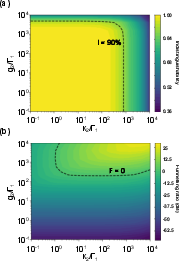
Figure 2: Photon indistinguishability Q∼1050 and funneling ratio Q∼1051 as functions of outer cavity decay rate Q∼1052 and coupling rate Q∼1053, highlighting high Q∼1054 and broad favorable regions.
For an emitter at Q∼1055 with Q∼1056, Q∼1057 is achieved with an outer cavity having Q∼1058; for Q∼1059, Q0 drops to Q1. These Q2 values are within reach of current experimental platforms, a stark contrast to prior approaches.
Effective Emitter Model and Analytical Insights
The plasmonic nanoresonator with high Q3 and Q4 forms an effective emitter with enhanced decay rate, Q5, coupled to the outer cavity with effective decay rate Q6 and photon exchange rate Q7. The ratio Q8 is central; for Q9, Γ10 is achieved with Γ11 as large as Γ12, validating high Γ13.
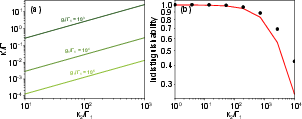
Figure 3: Evolution of effective system parameter ratios and comparison of analytical and numerical Γ14 estimations, showing strong agreement and regime boundaries.
Direct Emitter-Cavity Coupling and Extraction Efficiency Enhancement
The nested architecture enables a direct photon exchange channel (Γ15), not present in cascaded cavities. Increasing Γ16 yields significant gains in Γ17 with marginal degradation in Γ18. At Γ19, κ10 increases 25-fold (κ11), and at κ12, the gain reaches κ13-fold (κ14), with κ15 remaining above κ16.
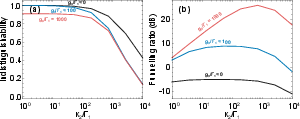
Figure 4: Indistinguishability κ17 and funneling ratio κ18 as functions of κ19 and g10, illustrating efficiency gains from direct coupling.
Extending g11 to practical values (g12) enables g13 and boosts g14 by a factor of 12 (g15).
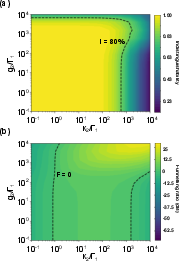
Figure 5: g16 and g17 as functions of g18 and g19 for fixed κ20, showing broader regions of enhanced extraction and indistinguishability.
Plasmonic Bowtie Resonator Design and Realistic Implementation
Finite-difference time-domain simulations optimize bowtie geometry for hBN emitters at κ21. Aluminum is chosen for compatibility with visible wavelengths.
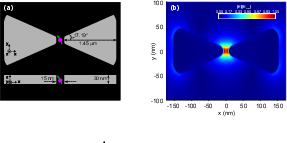
Figure 6: Optimized bowtie geometry and spatial electric field profile at resonance.
The bowtie mode exhibits a full-width at half maximum of κ22, yielding κ23 for κ24. Purcell factors exceed κ25 for optimal alignment and κ26 for a κ27 offset.
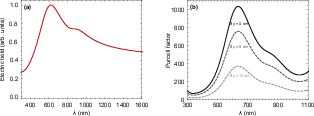 *Figure 7: Bowtie spectral profile and Purcell factor dependence on emitter alignment. *
Numerical estimates with moderate κ28 and κ29 values confirm robustness: high g20 and g21 are sustained over wide g22 and g23 ranges.
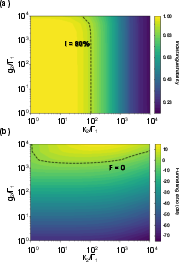
Figure 8: Photon indistinguishability and funneling ratio contours for conservative bowtie parameters.
Practical and Theoretical Implications
This hybrid plasmonic-dielectric cavity scheme radically reduces the quality factor required for indistinguishable photon generation from highly dephased emitters, bringing the regime within existing experimental capabilities. Compared to cascaded or single dielectric cavities, g24 requirements are lowered by two to three orders of magnitude. The nested geometry's direct emitter-cavity coupling channel enables an additional pathway for photon extraction, enhancing funneling ratio and efficiency beyond what is achievable with linear filtering or traditional funnelling configurations.
The relaxation of mode volume dependence not only tolerates larger outer cavities but opens the possibility for higher-order modes and increased device lengths, further facilitating practical photonic device integration. The theoretical framework, including the effective emitter model, provides a robust tool for analyzing complex hybrid photonic architectures.
Conclusion
The composite plasmonic-dielectric cavity architecture establishes a highly practical method for generating indistinguishable photons from solid-state emitters with substantial dephasing, without the need for prohibitively high-g25 cavities. High indistinguishability (g26) and extraction efficiency are achievable under conditions that are compatible with modern fabrication methods. The framework's flexibility, enabling efficient photon funneling via both indirect (plasmonic) and direct emitter-cavity pathways, paves the way for scalable, robust single-photon sources appropriate for quantum photonic networks, simulation, and secure communication. Theoretical results presented here highlight the potential for further advancements in photonic device engineering, including integration of hybrid nanostructures and complex cavity field topologies (2604.19666).