- The paper presents a dynamic Bayesian model that captures time-order asymmetries in sequential haptic discrimination tasks.
- It quantitatively integrates evolving priors, sensory noise, and memory decay to explain perceptual biases.
- The model achieves strong empirical fits and offers actionable insights for adaptive haptic interface design and cognitive research.
Bayesian Modelling of Time-Order Effects in Haptic Perception
Introduction and Motivation
Time-order effects in perception—particularly, asymmetries introduced by the sequential presentation of stimuli—represent a key challenge in understanding human sensory inference, memory, and comparison under uncertainty. The paper "Modelling time-order effects in haptic perception with a Bayesian dynamical framework" (2604.19662) rigorously addresses this phenomenon in the context of haptic discrimination, dissecting both the behavioural psychophysics and the computational mechanisms underpinning such effects. Central to the analysis is the integration of Bayesian inference, temporal evolution of internal priors, and the quantification of inter- and intra-individual variability.
Experimental Paradigm and Behavioural Findings
The authors employ a two-alternative forced choice haptic discrimination task, presenting sequential vibrotactile stimuli to subjects (Fig. 1A,B). Each trial systematically varies both the amplitude (log-scaled) of the comparison and reference stimuli and their temporal order. The task is to judge whether the two sequential stimuli are equal or different. Behavioural results (Fig. 1C) unambiguously reveal time-order asymmetries: the probability of perceiving two stimuli as equal is not invariant to their presentation order, and the direction of the effect varies across subjects.
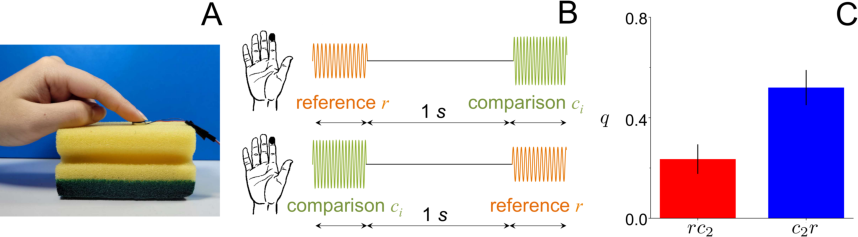
Figure 1: Experimental design, order permutations for stimulus presentation, and example data showing significant time-order asymmetry in “equal” judgments.
This observation demonstrates that classic signal detection or direct comparison models, which assume symmetry in perceptual processing, are insufficient to account for the empirical data. Instead, the authors formulate and quantitatively validate a dynamic Bayesian framework to model the underlying cognitive processes.
Bayesian Dynamical Model of Perception
The core of the framework (Fig. 2) conceptualizes the subject as an ideal observer, who maintains a probabilistic (Gaussian) internal representation (prior) over the log-intensity of the vibration stimulus. Each sensory observation yields a noisy likelihood, which is combined with the prior via Bayes’ rule to yield a posterior over stimulus intensity.
Crucially, between sequential presentations, the memory trace of a stimulus degrades: the posterior evolves via a propagator that introduces diffusion toward the prior (i.e., increasing uncertainty and partial reversion to baseline expectation). Thus, the model explicitly incorporates both uncertainty in perception and memory decay, with evolution governed by parameters: prior mean (μ1), prior variance (σ12), likelihood noise (σℓ2), and propagation variance (σp2).
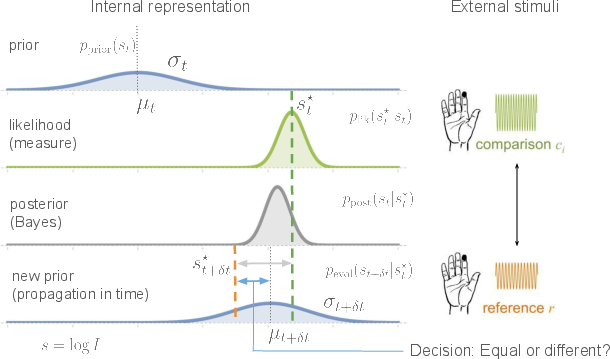
Figure 2: Schematic of the Bayesian model, propagation of uncertainty, and sequential belief updates between stimulus presentations.
The model does not simply decode the most likely stimulus but specifies the full posterior distribution and formalizes the comparison process as the detection of a statistically significant change in the posterior after the second stimulus arrives.
Model Inversion, Parameter Estimation, and Goodness of Fit
For each subject, the model parameters are estimated by maximizing the likelihood of the observed “equal/different” responses across all presentation pairs and orders. The model yields not only subject-specific fits but also uncertainty quantification for each parameter.
Empirical fits show strong quantitative agreement (Fig. 3, upper panels) between observed probabilities and Bayesian model predictions. The relative position of a subject's prior mean with respect to the stimulus range critically determines the direction and magnitude of the observed time-order asymmetry.
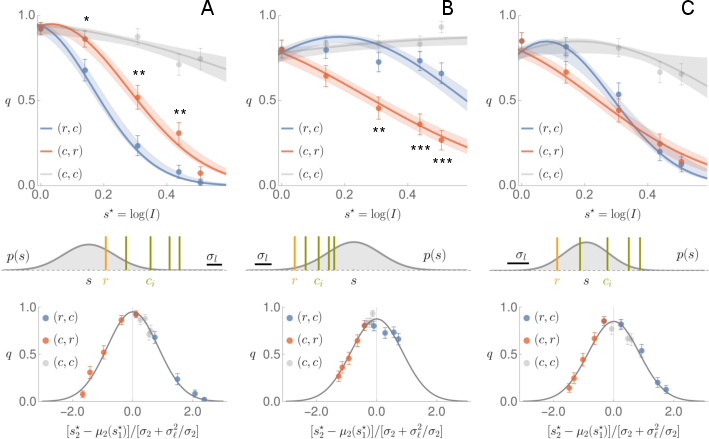
Figure 3: Behavioural data and model fits for three representative subjects, followed by amplitude-normalized data collapse confirming the model’s predicted invariances.
Moreover, when responses are plotted against a normalized distance combining sensory evidence, prior, and uncertainty, data across variables and orders collapse onto a single universal curve (Fig. 3, lower panels), confirming a core prediction of the model.
The full population fit (Fig. 4) demonstrates variability in prior location and uncertainty across individuals, with clear separation in the multidimensional parameter space between those exhibiting positive, negative, or absent asymmetry. Statistical model comparison shows that the generative Bayesian model—despite having far fewer parameters than a fully non-parametric, response-frequency based model—achieves superior posterior evidence for all subjects.
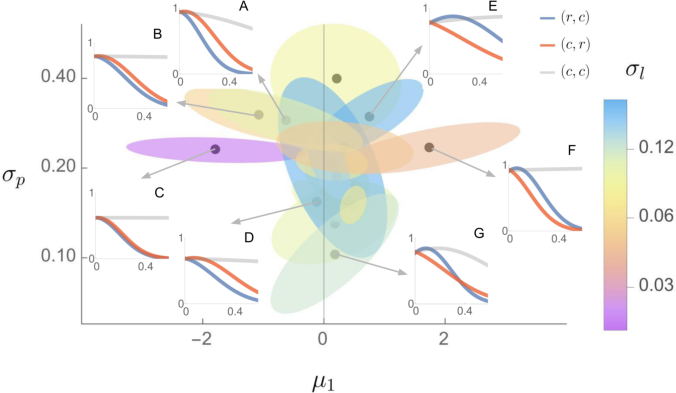
Figure 4: Distribution of fitted subject-specific parameters, highlighting interplay between prior location, propagation error, and likelihood noise.
An important theoretical contribution is the demonstration that the model induces non-obvious, subject-dependent symmetries in perceptual space (Fig. 5). The probability of ‘equality’ judgments is not symmetric under exchange of the first and second stimuli, but is symmetric under joint transformation of their values—a form of conditional symmetry determined by the internal prior and the diffusion dynamics.
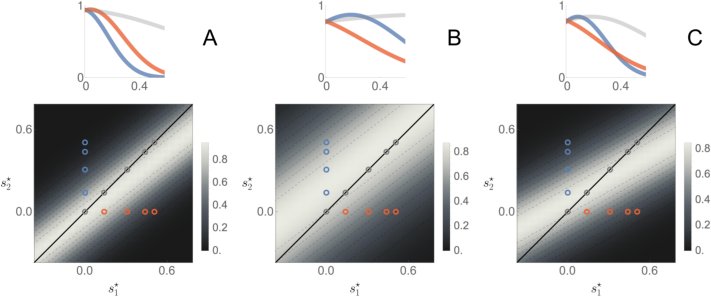
Figure 5: Model-predicted symmetries in the (s1∗,s2∗) perceptual plane, showing equivalence classes and mapping of stimulus pairs with identical likelihood of “equal” judgments.
Analytically, the axis of symmetry can be derived as a linear relation in (s1∗,s2∗) space whose slope and intercept depend on the ratio of likelihood to propagation variances (γ=σℓ2/σp2) and prior mean μ1 (Fig. 6). In the limiting case of vanishing likelihood noise, classical stimulus exchange symmetry is recovered.

Figure 6: Dependence of prior uncertainty, symmetry axis slope, and intercept on noise/propagator variance ratio, elucidating the geometric structure imposed by Bayesian inference.
This geometric formalism provides a principled, quantitative framework linking observable psychophysical biases with latent inference parameters, and offers a tool for extending the model to richer experimental designs and other sensory modalities.
Theoretical and Practical Implications
The Bayesian dynamical framework strengthens the argument that temporal biases and asymmetries in perception reflect not just phenomenological quirks but are emergent consequences of optimal inference under uncertainty, dynamic prior evolution, and memory decay. The model, with only four interpretable parameters per subject, can account for both the magnitude and sign of asymmetry—attributes that classical models fail to capture.
Practically, these findings have implications for the design of haptic interfaces and benchmarking of user performance in sequential stimulus paradigms. The model can be extended to scenarios with longer sequences, variable intervals, or adaptive learning and can inform the construction of adaptive or ‘bias-aware’ haptic feedback systems. The theoretical construct further motivates investigation into the neural substrates underpinning the dynamical propagation of priors and the role of population coding and synaptic adaptation.
The model’s generative, subject-specific nature also enables principled characterization of perceptual noise, prior bias, and their evolution—offering a bridge between behavioural measurement, cognitive theory, and neural implementation.
Conclusion
This study provides a comprehensive Bayesian account of time-order effects in haptic perception, demonstrating that observed asymmetries originate from a combination of dynamically-evolving expectations and noisy sensory integration. The model yields strong quantitative fits and exposes a precise link between the statistical geometry of perception and the interplay of prior expectation and memory. The approach generalizes to other contexts, representing a robust methodological and conceptual advance in the modeling of sequential perception and decision-making under uncertainty.