- The paper establishes that regular traveling-wave solutions fail to exist when the bistable reaction’s interior zero lies in the negative diffusivity region, necessitating shock profiles.
- The paper develops a rigorous analytical framework using Rankine–Hugoniot conditions and potential matching to characterize a family of admissible, monotone shock wavefronts.
- The paper provides explicit algebraic criteria and bounds for shock propagation speeds, with applications to biologically relevant reaction–diffusion models.
Shock Wavefronts for Parabolic Equations with Sign-Changing Diffusivity
The study addresses reaction–diffusion equations characterized by a one-dimensional spatial domain and a diffusion coefficient that exhibits sign changes from positive to negative and back. The canonical form of the equation is
ut=P(u)xx+g(u),
where u represents the density of an entity constrained to [0,1], P is a twice differentiable diffusion potential, and g is a continuous, typically bistable, reaction term. The principal innovation is the rigorous treatment of traveling-wave solutions—specifically, shock wavefronts—in the case where the reaction term is bistable and its interior zero is located precisely within the region of negative diffusivity.
The distinctive feature of the problem is the sign-changing diffusivity:
- P′>0 on (0,α)∪(β,1), P′<0 on (α,β), for 0<α<γ<β<1.
- u0 is bistable with u1, u2 on u3, u4 on u5.
Classically, traveling-wave solutions with continuous profiles cannot exist under these conditions, motivating the investigation into discontinuous, monotone shock profiles joining the two stable steady states, 0 and 1.
Analytical Framework and Main Results
The paper develops a comprehensive analytical framework for the existence, uniqueness, and characterization of shock wavefronts. The main results can be summarized as follows:
- Nonexistence of Regular Wavefronts: When the bistable equilibrium u6 possesses its interior zero u7 in the region of negative diffusivity, regular monotone traveling-wave solutions connecting u8 to u9 cannot exist.
- Existence of Shock Wavefronts: There exists a family of admissible shock profiles (i.e., monotone solutions with a finite discontinuity) under certain relations between the boundary values of the diffusion potential:
- If [0,1]0, for each left state [0,1]1 in a non-empty, explicitly characterized interval [0,1]2, there is a unique right state [0,1]3 and a unique propagation speed [0,1]4 such that the shock profile jumps from [0,1]5 to [0,1]6.
- If [0,1]7, only trivial (piecewise-constant) profiles are permitted.
- If [0,1]8, shock wavefronts do not exist.
The conditions for admissibility of a discontinuity are:
[0,1]9
and a Rankine–Hugoniot-type relation for the shock speed.
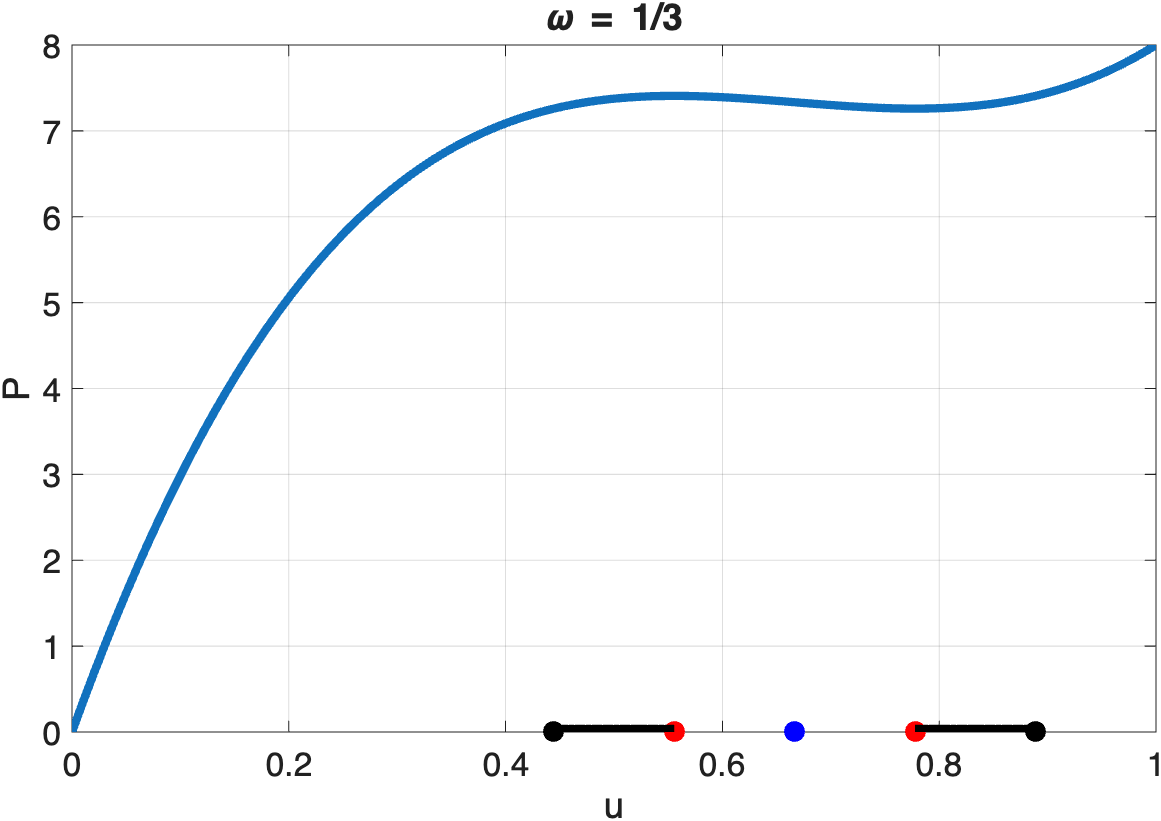
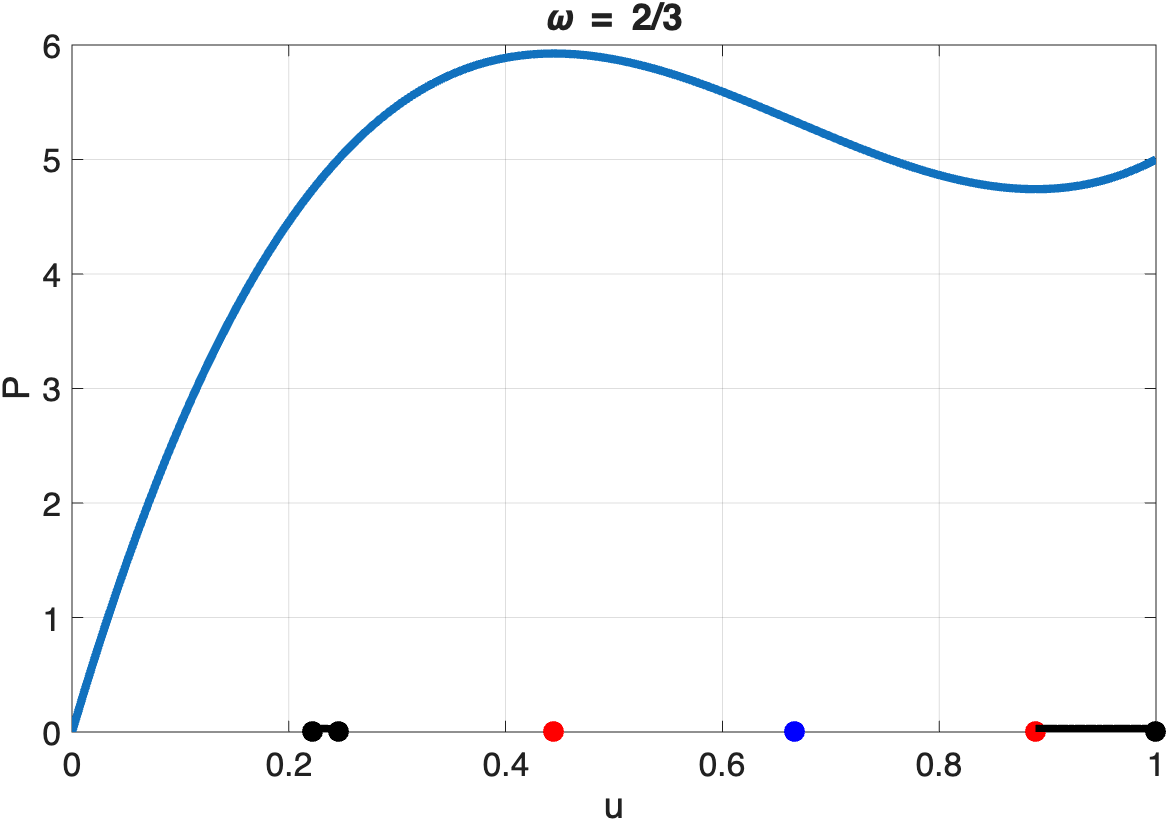
Figure 2: The potential P0 with the locations of P1 and P2 (red), the symmetric point P3 (blue), and the boundaries of the admissible intervals (black).
This construction is made explicit for a biologically relevant reaction–diffusion system (the "invasion model"), where the coefficients have concrete parameterization, and the resulting intervals P4 and function P5 relating left to right states are shown to admit full analytical characterization.
- Structural and Geometric Conditions: The set of admissible pairs P6 (corresponding to shock locations) is the graph of a strictly increasing function P7 defined on P8. The analytic structure ensures a continuum of possible shocks, parameterized by the left state and ordered by decreasing speed.
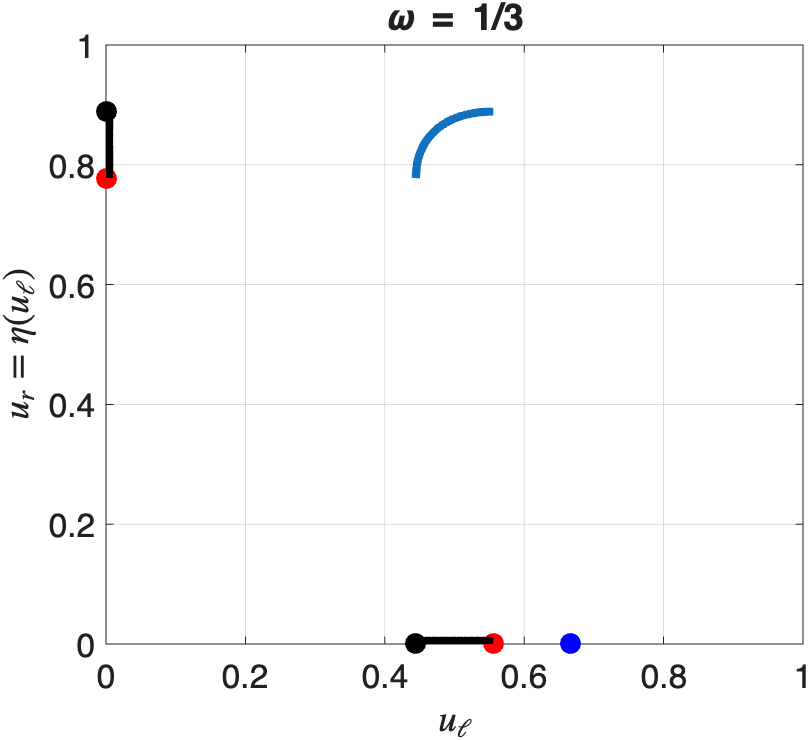
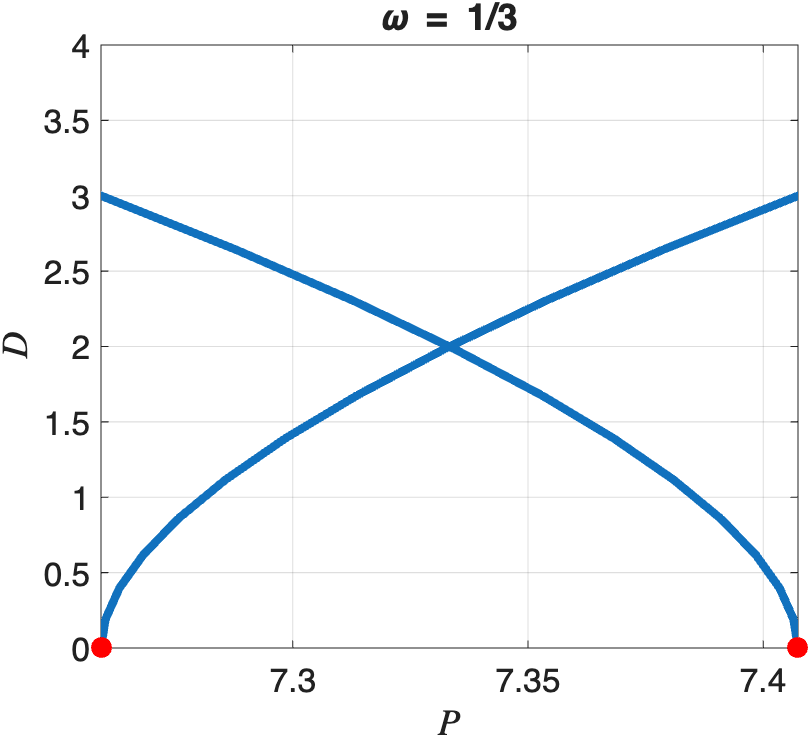
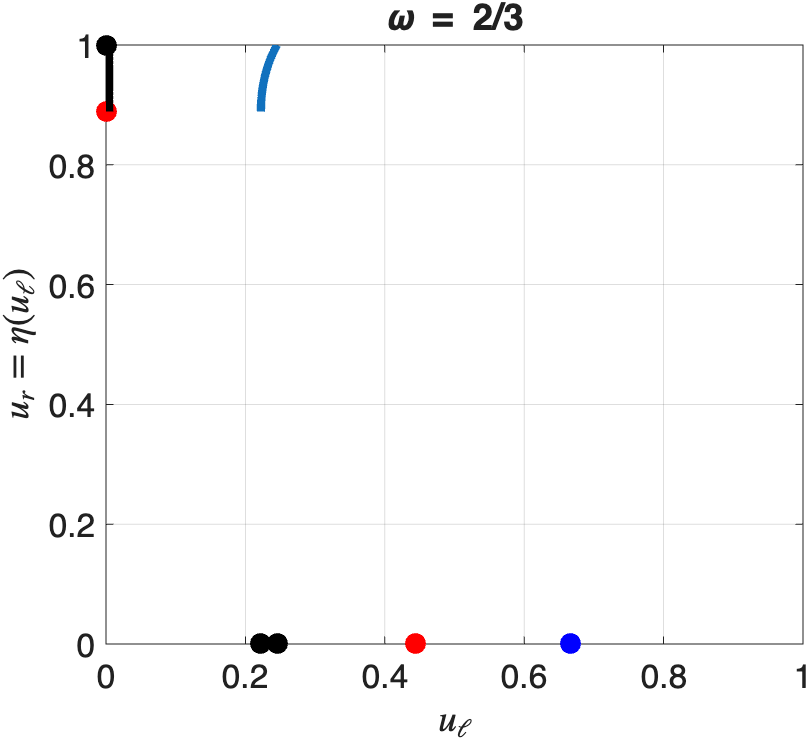
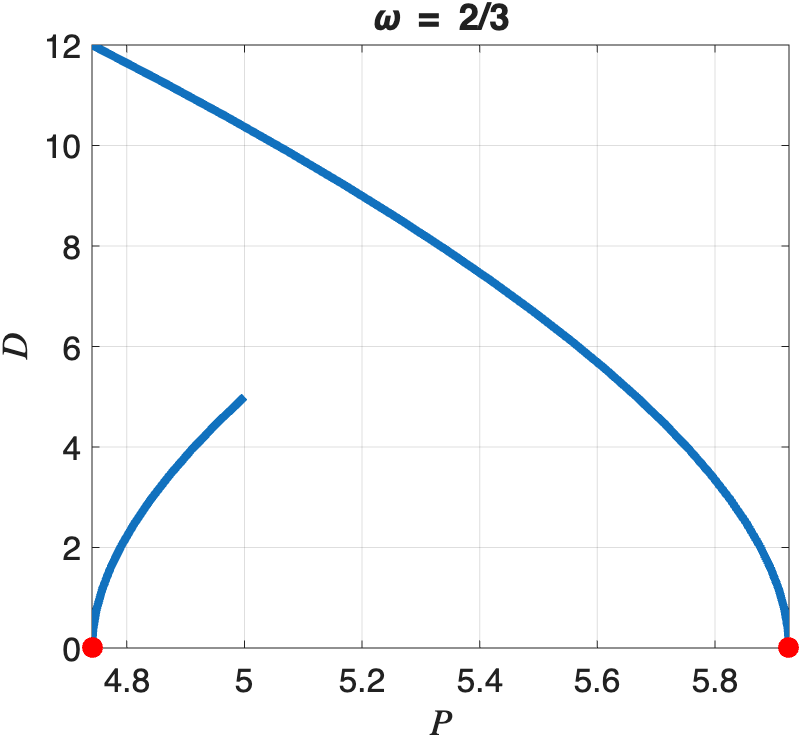
Figure 4: P9 maps g0 (left state) to g1 (right state); g2 and g3 are shown for different regimes of the parameter g4, which determines the nonlinearity of diffusivity.
- Algebraic Uniqueness Criteria: Certain additional physically motivated criteria, such as continuity of diffusivity across the shock (g5), select a unique admissible shock profile within the continuum, or are shown to be incompatible, emphasizing the role of internal parameter regimes.
Technical Insights
Shock profiles are defined as monotone, bounded variation solutions to the traveling-wave ODE for g6 with fixed asymptotics:
g7
interpreted in the distributional sense when admitting discontinuities. The existence is established via a "pasting" construction, gluing regular "semi-wavefronts" (from 1 down to g8 and from g9 down to 0), matching at the discontinuity under the potential jump and generalized Rankine–Hugoniot conditions.
Key to the analysis is a reduction of the second-order traveling-wave ODE to a singular first-order equation for P′>00 on the corresponding monotonicity intervals. By monotonicity, invertibility enables parameter continuation and extension arguments.
Notably, shocks are admissible only for pairs P′>01 solving P′>02 with either P′>03 or P′>04, with nontrivial structure determined by the geometry of P′>05. The right state is obtained by traversing the level sets of the potential, yielding a multivalued algebraic relation that is resolved explicitly in the specific biological model.
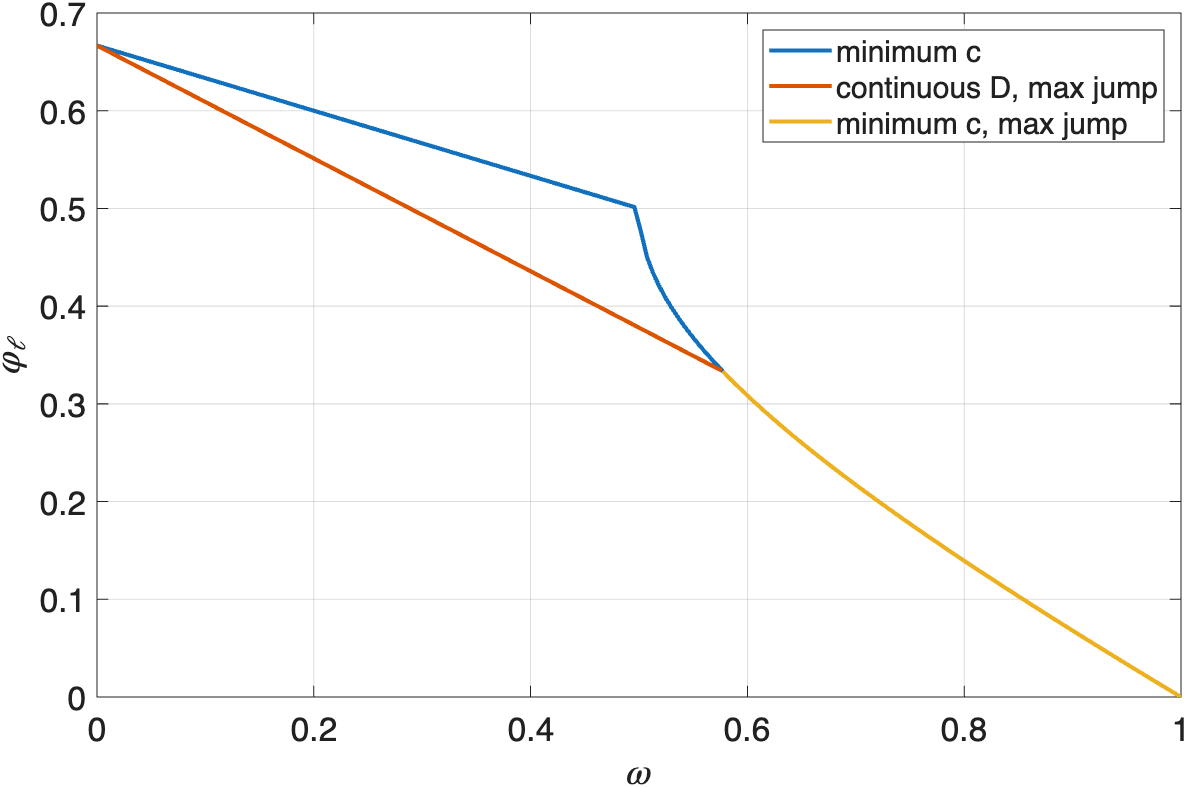
Figure 6: Values of P′>06 for which the diffusivity is matched across the shock (orange), and those which minimize the shock speed (blue/yellow), plotted as functions of the parameter P′>07.
Bounds on Shock Speed
Explicit lower and upper bounds for the propagation speed P′>08 of the shock profile are obtained as
P′>09
The speed is shown to be continuous and strictly decreasing as a function of (0,α)∪(β,1)0 within the admissible interval. This enables a natural selection criterion (minimal speed) as analogous to the stabilization of planar fronts in classical reaction-diffusion equations.
Biological Model Specialization
The analysis is applied to a reaction–diffusion model for cell population movement, parameterized by diffusivities and reaction rates ((0,α)∪(β,1)1). The admissible intervals for shock states and their explicit images under (0,α)∪(β,1)2 are derived using the closed-form expressions for (0,α)∪(β,1)3 and its derivatives, yielding a complete atlas of regime diagrams as functions of the underlying biological parameters.
Figure 7: The potential (0,α)∪(β,1)4 for two biologically relevant parameter sets, highlighting the geometrical locus of admissible shock transitions.
Interpretation of the physical constraints reveals which regions of parameter space admit shocks with continuous, maximal, or minimal jump in density, and when additional criteria (e.g., diffusivity continuity) select a unique transition.
Theoretical Implications
This work provides a rigorous classification of traveling-wave solution structure in nonlinear degenerate parabolic equations with forward-backward-forward diffusion patterns. The result that a continuum of shock profiles (with strictly ordered speed) exists, parametrized by left jump states, constitutes a significant clarification over previous heuristic and numerical studies. Moreover, the established algebraic and variational selection criteria (e.g., matching of diffusivity, minimal speed) contribute a theoretical counterpart to entropy conditions in hyperbolic conservation laws.
The analytical machinery developed avoids recourse to higher-order regularizations or asymptotic singular perturbation, emphasizing direct functional analytic and geometric techniques adapted to equations with sign-changing degenerate operators.
Conclusion
The paper delivers a comprehensive existence and classification theorem for shock wavefronts in parabolic reaction–diffusion equations with sign-changing diffusivity and bistable reactions. The explicit parameterizations and analytic bounds contribute to the understanding of nonlinear wave propagation in such degenerate media, with implications for modeling shocks in biological and physical transport processes. The methodology is broadly applicable to other problems involving forward-backward parabolic equations, with the structure of admissible shocks governed by the geometry of the conserved potential and algebraic connections to Rankine–Hugoniot-type constraints.
Future analytical work may extend these results to higher dimensional or systems contexts, or investigate the stability and selection of the physically relevant (e.g., minimal speed) shock profiles under perturbed dynamics.

