Centrality Dependence of the Balance Functions for Identified Particles in Pb--Pb Collisions Using Pythia + Angantyr
Published 21 Apr 2026 in hep-ph | (2604.19585v1)
Abstract: In this paper, we study the balance functions for pions, kaons, and protons in Pb--Pb collisions at $\sqrt{s_{\mathrm{NN}}} = 2.76$ TeV using the PYTHIA 8.3 + Angantyr model. The balance function is evaluated through two-particle azimuthal angular correlations $(Δφ, Δη)$ between particle and antiparticle. Correlations are constructed for $ππ$, $KK$, and $pp$, and their dependence on collision centrality is investigated. The results indicate that the balance function for pions is narrower compared to kaons and protons. Notably, the pion balance function width decreases from peripheral to central collisions, while the widths for kaons and protons remain nearly unchanged. For the Monash 2013 tune used in this study, PYTHIA 8.3 + Angantyr describes peripheral collisions reasonably well but does not quantitatively reproduce central Pb--Pb data. This suggests that an improved description of central Pb--Pb collisions may require a dedicated heavy-ion tuning of the Angantyr framework. We further explore the influence of resonance decays and collective effects by incorporating multi-parton interactions and color reconnection into the analysis. Owing to resonance effects and Bose--Einstein correlations, a dip at $Δη= 0$ and $Δφ= 0$ is observed for pions and kaons.
The paper demonstrates that pion balance functions narrow with increasing centrality, indicating late-stage hadronization and enhanced radial flow.
It employs Pythia8.3+Angantyr with functionalities like color reconnection, resonance decays, and BE correlations to benchmark against ALICE data.
The analysis reveals discrepancies in pion predictions for central events and highlights the need for improved modeling of hydrodynamic expansion and final-state interactions.
Centrality Dependence of the Balance Functions for Identified Particles in Pb–Pb Collisions Using Pythia + Angantyr
Introduction
The study systematically investigates charge balance functions (BFs) for identified particles (pions, kaons, protons) produced in Pb–Pb collisions at sNN=2.76TeV, leveraging the Pythia8.3 + Angantyr event generator. The balance function is a key observable diagnosing charge–anticharge correlations and is sensitive to both the space–time dynamics of particle production and the collective properties of the medium formed in relativistic heavy-ion collisions. In the context of QGP studies, BF widths encode information about the hadronization time, diffusion, and radial flow effects. The present work analyzes the centrality dependence of BFs projected in azimuthal angle (Δφ) and rapidity (Δy), quantifying medium and resonance-induced effects and benchmarking against ALICE data. The influences of multi-parton interactions (MPIs), color reconnection (CR), resonance decays, and Bose–Einstein (BE) correlations are thoroughly examined.
Balance Functions as Probes of Hadronization Dynamics
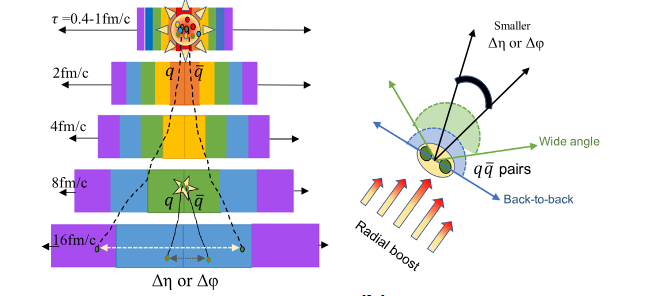
The central role of BFs is as probes of the production time and subsequent diffusion of correlated charge–anticharge pairs. The underlying mechanism is succinctly illustrated by contrasting the BF width for early versus late-stage pair creation: early production leads to broader Δη and Δφ distributions due to longer diffusion and stronger expansion, whereas late hadronization narrows these correlations. Additionally, increased radial flow in central collisions further narrows BFs. Pions, typically hadronized at later stages and subject to greater collective flow, are therefore expected to exhibit the narrowest BFs, while kaons and protons, generated earlier, yield broader correlations.
Figure 1: Illustration of how the production time and radial flow affect the width of charge balance functions.
Event Generation and Modelling Framework
The simulations employ Pythia8.3 + Angantyr in the Monash 2013 tune, with 3×10⁸ minimum-bias Pb–Pb events at sNN=2.76 TeV. Angantyr includes soft/hard interactions, MPI, ISR/FSR, CR, resonance decays, and string fragmentation; however, no explicit modeling of a thermalized QGP or hadronic rescattering is implemented. CR is studied as it modifies the string topology, affecting particle yields and correlation structures. Identification, selection criteria, and kinematic ranges strictly follow those in experimental analyses to ensure valid comparison.
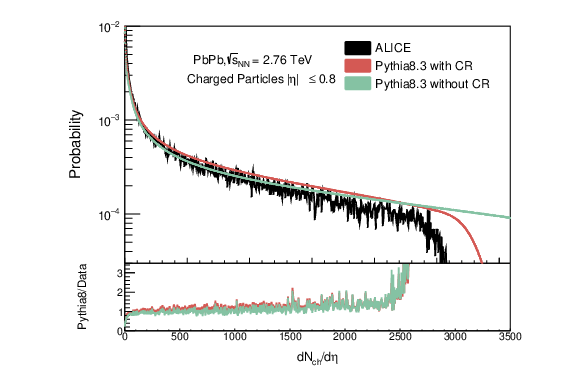
Empirical centrality slicing is validated in Pythia against ALICE data, with and without CR.
Figure 2: Centrality dependence of charged particle multiplicities in simulation and ALICE data, illustrating significant sensitivity to CR settings.
Results: Centrality Dependence and Species Sensitivity of BFs
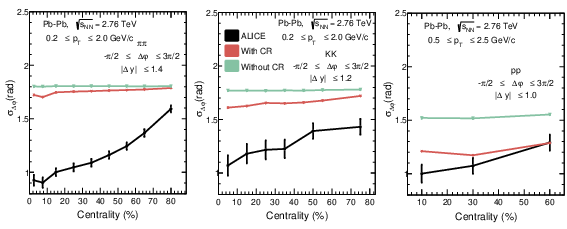
Pion Pair Balance Functions
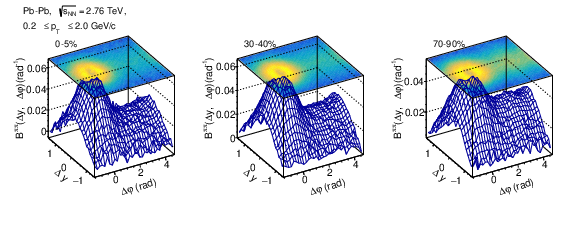
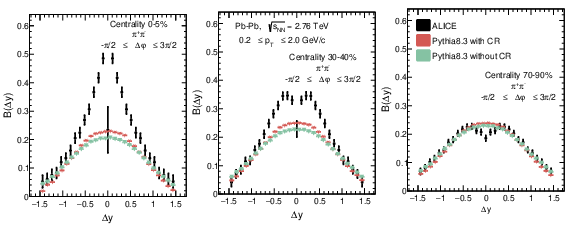
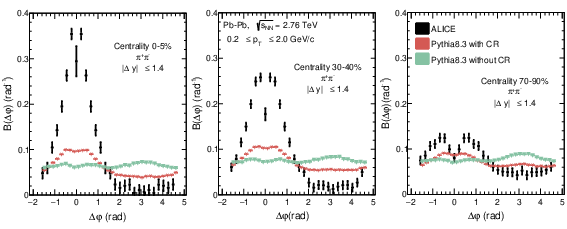
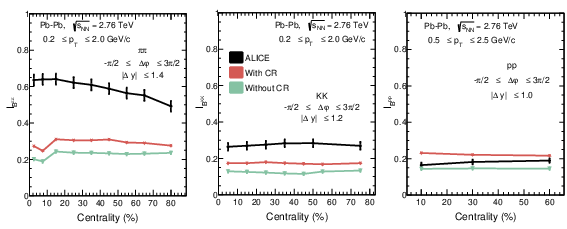
Pion BFs display substantial narrowing from peripheral to central collisions, both in Δy and Δφ, consistent with late-stage hadronization and amplified radial flow in more central events.
Figure 3: Two-dimensional pion pair BFs in several centrality classes highlighting narrowing with increasing centrality.
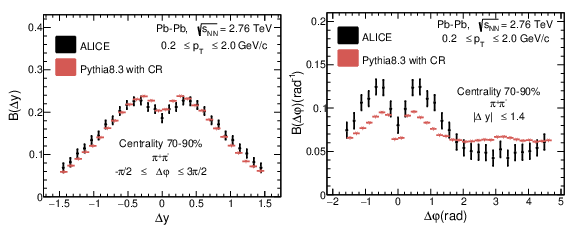
Figure 4: One-dimensional Δyprojection for pion BFs, including comparison among different CR settings and ALICE data.
Figure 5: One-dimensional Δφ0 projection for pion BFs, further illustrating narrowing in central collisions.
Simulation results with CR best describe peripheral data but systematically underestimate the narrowing observed in central events, suggesting either insufficient radial flow or limitations in the Angantyr tune for heavy-ion dynamics.
Impact of Resonances and BE Correlations on Pion BFs
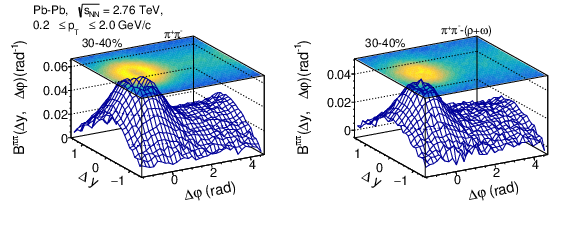
The BF exhibits a characteristic dip at Δφ1, a feature attributed to resonance decays (primarily Δφ2 and Δφ3 mesons) and quantum-statistical BE correlations. Removing resonance daughters from the BF calculations eliminates this dip and further narrows the BF, quantifying the strong effect of resonance feeddown.
Figure 6: Impact of resonance removal on the two-dimensional pion BF, revealing the disappearance of the central dip.
Explicit inclusion of BE correlations can correctly model the central dip in peripheral events but fails for central collisions due to limitations in the available system size parameter in Pythia.
Figure 7: BE correlations in the Δφ4 and Δφ5 projections for pions, showing agreement with ALICE data only for peripheral events.
Kaon Pair Balance Functions
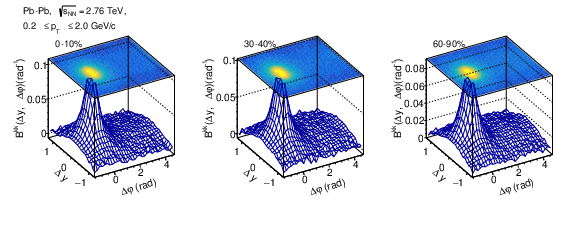
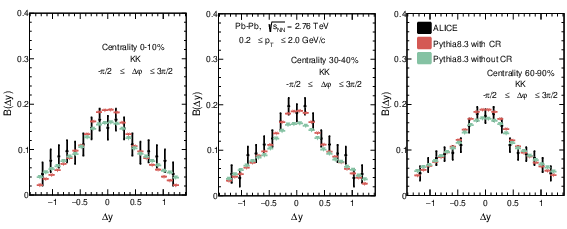
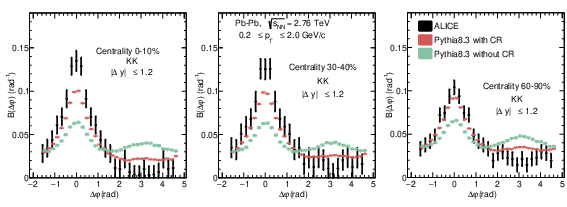
Kaon BFs remain largely independent of centrality, consistent with their production at early times. The widths are broader compared to pions, supporting the expected species hierarchy, and are dominated by feeddown from Δφ6 decays.
Figure 8: Two-dimensional kaon BFs for various centrality classes, showing negligible evolution in width.
Figure 9: Δφ7 projections of kaon BFs comparing simulation to ALICE data; the model achieves good agreement.
Figure 10: Δφ8 projections of kaon BFs, similarly showing broad structure with no marked centrality dependence.
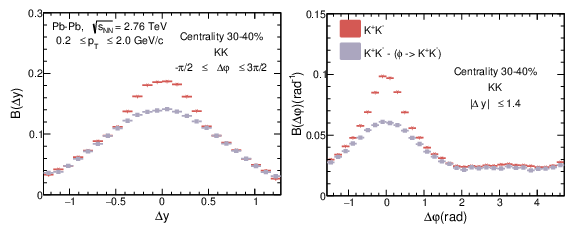
Resonance removal studies confirm that Δφ9-meson decays dominate the near-side structure; excluding Δy0 daughters significantly flattens the BF.
Figure 11: Effect of resonance removal on kaon BF projections, showing a substantial decrease in near-side correlation.
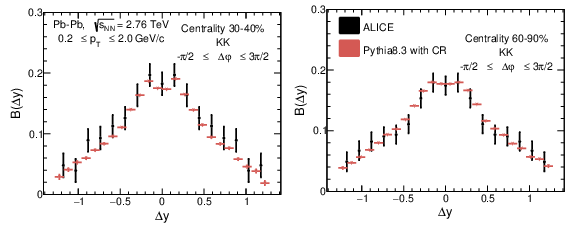
Bose–Einstein correlations, when enabled, reproduce the experimentally observed dip at Δy1 for less central events.
Figure 12: Inclusion of BE correlations in kaon BF for 30–40% and 60–90% centralities brings the model in agreement with data at low Δy2.
Proton Pair Balance Functions
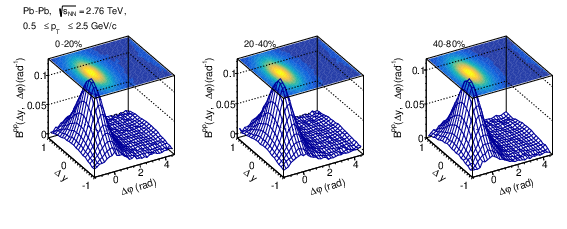
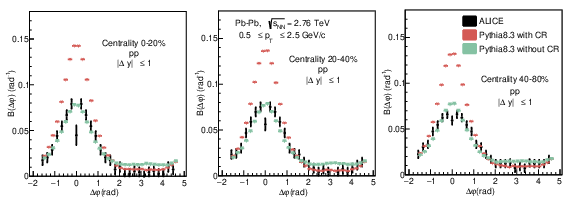
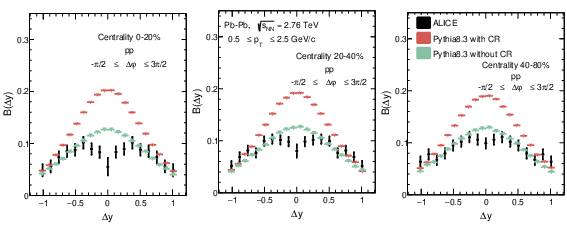
Proton BFs are broad and show negligible sensitivity to centrality, indicating early baryon–antibaryon production. Unlike the mesonic sector, model predictions only agree with ALICE data when CR is disabled.
Figure 13: Two-dimensional proton BF for three centrality intervals—no significant evolution or narrowing is observed.
Figure 14: Δy3 projections for protons comparing with/without CR and ALICE results; best agreement is obtained without CR.
Figure 15: Δy4 projections for protons; simulation without CR is mandatory for approximate concordance with experiment.
The dip at Δy5 seen in ALICE data is absent in the Pythia + Angantyr model, as it lacks hadronic rescattering and baryonic annihilation processes.
Quantitative Study of BF Widths and Integrals
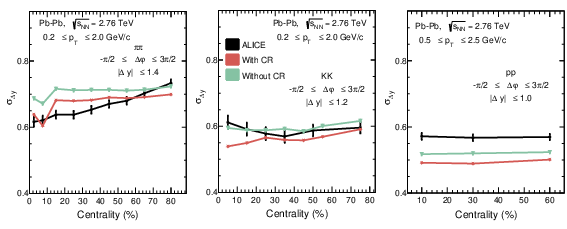
The RMS widths (Δy6 and Δy7) and integrals (Δy8) of BFs for all three particle species are quantified. Pion BFs show a pronounced narrowing with increasing centrality in both axes, although the simulation underestimates the effect in central events. Kaons and protons exhibit nearly flat behavior, both for width and integral, across centrality.
Figure 16: Centrality dependence of BF width in Δy9 for pions, kaons, and protons; only pions show significant narrowing.
Figure 17: Centrality dependence of BF width in Δη0, revealing strong narrowing for pions, nearly flat trend for kaons/protons.
Figure 18: BF integrals as function of centrality; declining trend only evident for pions.
Discussion and Implications
The species-dependent and centrality-dependent evolution of BFs provides critical constraints on models of particle production and collective flow. For pions, the observed narrowing and centrality dependence are signatures of late-stage hadronization and substantial radial flow. The inability of Pythia8.3 + Angantyr (even with CR) to quantitatively reproduce these trends in central Pb–Pb collisions exposes intrinsic limitations—particularly the absence of realistic hydrodynamic expansion and hadronic afterburners. For kaons and protons, the model is more successful, possibly reflecting the fact that their BFs are less sensitive to late-stage medium effects and instead encode early dynamical information. The resonance and BE studies highlight the necessity of accurate implementation of quantum effects and decay feeddown for a complete description of correlations.
Future developments should focus on improved tuning of color reconnection and incorporation of thermalization modules or hybrid approaches (hydrodynamics + transport), especially for central heavy-ion reactions. The observed discrepancies in the pion channel motivate refinement of final-state interactions and quantum-statistical effect handling within Pythia-based generators.
Conclusion
This study demonstrates that Pythia8.3 + Angantyr, with in-depth control over resonance and BE effects, can qualitatively describe peripheral collision BF data for all considered species. The narrowing of pion balance functions with increasing centrality is qualitatively captured but quantitatively underestimated, signaling missing physics in the modeling of central heavy-ion events. Kaon and proton BFs are described more accurately, highlighting distinct sensitivities to hadronization timing and collective flow. The work establishes a framework for systematic BF analysis in heavy-ion phenomenology and paves the way for further generator development targeting QGP-specific signatures and late-stage dynamics.