PRADAS: PRior-Assisted DAta Splitting for False Discovery Rate Control
Published 21 Apr 2026 in stat.ME | (2604.19517v1)
Abstract: In the FDR-controlling literature, mirror statistics offer a flexible alternative to $p$-value based procedures. When prior information is available, however, it is unclear how to incorporate mirror statistics in a principled way, and the standard equal split used by data-splitting methods can be inefficient. In this paper, we characterize a broader class of mirror statistics for any fixed splitting scheme and establish asymptotic FDR control under mild weak-dependence conditions using a two-stage procedure inspired by \cite{li2021whiteout}. Within this class, we derive a Bayes-optimal mirror statistic. Theoretically, we demonstrate its power advantage through analyses in the Rare/Weak signal model. Building upon this Bayes-optimal mirror statistic, we propose \textsc{PRADAS} (PRior-Assisted DAta Splitting) that treats split ratio as a stopping time and recasts the data-splitting as an optional stopping over a natural filtration; the optimal stopping rule is characterized by the Snell envelope and computed efficiently via a Longstaff--Schwartz regression approximation. Both simulations and real data examples demonstrate the effectiveness of our proposed framework.
The paper proposes a Bayes-optimal mirror statistic that leverages structured prior information to minimize the false discovery proportion threshold.
It introduces an adaptive data splitting protocol formulated as an optimal stopping problem, balancing exploratory and confirmatory phases.
Empirical results demonstrate that PRADAS outperforms classical knockoff and p-value methods in both power and FDR control, especially in correlated and structured settings.
PRADAS: Prior-Assisted Data Splitting for FDR Control
Introduction and Motivation
Large-scale multiple testing with rigorous false discovery rate (FDR) guarantees remains central across high-dimensional statistical applications, especially in genomics and structured feature selection. Classical p-value-based procedures such as BH and its variants hinge on strong assumptions (e.g., independence, PRDS) and require exact or tractable null distributions, which are unavailable in many complex models. FDR-controlling knockoff constructions circumvent p-values but encounter both computational and power limitations, especially under high feature correlation or challenging covariate distributions.
Mirror statistics computed via data-splitting alleviate some limitations by exploiting minimal symmetry assumptions, offering flexible nonparametric FDR control. Nevertheless, two major inefficiencies persist: (1) the integration of rich, structured prior information is largely unaddressed, and (2) the choice of data splitting ratio is typically fixed and ad hoc, failing to exploit adaptive trade-offs between inference and calibration.
"PRADAS: PRior-Assisted DAta Splitting for False Discovery Rate Control" (2604.19517) addresses these substantive gaps by developing a unified theoretical and algorithmic framework for FDR control that optimally leverages prior information and adaptively selects the data-splitting ratio. The paper advances (a) a Bayes-optimal class of mirror statistics with provable FDR control under generic dependence, (b) a dynamic, prior-assisted sample split protocol formalized as an optimal stopping problem (solved via the Snell envelope and regression-based approximations), and (c) demonstrates the resultant power gains in both rare/weak and structured-signal regimes.
General Class and Bayes-Optimality of Mirror Statistics
The authors formally extend the mirror statistic paradigm by introducing a general two-stage procedure: (1) an exploration phase computing feature-specific ranking data and a best-guess statistic assignment, and (2) a confirmation phase validating the assignment and controlling FDP through a sequential threshold. Under mild exchangeability and weak-dependence assumptions, any mirror statistic within this class asymptotically controls FDR. The critical insight is that the symmetry property for null features need only hold asymptotically, enabling an expansive set of data-generating procedures.
The Bayes-optimal mirror statistic is then derived for any fixed split. It equals the log-likelihood ratio of the data ordering, or more precisely,
Mj⋆=rj⋆⋅logP(rj⋆=−1∣D)P(rj⋆=1∣D)
where rj⋆ is the optimal label guess and D denotes all ranking data for feature j. This quantity generalizes the sign-sum mirror statistic, recovers local fdr-based ranking in simple cases, and provably minimizes the FDP threshold required for FDR control in the rare/weak asymptotic regime.
The power gains over vanilla (prior-agnostic) statistics are substantiated by precise phase diagrams and Hamming error rates—demonstrating that the Bayes-optimal statistic strictly dominates sign-sum in correlated settings and those with nontrivial structure or grouping.
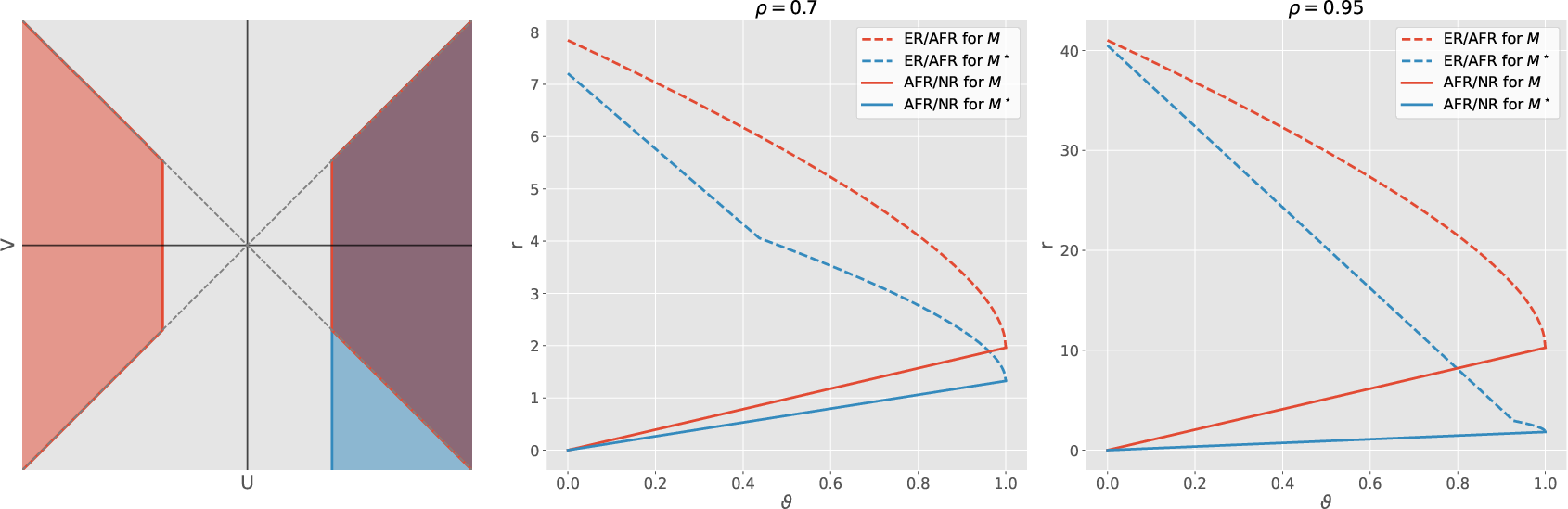
Figure 1: The optimal rejection rule for mirror statistics (M and M) is contrasted, with phase diagrams visualizing superiority of M⋆ under high correlation.
Prior-Assisted and Adaptive Data Splitting
A central contribution is the recasting of the split-ratio selection problem as a stopping-time decision over the filtration generated by sequentially growing the first data split. The core technical insight is that FDR remains controlled for any (even data-adaptively chosen) stopping time as long as the symmetry/exchangeability property is respected at each candidate split.
The prior-assisted data splitting protocol (ADMS, Adaptive Data Splitting with Mirror Statistics) computes, for each feature and candidate split ratio, the expected gain (reward) in the confirmation score and then uses the Snell envelope to determine the stopping time that maximizes the expected power under the FDR constraint. Computational scalability is achieved via Longstaff-Schwartz least-squares Monte Carlo, regressing future continuation values onto feature summaries, yielding effective and numerically stable stopping rules even in high-dimensional settings.
Theoretical Power Analysis in Rare/Weak and Structured Regimes
Theoretical results detail strict power improvements in the rare/weak and grouped-signal models. For instance, in the rare/weak regime, the Hamming error exponent (and phase diagram boundaries for exact and almost full recovery) are improved compared to sign-sum and standard masked likelihood procedures, with the improvement increasing as the underlying feature correlation or prior structure departs from the independence ideal.
The paper establishes that (1) mirror statistics constructed with optimal prior- and data-driven inference realize the Bayes-optimal phase transition (proven by asymptotic lower bound arguments), and (2) naive or misspecified prior information does not harm asymptotic FDR, but can reduce power, reflecting the inherent robustness and adaptivity of the approach.
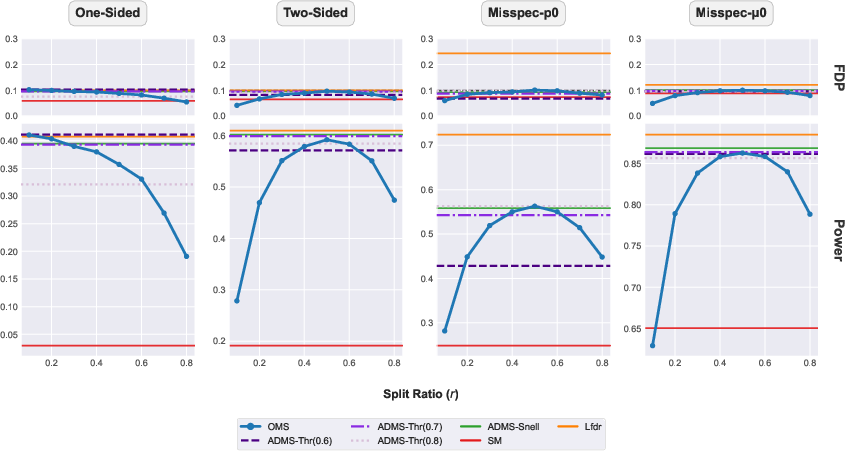
Figure 2: Power and FDP control at q=0.1—Bayes-optimal mirror and ADMS consistently control FDR and achieve maximal power across data settings.
Empirical Validation: Simulations and Application
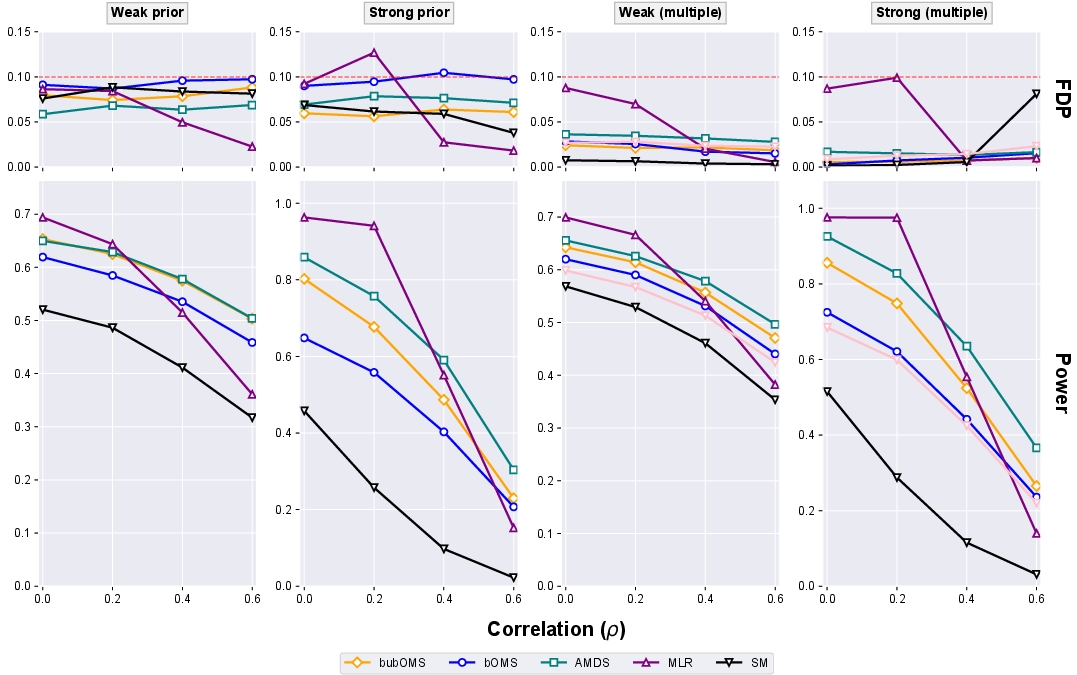
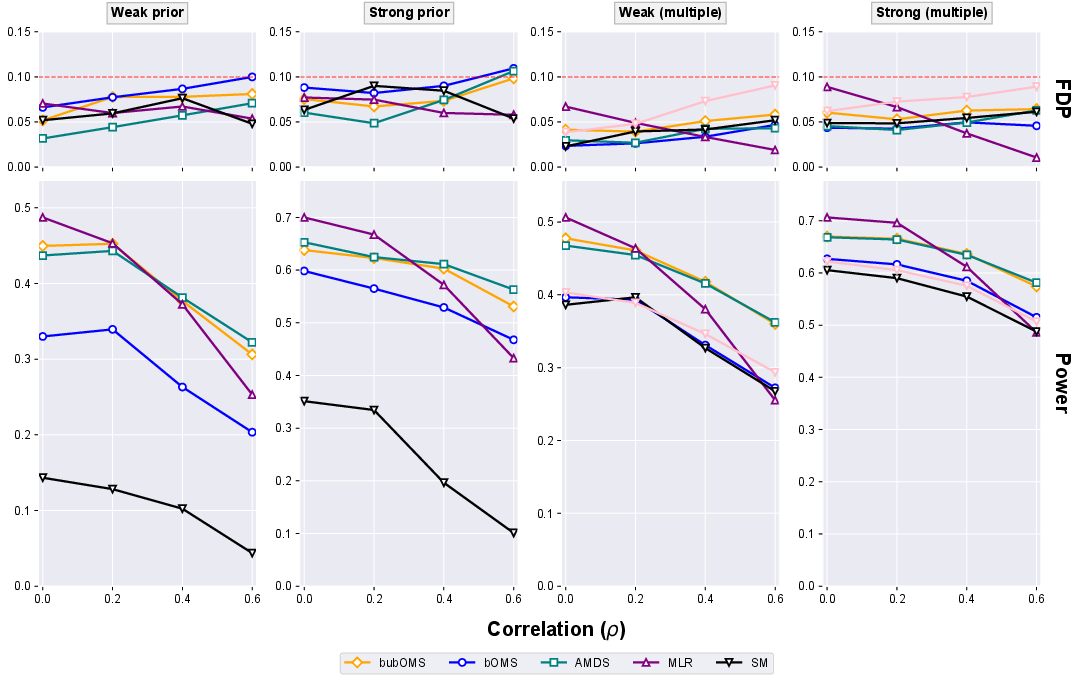
Extensive simulations in multivariate normal-mean, high-dimensional linear, and logistic regression models confirm the theoretical results. In all regimes, ADMS—especially with the data-driven Snell-stopping—dominates not only sign-sum and standard knockoff statistics, but also achieves performance matching or exceeding the local fdr (Lfdr) oracle while maintaining valid FDR even under prior misspecification.
Figure 3: Linear regression, p0—ADMS yields highest true positive discoveries across all correlation strengths.
Figure 4: Logistic regression for p1 and p2: ADMS outperforms all DS-based methods on both power and FDR metrics.
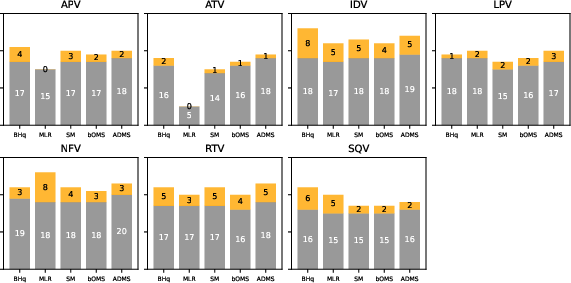
Figure 5: Discovered mutations for seven PI drugs in HIV dataset; ADMS leads in true discoveries with FDR controlled at p3.
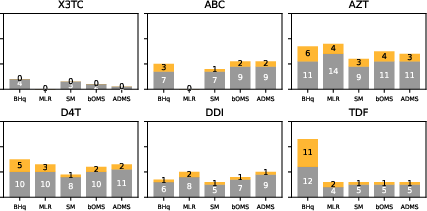
Figure 6: Discovered mutations for six NRTI drugs; ADMS outperforms BHq and knockoff-based statistics under the same FDR threshold.
Notably, on the HIV drug-resistance real dataset, the method identifies more true positives than competing FDR controllers, especially in regimes of strong prior structure and feature correlation, with empirical FDP consistently controlled below the nominal threshold.
Implications and Future Directions
This work formulates a theoretically rigorous and algorithmically scalable solution to optimal use of prior information and data splitting in FDR control. By unifying information-theoretic power guarantees with optimal stopping theory, the framework sets a new methodological standard for structured inference in high dimensions.
Practically, these approaches are applicable wherever informative feature priors (such as multi-omics, transfer learning, or grouped structures) can be obtained, and are robust to the dependence and model-mismatch scenarios that stymie classical knockoff and p-value weighting methods.
Future directions include extension to settings with dynamically evolving priors (e.g., online or federated inference), functional data and network-based feature structures, and computational enhancements leveraging variational Bayes or neural inference engines for large-scale meta-analyses.
Conclusion
The PRADAS framework establishes the Bayes-optimality and computational feasibility of prior-assisted, adaptively-stopped mirror statistics for FDR control. It achieves strict improvements in power and robustness over existing methods, while maintaining finite- or asymptotic FDR control under minimal dependence assumptions. The fusion of prior integration, adaptive sampling, and optimal stopping in this context creates a flexible statistical toolkit ready for diverse high-dimensional FDR applications throughout the sciences.
“Emergent Mind helps me see which AI papers have caught fire online.”
Philip
Creator, AI Explained on YouTube
Sign up for free to explore the frontiers of research
Discover trending papers, chat with arXiv, and track the latest research shaping the future of science and technology.Discover trending papers, chat with arXiv, and more.