- The paper demonstrates that transparency in AI-mediated language support significantly enhances conversation quality, intimacy, and usability in intergenerational communication.
- It employs a rigorous mixed-method design using repeated-measures ANOVA and qualitative interviews to evaluate three interface variants.
- The findings imply that allowing users to verify AI translations respects individual identity and aids in maintaining conversational authenticity.
Overview and Research Context
This paper investigates the design and empirical evaluation of GenSync, a GPT-4–based chat interface intended to enhance intergenerational family communication in settings with substantial linguistic divergence, specifically those characterized by generation-specific slang (here, the Korean “Kupsikche” phenomenon). The study rigorously examines three interface variants—control (no translation), black-box (interpretation only), and transparent (showing both the original and interpreted message)—to measure their effects on conversation quality, intimacy, and usability in family dyads. The research explicitly situates translation visibility as the principal experimental variable, reflecting the growing emphasis on transparency and verification in AI-mediated interpersonal support systems.
System Architecture and Methodological Rigor
GenSync is architected around few-shot-prompted LLM translation pipelined into a messaging interface. Prompts contain direction-specific interpretation tasks, curated K-slang examples, and context-sensitive constraints on output format and tone. The study sample (N=32; 16 dyads) covers a significant generational span and leverages both within-subjects quantitative evaluation (repeated-measures ANOVA/Friedman tests) and thematic qualitative analysis based on post-hoc interviews. Such a design ensures strong internal validity when examining subtle conversational and relational phenomena.
Empirical Findings
The paper provides robust quantitative results demonstrating that translation visibility determines both conversational and relational outcomes:
- Conversation Quality: Transparent mode significantly outperforms both control and black-box conditions (p<.05), achieving the highest ratings (M=3.53) versus control (M=3.00) and black-box (M=2.62). Qualitative accounts reveal that transparency enables participants to verify AI outputs, maintain topic expansion, and prevent misalignment—functions that are especially critical when interpreting subcultural slang.
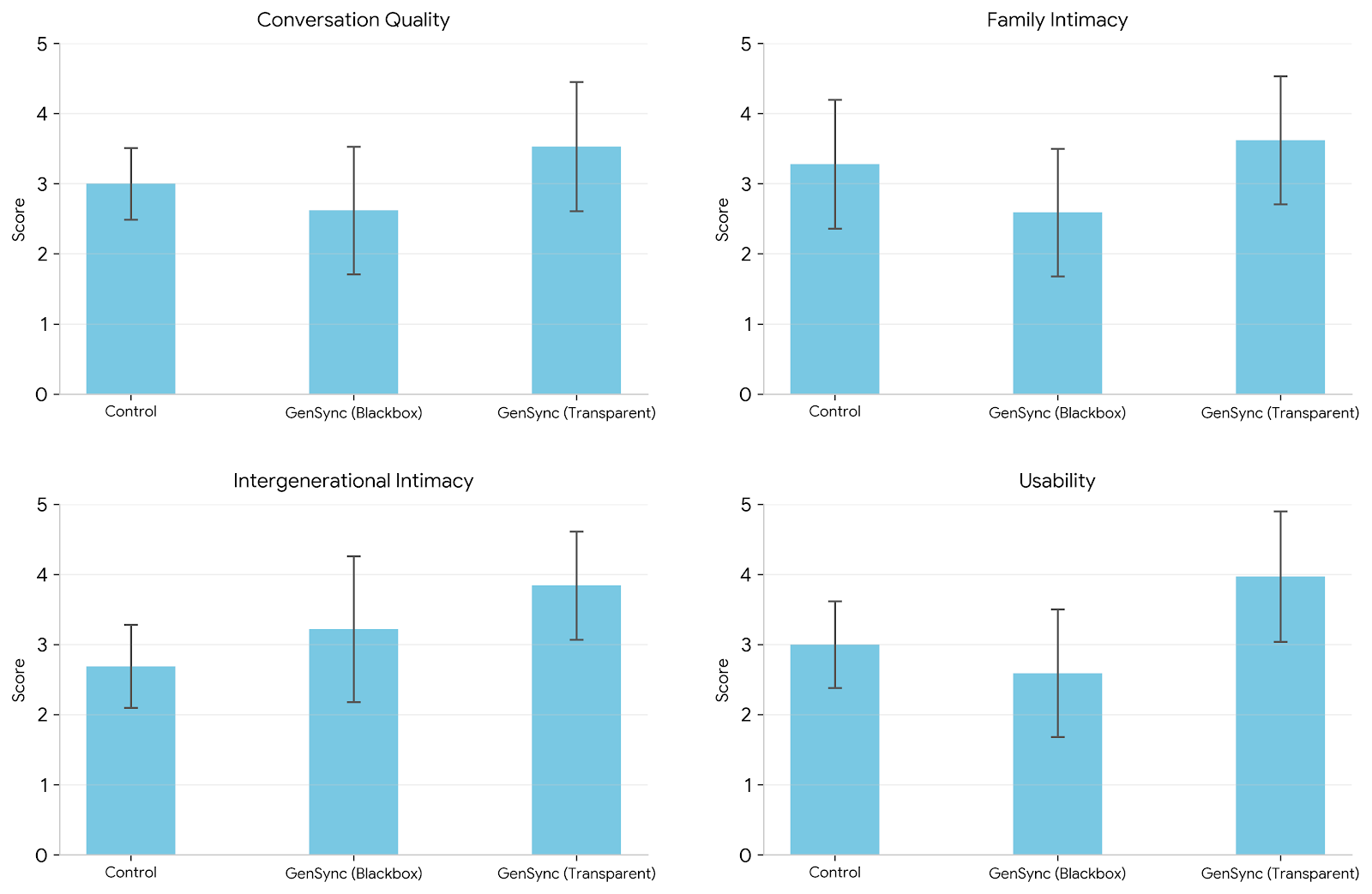
Figure 1: Transparent GenSync yields consistently higher conversation quality, family intimacy, and usability, outperforming both black-box and control conditions (p<.05).
- Family/Intergenerational Intimacy: Significant improvements in intimacy are observed in transparent GenSync, with post-hoc comparisons revealing large effect sizes (e.g., dz=−1.20 for B vs C on family intimacy). Notably, black-box translation frequently reduces perceived genuineness, as its tendency to produce formal or impersonal outputs dilutes participants’ authentic “voice.”
- Usability: Transparent GenSync achieves the highest usability scores (M=3.97), emphasizing the importance of interface affordances for user verification and learning. Participants articulate that the ability to view both message variants supports trust calibration and error detection.
The data substantiate a critical design implication: translation should not be framed merely as a conduit for meaning transfer, but as a collaborative interpretive process. Obscuring the transformation process (black-box mode) damages trust, agency, and conversation flow, echoing prior work on explanation and XAI in sensitive social applications. Transparent presentation of AI interpretations shifts user interaction from passive consumption to active verification, enabling users to negotiate intent and meaning at a finer granularity.
Theoretical and Practical Implications
The findings interrogate deeply the problem of representational tensions in language mediation—i.e., the risk of AI homogenizing user identity or flattening affect through stylistic or pragmatic “normalization.” By enabling simultaneous access to original and translated messages, the transparent interface respects the agency and expressive diversity of both interlocutors. The study moves beyond mere translation quality to underscore issues of identity attribution, stylistic authenticity, and the locus of conversational control.
Practically, these results advise designers of communication tools for families, cross-generational teams, and multicultural groups to prioritize interpretability and user-side verification. The central insight is that AI should function as an assistive and referential resource, not an authoritative surrogate, especially in high-context or relationally sensitive conversations.
Limitations and Directions for Future Research
While methodologically sound, the study’s scope is culturally specific to Korean familial hierarchies and linguistic forms. Cross-cultural validation remains necessary, given that norms of conversational agency, explicitness, and generational boundaries vary internationally. Furthermore, longitudinal deployment in real-world family chat ecosystems would illuminate the evolving relational dynamics and slow-burn effects of persistent AI mediation.
From a technical perspective, extension to more personalized or adaptive model output—balancing both interpretive accuracy and stylistic fidelity—remains an important direction, as some participants note dissatisfaction with AI-authored slang that mismatches personal idiolects.
Conclusion
This work contributes a nuanced, empirically-backed understanding of how the transparency of AI-mediated language support interfaces scaffolds intergenerational communication. Transparent translation mechanisms not only enhance conversation quality, intimacy, and usability, but also respect the representational plurality inherent to familial dialogue. The findings challenge designers to treat AI as an interpretive mediator rather than a replacement, foregrounding user agency and relational identity. Further investigation is warranted across cultures, contexts, and longer time scales to generalize and operationalize these recommendations in future AI communication systems.

