Published 21 Apr 2026 in hep-th and hep-ph | (2604.19250v1)
Abstract: Fibre inflation is one of the most attractive models realized in the type IIB orientifold compactification. It is embedded in the framework of L(arge) V(olume) S(cenarios) using a class of compactifying Calabi-Yau (CY) threefolds having K3-fibration. The standard single-field fibre inflation is driven by a fibre modulus which needs to travel a trans-Planckian distance of the order of ${\cal O}(5-8)$M$_p$ in the effective moduli space. The global embedding attempts using concrete CY orientifold setups have shown that Kähler cone conditions can generically induce some significantly tight bounds on the inflaton range, especially in the presence of a Swiss-Cheese structure via an exceptional rigid divisor in the CY threefold. Such field range bounds usually obstruct the inflationary plateau, leading to insufficient number of efolds during the inflationary dynamics. In this context, we review our recent work about the possibility of assisting multiple fibre moduli such that the burden of traveling the required trans-Planckian distance could be shared by multiple fields, and successful inflation could be realized before hitting (or being too close to) their respective individual Kähler cone boundaries.
The paper introduces a multifield assisted inflation mechanism that distributes the required trans-Planckian displacement across several Kähler moduli.
It develops a global embedding of fibre inflation in a K3-fibred Calabi-Yau using perturbative stabilization methods within the large volume scenario.
Numerical results confirm that the model achieves compatibility with CMB data while robustly maintaining moduli stabilization under geometric constraints.
Assisted Fibre Inflation in Perturbative LVS: A Rigorous String Cosmology Realization
Introduction
The paper "On Global Embedding of Assisted Fibre Inflation" (2604.19250) addresses key obstacles in embedding inflationary models within the type IIB Calabi-Yau string compactification, focusing on K3-fibered geometries within the perturbative Large Volume Scenario (pLVS). While single-field fibre inflation in Large Volume Scenarios (LVS) is a well-studied avenue for UV-complete models of inflation, implementing these models globally has clashed with geometric constraints, notably the Kähler cone bounds which restrict field excursions. The authors develop a multifield assisted version of fibre inflation, in which the inflationary trajectory is shared among multiple (fibre) Kähler moduli. This framework enables the required trans-Planckian displacement needed for successful slow-roll inflation to be distributed, keeping individual moduli trajectories inside the physical region of the moduli space.
Global Model Construction and Moduli Stabilization
The study commences with a precise construction of a K3-fibred Calabi-Yau orientifold. The underlying geometry consists of seven toric divisors, with six K3 surfaces and one SD-type divisor. The overall Calabi-Yau volume is given by V∝τ1τ2τ3, where the τα denote four-cycle volumes. This structure leads to three Kähler moduli, well-suited for multifield inflationary trajectories.
Moduli stabilization proceeds via the following sequence:
Complex structure moduli and axio-dilaton are stabilized at high scale via three-form fluxes, utilizing the Gukov-Vafa-Witten (GVW) superpotential.
Kähler moduli stabilization employs only perturbative effects: the leading-order α′3 corrections (Becker-Becker-Haack-Louis) and, critically, logarithmic loop corrections ("log-loop") which suffice due to the absence of rigid divisors required for non-perturbative effects.
Volume stabilization: The scalar potential, including these perturbative contributions, produces an exponentially large, stable minimum for the overall volume modulus V, with the vacuum energy uplifted via D-term or T-brane contributions to yield a de Sitter vacuum.
The resulting scalar potential for the residual Kähler moduli incorporates dominant perturbative corrections, winding-type loop effects from intersecting D7/O7s, and higher derivative F4 terms. The hierarchy between these contributions is carefully tracked.
Single-Field Fibre Inflation and Its Limitations
In the single-field limit, residual flat directions are combined into a unique inflaton trajectory by identifying two fibre moduli, e.g., t2=t3. The canonical inflaton field features a Starobinsky-like potential:
V(ϕ)≃V0(RLVS+R0e−2γϕ−e−γϕ+R1eγϕ+R2e2γϕ),
with the leading terms yielding a plateau suitable for slow-roll inflation. Numerical exploration yields robust compatibility with CMB observations (Planck/ACT/DESI): spectral index ns∼0.975, tensor-to-scalar ratio r∼0.004, and power spectrum amplitude Ps∼2.1×10⁻⁹. The inflaton excursion, τα0, is trans-Planckian, as required for producing sufficient τα1 efolds.
However, detailed analysis reveals super-Planckian field excursions are generically incompatible with Kähler cone bounds derived from explicit Calabi-Yau geometry, jeopardizing the global consistency of the single-field construction.
Assisted Inflation and Multi-Field Dynamics
To overcome the limitations of single-field scenarios, the paper introduces an assisted inflation mechanism utilizing all three Kähler moduli. The inflationary direction runs diagonally in the moduli space, permitting the total required displacement to be shared, so that each modulus covers a parametrically smaller distance.
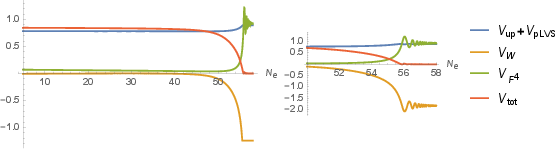
The multifield equations of motion are constructed with the proper field-space metric and full scalar potential, and solved numerically. The effective field shift for each modulus is found to scale as τα2 with τα3 the number of fields, a direct realization of the classic assisted inflation mechanism in a UV-complete string embedding.
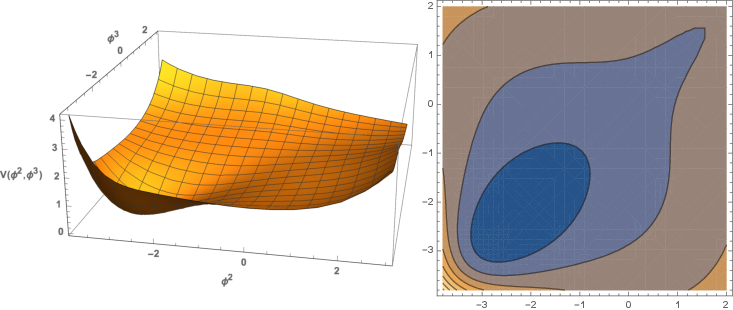
Figure 1: Assisted inflationary track in the τα4 plane while keeping τα5 fixed at its minimum.
The inflationary trajectories are visualized in the moduli plane, showing that the effective collective motion allows the system to follow a flat direction, keeping all fields well within physical Kähler cone limits throughout inflation.
The calculation of cosmological observables for benchmark parameter sets confirms the model's compatibility with current observational bounds: τα6, τα7 (ACT+DESI preferred region), with power spectrum and running within experimental constraints. For these cases, individual moduli excursions are typically τα8, contrasting with the much larger single-field requirements.
Dynamics, Scale Separation, and Robustness
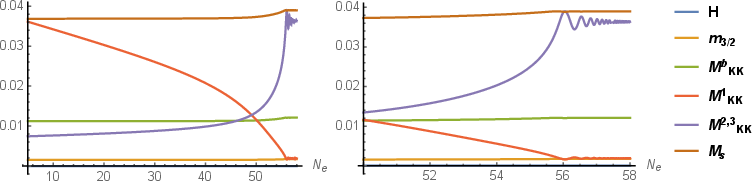
Robustness of moduli stabilization and mass hierarchies is analyzed throughout the inflationary evolution. The volume modulus remains stabilized at high mass, while the lighter Kähler moduli drive inflation. The supergravity control is not lost: all moduli remain inside their allowed region and the mass scales preserve a clear hierarchy
τα9
during the entire inflationary phase, as demonstrated numerically.
Figure 2: Evolution of various contributions to the scalar potential during multifield inflationary dynamics.
Figure 3: Time evolution of the relevant mass scales, ensuring supergravity control is maintained during inflation.
The numerical solutions further establish that the strong dependence of α′30 and α′31 on the field trajectory can be tuned via the model parameters, e.g., string coupling and flux superpotential, offering flexibility for future phenomenological exploration.
Theoretical Implications and Future Directions
This work systematically demonstrates that string-theoretic inflationary models need not rely on non-perturbative Kähler moduli stabilization; with suitable geometry and perturbative corrections, pLVS can realize all required features, broadening the class of suitable compactifications. The multi-moduli realization provides a globally consistent solution to swampland constraints arising from Kähler cone bounds and the swampland distance conjecture, offering new perspectives on the landscape of string cosmology. The flexible parameter space enables further studies of reheating, non-Gaussianity, isocurvature modes, and connections to post-inflationary moduli dynamics.
This structure also allows for future investigation into fractal moduli spaces with larger α′32, model-dependent kinetic couplings, and explicit stringy corrections to the multi-field effective action.
Conclusion
The paper rigorously formulates and globally embeds assisted fibre inflation within type IIB pLVS compactifications. Through explicit global model building, the authors establish that multifield inflation driven by several fibre Kähler moduli yields successful inflationary phenomenology, complies with both geometric and observational constraints, and robustly maintains moduli stabilization. The assisted mechanism mitigates trans-Planckian field shift problems, enabling compatibility with string-theoretic consistency conditions. This construction provides a systematic template for future inflationary model-building in string compactifications, facilitating a more complete interplay between UV-complete theory and cosmological phenomenology.