- The paper reports the first secure detection of a stationary octupole (ℓ=3) sectoral pulsation mode in TIC 287869463, identified by its distinct 6νorb frequency splitting.
- The paper employs automated frequency extraction with Fourier analysis and Monte Carlo tests on TESS light curves to confirm the mode’s nonlinear coupling and stationary nature.
- The paper underscores the implications for asteroseismic modeling and binary evolution by refining our understanding of tidal, Coriolis, and centrifugal perturbations in close binaries.
Discovery of a Stationary Octupole Pulsation Mode in a δ Scuti Star
Context and Motivation
Stellar oscillation theory traditionally employs spherical harmonics to describe pulsation eigenmodes, characterized by radial overtone (n), angular degree (ℓ), and azimuthal order (m). While the Sun’s resolved surface enables direct observation of high-ℓ modes (ℓ≫3), most stars exhibit only low-degree modes due to severe visibility cancellation for ℓ≥3 (2604.18836). Moreover, pulsation axes have historically been assumed to align with stellar rotation axes, except in rare cases like roAp stars—where oblique pulsation and magnetic effects alter mode geometry. Recent observational advances from TESS have enabled discovery of tidally induced and coupled pulsation modes in binary systems, including “tidally tilted” and “tri-axial” pulsators, typically interpreted as being produced by linear combinations and perturbations via tidal, Coriolis, and centrifugal forces.
This paper presents the first secure detection of a stationary octupole (ℓ=3) sectoral mode in a δ Scuti star, TIC 287869463. This mode is a novel eigenmode produced by tidal interactions in a close binary context, unambiguously separated by 6νorb, and cannot be described by tidal tilting around the orbital axes.
Observational Analysis and Mode Identification
A targeted search of 51,820 TESS eclipsing binary light curves with n0 Scuti candidates (n1 between 6500–9000K) led to discovery of an octupole mode in TIC 287869463. Automated frequency extraction and echelle diagram generation revealed two distinct pulsation peaks in the Fourier transform, separated exactly by n2 within n3 precision. Dipole modes split by n4 were also observed.
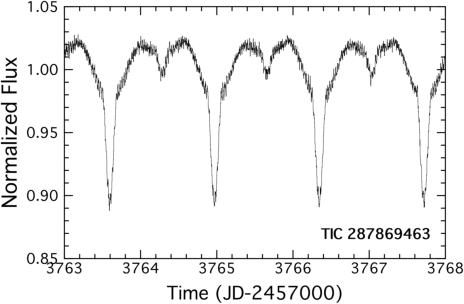
Figure 1: The raw TESS light curve of TIC 287869463, showing prominent pulsations superposed on the binary eclipses, and the Fourier reconstruction after subtraction of orbital harmonics.
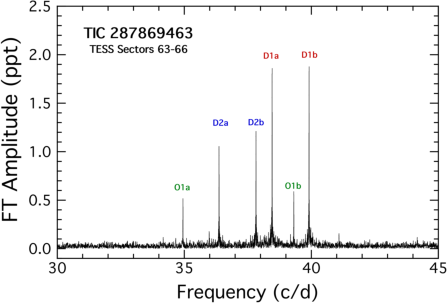
Figure 2: Fourier transform highlighting dipole (D1, D2) and octupole (O1) modes and their frequency separation by integer multiples of n5.
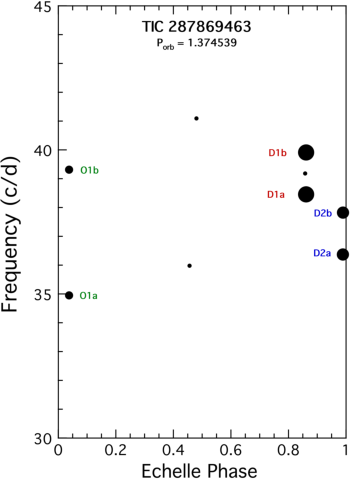
Figure 3: Echelle diagram visualizing frequency splitting as integer multiples of n6, confirming the octupole’s n7 spacing.
Phase tracking across multi-year TESS coverage shows the amplitude and phase variations of mode components are tightly correlated; the n8 mode’s two prominent components maintain constant phase difference near n9 at primary eclipses, evidencing a stationary (non-circulating) eigenmode.
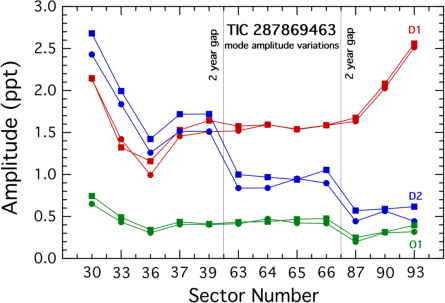
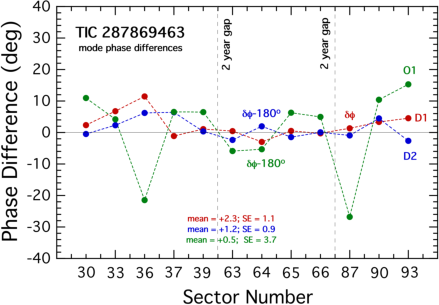
Figure 4: Sector-wise amplitude and phase difference of dipole and octupole mode components, demonstrating invariant geometry and strong correlation.
Amplitude reconstruction as a function of orbital phase reveals that the octupole mode exhibits six maxima and six ℓ0 phase jumps during each orbit, in contrast to two maxima and two jumps for dipole modes.
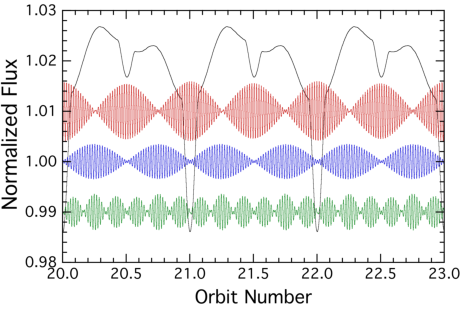
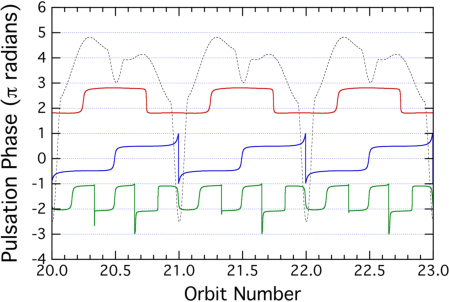
Figure 5: Orbital-phase dependence of pulsation amplitude and phase, confirming the six-fold structure associated with octupole (O1) mode.
Monte Carlo tests and frequency coincidence probability estimate the odds of random alignment for the octupole pair at ℓ1, confirming physical coupling.
Theoretical Interpretation and Simulations
The observed ℓ2 mode is interpreted as a “Fuller mode”—a stationary eigenmode formed from linear combinations of ℓ3 and ℓ4 spherical harmonics, perturbed into a “ℓ5” sectoral mode via binary tidal, Coriolis, and centrifugal interactions. These modes, with axes aligned to the orbital angular momentum, are stationary in the rotating reference frame and have six amplitude maxima per orbit.
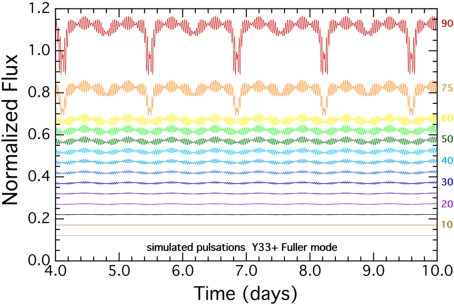
Figure 6: Simulated light curves showing six maxima per orbit for a ℓ6 mode at various orbital inclination angles.
Simulated Fourier transforms distinguish between stationary Fuller modes and tidally tilted modes; only the ℓ7 mode matches the observed frequency multiplet and amplitude modulation.
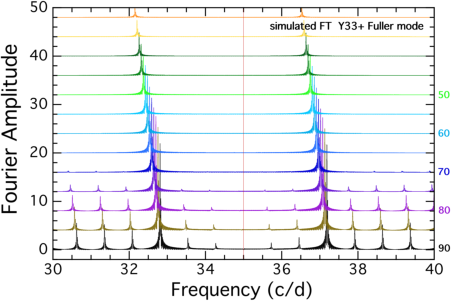
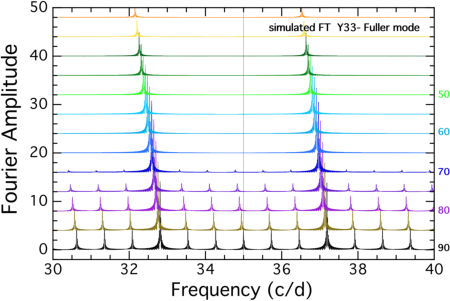
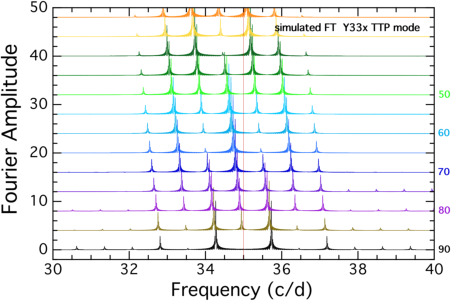
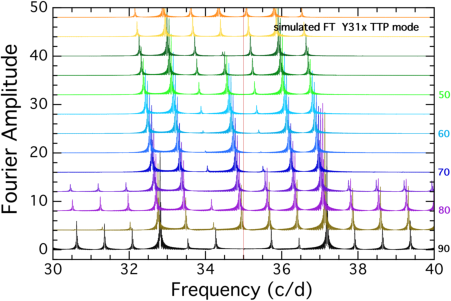
Figure 7: Simulated FTs for a selection of ℓ8 modes, highlighting the ℓ9 mode's distinctive m0 splitting.
Cartographic representations illustrate the surface flux perturbation patterns for m1 and m2 modes at a given observer inclination, further clarifying geometric visibility.
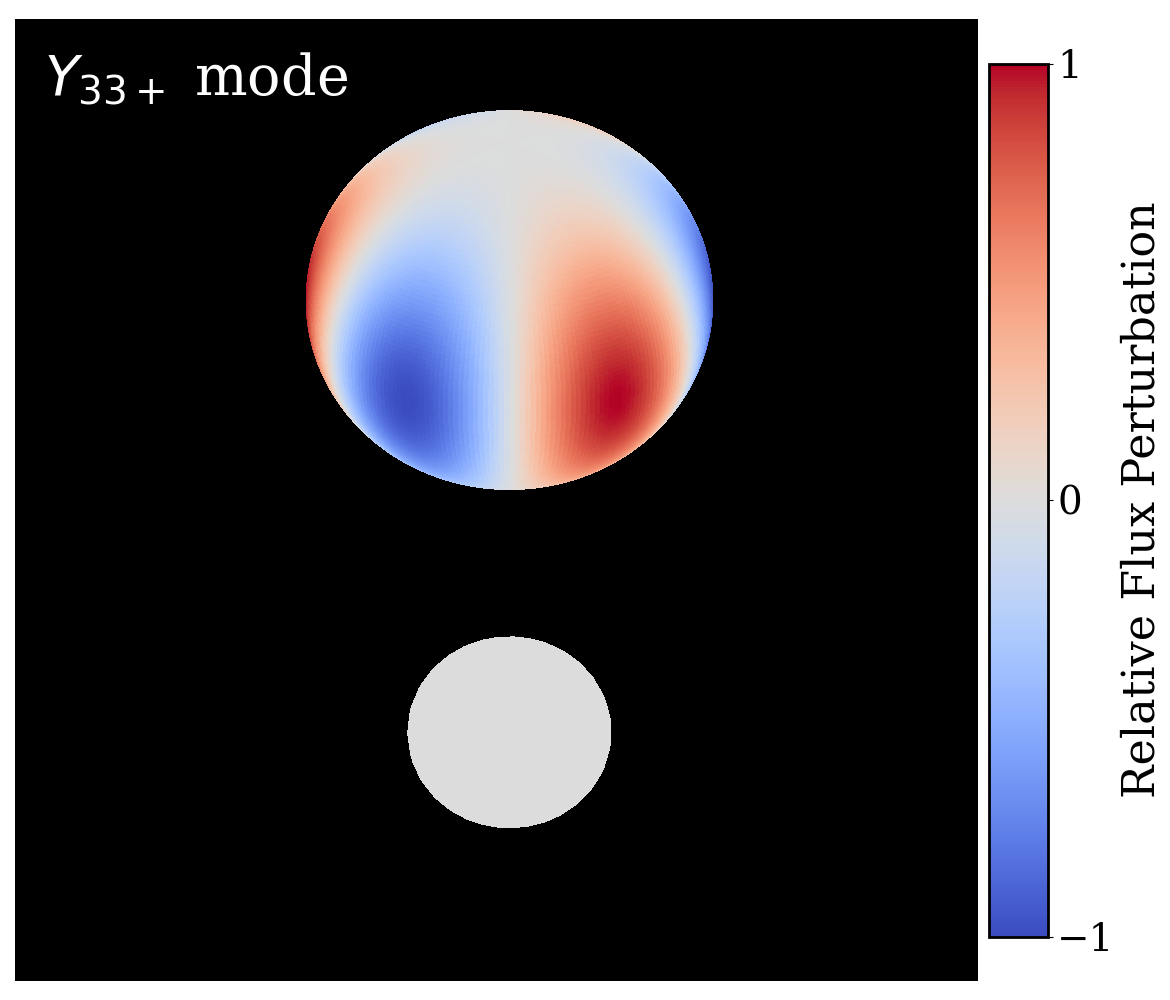
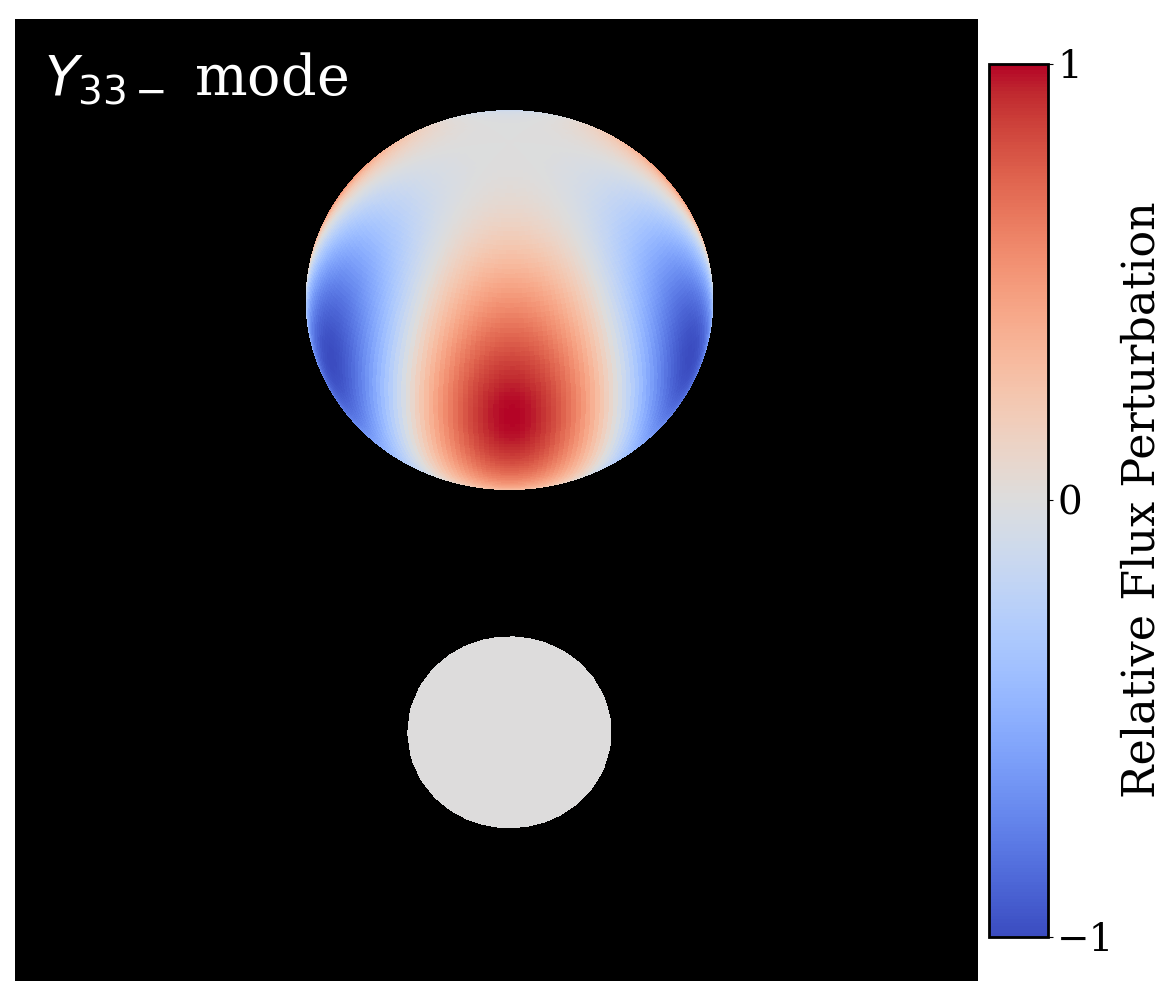
Figure 8: Surface flux perturbation patterns for m3 (top) and m4 (bottom) modes, demonstrating their angular structure and modulation.
Binary System Characterization
Detailed SED fitting and custom light curve modeling yield precise parameters for TIC 287869463. The primary (pulsating) star is m5, m6, and m7K; the secondary is m8, m9, and ℓ0K. Orbital period is ℓ1\,d with inclination ℓ2, at a distance of ℓ3\,pc.
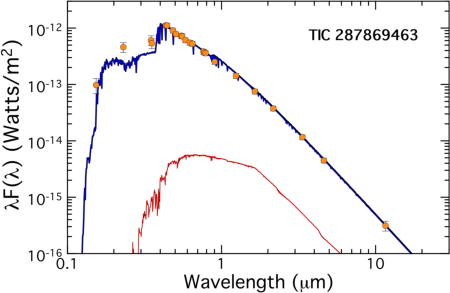
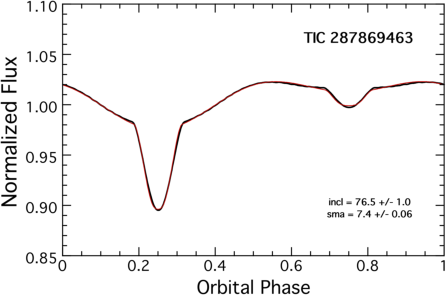
Figure 9: Best-fit SED and light curve model for TIC 287869463, replicating both the composite spectrum and orbital dynamics.
Visibility calculations based on disc-averaging show a sharp decline with ℓ4; for TESS-like red passbands, visibility drops from ℓ5 (dipole) to ℓ6 (octupole), indicating severe geometric cancellation for higher-ℓ7 modes.
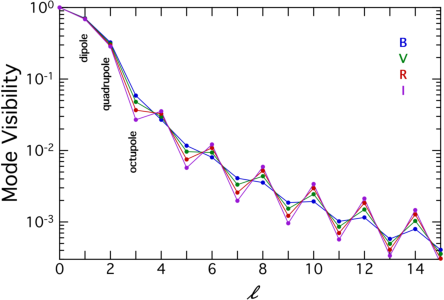
Figure 10: Mode visibility as a function of ℓ8, with octupole visibility notably suppressed compared to dipole and quadrupole modes.
Evolutionary tracks in the HR diagram juxtaposed against derived stellar parameters provide constraints for future seismic modeling.
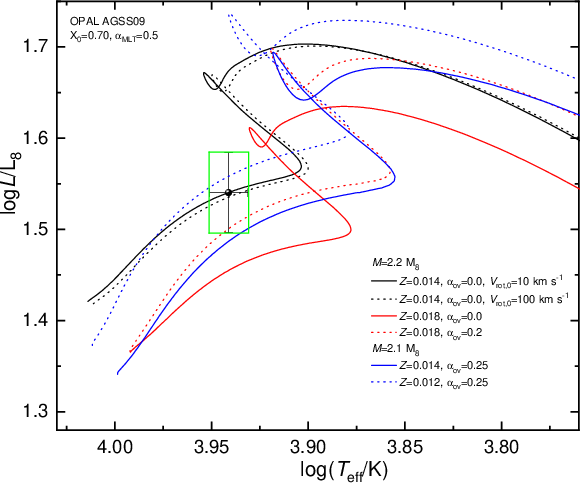
Figure 11: Multiple stellar evolution tracks compared to observed luminosity and ℓ9 of TIC 287869463, supporting mode identification.
Frequency Evolution and Eclipse Timing Variations
Phase tracking analysis reveals steady, monotonic increases in mode frequencies and orbital frequency over the TESS epoch, with frequency splits remaining strictly integer multiples of ℓ≫30. Eclipse timing variation curves (ETVs) for each component and the binary period indicate period decreases, but at non-identical rates—suggesting underlying complex dynamical effects.
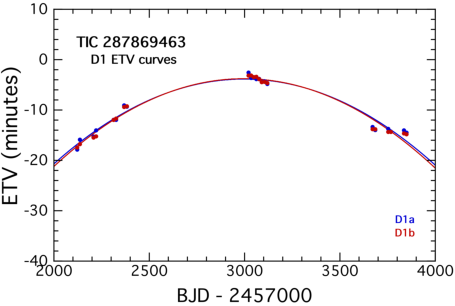
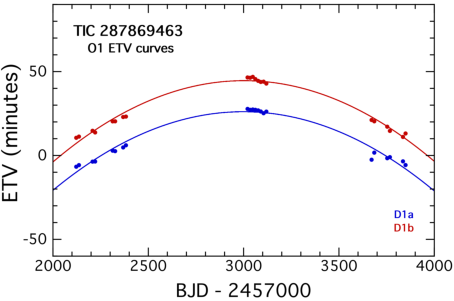
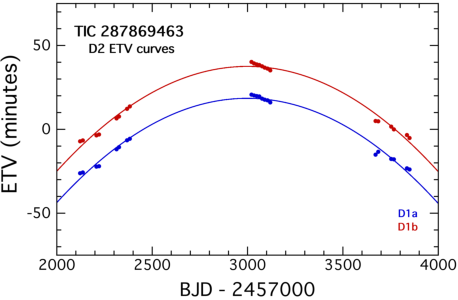
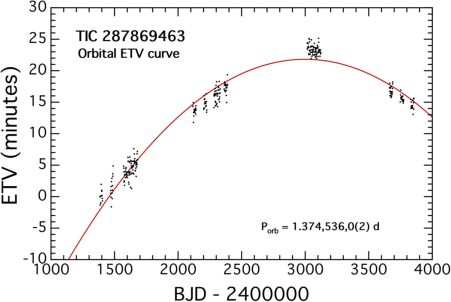
Figure 12: ETV curves for dipole and octupole mode components and the orbital period, indicating non-linear frequency evolution and correlations.
Implications and Future Directions
This discovery formally extends the class of Fuller modes to stationary sectoral ℓ≫31 in ℓ≫32 Scuti binaries, challenging previous interpretations based on simple tidal tilting. Higher-order modes (ℓ≫33) may also be detectable under exceptional circumstances, but geometric cancellation poses significant obstacles for ℓ≫34. Theoretical implications include greater specificity in mode coupling paradigms for close binaries, potential for detailed asteroseismic modeling, and improved understanding of internal angular momentum transfer and stellar evolution in perturbed systems.
Time-series spectroscopy is recommended for radial velocity verification of octupole mode identification. Seismic modeling could yield strong constraints on metallicity, convection parameters, and overshooting distance, exploiting precisely measured stellar properties.
Conclusion
A stationary sectoral octupole (ℓ≫35) mode has been unambiguously identified in TIC 287869463, marking the first such detection in a ℓ≫36 Scuti star and the first stationary ℓ≫37 mode across all stellar types. The mode is formed by tidal, Coriolis, and centrifugal perturbations acting on the orbital axis, producing a distinctive multiplet structure and orbital-phase-dependent amplitude modulation. This work expands the theoretical landscape of binary-induced stellar pulsations, establishes the observational viability of higher-degree modes in non-solar stars, and lays the groundwork for future seismic and dynamical studies of tidally coupled pulsators.