- The paper demonstrates that the holographic Wilson loop obeys an area law, providing quantitative evidence for confinement in a finite duality cascade.
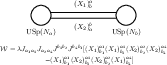
- It constructs tensionful domain walls via D5-branes that yield a supersymmetric YM-CS theory, matching mixed anomaly inflow conditions.
- The absence of massless axionic modes leads to strictly gapped IR vacua, in full agreement with supersymmetry and anomaly cancellation expectations.
Confinement in a Finite Duality Cascade: Holographic Checks and Symmetry Structures
Overview
The paper "Confinement in a finite duality cascade" (2604.18702) investigates the confining dynamics realized in a new holographic dual of a four-dimensional N=1 supersymmetric gauge theory. This theory, constructed via D3-branes at the conifold singularity in the presence of an O7-plane, manifests a finite duality cascade flowing from a UV conformal manifold to a discrete set of fully gapped IR vacua. The work focuses on several non-perturbative probes, including the holographic Wilson loop, the structure and dynamics of domain walls, and the absence of massless axionic modes, providing consistency with field-theoretical expectations for confinement, discrete symmetry breaking, and strict gap formation.
Holographic Wilson Loop and Area Law
The central order parameter for confinement is the Wilson loop in the fundamental representation. The authors employ the holographic prescription following Maldacena's formalism [Maldacena:1998im], adapted to the nontrivial dilaton profile characterizing their supergravity background. The critical result is that the expectation value of the Wilson loop satisfies an area law, yielding a linearly rising potential at large separation:
- The Nambu-Goto action is computed in the string frame, with the dilaton modifying the geometry and effectively preventing the worldsheet from reaching the curvature singularity at τ=0. For infinite separation, the minimal radial coordinate of the string is τ⋆>0, avoiding the singularity entirely.
- Numerical and analytical studies show a crossover behavior: for large L, the loop exhibits strict linear (confinement) scaling, while for small L, conformal-like scaling is modified by logarithms arising from the running gauge coupling.
The dependence of the action S on L across this transition is clearly visualized, demonstrating the crossover from UV conformality to IR confinement:
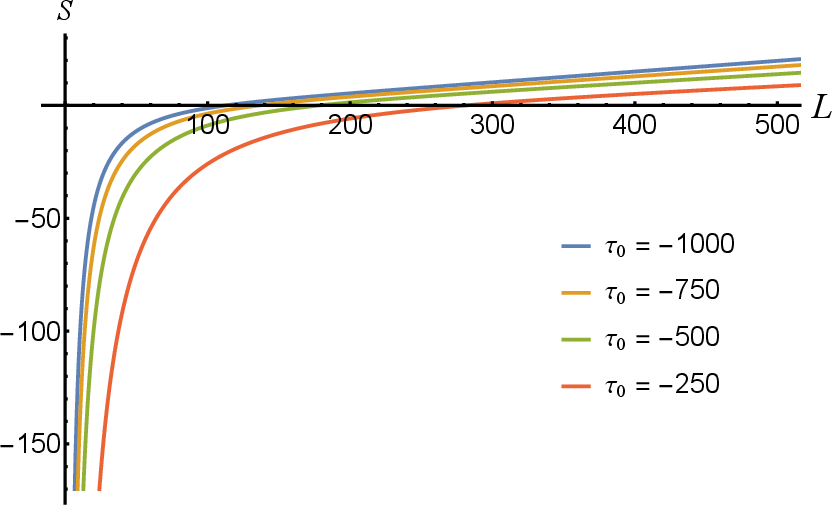
Figure 1: S as a function of L for varying τ0, with an area law realized at large τ=00.
This result solidifies the presence of confinement and τ=01 one-form symmetry preservation in the infrared theory.
Domain Walls and Chern-Simons Structure
The construction and analysis of domain walls between confining vacua is a second pillar of the paper.
- In the gauge theory, τ=02 SYM with USp(τ=03) gauge group exhibits a discrete τ=04 vacuum structure due to spontaneous breaking of a non-anomalous τ=05 R-symmetry. These vacua are separated by tensionful domain walls with codimension-one topological support.
- Field theory requirements, including the mixed 't Hooft anomaly between the discrete axial symmetry and the one-form gauge symmetry [Cordova:2019uob], demand the presence of specific symmetry-protected topological (SPT) structures. Supersymmetry constrains the IR theory on the wall to a YM-CS theory, reducing to a topological CS theory in the deep infrared:
τ=06
The domain wall theory reproduces the predicted mixed anomaly, matching the required inflow action and topological features; its tension minimizes at the tip τ=09, as shown via the explicit DBI computation.
Mass Gap and Axionic String Stability
A critical distinction from models such as Klebanov-Strassler is the strict absence of massless modes in the confining vacuum. The orientifold projection eliminates the baryonic branch responsible for axionic strings:
- The massless axionic string corresponding to the Goldstone mode in KS models is forbidden in the type IIB O7 setup due to instability inherited from type I string theory D-branes via T-duality [Bergman:2000tm].
- Consequently, the IR vacua are strictly gapped, in full agreement with supersymmetry and anomaly constraints.
Asymptotic Expansions and Numerical Analysis
The paper carries out detailed asymptotic expansions of the Wilson loop action in both large and small τ⋆>00 regimes. These results confirm:
- Large τ⋆>01: Divergences in τ⋆>02 and τ⋆>03 cancel in their ratio, yielding a finite confining tension extracted from the maximum of τ⋆>04.
- Small τ⋆>05: Modified Coulomb scaling with logarithmic distortion, consistent with the running coupling approaching the conformal point.
Further figures reinforce these numerical findings:
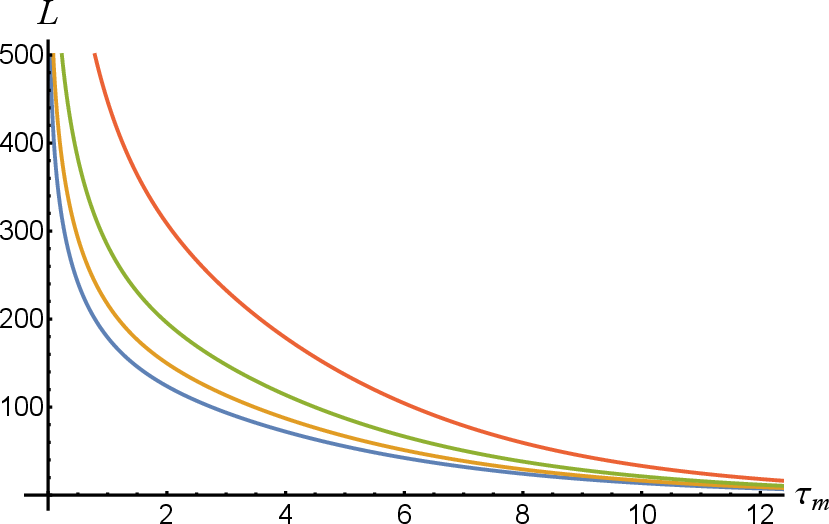
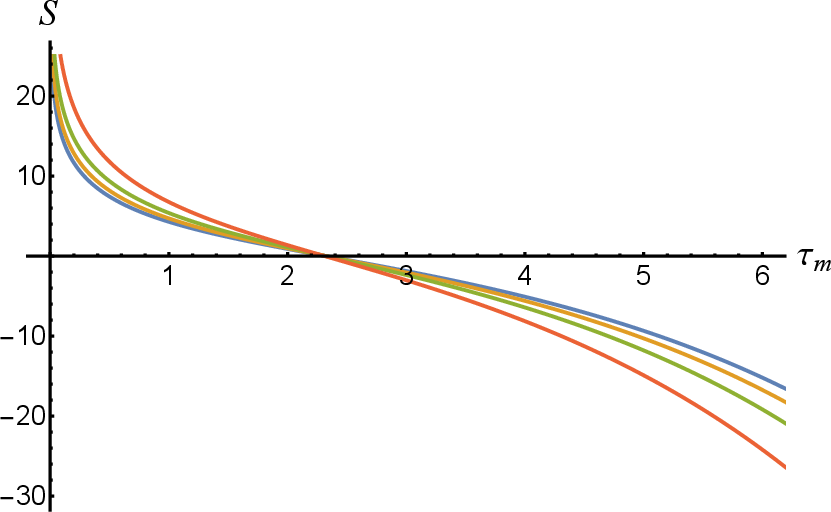
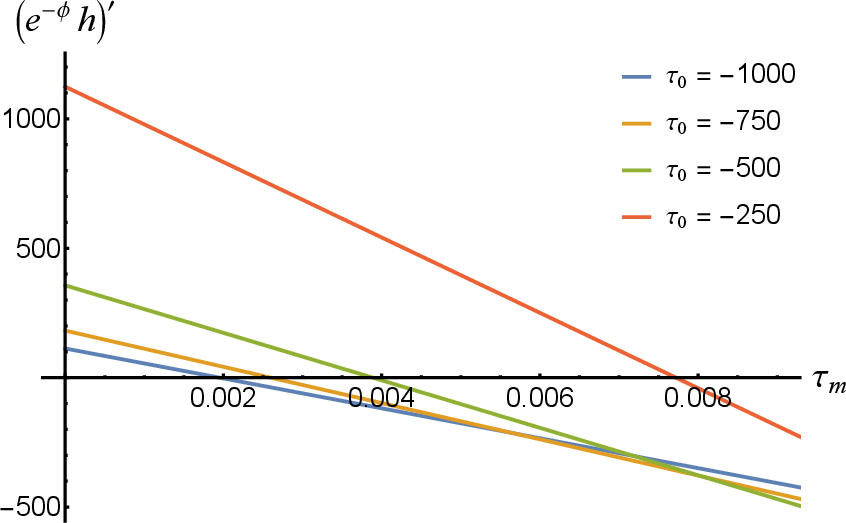
Figure 3: τ⋆>06 as a function of τ⋆>07, illustrating divergent behavior at τ⋆>08.
Implications, Practical and Theoretical
The model constructed here advances the holographic study of confining gauge theories by addressing key deficiencies of prior models:
- UV Completion: The duality cascade terminates at a finite rank, providing a UV fixed point with controlled degrees of freedom, avoiding infinite-rank pathologies.
- Strict Mass Gap: Absence of baryonic directions and associated gapless modes rectifies shortcomings of KS-type vacua.
Practically, this framework paves the way for analytic, non-perturbative access to four-dimensional confining dynamics, including topological defects and symmetry structures, with effective matching to anomaly inflow and global symmetry TFTs. Further development can target the construction of holographic duals for generalized symmetry operators, variant global forms, and their systematic classification—deploying recent progress in Symmetry TFTs [Apruzzi:2021nmk, Freed:2022qnc].
Conclusion
The study rigorously verifies that the orientifolded conifold construction with a finite duality cascade realizes strict confinement, area law behavior, discrete symmetry breaking with domain walls governed by supersymmetric Chern-Simons theory, and a gapped vacuum structure. These results, both analytic and numerical, reconcile holographic duality with field-theoretical anomaly and symmetry requirements, establishing a benchmark for future developments in holographic gauge theories and classification of topological and symmetry defects.