- The paper establishes a unified framework by extending the Hatsugai-Kohmoto model to multi-orbital systems that reveal unconventional magnetic phases.
- It employs momentum-space local Hubbard interactions and perturbative mapping to effective spin models to uncover diverse symmetry-breaking orders.
- The model characterizes d‑wave altermagnetism and odd‑parity orders with distinct spectral signatures, providing benchmarks for numerical simulations.
Generalized Hatsugai-Kohmoto Models: A Framework for Altermagnets and Odd-Parity Magnetism
Introduction
This work introduces and analyzes a generalized multi-orbital Hatsugai-Kohmoto (HK) model to explore the phase structure and physical manifestations of unconventional magnets within exactly solvable settings. HK models, characterized by momentum-space locality and extensive ground-state degeneracy, provide a tractable platform to investigate Mott physics, non-Fermi liquid behavior, and emergent phenomena in strongly interacting itinerant systems. The paper extends the canonical HK model to include multi-orbital interactions and various momentum-space perturbations, elucidating the mechanisms by which altermagnetism and odd-parity magnetism can arise, and examining the resulting spectral and spin properties.
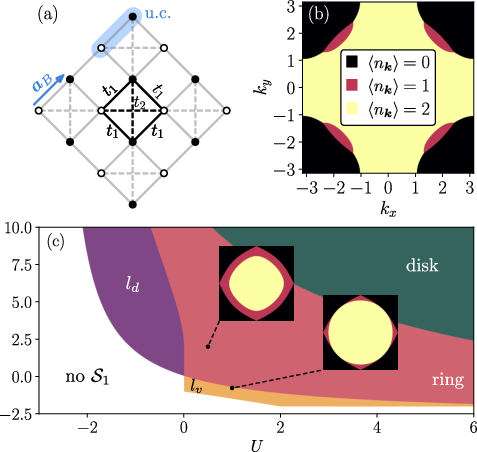
Figure 1: Checkerboard lattice with two sublattices (A, B), nearest (t1) and next-nearest neighbor hopping (t2), and momentum-space ground state occupation structure in the ld regime.
Model Construction and Ground State Characterization
The generalized model studied here is defined on a checkerboard lattice comprising two sublattices with both nearest (t1) and directionally dependent next-nearest neighbor (t2) hopping amplitudes. The Hamiltonian contains momentum-space local Hubbard interactions with intra- and inter-orbital terms (U, U′), leading to a momentum-dependent occupation pattern in the Brillouin zone (BZ). For appropriate parameter choices, the ground state exhibits regions of zero, single, and double occupancy (S0, S1, S2). Crucially, the singly occupied region t20 supports extensive spin degeneracy, with the ground state parametrized by arbitrary spin configurations at each momentum.
The phase diagram of these occupation regions, controlled by t21 and t22, includes simply connected disks, rings, and lobe structures (t23, t24). The latter are especially significant for unconventional magnetic phases.
Emergence of Unconventional Magnetism through Perturbations
Mapping to Momentum-Space Heisenberg Models
To probe symmetry-breaking instabilities, the paper introduces spatially local Hubbard-like perturbations (t25, t26) projected onto the degenerate ground-state manifold. First-order perturbation theory yields an effective dense and frustrated spin-1/2 Heisenberg model in momentum space, with couplings determined by the orbital wavefunctions and interaction structure.
Importantly, the translation symmetry is preserved in this projected subspace, and conventional antiferromagnetic order is not accessible at this level. Instead, the model supports collinear phases with complex spin textures, resolved via classical Ising minimization, leading to various unconventional magnet phases.
Altermagnets and Odd-Parity Magnetism
A salient result is the stabilization of t27-wave altermagnetic order in the t28 regime. This phase breaks time-reversal (t29) but preserves inversion (ld0) symmetry; its order parameter resides on bonds rather than sites, manifesting as alternating spin polarization on nearest-neighbor links (see Figure 2).
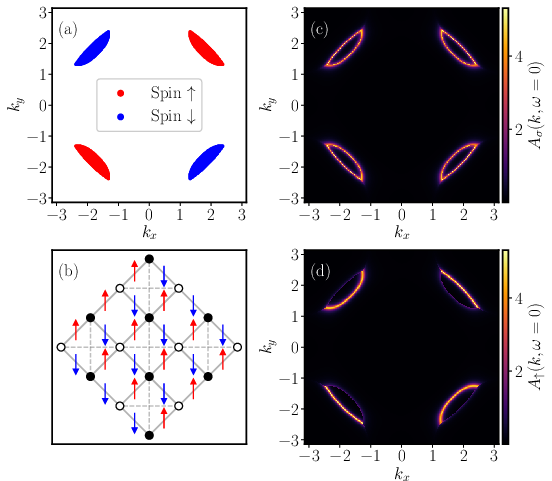
Figure 2: ld1-wave spin configuration stabilized by the perturbation and resulting bond spin order for altermagnets.
The spectral function is demonstrably spin split and anisotropic within the relevant pockets, reflecting the ld2-wave symmetry and the presence of unconventional magnetic order. Other regimes exhibit ld3-wave magnetic order (opposite spin polarization at ld4 and ld5), and conventional ferromagnetism. These phases are systematically catalogued in the phase diagram, with the transition controlled by the sign and spatial structure of the exchange couplings.
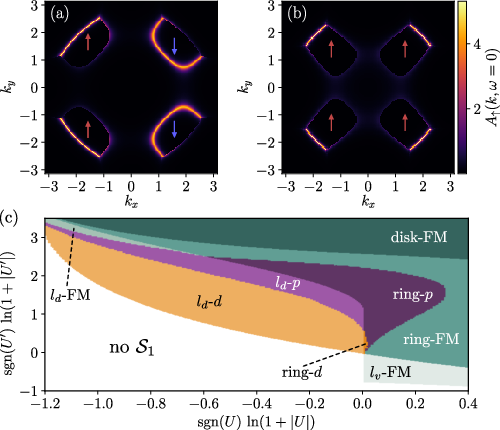
Figure 3: Spin-resolved spectral functions for ld6-wave and ferromagnetic phases, and phase diagram classifying magnetic order types according to the shape of ld7.
Contrasts with Single-Orbital HK Models
Single-orbital HK models, while able to host ring and disk occupation patterns, display a more restricted magnetic phase space, underscoring the versatility of the multi-orbital extension.
The study further incorporates momentum-space cluster interactions that remain compatible with exact diagonalization. For instance, coupling ld8 only to ld9 completely lifts the ground-state degeneracy, producing a unique singlet ground state with suppression of magnetic order.
The spectral function in this regime maintains features reminiscent of unconventional magnets, including gap formation and suppressed low-energy spectral weight, without breaking spin-rotation symmetry. This scenario naturally realizes spectral signatures akin to fractionalized itinerant altermagnets, previously discussed in partonic effective theories [PhysRevResearch.7.023152].
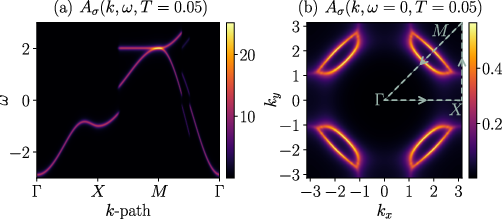
Figure 4: Spectral function for the singlet-ground-state regime, showing gap opening and momentum-dependent structure.
Spin Structure Factor and Correlations
The static spin structure factor is computed for both the symmetry-breaking and singlet regimes. In the singlet phase, ferromagnetic correlations at t10 are exhausted by singlet formation; for cluster-extended interactions (e.g., connecting t11 with t12), antiferromagnetic correlations at finite momentum can be coherently suppressed. Thus, HK-like models provide precise theoretical control over the magnetic correlation landscape.
Implications and Prospects
The results demonstrate that generalized HK models serve as a transparent and exactly solvable framework for exploring unconventional magnetism—including altermagnetic and odd-parity orders—in correlated electronic systems. The ability to control ground-state degeneracy and induce various symmetry-breaking or fractionalized phases via local and cluster-based perturbations enables systematic study of quantum magnetism, spin-rotation symmetry breaking, and correlated spectral phenomena.
Practically, these models provide valuable benchmarks for numerical simulations and theoretical analysis of phenomena that are otherwise intractable in generic strongly correlated systems. Theoretically, the findings raise questions regarding the interplay between unconventional magnetism and pairing, the potential for topological orders in momentum-space-local correlated models, and the extension to higher orbital multiplicities or more exotic perturbations.
Conclusion
The paper establishes a unified framework for exactly solvable HK-like models encompassing multi-orbital, momentum-space-local interactions and controlled perturbations. These models are shown to host a rich variety of unconventional magnet phases with distinctive spectral and spin correlation signatures, as well as unique non-magnetic singlet ground states. The approach sets the stage for future investigations of symmetry-breaking, fractionalization, and interplay of magnetism with superconductivity and topology in strongly correlated quantum matter.
(2604.18684)