- The paper presents a novel approach by translating LTLf+ obligation formulas into deterministic weak automata, enabling efficient synthesis over infinite traces.
- It details symbolic algorithms, including nested fixpoint and SCC-decomposition methods, which reduce synthesis to solving specialized DWA games with quadratic to linear time complexity.
- Experimental analysis demonstrates competitive performance against finite-trace synthesis, highlighting practical scalability and applicability in verification, planning, and control.
Symbolic Synthesis for LTLf+ Obligations: Theory, Algorithms, and Experimental Analysis
Background and Motivation
This paper addresses the symbolic synthesis of strategies for obligation properties specified in LTLf+, an extension of LTLf enabling specification over infinite traces. Obligation properties, characterized as positive Boolean combinations of safety and guarantee (co-safety) properties, occupy the second level in the Manna-Pnueli hierarchy, capturing a broad class of practically relevant specifications. The authors present a translation of obligation LTLf+ formulas into deterministic weak automata (DWA), preserving the algorithmic efficiency and closure properties of deterministic finite automata (DFA), thereby facilitating efficient synthesis algorithms in the infinite-trace setting.
Specification and Temporal Hierarchy
The Manna-Pnueli hierarchy classifies temporal properties over infinite traces into several levels: safety, guarantee, recurrence, persistence, and their Boolean combinations—obligation and reactivity properties. Obligation properties are formed from safety ("always") and guarantee ("eventually") finite-trace LTLf formulas via universal and existential quantification over trace prefixes. The syntax for LTLf+ formulas is layered, focusing here on Boolean formulas constructed from ∀Φ (safety) and ∃Φ (guarantee) components. The obligation fragment is shown to fully capture the class of obligation properties over infinite traces and to be invariant under translations between classical LTL and LTLf+ (2604.18532).
Symbolic DWA Construction and Properties
The paper introduces symbolic algorithms for constructing DWA from obligation LTLf+ formulas. Each finite-trace component f0 is translated via symbolic DFA construction, followed by transformation into a DWA: accepting (guarantee) or rejecting (safety) states are rendered absorbing, resulting in weak SCCs. Boolean closure and efficient (Hopcroft-style) minimization are inherited from DFA theory, and the resultant automata remain exponentially succinct. The final DWA representing the synthesis specification is obtained via symbolic product and closure operations. The structure of constructed DWA exhibits clean partitioning: for f1 finite-trace components, the composed state space is partitioned into f2 regions corresponding to the acceptance of component automata, forming a DAG with fully-accepting or fully-rejecting SCCs.
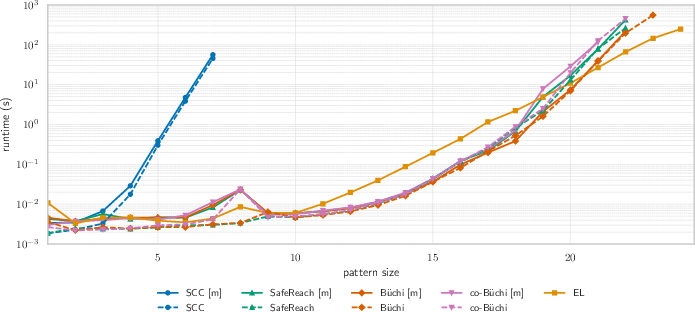
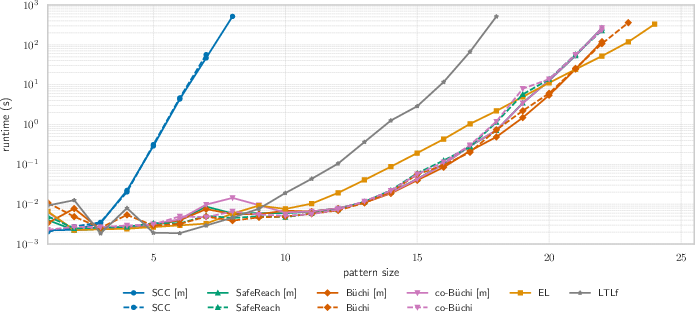
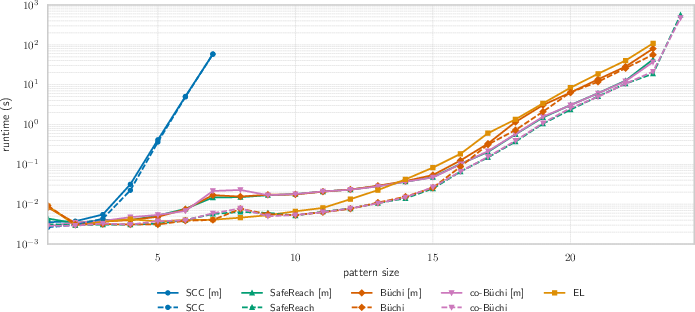
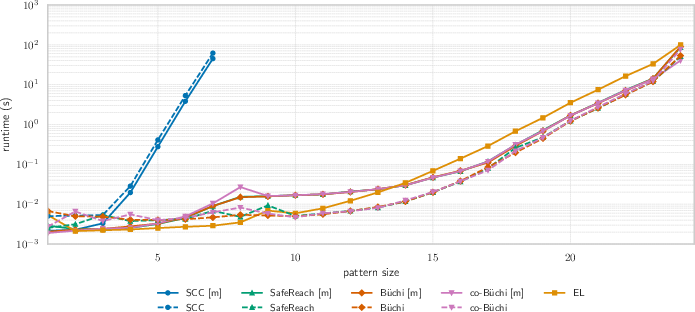
Figure 1: Structural partitioning of DWA state space induced by Boolean combinations of trace quantifiers.
Reduction to DWA Games and Synthesis Algorithms
Synthesis reduces to solving infinite-duration games over DWA, which are a subclass of B\"uchi/co-B\"uchi games with weak acceptance. The paper details several symbolic algorithms:
- Classical nested fixpoint algorithms for B\"uchi/co-B\"uchi game solving (quadratic time).
- An alternating safety and reachability fixpoint algorithm, leveraging monotonicity and convergence properties (quadratic time).
- SCC-decomposition-driven algorithm exploiting the DAG structure of weak automata for linear-time synthesis.
These algorithms operate symbolically on BDD representations and yield memoryless (positional) strategies for the system player, matching the theoretical complexity of finite-trace LTLf3 synthesis [DBLP:journals/ipl/Loding01].
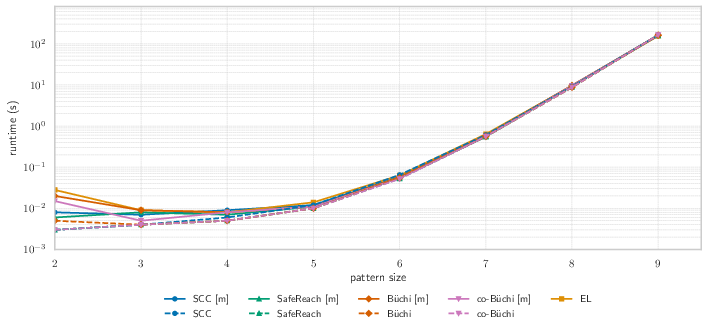
Figure 2: Runtime comparison of solvers on counter pattern f4.
Implementation and Experimental Results
All algorithms are implemented in the LydiaSyft+ framework [10.24963/kr.2025/78], supporting symbolic automata minimization, incremental product construction, and threshold-based switching to symbolic representation. The experiments focus on benchmark patterns—counters, various Boolean conjunction/disjunction combinations of trace quantifiers, and implication patterns—evaluating runtime, state space, BDD sizes, and minimization effects.
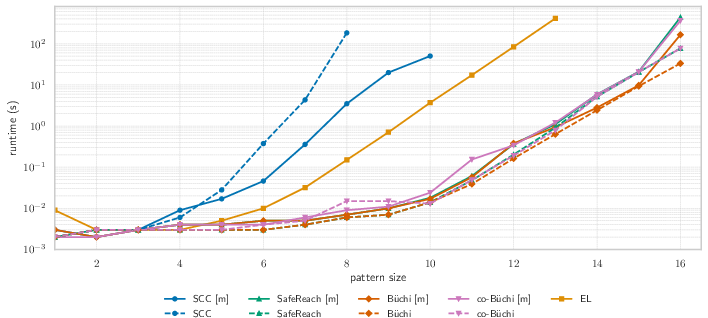
Figure 3: Runtime analysis for solvers on implication pattern benchmarks.
Key experimental findings include:
- Direct symbolic DWA synthesis for obligation LTLf5+ formulas achieves performance comparable to finite-trace LTLf6 synthesis, with DFA construction typically dominating runtime.
- The SCC-based solver benefits from minimization, but its practical impact is mitigated by symbolic representation overhead.
- EL-based methods perform well on conjunctions of guarantee properties due to decomposable objectives; B\"uchi-based solvers excel on implication patterns.
- Minimization yields variable results depending on domain structure and BDD encoding.
Implications and Future Directions
The paper demonstrates that the structural simplicity of DWA automata and games enables highly efficient synthesis for infinite-trace obligation properties, matching the algorithmic performance of LTLf7 synthesis. This significantly broadens practical synthesis capability, supporting specifications common in verification, planning, and declarative control knowledge. Theoretically, the approach provides a pathway for compositional and symbolic treatment of higher levels in the temporal hierarchy, potentially including recurrence and persistence properties.
The f8 automata size bound is optimal for general LTLf9+ formulas but may be improved for restricted fragments or with compositional minimization strategies. Advances in symbolic SCC decomposition, perhaps inspired by SPOT’s MTBDD-based approaches [DuretLutzZPGV25], could further reduce practical overheads and enable applications in data-aware systems, generalized planning, and modular synthesis.
Conclusion
Symbolic translation and synthesis for obligation LTLf0+ properties via deterministic weak automata provide both a theoretically elegant and practically scalable approach, as substantiated by thorough algorithmic and experimental investigation. The closure, minimization, and game-solving properties inherited from DFA theory directly extend to infinite-trace settings for obligation specifications, yielding synthesis algorithms with robust complexity guarantees and real-world applicability. Future work may extend these techniques to richer fragments and explore integration with planning and verification systems, maintaining compositional symbolic efficiency throughout.