- The paper introduces an automated rule library learning pipeline (E²I workflow) that systematically mines optimization patterns from diverse RTL code pairs.
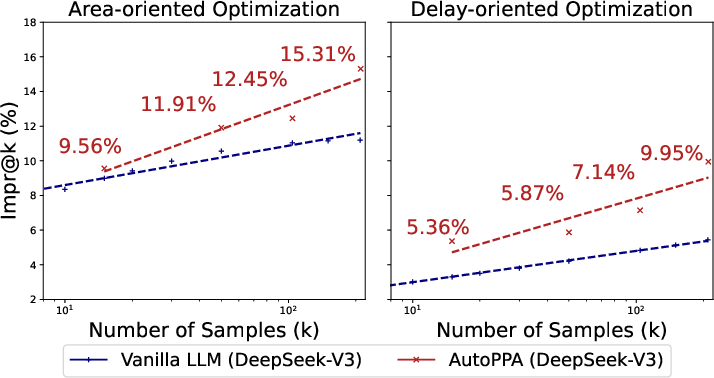
- It achieves up to 15.31% area and 11.28% delay improvements over manual methods by integrating adaptive retrieval and rule-based beam search.
- The research demonstrates scalable, context-aware optimization across various benchmarks using LLMs and modern EDA tools.
AutoPPA: Automated Circuit PPA Optimization via Contrastive Code-based Rule Library Learning
Motivation and Problem Statement
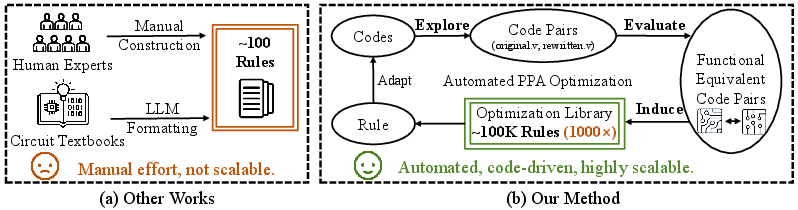
Performance, power, and area (PPA) optimization at the register-transfer level (RTL) is central to high-quality IC design, requiring nuanced knowledge of circuit structure-function relationships. Prior attempts to automate RTL optimization via LLMs have been constrained either by insufficient circuit-structure understanding (feedback-based) or by limited scalability of manually curated rule bases (knowledge-based). The central question addressed by "AutoPPA: Automated Circuit PPA Optimization via Contrastive Code-based Rule Library Learning" (2604.18445) is whether scalable, reusable PPA optimization knowledge can be induced automatically—directly from raw RTL code—without human intervention or prior knowledge.
Contrastive Code-based Rule Library Learning
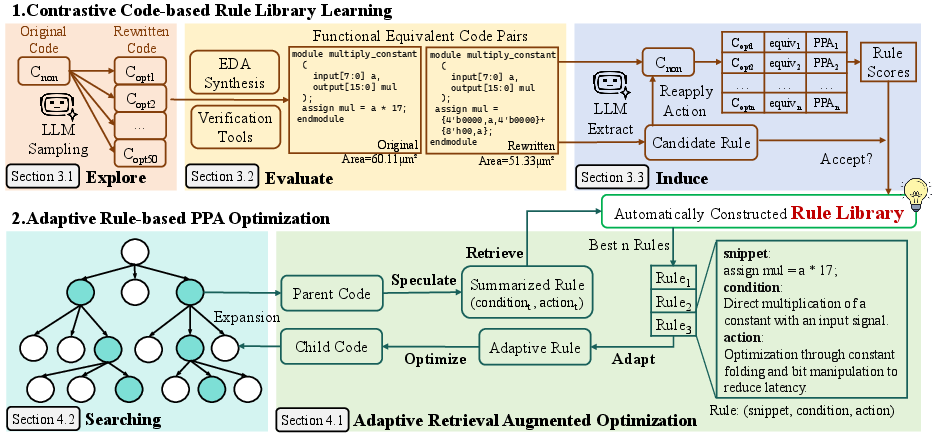
AutoPPA introduces a fully automated rule library learning pipeline, the Explore-Evaluate-Induce (E2I) workflow, designed to systematically mine high-impact optimization patterns from broadly sampled functionally equivalent RTL code pairs:
Adaptive Rule-based PPA Optimization
AutoPPA’s optimization engine comprises a retrieval-augmented, multi-step search framework:
Experimental Results
Comprehensive evaluation is performed across 60 benchmark designs (including large, practical modules), with metrics sourced from both open-source and commercial EDA toolchains (Yosys/OpenSTA, SiliconCompiler, Design Compiler), and spanning process nodes from 12nm to 65nm.
Key findings:
Implications and Theoretical Impact
AutoPPA shifts the paradigm of RTL optimization by demonstrating that contrastive code generation can synthesize domain knowledge at scale, obviating the need for manual expert rule curation. The automated induction of (snippet, condition, action) triples bears resemblance to emergent program analysis, but leverages LLMs to both generate diverse code samples and abstract rules. The adaptive retrieval/search strategy ensures that rule application is context-aware and multi-step, overcoming abstraction gaps between generic rules and design-specific optimizations.
Practically, AutoPPA considerably increases productivity and optimization magnitude compared to both manual and previous LLM-based methods. The approach is process-agnostic, scalable, and compatible with contemporary EDA flows. Theoretically, AutoPPA's workflow advances the automation of hardware-specific code reasoning, and its success in domain rule induction suggests broader applicability in logic synthesis, system-level optimization, and co-design tasks.
Future Directions
Several future avenues are suggested:
- Extension to Physical Design: Applying inductive rule learning to layout/timing closure and cross-stage EDA optimization.
- Cross-domain Rule Transfer: Investigating transferability of rules across process nodes, architectures, and design styles.
- Integration with RL and Search Algorithms: Combining contrastive learning with RL methods to optimize search landscapes.
- Improved LLM Backbones: Scaling to larger, more domain-specific LLMs, as well as hybrid models integrating symbolic and neural reasoning.
Conclusion
AutoPPA establishes a fully automated workflow for RTL PPA optimization by mining a high-quality rule library directly from raw code and enabling context-aware, iterative optimization via LLMs. Geometric improvements in area and delay, surpassing both expert and prior SOTA methods, are demonstrated. The method resolves scalability, abstraction, and applicability challenges of prior approaches, opening new directions for automated, knowledge-driven EDA.