- The paper introduces a robust conformal prediction framework using half-mass radii as a non-conformity score to achieve finite-sample validity even with atypical data points.
- It demonstrates that the conformal prediction region converges to a central set with an O(√(log n/n)) rate and exponential concentration bounds.
- The approach offers a computationally efficient, geometrically interpretable method for set estimation in high-dimensional, heavy-tailed, and contaminated datasets.
Introduction and Motivation
The paper "Conformal Robust Set Estimation" (2604.18441) addresses the intersection of robust geometric inference and conformal prediction. Traditional conformal prediction methods provide finite-sample, distribution-free coverage guarantees under exchangeability but often lack robustness—especially in the presence of outliers, heavy-tailed distributions, or multi-modal structure. Commonly used residual-based non-conformity scores can yield prediction sets that are overly conservative and strongly influenced by a small fraction of atypical points.
This work introduces a robust conformal prediction framework leveraging the half-mass radius—a geometric functional representing the distance from a point to its (⌊n/2⌋+1)-nearest neighbor (denoted k-NN). This score corresponds to an empirical version of the distance-to-a-measure functional, δP, known for its stability under data perturbations and robustness to contamination, making it a principled candidate for robust non-conformity evaluation.
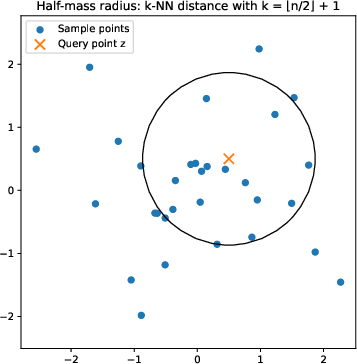
Figure 1: Illustration of the half-mass radius; the circle centered at z has radius equal to the distance to its k-NN, coinciding with the non-conformity score A(B,z).
Theoretical Foundations and Methodology
The central methodological innovation is the adoption of the half-mass radius as the non-conformity score:
A(B,z)=I⊂B:∣I∣>n/2minXi∈Imax∥z−Xi∥.
It is shown that A(B,z) is equivalent to the k-NN distance, affording computational tractability and direct geometric interpretation.
The conformal prediction region γα(ℵn) constructed via this score is shown to converge (in probability) to a robust population central set, identified by
k0
where k1 is selected such that k2.
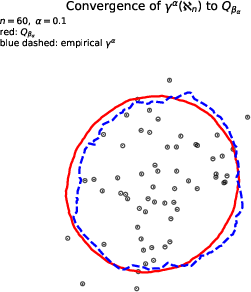
Figure 2: Geometric convergence of k3 to the population robust central set k4 for a 2D Gaussian distribution.
The authors establish exponential concentration and tail bounds for the deviation between k5 and k6, including explicit probabilistic control leveraging VC theory and concentration inequalities. Under mild regularity assumptions (margin condition on k7), the convergence rate is shown to be k8 in Hausdorff distance.
Geometric Representation and Computational Aspects
A substantive part of the analysis is devoted to geometric representations and computational descriptions of empirical central sets:
k9
with δP0 the empirical measure. This set can be equivalently described as the collection of points contained in at least δP1 balls of radius δP2 centered at sample points.
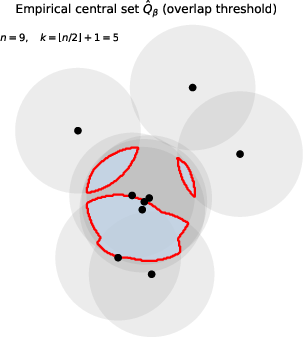
Figure 3: Each translucent disc is δP3; the shaded region covers points included in at least δP4 balls, defining δP5.
An efficient inner approximation is constructed using local radii δP6 (distance from δP7 to its δP8-NN in δP9), enabling the construction of certified balls z0. This facilitates practical estimation and robust coverage for large-scale or high-dimensional data.
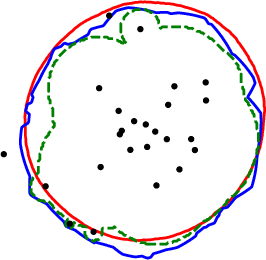
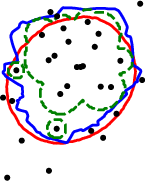
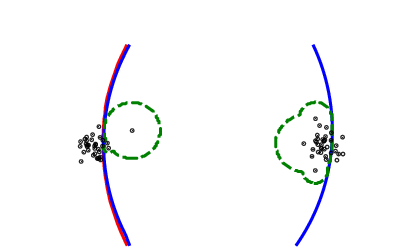
Figure 4: Comparison between z1 (red), z2 (blue), and a conservative inner proxy (green), demonstrating geometric convergence and robust core approximation.
Numerical Results and Claims
Strong numerical results are provided regarding geometric consistency. It is proven that under the margin condition, z3 converges to z4 in symmetric difference probability and in Hausdorff distance. The probability of a discrepancy can be bounded via binomial tail bounds, yielding exponential convergence rates. The robust geometric approach is shown to be uniformly valid in finite samples and asymptotically targets a population central region that is insensitive to outliers and heavy-tailed behavior.
A bold claim made is that the use of geometric half-mass radii in conformal prediction provides not only marginal validity but also robust and geometrically meaningful convergence guarantees, outperforming classical residual-based scores especially in non-ideal settings.
Implications and Future Directions
Practically, the framework enables robust set estimation for predictive inference tasks in the presence of challenging distributional features. The approach admits extension to functional settings, manifold-valued data, time series, and applications demanding high robustness, such as anomaly detection or trustworthy AI systems.
Theoretically, the link between conformal calibration and geometric inference deepens, suggesting new research avenues into robust non-conformity scoring, efficient representations of central sets, and computational methods for set estimation in large or complex domains. Integration with topological data analysis and robust statistics provides additional opportunities for advancing uncertainty quantification mechanisms in high-dimensional inference.
Further developments may focus on scalable algorithms for z5-NN-based conformal regions, adaptive selection of z6, and broader generalizations of geometric functionals in structured or non-Euclidean spaces relevant to AI and data science.
Conclusion
"Conformal Robust Set Estimation" (2604.18441) rigorously formulates and analyzes a robust conformal prediction scheme based on geometric half-mass radii. The method achieves finite-sample validity, geometric consistency, and robustness to distributional irregularities, providing theoretical guarantees and practical computational strategies. The integration of robust geometric statistics into conformal frameworks delivers both principled and practical advances for set estimation and predictive inference in modern statistical and machine learning contexts.

