- The paper introduces adaptive kernel selection methods (variational and cross-validation approaches) that optimize kernel mixtures to improve eigenfunction recovery in KDM.
- Key contributions include differentiable optimization through the eigenproblem and scalable selection via random Fourier features for high-dimensional dynamical data.
- The work provides theoretical guarantees on operator stability and empirical evidence that adaptive methods outperform fixed Gaussian kernels across various dynamical settings.
Adaptive Kernel Selection for Kernelized Diffusion Maps
Introduction and Motivation
Kernelized Diffusion Maps (KDM) are spectral methods for identifying slow collective variables, metastable structures, and low-dimensional manifolds in high-dimensional dynamical datasets. The accuracy of KDM is determined by the choice of kernel, which governs both the geometry imposed on the data and the regularity properties of the spectral embedding. A critical challenge addressed in "Adaptive Kernel Selection for Kernelized Diffusion Maps" (2604.18402) is how to select or adapt this kernel from data to maximize the accuracy and stability of KDM eigenfunctions—particularly in the presence of noise and for complex dynamical processes where a fixed kernel leads to suboptimal representations.
The paper introduces two complementary approaches for adaptive kernel selection in KDM: (1) a differentiable variational outer-loop for learning continuous kernel mixtures via automatic differentiation through the Cholesky-reduced KDM eigenproblem, and (2) an unsupervised cross-validation (CV) pipeline that performs model selection across multiple kernel families and bandwidths, leveraging random Fourier features (RFF) for scalability. A unified operator-theoretic analysis establishes continuity, stability, and consistency guarantees for these adaptive schemes.
Theoretical Framework
Background: KDM and Spectral Estimation
Kernelized Diffusion Maps (KDM) generalize diffusion maps by approximating the operator spectrum in a reproducing kernel Hilbert space (RKHS) [pmlr-v195-pillaud-vivien23a]. KDM constructs a pair of empirical operators—a covariance operator and an RKHS-based Dirichlet gradient operator—whose generalized eigenproblem yields eigenfunctions approximating those of the underlying generator or Laplace–Beltrami operator. This setting enables dimension-free statistical rates and flexible numerical approximations (Nyström, RFF), making kernel selection a central issue.
Adaptive Kernel Parameterization
The core idea of kernel adaptation is to optimize over a dictionary of base kernels {kℓ} via convex mixtures
kβ(x,y)=ℓ=1∑Lβℓkℓ(x,y),β∈ΔL,
where ΔL is the probability simplex. The mixture kernel norm is characterized by an infimal-convolution form, which justifies RKHS penalties when learning β.
Variational and Cross-Validation Pipelines
- Variational Multiple Kernel Learning (VMKL): The method differentiates through the KDM eigenproblem with respect to kernel mixture parameters. The outer objective combines eigenvalue maximization, RKHS regularization, and eigenfunction orthonormality losses (with generator residuals optionally included for dynamical systems). The entire pipeline is implemented with autodifferentiation-enabled solvers.
- Cross-Validated Model Selection with RFF: To escape the local optima of continuous optimization, the CV pipeline performs discrete selection over multiple kernel families (Gaussian, Matérn-3/2, Rational Quadratic, Laplacian) and a sweeping range of bandwidths, evaluating on a held-out eigenvalue-sum or spectral-gap score. RFFs provide efficient high-dimensional approximations without the computational bottlenecks of Nyström derivatives.
Operator-Theoretic Guarantees
- Lipschitz continuity of operators: The dependence of the KDM operators on kernel weights is Lipschitz on the simplex. This guarantees smoothness of the KDM spectrum under kernel mixture adaptation.
- Spectral projector stability: Under a uniform eigengap, the leading projector of the operator is stable with respect to kernel perturbations.
- Consistency of CV selector: The cross-validated selector achieves exponential consistency over a finite kernel dictionary, provided concentration and margin conditions on the operator spectrum hold.
- Residual-control theorem: A fundamental result links the generator residual norm to the distance from the estimated subspace to the true eigenspace. Thus, minimizing generator residuals serves as a rigorous certificate of spectral proximity when incorporated into the loss.
Empirical Results
Rigorous experiments across Ornstein–Uhlenbeck processes (OU, in 2D, 3D, and d=10…20), double-well potentials, and noisy circle manifolds systematically analyze kernel adaptation strategies. The critical finding is that kernel adaptation—by either CV+RFF or VMKL variational pipelines—consistently yields stronger eigenfunction recovery compared to fixed (uniform) Gaussian kernels.
Illustrative Recovery on 1D Potentials
The CV-selected kernel precisely tracks the leading modes of the reference operator, providing tightly matched eigenfunctions:
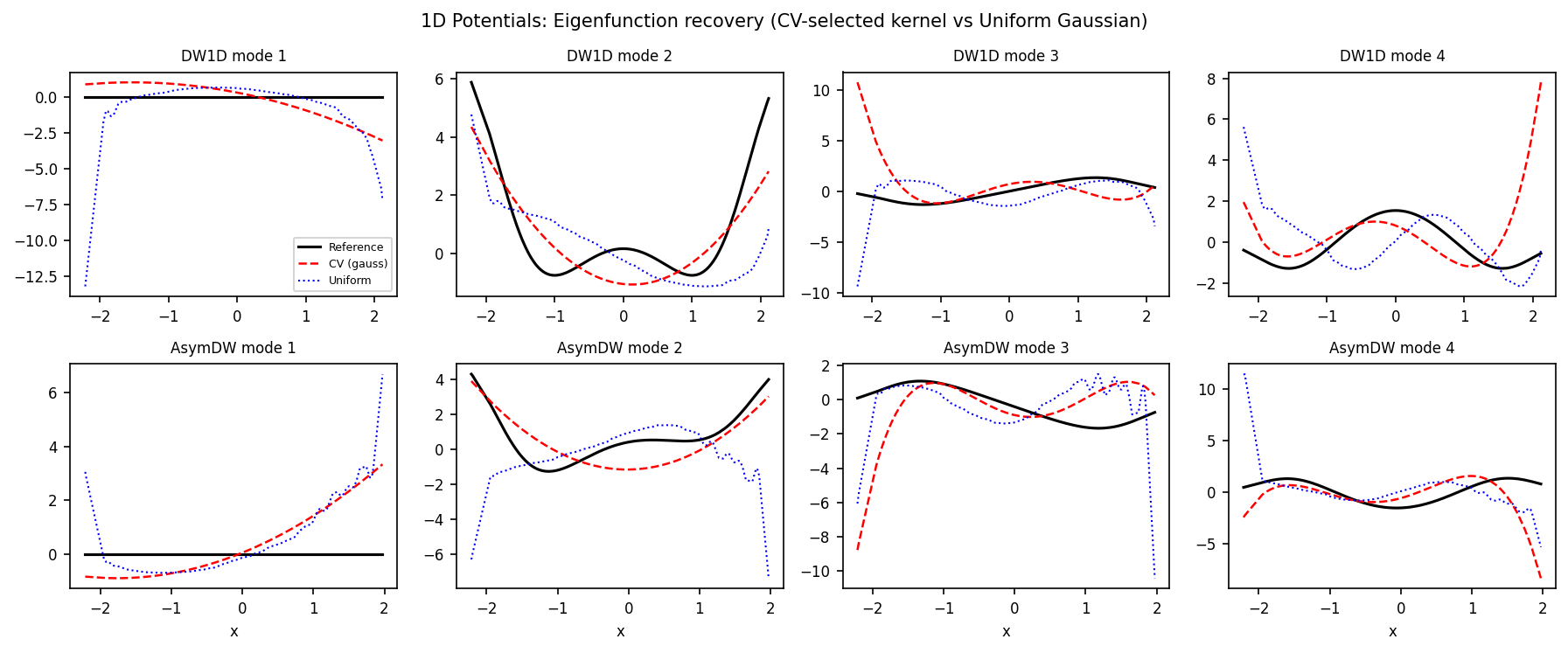
Figure 1: 1D potentials—reference (black) vs CV-selected kernel (red dashed) vs Uniform Gaussian (blue dotted). The CV kernel accurately captures modes 1–3.
High-Dimensional Dynamical Processes
On 2D and 3D OU processes, the CV+RFF pipeline—automatically selecting non-Gaussian kernels (notably Matérn-3/2)—achieves SubR2 scores of 0.98+, indicating almost perfect eigenspace recovery:
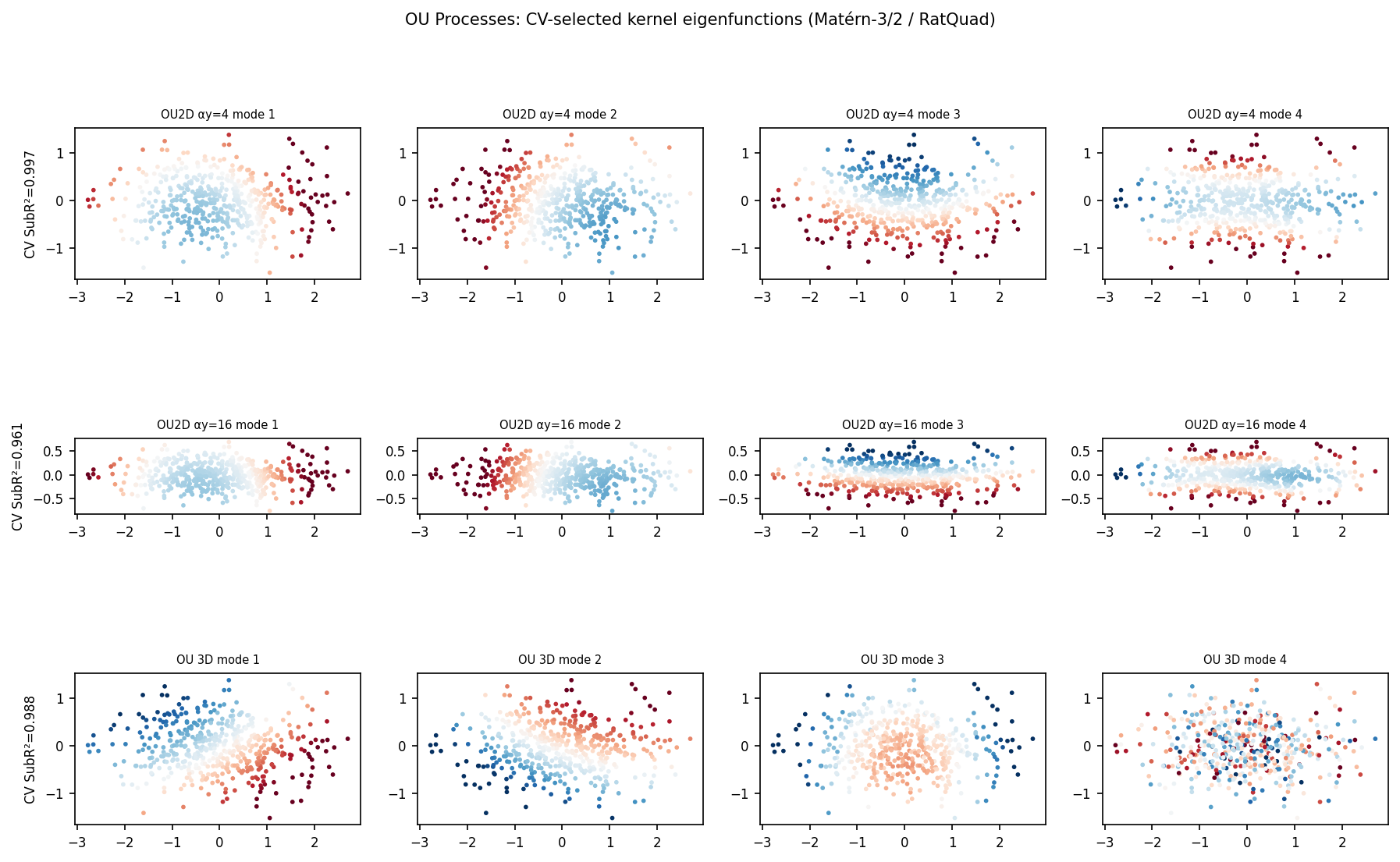
Figure 2: OU processes—CV-selected eigenfunctions, demonstrating SubR2>0.98 with automatic adaptation.
This performance is robust to increased sample size and persists in higher dimensions (d=10,20), with adaptive kernel selection yielding 1.5–2× lower subspace errors than uniform Gaussian baselines, even with matched RFF feature budgets.
Circle Manifold and Noise Regimes
On S1 with noise, the difference between adaptive and uniform kernels narrows, reflecting the geometric simplicity. However, the variational approach can outperform CV+RFF via fine-tuned bandwidth learning when the eigenvalue-sum CV score becomes biased.
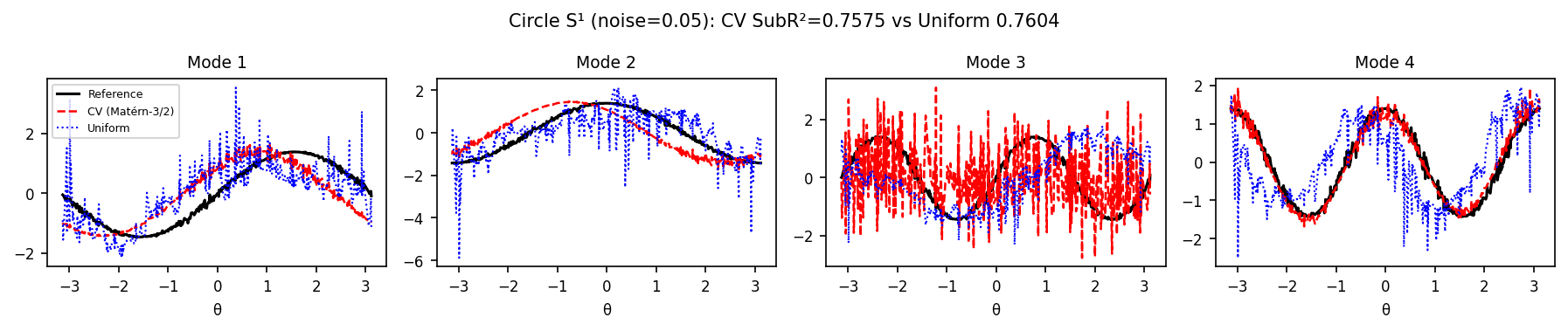
Figure 3: Circle kβ(x,y)=ℓ=1∑Lβℓkℓ(x,y),β∈ΔL,0: learned eigenfunctions as a function of angle with adaptive kernel selection.
Residual Analysis and Higher-Order Modes
The kernel adaptation schemes yield lower eigenfunction residuals, especially for higher modes, reflecting higher-fidelity spectral recovery:
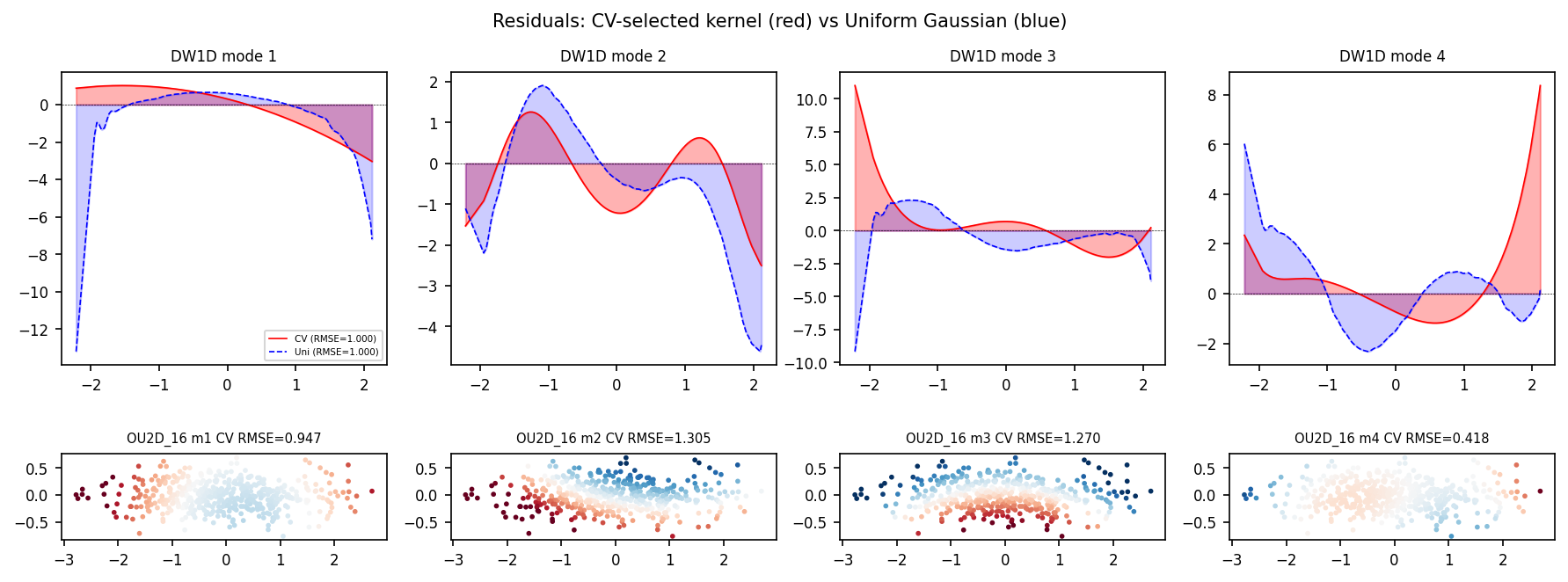
Figure 4: Residuals between KDM and reference eigenfunctions for DW1D and OU2D. The CV-selected kernel yields smaller errors, especially on subdominant modes.
Summary metrics confirm that adaptive pipelines consistently outperform uniform baselines for a variety of dynamical and geometric settings:
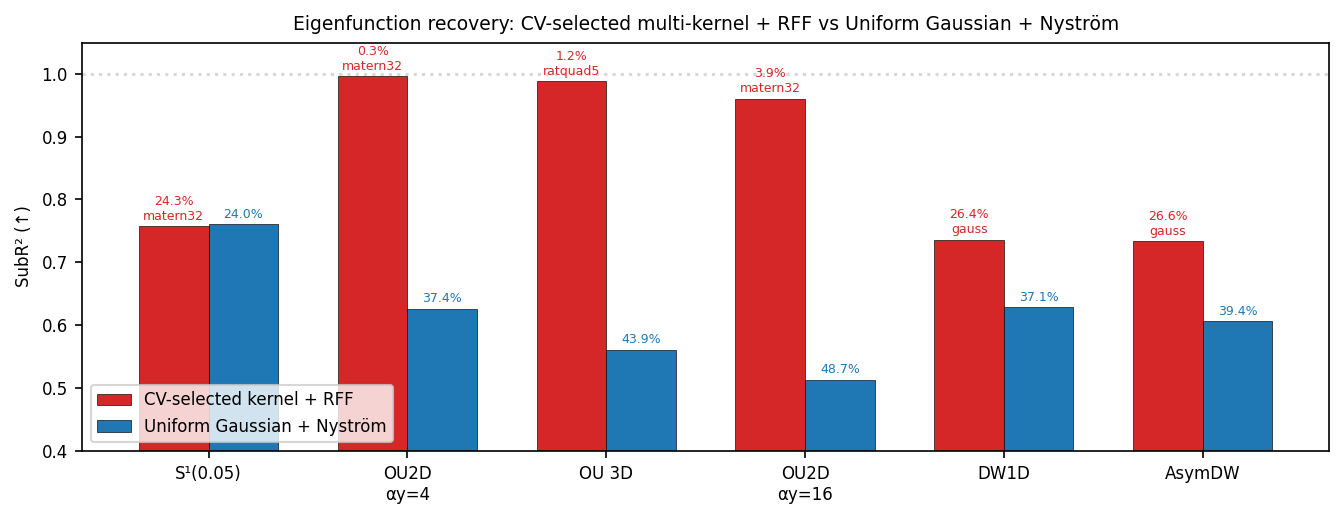
Figure 5: Summary of SubRkβ(x,y)=ℓ=1∑Lβℓkℓ(x,y),β∈ΔL,1 across all problems. Red bars (CV+RFF) systematically exceed blue bars (Uniform+Nyström), with explicit percentage improvements.
Kernel Family Selection Landscape
The cross-validated eigenvalue-sum score landscape reveals that Matérn-3/2 kernels dominate for OU-type problems at large bandwidths, whereas Gaussian kernels are preferred for 1D potentials. This kernel-family adaptation is automatic and data-driven.
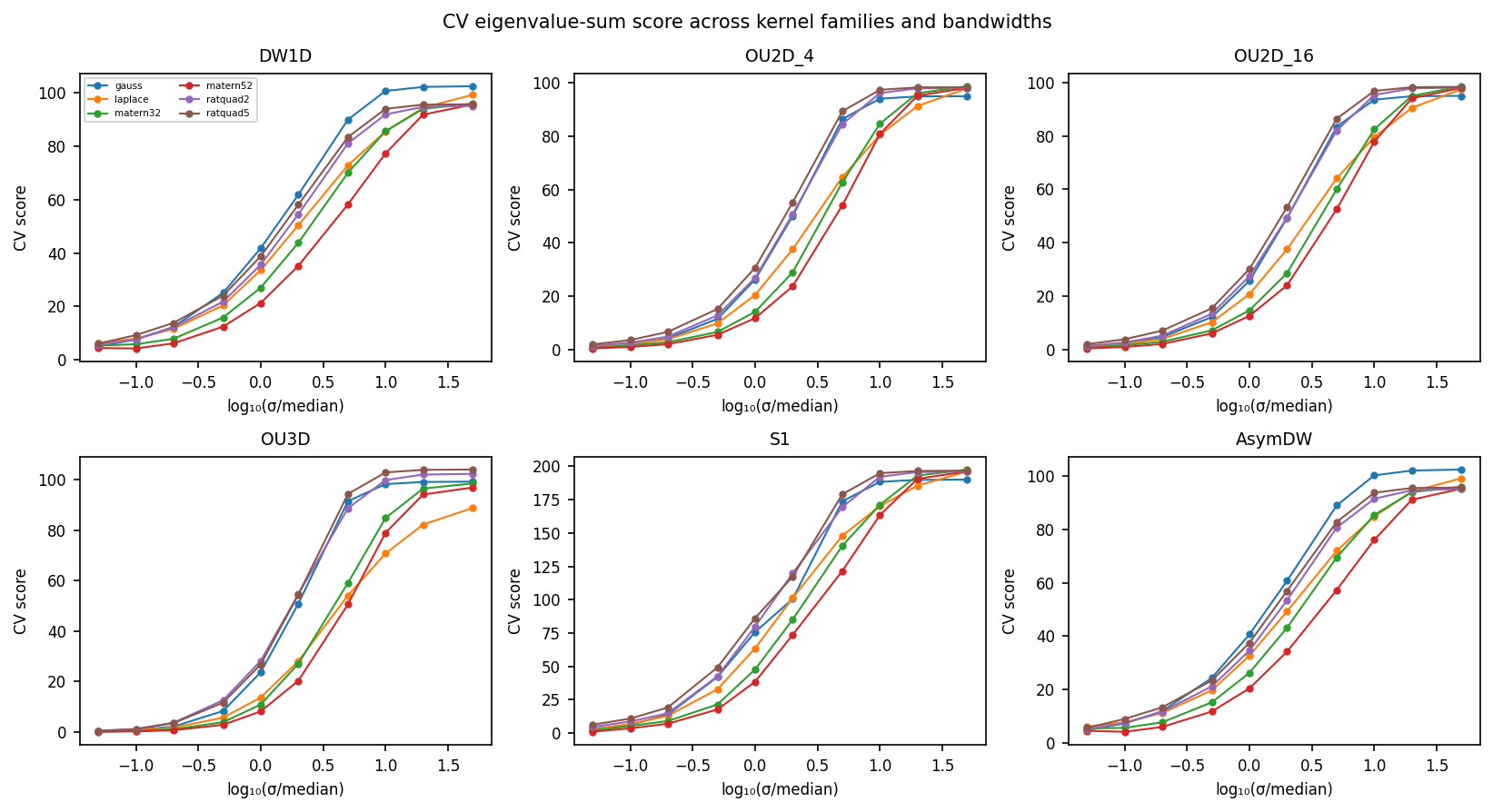
Figure 6: CV score landscape across kernel families/bandwidths, evidencing varied optimal choices across tasks.
Failure Modes, Pathology, and Hybrid Approaches
The analysis details inherent pathologies in unconstrained gradient-based bandwidth optimization: orthonormality penalties tend to drive bandwidth to zero (kβ(x,y)=ℓ=1∑Lβℓkℓ(x,y),β∈ΔL,2), while eigenvalue-only losses can trivialize at very large bandwidths (kβ(x,y)=ℓ=1∑Lβℓkℓ(x,y),β∈ΔL,3). Rayleigh-quadratic regularizers are inadequate for preventing collapse or trivialization. Consequently, direct gradient-based methods can induce degenerate solutions unless stabilized by hybrid procedures—specifically, initializing with CV-selected coarse bandwidths/kernel families and refining via bounded, differentiable parameterizations.
Empirical Strategy: Hybrid Selection and Refinement
The most robust empirical approach is thus a two-stage pipeline:
- Use cross-validation to select the kernel family and coarse bandwidth (global model selection).
- Apply variational fine-tuning within a constrained neighborhood to adapt bandwidths per-coordinate, exploiting the stability and computational tractability of RFF-based inner loops.
Implications and Future Directions
Adaptive kernel selection for KDM yields substantial practical improvements for spectral operator learning in complex, noisy dynamical systems and high-dimensional data regimes. The demonstrated theoretical guarantees—operator smoothness, spectral stability, and CV consistency—provide a rigorous underpinning for end-to-end kernel adaptation.
The methodological contributions have broader implications for operator learning, manifold learning, Koopman operator approximation, and unsupervised representation learning. The findings open several avenues:
- Unified RFF-variational objectives: Extending differentiable inner loops for RFF approximations could yield scalable, hybrid adaptive frameworks.
- Alternative scoring rules: Addressing bias in eigenvalue-sum CV, e.g., via spectral gap or reconstruction-based validation, warrants systematic study.
- Data-dependent kernel dictionaries: Adaptive, data-driven kernel family construction beyond hand-picked dictionaries can further automate model selection.
- Operator-valued extensions: Generalizing adaptive kernel selection to matrix-valued and non-self-adjoint operators could substantially expand applicability in dynamical systems and control.
Conclusion
This work establishes both the formal theory and empirical effectiveness of adaptive kernel selection for KDM, demonstrating that data-driven kernel optimization—combining differentiable optimization and scalable cross-validation—systematically improves spectral recovery over uniform baselines, particularly in high-dimensional and dynamical settings. The results clarify structural instabilities in gradient-based kernel tuning and provide practical guidelines for robust spectral operator estimation, with broad applicability in machine learning, molecular dynamics, and beyond (2604.18402).