- The paper introduces MFMDQwen, an LLM fine-tuned on multilingual, instruction-rich datasets for financial misinformation detection across four languages.
- It employs a unified architecture with multi-task supervised fine-tuning and reinforcement learning to robustly handle cross-lingual and context-dependent tasks.
- Experimental results demonstrate superior Macro-F1 performance on six of nine benchmarks, especially excelling on Chinese and low-resource languages.
Introduction
Financial misinformation poses acute risks to both individuals' investment decisions and the stability of financial markets. The detection of such misinformation is especially challenging in multilingual environments due to inherent linguistic, contextual, and financial subtleties. Existing LLM-based approaches are predominantly limited to English and often address only single-task financial misinformation scenarios, resulting in constrained cross-lingual and task transferability. The work introduces MFMDQwen—a novel, open-source LLM optimized for Multilingual Financial Misinformation Detection (MFMD)—alongside two pivotal resources: MFMD4Instruction, an instruction-tuning dataset for four languages, and MFMDBench, a comprehensive multilingual evaluation benchmark.
Model Architecture and Training Regimen
MFMDQwen employs a unified architecture designed to support generative, instruction-tuned financial misinformation detection tasks across English, Chinese, Greek, and Bengali.
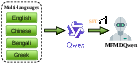
Figure 1: Overview of the MFMDQwen architecture, depicting the integration of instruction-tuning data and multi-stage supervised fine-tuning.
The model formalizes MFMD as a conditional generation problem, where each task instance consists of a context-query pair and a target answer sequence. All task data are merged for multi-task SFT, maximizing the conditional log-likelihood of the ground-truth target answers given the context. Training leverages DeepSpeed ZeRO-3 for memory optimization, supporting long sequence inputs (up to 24k tokens) and outputs (up to 8k) for robust document-level verification. The Supervised Fine-Tuning (SFT) phase is followed by Reinforcement Learning (RL) to calibrate response quality and reliability.
Dataset Construction
MFMD4Instruction
MFMD4Instruction unifies and structures data from nine heterogeneous datasets covering a spectrum of financial misinformation subtasks. These include classic fact-checking and claim verification datasets (FinDVer, CHEF, MDFEND), social media manipulation detection (BanMANI), and professional reference-free counterfactual detection (RFC-Bench). The dataset is comprehensively multilingual, including parallel and aligned instances in English, Chinese, Greek, and Bengali, with task- and language-specific prompt templates to maximize instruction adherence and cross-lingual robustness.
MFMDBench
MFMDBench is assembled as the primary evaluation suite, comprising nine datasets, each mapped to a scenario in the financial misinformation detection taxonomy. This benchmark supports robust evaluation across linguistic and cultural boundaries and enables precise ablations of error sources, label distribution effects, and generalization failures.
Experimental Evaluation
MFMDQwen is evaluated against a range of open-source and domain-specific baselines, including Qwen3/2.5, Llama-3, and FMDLlama variants, across all dimensions of MFMDBench (language, task, and manipulation type). Key findings are:
- MFMDQwen achieves the highest Macro-F1 on 6 out of 9 benchmarks. The model consistently outperforms both general-domain LLMs and the leading financial misinformation-specific LLM (FMDLlama) in cross-lingual, context-dependent, and noisy-source settings.
- MFMDQwen shows pronounced superiority on Chinese datasets, notably CHEF and MDFEND, with F1 gains of up to 0.30 over the best baseline.
- For English claim verification (FinDVer), all high-capacity LLMs show near parity, highlighting the relatively saturated and structured nature of the dataset compared to noisy, less-resourced settings.
- Bengali and Greek, as low-resource languages, yield saturated performance with high accuracy but limited differentiation among models due to simplicity and dataset size.
Within task-specific error analyses, the paper identifies label polarity instability, arithmetic failures, and weak evidence grounding as recurring model limitations, indicating the need for explicit mechanisms for fine-grained numerical and table-level reasoning.
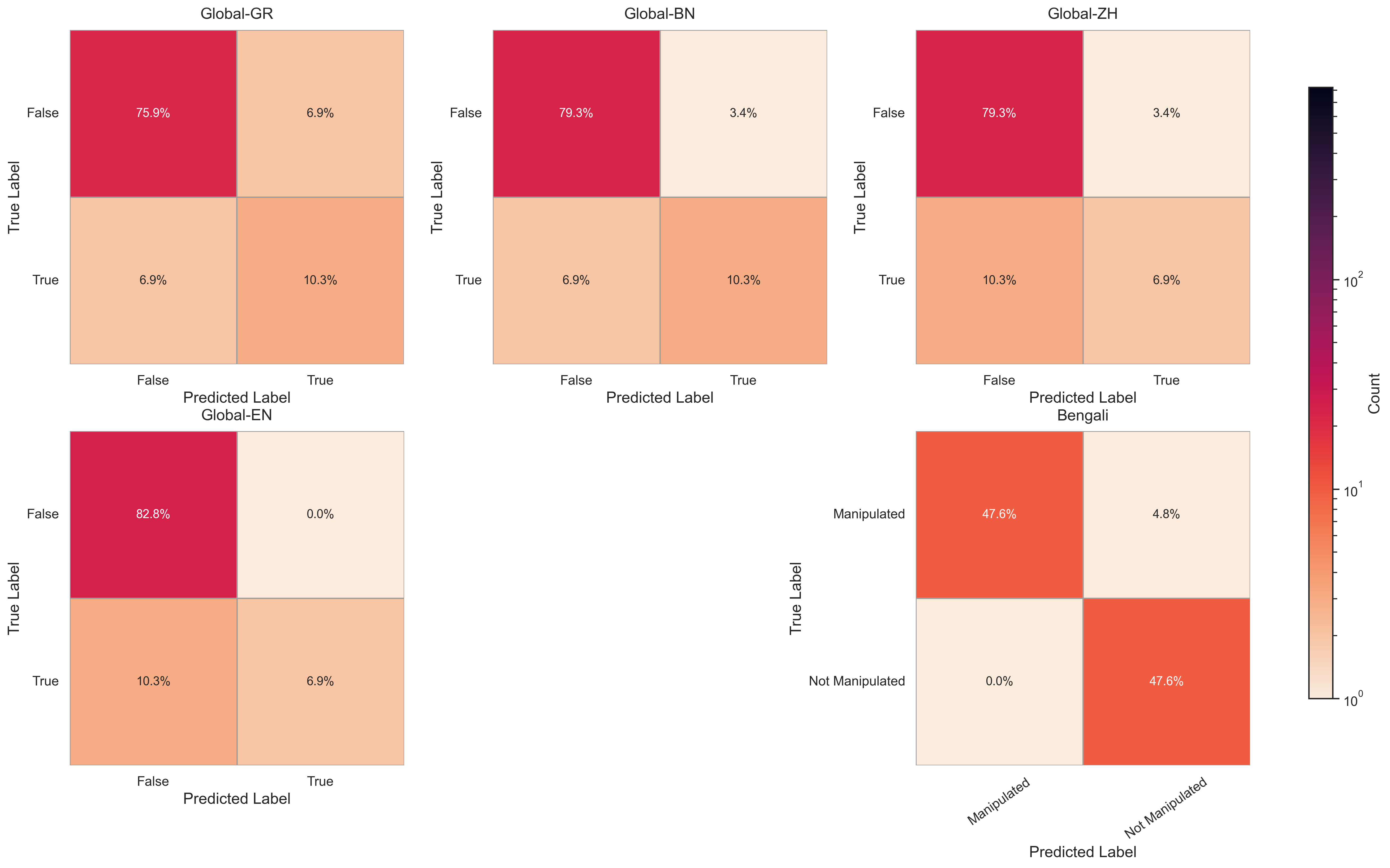
Figure 2: Confusion matrices for five binary classification MFMD datasets across languages, exposing failure patterns such as polarity reversals and class imbalance errors.
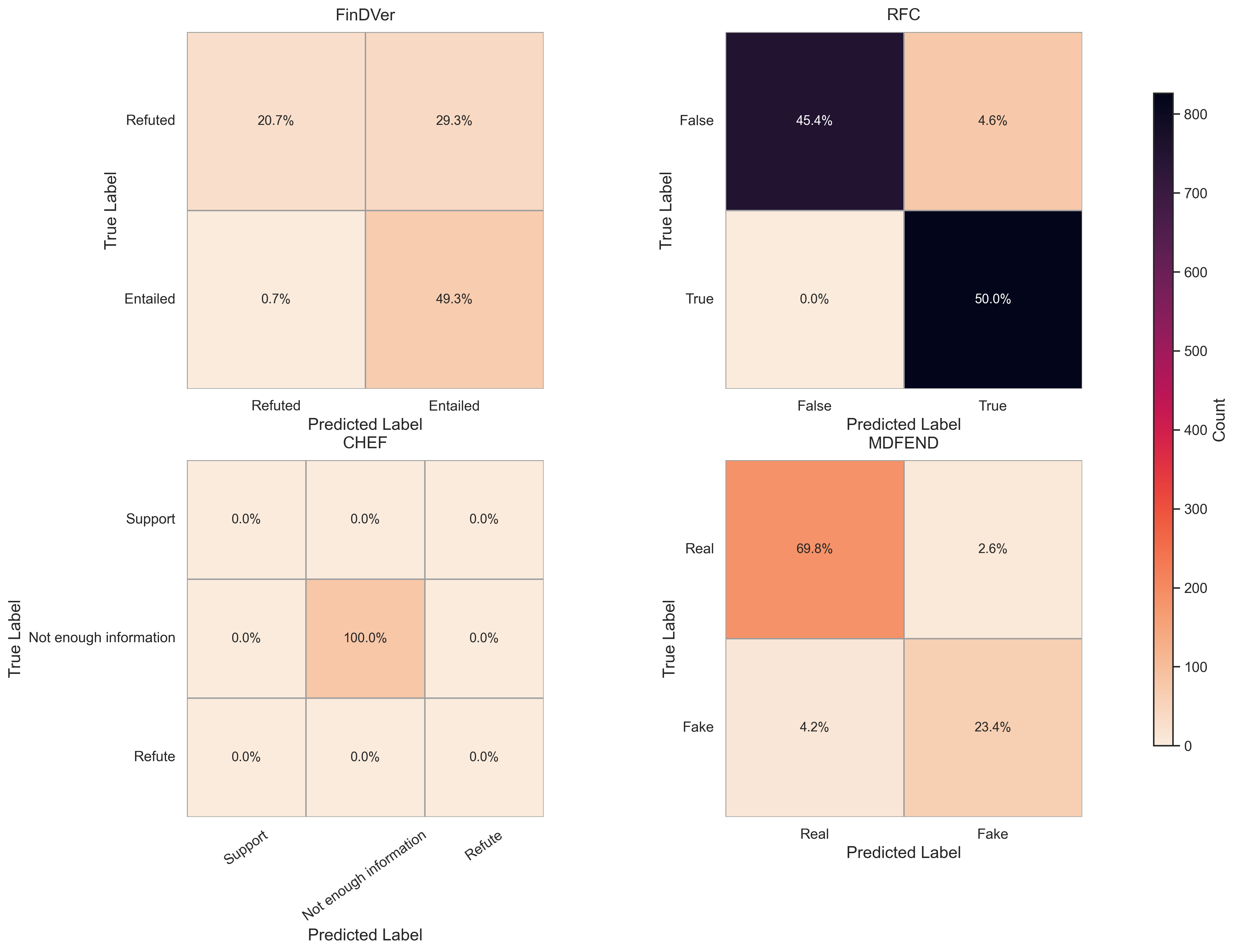
Figure 3: Confusion matrices for multi-label and paragraph-level MFMD datasets, demonstrating MFMDQwen’s superior discrimination in complex, context-heavy tasks.
Theoretical and Practical Implications
MFMDQwen substantiates that domain-specific supervised fine-tuning on a bilingual or multilingual, instruction-rich dataset significantly enhances cross-lingual financial misinformation detection even with smaller parameter counts (8B–32B) compared to significantly larger generalist models. This evidences the critical role of aligned prompt-engineered data and high-fidelity, multi-task SFT in constructing robust financial domain LLMs for multilingual markets.
Practically, the release of MFMD4Instruction and MFMDBench as open resources enables rigorous evaluation and further development of MFMD systems. The instruction-centric dataset design provides a template for future domain- and language-agnostic model development in high-stakes NLP applications beyond finance.
Future Directions
Performance ceilings on tasks involving arithmetic reasoning, fine-grained table interpretation, and partial evidence matching suggest that hybrid neuro-symbolic architectures or the integration of specialized numerical/verificatory toolkits may be required to close the gap to expert-level financial analysis. Further expansion of MFMD4Instruction and MFMDBench to additional languages and emergent misinformation modalities (e.g., multimodal, conversational, and real-time social media settings) will drive the continual robustness and applicability of MFMDQwen derivatives.
Conclusion
MFMDQwen represents a substantive advance in open-source, instruction-tuned LLMs for multilingual financial misinformation detection, achieving state-of-the-art results on the majority of evaluated MFMD tasks and languages. By releasing the MFMDQwen model, the MFMD4Instruction tuning data, and the MFMDBench benchmark, the work sets a new methodological and empirical foundation for cross-lingual, financial-domain fact verification with LLMs. Future extensions focusing on complex reasoning, evidence grounding, and robust cross-domain transfer will further mature this line of research.
(2604.18272)