- The paper demonstrates that globally phase-locked chiral motion emerges from non-reciprocal interactions in a two-species Vicsek model.
- It shows that chiral stability is achieved only under high density, low motility, small system size, and optimal coupling conditions.
- The study reveals that increasing motility, population imbalances, or system size triggers a breakdown of macroscopic chiral order.
Stability and Breakdown of Chiral Motion in Non-Reciprocal Flocking
Model Overview and Theoretical Foundation
The work addresses the emergence, stability, and destruction of chiral collective motion in a non-reciprocal two-species Vicsek model (NRTSVM). The system is composed of self-propelled particles (“pursuer” A and “evader” B species) with intra-species alignment, but crucially non-reciprocal inter-species interactions: A aligns with B (ferromagnetic coupling), while B anti-aligns with A (antiferromagnetic coupling). The non-reciprocal frustration parameter μ quantifies the ratio of inter- to intra-species interaction strengths.
The central theoretical result is that in this discrete-time, metric, finite-range NRTSVM, stable globally chiral motion—a state characterized by persistent, collective, phase-locked rotation of both species—only exists within a sharply delimited parameter regime defined by high particle density, extremely low motility, small system size, and sufficiently strong non-reciprocal coupling. The study systematically investigates the micro-to-macroscopic transition of chiral behavior, delineates the order parameters for phase identification, and establishes connections to mean-field theory.
Emergence and Characterization of Chiral States
In the low-motility, high-density finite-size regime, A and B maintain a quadrature phase difference (±π/2), yielding stable collective rotation (Figure 1). Phase-locking and secondary chiral order parameters (Ψ, χ) exhibit values close to unity, and angular velocity distributions show sharp nonzero peaks, evidencing robust chiral rotation. The oscillation frequency and turning activity increase monotonically with μ; the numerical observations are closely matched by mean-field predictions, specifically ∣ωMF∣=arctan(μ).
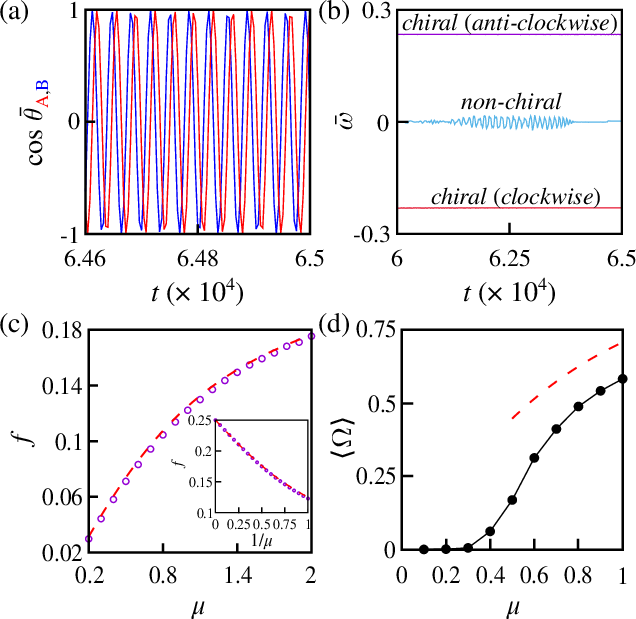
Figure 1: Steady-state chiral oscillations in global mean orientations, with persistent quadrature between A and B species in the chiral regime.
Limits of Chiral Stability: Density, Motility, and Finite-Size Effects
Chiral order is highly sensitive to system parameters. Decreasing density, increasing motility, or enlarging system size all diminish global chiral coherence. The collapse of χ and the decay of phase correlation Cϕ(r) with increasing L signifies a loss of long-range chiral order; only local clusters retain coherence in the large-system limit (Figure 2). The stability diagrams further expose the tight window for macroscopic chirality: higher motilities or larger systems require unrealistically high densities for chiral order to persist.
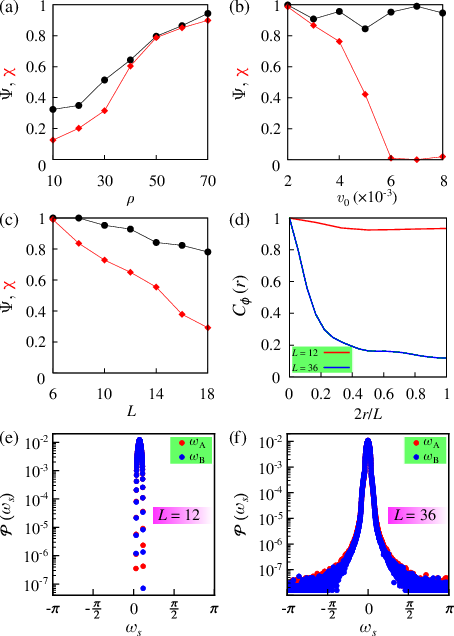
Figure 2: Suppression of chiral phase-locking with reduced density, increased motility, or system size; coherent rotation transitions to segregation or locally ordered clusters.
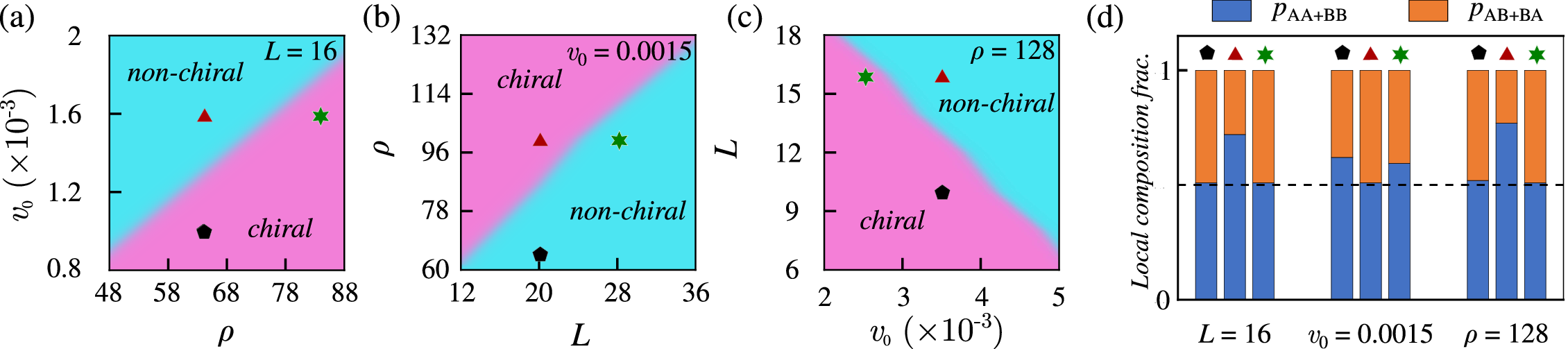
Figure 3: Chiral state stability phase diagrams as a function of density, motility, and system size, delineating the limited region supporting chiral order.
Dependence on Non-Reciprocal Couplings
A phase diagram in the (JAB, ±π/20) coupling plane reveals that global chiral motion necessitates both strong pursuing alignment (±π/21) and a moderate range of evasion (±π/22). Excessive anti-alignment drives species segregation, truncating inter-species contact and annihilating chirality. In contrast to ±π/23 (Ising-like) active-spin analogs (where run-and-chase patterns dominate), the continuous ±π/24 symmetry in the NRTSVM allows non-reciprocal frustration to be relaxed as a smooth, phase-locked rotor only if local A–B mixing remains robust.
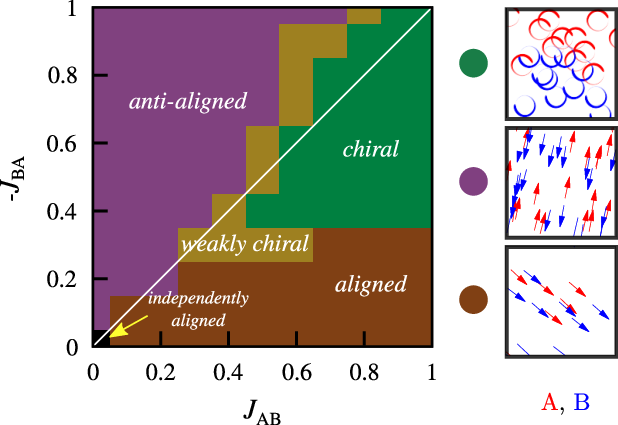
Figure 4: Chiral state exists only in a sharply bounded region of (±π/25, ±π/26) space; strong anti-alignment induces segregation, suppressing chirality.
Effects of Population and Motility Asymmetry
Population imbalance (±π/27) breaks the symmetry of the chiral state. An evader (B) majority rapidly triggers transition to porous parallel-flocking, as the minority species aligns passively with the dominant flocks. A pursuer (A) majority allows for locally chiral domains and chiral-polar mixed states before eventually crossing over to anti-parallel flocking as B becomes dilute. These transitions are systematically reflected in angular velocity distributions that shift from peaks at finite values (chiral) toward central peaks at zero (non-chiral) with increasing asymmetry (Figure 5).
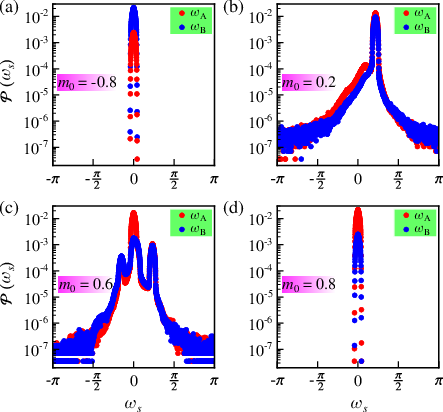
Figure 5: Probability distributions of angular velocity for different population imbalances, mapping the decay of chiral dynamics with loss of local A–B mixing.
When species have disparate motilities (±π/28), phase-locking collapses, yielding asynchronous local oscillations and ultimately complete segregation: the faster species forms dense, polar flocks, while the slower species becomes a dispersed background. These phenomena are accentuated and clarified under strong motility mismatch, where the transition from transient chiral oscillations to irreversible phase-separated flocking is evident (Figure 6).
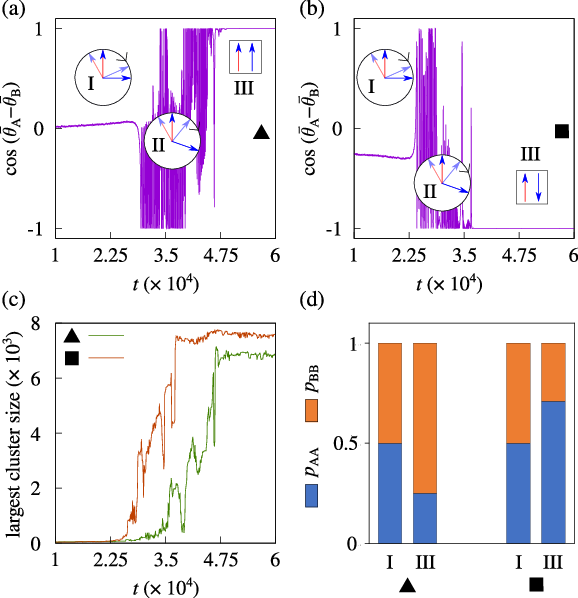
Figure 6: Chirality decays via dephasing and segregation under strong motility asymmetry, visualized through the loss of phase coherence and emergence of phase-separated flocks.
Breakdown Mechanisms and Suppression of Giant Fluctuations
Outside the chiral window, the system exhibits classical polarized flocking, spatial segregation, or only patches of local orientational order. The breakdown mechanisms are supported by neighborhood composition analysis, where decreasing local A–B mixing correlates directly with loss of chirality. Furthermore, the inclusion of non-reciprocity progressively suppresses the giant density fluctuations characteristic of conventional Vicsek and polar models, as non-reciprocal frustration transforms coherent translational domains into fragmented, curved, and short-lived structures (Figure 7).
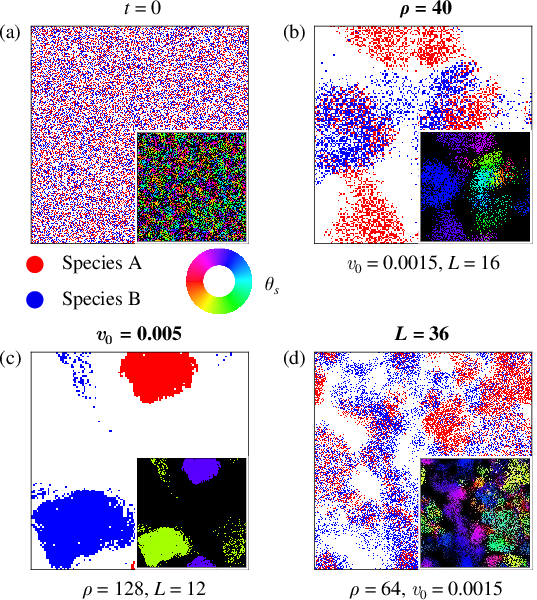
Figure 8: Representative non-chiral steady states arising from low density, high speed, or large system limit: segregation, local clustering, and patchiness dominate.
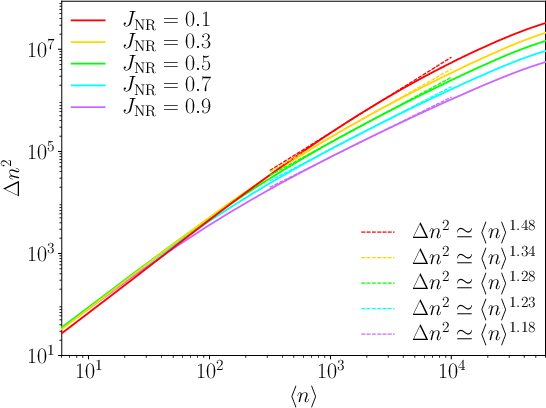
Figure 7: Non-reciprocity suppresses giant density fluctuations, as evidenced by the reduced scaling exponent of number variance with increasing inter-species coupling.
Practical and Theoretical Implications
The findings clarify that globally coherent chiral motion in finite-range, non-reciprocal Vicsek models is not a generic outcome of non-reciprocity, but rather requires finely tuned conditions: high density, extremely low motility, small system sizes, sustained local mixing, and an optimal range of non-reciprocal couplings. In real and synthetic active matter systems, this suggests that observation of macroscopic chiral rotation arising purely from non-reciprocal interactions is highly non-universal and will be fragile to scale-up, asymmetry, or perturbations.
Theoretically, the results highlight the qualitative contrast between continuous-symmetry and discrete-symmetry models: only the former admit true persistent chiral rotation in the presence of sustained frustration and mixing. The strong susceptibility to segregation underlies the breakdown of long-range order as system size increases and offers a context for understanding experimental results on active matter mixtures, programmable robots, and biological collectives, where chirality often remains limited to finite domains or is stabilized only by additional physical constraints.
Future Directions
The work raises several avenues for further research: constructing non-reciprocal multi-state models interpolating between discrete and continuous symmetries; developing finite-size scaling theories for chiral order; extending analysis to include heterogeneous noise, spatial disorder, or long-range interactions; and examining connections to non-reciprocal synchronization and time-crystalline order reported in related models.
Conclusion
This study rigorously establishes that in the discrete-time, metric, two-species non-reciprocal Vicsek model, globally phase-locked chiral states are stable only within a restricted, non-generic region of parameter space. The global chiral phase is destroyed by increased motility, population or motility imbalance, system size, or excessive anti-alignment. Stable macroscopic chirality thus requires not only non-reciprocal frustration but also local inter-species mixing and carefully tuned system parameters. As a broader implication, chirality in finite-range non-reciprocal active matter cannot be considered a universal large-scale phenomenon, but must be understood as a regime sharply limited by the interplay of symmetry, activity, and system control parameters.
Reference:
"Stability and breakdown of chiral motion in non-reciprocal flocking" (2604.18125)

