- The paper presents a fused gather–GEMM–scatter CUDA kernel that reduces intermediate DRAM traffic by nearly 1.8× and accelerates matrix–vector products by 6–7×.
- It utilizes CuPy runtime compilation and BF16 tensor cores to optimize per-element stiffness computations in the 3D SIMP finite element method.
- Numerical results demonstrate nearly identical solution quality with significant energy savings on large-scale cantilever problems compared to traditional methods.
Matrix-Free 3D SIMP Topology Optimization with Fused Gather–GEMM–Scatter Kernels: Technical Analysis
Introduction
The paper "Matrix-Free 3D SIMP Topology Optimization with Fused Gather-GEMM-Scatter Kernels" (2604.18020) presents a substantial advance in high-performance topology optimization (TO) for structural mechanics, focusing specifically on GPU-accelerated matrix-free finite element methods (FEM) and computational throughput. The authors develop a fused single-kernel implementation for the critical Kv operation in 3D SIMP TO, deployed via CuPy runtime compilation and exploiting modern tensor core hardware. This essay provides a technical summary, numerical analysis, and discussion of the implications of the architecture and data observed in the paper.
Background: Challenges in Large-Scale 3D Topology Optimization
Standard 3D structural topology optimization, via the Solid Isotropic Material with Penalization (SIMP) method, is dominated by the sparse linear solves required for equilibrium at every iteration. The explicit assembly of global sparse stiffness matrices K becomes unscalable due to memory requirements and bandwidth constraints on modern GPUs, especially as system sizes reach millions of elements [aage2017giga, aage2013topology, liu20143d]. Matrix-free operator application, which evaluates Kv elementwise without explicit global assembly, is established as a remedy for these limitations [wang2025matrixfree, traff2023simple]. However, prior implementations typically decompose the operator into three GPU kernel launches—gather, batched GEMM, and scatter—that result in redundant global memory round-trips and DRAM bandwidth bottlenecks.
Fused Kernel Architecture and Implementation
The core contribution is the development of a fused single CUDA kernel, executing the gather, per-element stiffness multiply, and scatter in a one-pass approach, implemented through CuPy's runtime compilation (NVRTC) interface. This eliminates unnecessary DRAM traffic by keeping per-element intermediate vectors in registers and shared memory.
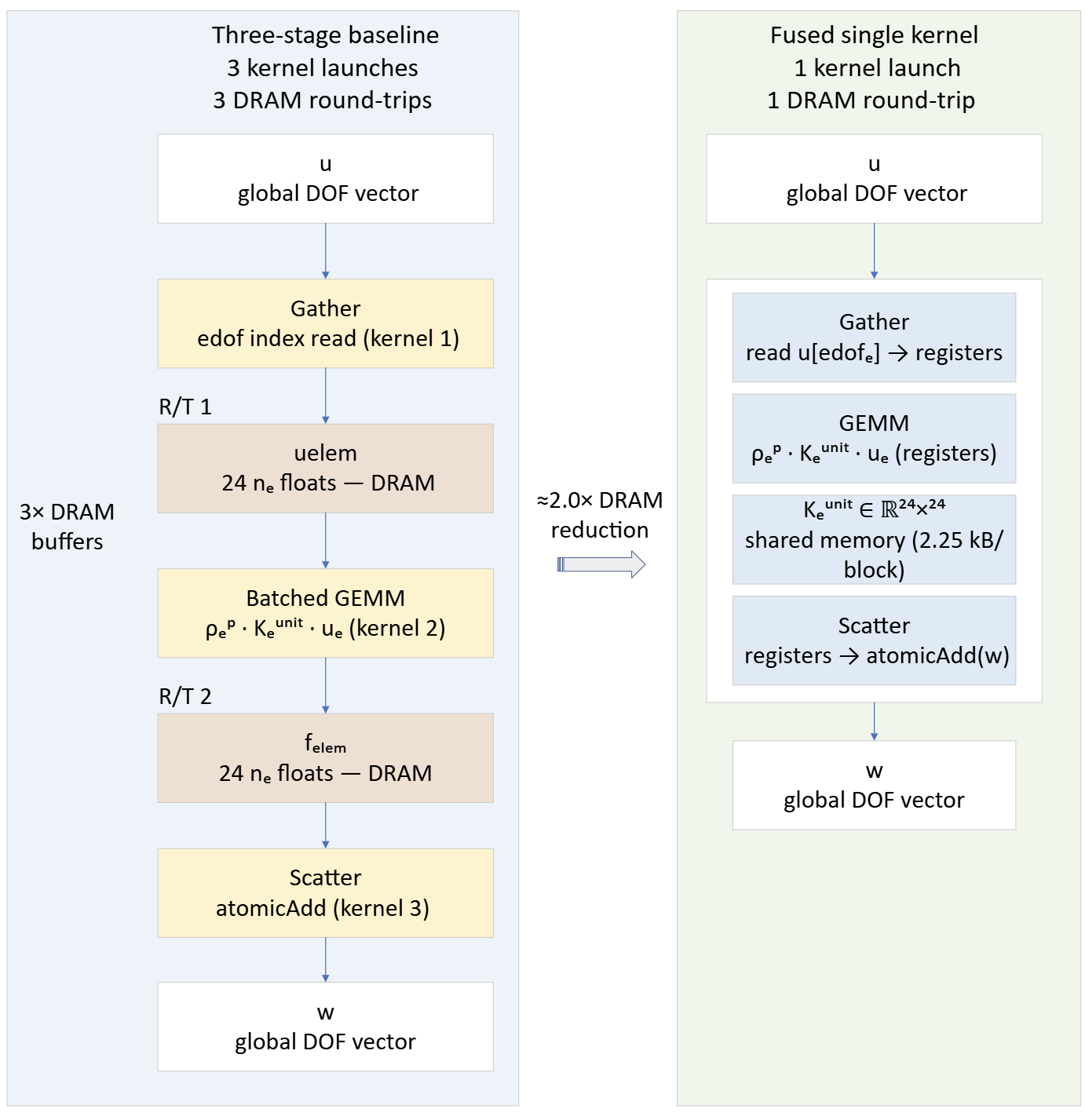
Figure 1: Comparison between the conventional three-stage pipeline (left) and the fused single-kernel pipeline (right), highlighting elimination of intermediate DRAM traffic.
This is achieved by leveraging the structure of the trilinear hexahedral (Q1) elements: the element stiffness matrix Kunit is identical across mesh elements (uniform mesh), allowing block-level shared memory broadcasting. The GPU kernel is launched with nelem/128 thread blocks (128 elements/block), and each thread handles the complete gather–GEMM–scatter sequence for a single element, with atomic accumulation to the global vector.
Arithmetic and Memory Efficiency:
- The fused kernel reduces the main DRAM memory traffic associated with intermediate per-element arrays (uelem, felem) by 2× compared to the baseline.
- Profiling shows effective DRAM traffic decreases from 768 bytes/element in the three-stage path to 384 bytes/element in the fused design, not accounting for index table and density field reads, which raise the practical reduction factor to ~1.8×.
Exploiting Tensor Cores: BF16 WMMA Variant
NVIDIA's Ada Lovelace tensor cores provide substantial raw throughput for matrix multiplications in BF16 precision, potentially doubling the FP32 throughput. The paper introduces a BF16 WMMA path for the kernel, padding the per-element 24×24 stiffness matrix to 32×32, tiled as K0 blocks for tensor core execution.
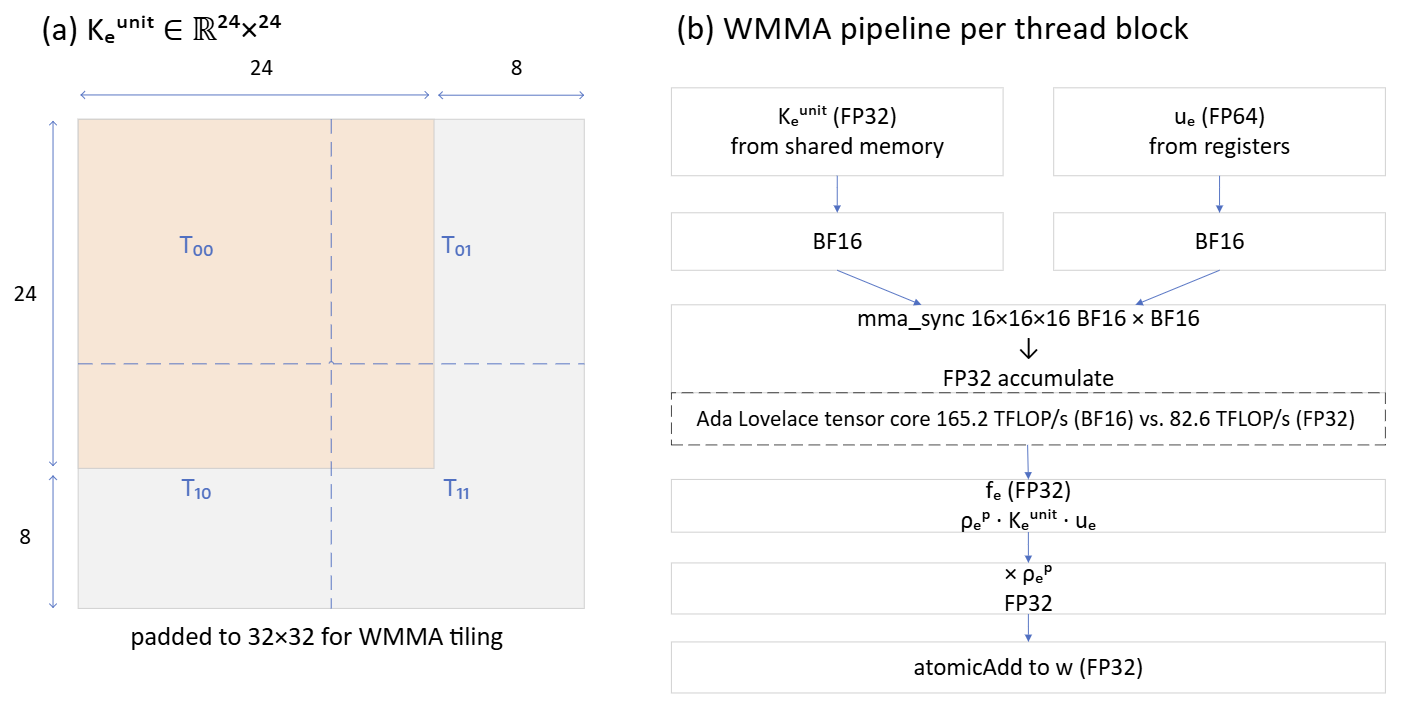
Figure 2: WMMA-based BF16 tensor-core tiling of the per-element stiffness product—zero-padding to K1, processed as four K2 fragments per element.
While the BF16 path demonstrates up to 14.3× acceleration for the “GEMM stage” vs. FP64, the operator as a whole remains bandwidth-bound due to the gather/scatter bottlenecks, and overall wall-time speedup is capped at ~6–7×.
Numerical Results and Analysis
Operator Profiling:
- Fused kernel achieves 6.0–6.6× per-matvec speedup over FP64 three-stage baseline for problems ranging K3–K4 elements (see Table 1 in paper).
- Application to full SIMP-120 runs yields 4.6–7.3× wall-time speedup depending on problem size.
Wall Time and Energy:
- Cantilever problems spanning K5 to K6 elements are solved in 17.5–997 seconds on an RTX 4090 for the fused kernel, vs. 80–6141s for the FP64 baseline.
- Board-level energy measurements show 3.2–4.9× lower energy consumption for the fused path over FP64 runs.
Solution Quality:
- Compliance and grayness (discreteness) metrics from the fused path are nearly identical (within K7 up to K8M elements, K9 at Kv0M elements) to FP64, confirming no numerical drift.
- Repeatability and non-determinism induced by floating-point atomics are empirically negligible at engineering accuracy.
Precision Barrier in Mixed-Precision Solvers
The empirical studies and power-iteration-based conditioning estimates reveal that the SIMP stiffness matrices are extremely ill-conditioned:
- Kv1 ranges from Kv2 (64k elements) to Kv3 (512k elements) under uniform density, with expected increases for late-phase SIMP penalties and higher contrast.
- For BF16 arithmetic (Kv4), the standard iterative refinement condition Kv5 is violated by more than an order of magnitude.
- BF16 CG and even iterative refinement with BF16 inner solves stagnate with large compliance errors (44–54%).
The paper thus confirms, both theoretically and empirically, that direct use of BF16 in the CG loop is infeasible for practical 3D SIMP TO problems and that IR is insufficient to resolve this unless the operator's effective condition number is reduced.
Implications and Path Towards Multigrid and Smoothers
The observed throughput of BF16 tensor cores in the GEMM microbenchmarks motivates a future solution path: The use of the BF16 implementation as a fine-grid smoother inside a geometric multigrid V-cycle, where the effective condition number of the subproblem processed by the smoother can be controlled. Integration with geometric multigrid preconditioning is projected to resolve CG iteration bottlenecks, making it possible to exploit the BF16 path for interior smooths while maintaining FP32/FP64 elsewhere.
The software is implemented in pure Python with CuPy for GPU compute, supporting accessible deployment and extension by the engineering optimization community.
Conclusion
This work achieves a highly efficient matrix-free gather–GEMM–scatter kernel for 3D SIMP TO, validated through strong numerical and energy performance against the three-stage baseline. It meticulously quantifies the throughput and memory advantages enabled by runtime compilation and kernel fusion, along with the severe stability constraints imposed by SIMP-induced conditioning on low-precision (BF16) arithmetic. The results demonstrate that the memory bandwidth, not raw floating-point throughput, remains the principal limiter for matrix-free FEM on GPUs. The future integration of geometric multigrid algorithms—where BF16 smoothers can operate below their conditioning threshold—represents a compelling research direction, with the present implementation serving as a robust and extensible platform.