- The paper introduces a decentralized vector-field guidance law that guarantees asymptotic convergence of UAV trajectories to open reference paths.
- It employs an arcsine-based heading adjustment and a repulsion law for collision avoidance, ensuring safe distances and uniform spacing.
- Simulations confirm zero collisions and stable speed profiles, demonstrating the approach’s scalability for urban air mobility.
Decentralized Vector-Field Guidance for Collision-Free Multi-UAV Path Following
The paper "Multi-UAV Path Following using Vector-Field Guidance" (2604.17995) addresses decentralized control of multiple UAVs tasked with following a designated open path—either a straight line or a sinusoidal curve—while maintaining collision avoidance and uniform inter-agent spacing. The motivation originates from increasing demand for scalable and robust multi-UAV coordination in applications such as aerial surveillance and urban delivery, where safe trajectory tracking and deterministic UAV traffic flow are paramount. The work advances prior literature, which has often focused on closed path scenarios or has relied on computationally intensive centralized or model predictive frameworks, by developing an analytically tractable and computationally light vector-field methodology.
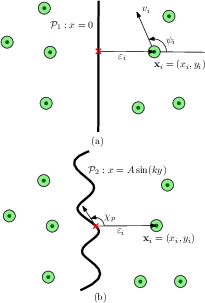
Figure 1: Two reference path scenarios: straight line (P1) and sinusoidal curve (P2), serving as test beds for UAV path following.
The control objectives explicitly include: (1) asymptotic convergence of each UAV's position to the reference path, (2) hard collision avoidance constraints with minimum inter-UAV distance, and (3) uniform spacing along the path. The setting assumes full path information and inter-agent communication, but excludes static obstacles, focusing exclusively on UAV mutual interactions.
Vector-Field-Based Path Following Guidance
The foundational component of the approach is an arcsine-based vector-field guidance law, leveraging cross-track error to compute the desired heading. For straight path (P1:x=0), the solution yields a heading that rotates the UAV toward the path from either side, and aligns it tangentially upon convergence. The sinusoidal path (P2:x=Asin(ky)) demands a dynamically varying tangent direction, addressed by appropriately parameterizing the local path tangent and offsetting the heading in an arcsine fashion with respect to lateral deviation.
The path following guidance is underpinned by Lyapunov stability arguments cited from prior work [shivam2023arcsine, shivam2024class], yielding guarantees of asymptotic convergence for arbitrary initial conditions, and ensuring that once the path is reached, UAVs proceed tangentially with stable trajectory alignment.
Collision Avoidance Mechanism
Collision avoidance is realized by a rotational repulsion law affecting the angular velocity of each UAV. Repulsion is activated upon proximity breach within a safety radius, and is computed as a function of inverse distance and relative bearing, ensuring that the UAV turns away from neighbors in a direction dictated by their position relative to its heading. A detailed analytical proposition provides formal guarantees: under equal-speed conditions and sufficient repulsion gain selection, the separation between any two UAVs is prevented from monotonically decreasing toward collision, with repulsion inducing a range acceleration that reverses the approach before safety thresholds are crossed.
The mathematical analysis (Proposition 1) demonstrates that, for a carefully selected gain kr, the system ensures that d¨i,j>0 when approach and proximity criteria are met, preserving collision avoidance dynamically. In transient regimes with speed deviations, conservative gain selection is advised to counteract additional approach rates.
Equispacing Velocity Control Law
Uniform inter-agent spacing is obtained through a predecessor-following velocity error law, wherein each UAV (except the leader) adjusts its speed based on the spacing error relative to its immediate predecessor. The error, defined in terms of arc length along the path, is regulated by a hyperbolic tangent function, ensuring bounded and strictly positive velocities. The recursive Lyapunov analysis (Proposition 2) ensures that all spacing errors asymptotically converge to zero, establishing string stability across the swarm.
Importantly, convergence of the path parameter rate to velocity (s˙i=vi) is leveraged, which holds once path alignment is achieved, justifying the theoretical assumptions used in the stability proofs.
Simulation Results and Quantitative Analysis
Extensive MATLAB simulations validate the efficacy of the proposed framework for both straight and sinusoidal paths. The UAVs start from randomized positions and converge rapidly to the reference path, with no collisions observed throughout the trajectory; the minimum separation parameter E consistently exceeds the safety threshold. Control profiles show angular velocities converging to zero and linear velocities stabilizing at the nominal speed, but flexibly adapting within preset bounds to accommodate spacing regulation.
Strong quantitative results include:
Practical and Theoretical Implications
The framework’s decentralized nature and computational simplicity make it amenable to large-scale multi-UAV deployments. Leveraging vector-field methods circumvents expensive optimization and centralized computation, providing scalability and robustness to environmental disturbances. Analytical guarantees for collision avoidance and equispacing address key safety and efficiency requirements for structured, multi-agent traffic scenarios.
On the theoretical side, the work extends stability and collision avoidance analysis for open-path scenarios beyond traditional formation or circumnavigation studies, and bridges gaps in prior literature pertaining to open-path parameterizations. Practical implications include improved airspace utilization and conflict resolution in urban air mobility and UAV corridor networks.
Speculative future directions may include:
- Extension to closed or more complex paths, including dynamically reconfigurable route networks
- Integration with real-time obstacle avoidance and intersection management
- Benchmarking against potential field and optimization-based controllers to quantify robustness and scalability metrics
Conclusion
This work develops a decentralized, vector-field-based guidance architecture for collision-free, uniformly spaced multi-UAV path following on open reference paths. Analytical and simulation results validate strong convergence and collision avoidance guarantees, with robust performance for both straight and sinusoidal path geometries. The approach is positioned for scalable application in operational multi-UAV systems, and opens avenues for further theoretical and practical development in distributed multi-agent guidance and airspace management.