- The paper presents a systematic taxonomy that categorizes GitHub abuse behaviors into attention hijacking, authority fraud, spam, and reputation manipulation.
- The framework employs symptom-driven detection methods including BM25-based keyword stuffing, text similarity for typo squatting, and API-driven commit analysis.
- The evaluation on 392 labeled instances achieved F1 scores above 89%, demonstrating robust detection accuracy for mitigating platform abuse.
Weaponizing the Commons: A Systematic Taxonomy and Detection Framework for Abuse on GitHub
Motivation and Problem Statement
GitHub, as the preeminent platform for open-source collaboration and software supply chain operations, is a focal point for both legitimate and malicious activity. Abuse behaviors on GitHub—including manipulation of reputation signals, propagation of spam, and exploitation of platform mechanisms—have been historically understudied in terms of their symptoms, root causes, and impact on ecosystem security. Unlike traditional software vulnerabilities, these forms of abuse leverage socio-technical affordances inherent to the platform, raising governance costs and threatening user trust and supply chain integrity. This paper bridges the gap by constructing a rigorous taxonomy of abuse behaviors, grounding detection in empirical analysis, and operationalizing detection strategies for systematic mitigation.
Taxonomy of GitHub Abuse Behaviors
The authors curate eight abuse subcategories, organized under four high-level categories derived from functional and reputational disruption mechanisms:
- Attention Hijacking: Manipulation of search and discovery indicators via Fake Stars, Automatic Updates, Keyword Stuffing, and Typo Squatting.
- Authority Fraud: Inflating project legitimacy by Spoofed Contributor attacks, exploiting commit attributions.
- Spam: Insertion of irrelevant or malicious content predominantly via Issue Spam, often automated for scale.
- Reputation Manipulation: Artificial enhancement of user profiles through Reputation Farming and Fake Stats.
Each taxonomy entry is associated with formalizable symptoms, including indicator manipulations (e.g., anomalous star activity, keyword relevance scores, commit frequency anomalies), text similarity metrics for typosquatting, and profile-claimed statistics versus ground-truth validation. The taxonomy moves beyond content analysis, integrating behavioral and structural cues that anchor detection in platform-specific mechanisms.
Unified Detection Framework and Evaluation
Detection strategies are directly mapped to symptoms defined in the taxonomy. Established tools (e.g., StarScout for Fake Stars [heSixMillionSuspected2025]) and classifiers (MLP + TF-IDF for Issue Spam [firake2025spamfilter]) are supplemented with new algorithmic approaches:
- Keyword Stuffing: BM25-based relevance computation distinguishes injected keywords from legitimate metadata.
- Typo Squatting: Text similarity and popularity ratio screening isolate repositories with high impersonation risk.
- Automatic Updates: GitHub API-driven update frequency and LOC modification ratio filter trivial commit sequences.
- Reputation Manipulation (Farming, Fake Stats): Detailed chronological and cross-source analyses validate claimed statistics and activity patterns.
The empirical benchmark utilizes 392 manually labeled instances, spanning abuse behaviors across repository and account dimensions. Evaluation shows robust category-wise performance; F1-scores exceed 89%, with BM25-powered Keyword Stuffing and Fake Stats detection reaching 93.2% and 93.6%, respectively.
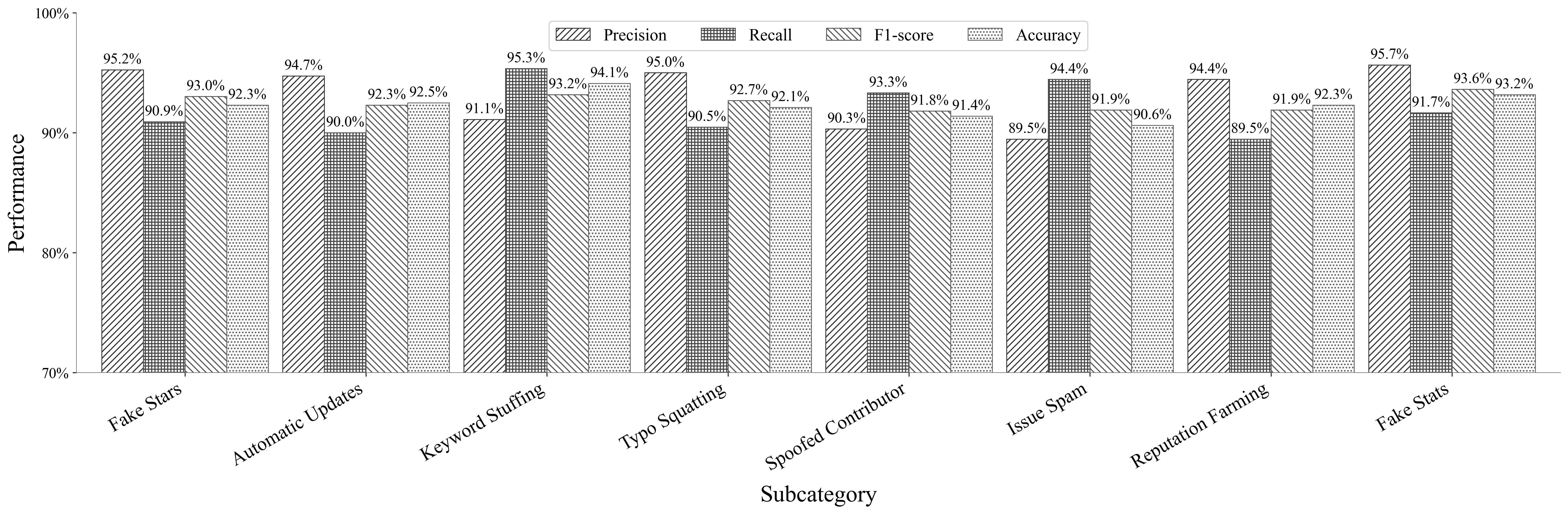
Figure 1: The performance of the comprehensive detection framework on small-scale artificial datasets.
These results demonstrate that symptom-driven, rule-based approaches—when aligned with platform-specific affordances—can yield highly accurate abuse detection outcomes even in the absence of large-scale training data. The main challenge for Issue Spam and Reputation Farming lies in symptom diversity, but operational metrics remain strong.
Practical and Theoretical Implications
Practically, the taxonomy and framework enable multi-layered intervention points in supply chain governance, from automated repository triage to contributor vetting and search signal validation. Release of the detection framework source code facilitates reproducibility and deployment in operational contexts. Theoretically, the work elaborates the socio-technical boundary of software supply chain security, extending classical vulnerability analysis to include behavioral attacks on trust, reputation, and platform signals.
Future directions center on scaling detection infrastructure to cover the broader GitHub corpus, accommodating longitudinal and multi-category co-occurrence analysis. Fine-grained correlation studies between abuse types can inform refinements of the taxonomy and facilitate the emergence of new mitigation paradigms, including adaptive anomaly detection and real-time alerting.
Conclusion
The paper advances systematic characterization and detection of GitHub abuse behaviors through an extensible taxonomy and unified framework, achieving high detection accuracy on curated datasets. By addressing both practical detection yield and underlying socio-technical mechanisms, the research lays a foundation for scalable abuse analysis and supply chain resilience in open-source ecosystems. Future developments should emphasize broader dataset coverage, automated signature refinement, and integration of behavioral signal analysis into platform-level risk mitigation and governance.