- The paper demonstrates that for Lawson surfaces with even m and k, the first nonzero Laplace–Beltrami eigenvalue is rigorously proven to be 2.
- It employs reflection symmetry, group theory, and nodal domain topology to control eigenfunction behavior and validate spectral properties.
- The study confirms aspects of Yau's conjecture in a specific context and provides a methodological framework for future spectral analysis of symmetric minimal surfaces.
Symmetry-Based Determination of the First Laplace Eigenvalue on Lawson Surfaces
Introduction and Context
The Laplace–Beltrami eigenvalue spectrum of closed minimal surfaces in the unit sphere, and particularly the value of the first nonzero eigenvalue, is a central concern in spectral geometry and geometric analysis. This study focuses on Lawson minimal surfaces ξm,k, a highly symmetric family of genus g=mk minimal surfaces embedded in S3 via explicit reflection constructions. Motivated by Yau's conjecture—predicting that λ1(M)=n for any closed, embedded minimal hypersurface Mn⊂Sn+1—the authors analyze λ1(ξm,k) for the case of even m,k, using symmetry, group theory, and nodal domain topology, and verify that in these cases λ1(ξm,k)=2.
Lawson Surfaces and Reflection Group Structure
Lawson's minimal surfaces are constructed by analytic continuation from a fundamental minimal disk Mm,k spanning a geodesic quadrilateral Γm,k in g=mk0, extended via Schwarz reflection across its geodesic boundaries. This iterative procedure produces a smooth, embedded, high-genus minimal surface exhibiting discrete symmetry. The crucial geometric aspect is the action of the finite reflection group g=mk1 generated by four geodesic reflections (explicitly realized as orthogonal block matrices), corresponding to the sides of g=mk2.
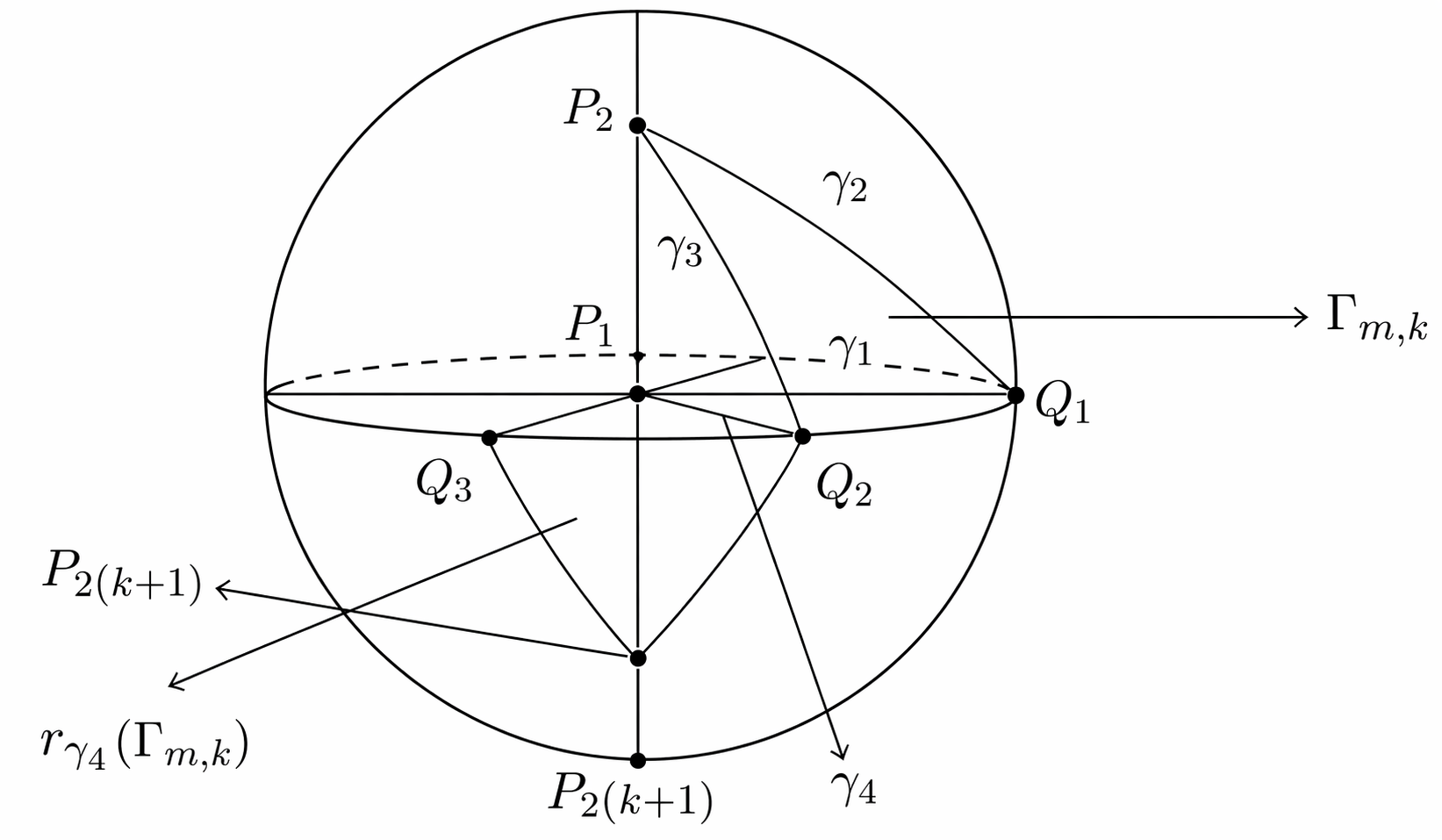
Figure 1: All vertices and fundamental patches of g=mk3 are generated via iterated reflections by g=mk4 acting on g=mk5.
This group is shown to have the structure
g=mk6
with explicit generators corresponding to geometric symmetries. The resulting tessellation of the sphere into congruent quadrilaterals provides a combinatorial framework for analyzing function invariance and nodal sets.
Spectral Problem and Symmetry Constraints
The Laplace–Beltrami operator on a closed Riemannian manifold has discrete, nonnegative spectrum; for minimal surfaces in g=mk7, Takahashi's theorem guarantees that coordinate functions restrict to eigenfunctions with eigenvalue 2. The central claim addressed is that, for g=mk8 with g=mk9 even,
S30,
matching the coordinate eigenvalue.
The proof strategy exploits three core properties:
- Reflection Symmetry: The eigenspace for S31 is S32-invariant; in the non-simple case (which is rare), action by isometries leads to global sign changes only.
- Nodal Topology: Courant's theorem restricts a first eigenfunction to have exactly two nodal domains. Invariance under the reflection group implies restrictive behavior on nodal sets in the fundamental patch.
- Geometric Obstruction: Any S33-invariant eigenfunction with a nontrivial nodal component in the fundamental domain necessarily results in more than two nodal domains after reflections, which is forbidden for the first eigenfunction.
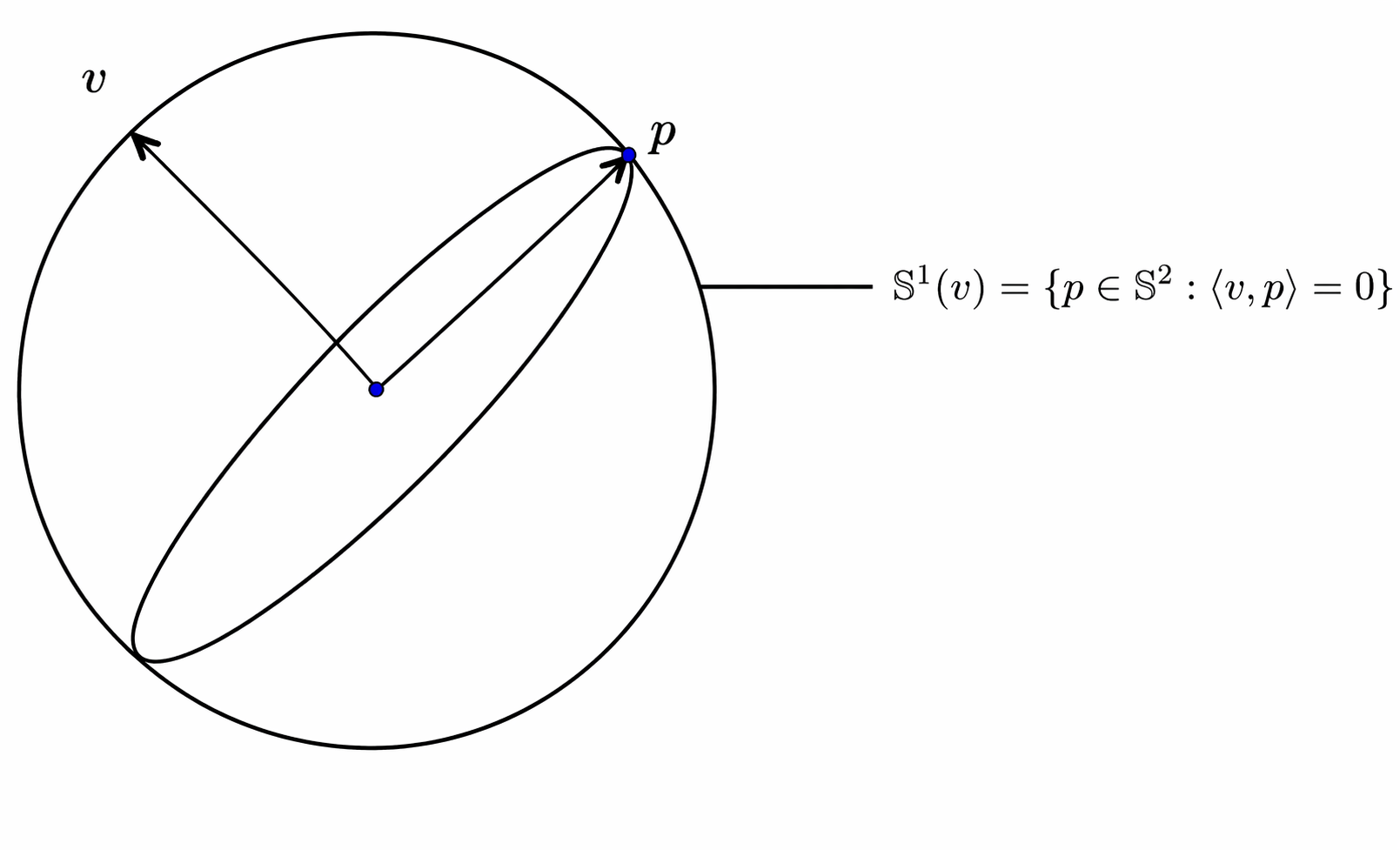
Figure 2: An equatorial sphere in S34 divides the space into hemispheres; reflections across such spheres underpin the symmetry arguments.
The argument is strengthened by considering the action of the reflection group on the tessellation of the sphere by the fundamental cells S35, with parity constraints governing which cells cover the image of S36.
Topological Analysis of Nodal Sets
A new topological obstruction is formulated: any nontrivial S37-invariant nodal set in a fundamental patch either fails to separate the patch or, if it does, reflections yield at least three nodal domains globally, violating Courant's theorem for S38. This yields a contradiction under the assumption S39.
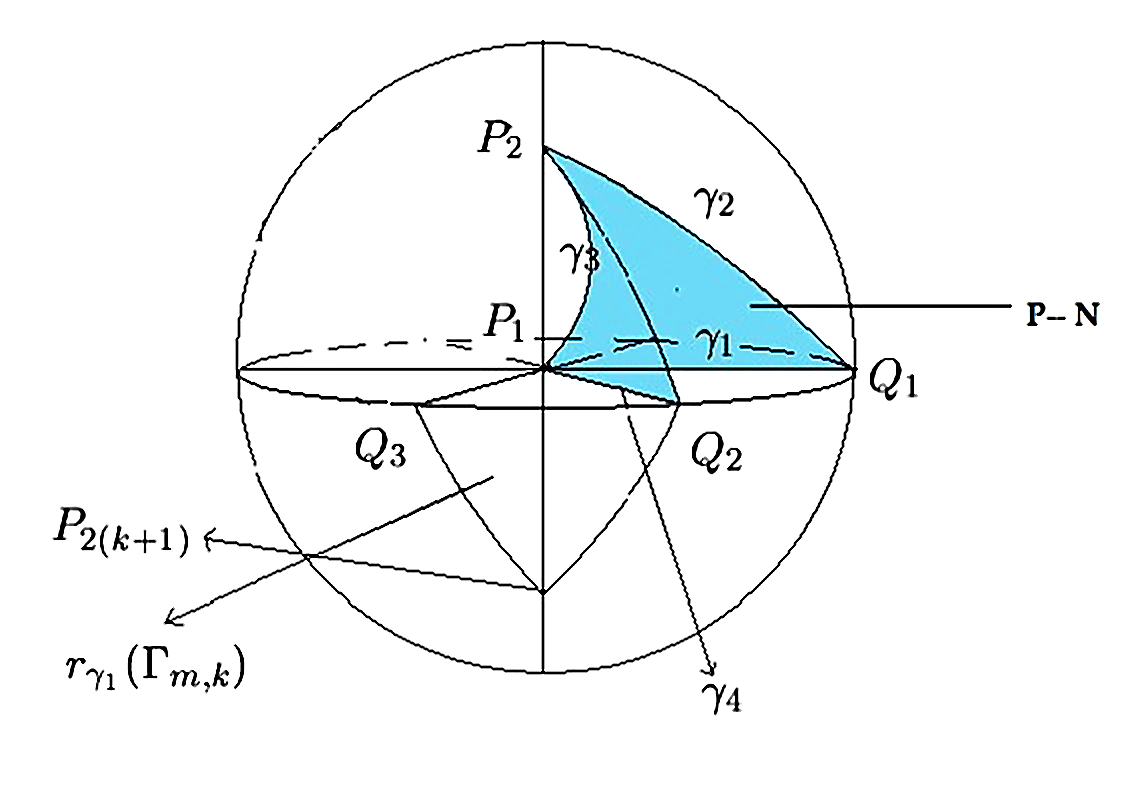
Figure 3: The shaded region is the fundamental patch; its extension illustrates geodesic reflection across a boundary edge and the structure of possible nodal sets.
The proof thus reduces the eigenvalue assertion to a verification of a local topological property of the nodal set, facilitated by explicit knowledge of the Lawson tessellation.
Implications and Directions
From a geometric analysis perspective, this result further substantiates the conjecture of Yau in two dimensions for large classes of symmetric minimal surfaces, sharpening the link between extrinsic symmetry and spectral invariants. The proof method—using group-theoretic and nodal-geometric obstructions—offers a template for analyzing spectral properties in other symmetric settings, potentially higher codimension or more general reflection tessellations.
Spectral geometry for minimal surfaces in high-symmetry environments is closely tied to extremal metric theory, eigenvalue optimization, and moduli problems in global geometry. The explicit algebraic structure of the reflection group may allow extensions to stability analysis, index calculations, or exploration of moduli space rigidity in the context of eigenvalue equality.
Further theoretical development may aim for a complete resolution of the minimal surface eigenvalue conjecture in λ1(M)=n0—possibly leveraging varifold methods, geometric measure theory, or even AI-assisted symbolic manipulation in cases where explicit symmetry is absent.
Conclusion
This paper achieves a rigorous determination of the first nonzero Laplace–Beltrami eigenvalue for Lawson surfaces with even parameters, by leveraging explicit reflection symmetry, group action, and topological properties of eigenfunction nodal sets. The key outcome, λ1(M)=n1, is anchored in a structural argument rooted in symmetry and the global geometry of the surface, and further delineates the tight interplay between minimal submanifold theory and spectral invariants in spheres (2604.17731).