- The paper establishes an explicit quantitative framework for uniform hyperbolic systems by providing uniform constants in proving classical results like the Stable Manifold Theorem.
- It develops constructive methods for Markov partitions and effective shadowing lemmas, enabling rigorous computer-assisted proofs in smooth dynamics.
- The work bridges symbolic dynamics with thermodynamic formalism, offering practical insights for calculating entropy, mixing rates, and invariant measures.
Overview and Context
The paper "Uniform Hyperbolicity and Symbolic Dynamics: Markov Partitions, Shadowing, and the Coding of Axiom A Systems" (2604.17608) rigorously establishes the quantitative geometric backbone connecting uniform hyperbolic dynamics to symbolic thermodynamic formalism. All classical structural results for Axiom A diffeomorphisms—including the Stable Manifold Theorem, spectral decomposition, shadowing lemma, Markov partition construction, and symbolic coding—are proved with explicit uniform constants, making the theory both analytically robust and immediately accessible for effective and rigorous computations.
This part is a segment of a six-part series, serving as the mathematical fulcrum that links symbolic dynamics and the thermodynamic formalism on subshifts of finite type (Parts I–II) to smooth dynamics and further abstract consequences (Parts IV–VI).
Principal Theorems and Technical Contributions
Stable Manifold Theorem with Quantitative Bounds
The paper's version of the Stable Manifold Theorem uses a backward graph transform and fiber contraction, yielding Cr regularity and Hölder dependence on the base point. Quantitative estimates for local manifold size are given explicitly through the formula
ε0=4C0(1−λ)2
where λ is the contraction rate and C0 bounds second derivatives of the diffeomorphism. The local stable/unstable manifolds are shown to depend on the base point with Hölder exponent determined by both system hyperbolicity and the regularity of Df.
Spectral Decomposition with Explicit Structure
The spectral decomposition theorem partitions the nonwandering set Ω(f) into finitely many basic sets Ωi, each topologically transitive and canonically decomposable into cyclically permuted mixing subsystems. Mixing rates and entropy are explicitly associated to the combinatorics of the symbolic coding and transition matrices.
Effective Shadowing Lemma
The paper proves a shadowing lemma giving explicit control of the shadowing error in terms of the pseudo-orbit size and the hyperbolicity modulus. This lemma provides the linear dependence:
α=C−1(1−λ)β
where α is the tolerance for pseudo-orbits, β is the desired shadowing error, and ε0=4C0(1−λ)20 is a system-dependent constant.
Constructive Markov Partition Theory
Markov partitions are constructed with arbitrarily small diameter and effective upper bounds in terms of shadowing and contraction parameters. The author gives a fully constructive method yielding explicit Markov rectangles realizing the local product structure.
Hölder Continuous Coding Map with Measurable Invertibility
A centerpiece is the construction of the coding map
ε0=4C0(1−λ)21
from a subshift of finite type to the hyperbolic set, with explicit Hölder continuity and an exceptional set of measure zero (for any Gibbs measure) where the coding may not be injective. The coding intertwines the symbolic shift ε0=4C0(1−λ)22 and the diffeomorphism ε0=4C0(1−λ)23, preserves entropy (ε0=4C0(1−λ)24), and allows smooth potentials to be pulled back to the symbolic system.
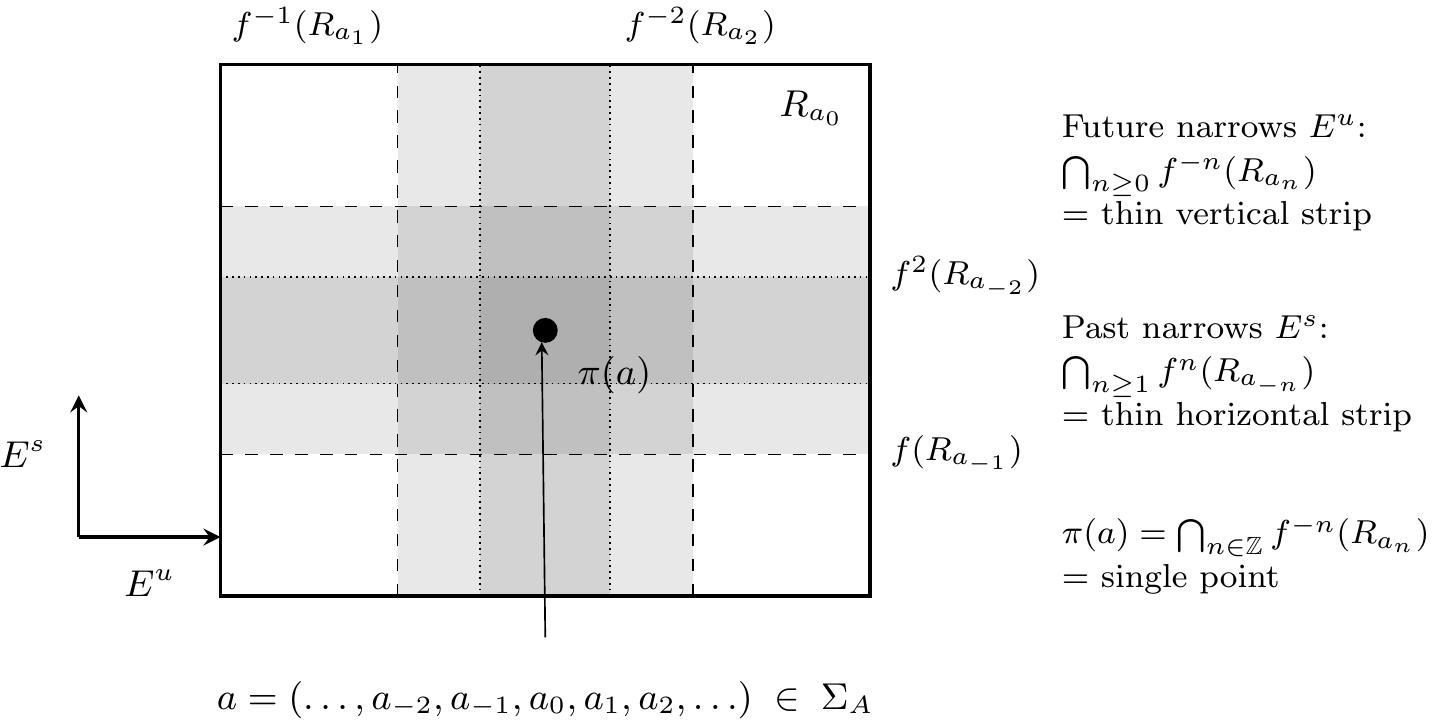
Figure 1: The coding map ε0=4C0(1−λ)25 illustrates how backward and forward cylinder sets under the symbolic dynamics correspond to nested Markov rectangles that shrink to a unique point in the smooth system for almost every itinerary.
Structural and Symbolic Implications
The established framework yields a tight bridge that allows all spectral, ergodic, and large deviations results known for SFTs and Ruelle–Perron–Frobenius operators to translate modulo explicit, computable distortion estimates to smooth Axiom A diffeomorphisms. The symbolic formalism supports the transfer of equilibrium state theory, variational principles, specification, periodic orbit formulas, uniqueness criteria, and entropy computations directly onto the manifold setting.
The presence of explicit constants throughout is contrary to the classical literature, which typically asserts existence without effective bounds.
Computational Consequences
The constructive nature of all the results empowers practical computer-assisted proofs in dynamics. For systems such as the Smale horseshoe, the partition size, contraction metric distortion, and required mesh for rigorous symbolic coding at target precision ε0=4C0(1−λ)26 are computable a priori. For example, for target accuracy ε0=4C0(1−λ)27 in the horseshoe system, the Markov partition's rectangle count can be bounded and explicitly realized.
Interplay with Broader Dynamical Theory
The explicit geometric coding produced here is foundational for further advances in the statistical study of non-uniformly hyperbolic and partially hyperbolic systems. The approach adopted extends, with suitable technical modifications, to systems beyond uniform hyperbolicity, as has been achieved in Sarig’s work for surface diffeomorphisms.
The separation of symbolic and smooth structure, supported by precise quantitative control, is critical for the perturbation theory and stochastic stability of SRB measures, as well as for the computation of fractal dimensions via thermodynamic formalism.
Open Problems and Further Directions
- Minimality and optimality of Markov partitions in terms of diameter and rectangle count remain unresolved, hinting at a variational Markov coding theory.
- Extending the fully effective program to smooth systems with non-uniform or partial hyperbolicity and constructing Markov towers with similar quantitative control is a primary challenge.
- The existence of computable, algorithmically verifiable hyperbolicity constants for generic ε0=4C0(1−λ)28 diffeomorphisms is still an open and critical question in rigorous numerical dynamics.
Conclusion
This work provides an authoritative and effective framework for the geometric and symbolic theory of uniform hyperbolic systems, cementing the equivalence of smooth and symbolic structures for Axiom A diffeomorphisms at an explicit quantitative level. It sets the stage for rigorous statistical and computational developments in hyperbolic dynamical systems and for the analysis of their thermodynamic formalism in both theoretical and practical contexts.