- The paper shows that nonlinear plasma lenses achieve achromatic beam transport, preserving beam emittance between plasma accelerator stages.
- It introduces a compact lattice design combining quadrupole- and sextupole-like components with dipoles to nullify dispersion up to second order.
- Numerical simulations confirm enhanced bandwidth (up to 3–5% energy spread) and robust tolerance against alignment errors compared to quadrupole-based optics.
Achromatic Staging Optics with Nonlinear Plasma Lenses for Plasma Accelerator Beamlines
Introduction and Motivation
The paper "Achromatic optics using nonlinear plasma lenses for beam-quality preservation between plasma-accelerator stages" (2604.17605) addresses a critical obstacle in plasma-based accelerator technology: the inter-stage transport of particle beams exhibiting both high divergence and significant energy spread. The motivation stems from the necessity of staging—concatenating several low- or medium-energy plasma accelerator modules—to achieve TeV-scale energies due to per-stage energy limits (typically ∼10 GeV). Unlike RF-based accelerators, plasma accelerators induce strong chromaticity via intense focusing gradients, severely complicating the preservation of transverse emittance and longitudinal phase space during extraction and reinjection stages.
The chromatic aberration problem is particularly pronounced in plasma-based sources, where the combination of high focusing strength, short beta functions, and non-negligible energy spread rapidly leads to emittance dilution if not precisely corrected. Previous corrections using linear (quadrupole) or standard nonlinear (sextupole) chromaticity-compensation optics are either too long or insufficiently broadband for compact staging. This paper establishes theoretically and numerically an achromatic, compact lattice utilizing nonlinear plasma lenses—devices whose focusing strength varies transversely, augmenting both quadrupole-like and sextupole-like field components—in tandem with magnetic dipoles.
Nonlinear Plasma Lens Theory
A pivotal component of the work is the explicit derivation of the required field profile for an achromatic, nonlinear plasma lens. Traditional (linear) plasma lenses provide position-independent focusing, causing chromatic focusing errors given a finite energy spread. The nonlinear plasma lens, by contrast, introduces a tunable gradient in focusing strength, as quantified by the parameter τx such that the field gradient's dependence on horizontal position x matches the chromatic energy offset via τx=1/Dx, where Dx is the induced dispersion. The lens field profile includes both quadrupole and sextupole components, and can be realized using either active (current-driven) or passive (density-profile-driven) plasma lenses. The authors provide analytic field solutions for both cases. Experimental strategies for implementing the required current and density gradients are discussed (e.g., Hall effect currents), with acknowledgment of plasma-specific effects such as wakefield-induced distortions and scattering.
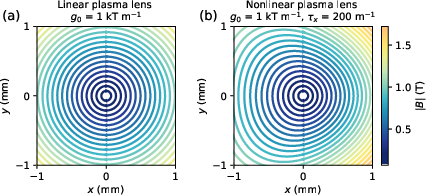
Figure 1: Comparison of the magnetic field profile in a linear (a) and nonlinear (b) active plasma lens, illustrating the introduction of a controlled gradient in the nonlinear case.
Achromatic Lattice Layout and Optics
The achromatic staging lattice comprises two main nonlinear plasma lenses, mirror symmetric about a central plane, with dipoles arranged to produce and nullify the necessary dispersion. A central sextupole is included to cancel second-order angular dispersion, with the main dipole's length and field defining the fundamental lattice scale.
The lattice provides simultaneous matching of the beta functions, dispersion up to second order, and longitudinal dispersion R56. Key requirements, such as zeroing both chromatic amplitude and R56 (or tuning them to an arbitrary value for bunch compression/self-correction), are met through coordinated adjustment of dipoles, lens gradients, and the central sextupole.

Figure 2: Schematic top view of the achromatic lattice showing plasma lenses, dipoles for driver separation/detouring, and the central sextupole.
The phase-space evolution through the lattice is confirmed via high-statistics particle tracking, showing that emittance, bunch length, and energy spread are restored at the exit of the optics—with intermediate excursions managed by design. The lattice is fundamentally symmetric and implements a −I transform between the lenses for geometric aberration cancellation.
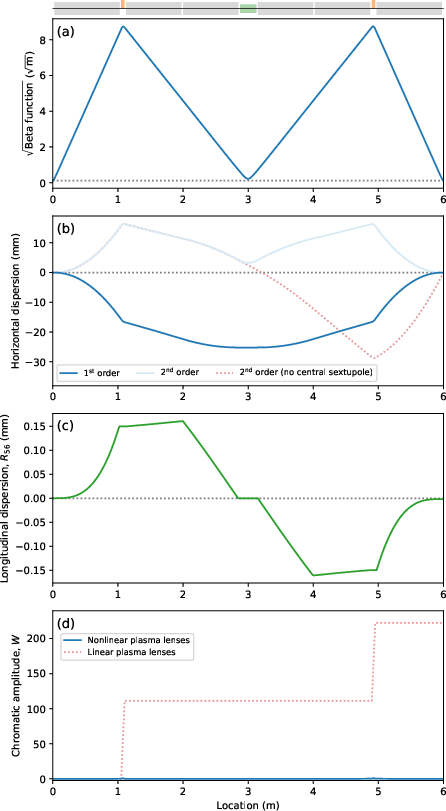
Figure 3: Evolution of matrix optics parameters through the lattice showing matching of beta, dispersion, R56 and local chromatic correction.
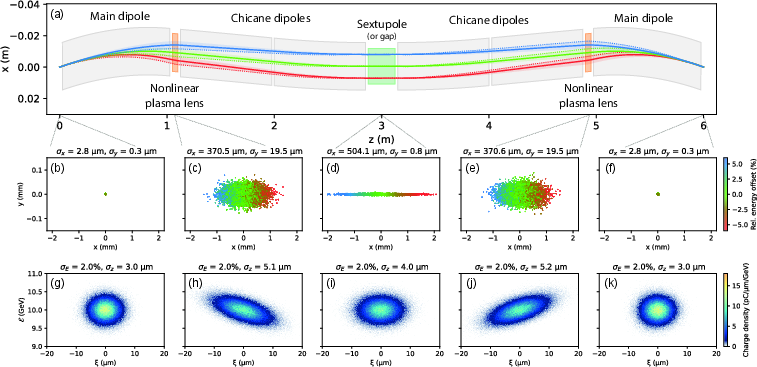
Figure 4: Operation principle and simulation snapshots for three discrete energy slices, showing trajectory, betatron envelope, and longitudinal phase-space evolution.
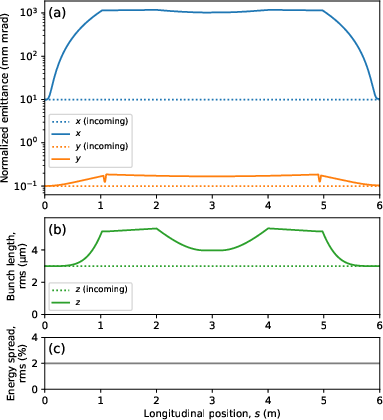
Figure 5: Full phase-space tracking of emittance, bunch length, and energy spread, demonstrating restoration of the initial six-dimensional beam distribution.
Comparison to Quadrupole- and Sextupole-Based Lattice Approaches
For benchmarking, a state-of-the-art quadrupole/sextupole achromatic lattice is synthesized. While functional, it requires approximately twice the length and components as the plasma-lens solution, manifests larger intermediate beta and dispersion values, and admits a much narrower energy bandwidth without emittance growth. Simulations confirm that chromatic emittance preservation is limited to sub-percent energy spreads for the magnetic lattice, as opposed to several percent for the plasma-lens-based lattice.

Figure 6: Top view of the comparative quadrupole/sextupole-based achromatic optics, demonstrating the increased element count and total length.
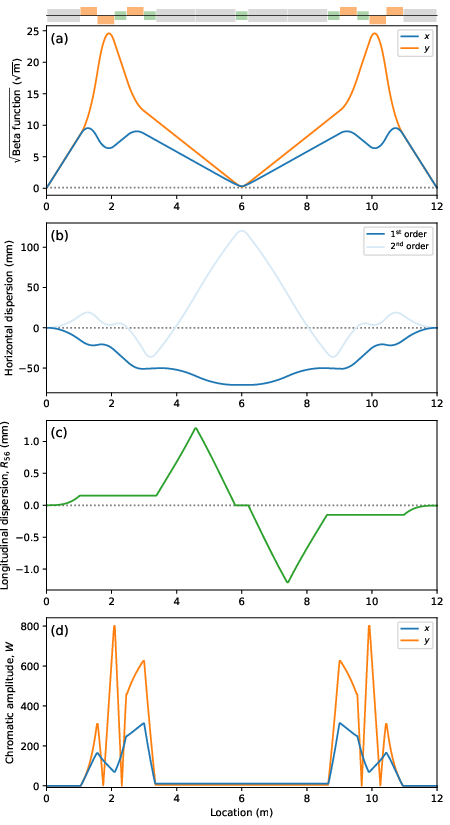
Figure 7: Evolution of optics functions in the quadrupole-based lattice, showing more pronounced excursions in chromatic amplitude and dispersion.
The performance envelope and relevant limitations are comprehensively explored both analytically and numerically:
- Chromatic Aberrations: The nonlinear plasma-lens approach maintains negligible chromatic emittance growth for rms energy spreads up to 3–5%, with higher-order terms becoming limiting at larger spreads. By contrast, linear optics (chromatic) lattices' emittance diverges linearly with σδ, limiting usable bandwidth to τx00.2%.
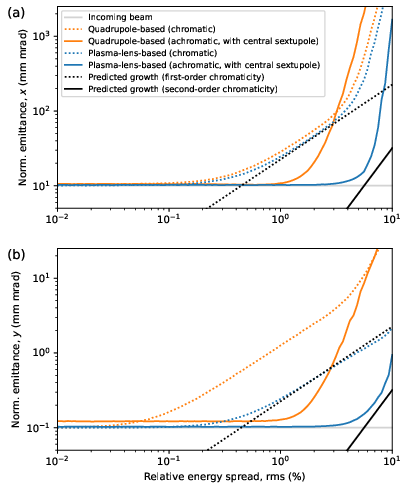
Figure 8: Simulated emittance growth due to chromatic aberrations in both plasma-lens and quadrupole-based lattices as a function of rms energy spread.
- Geometric Aberrations: For large incoming emittance or excessively tight matching (small τx1), nonlinearities in the plasma lens may induce additional emittance growth. Analytic expressions for these effects are provided, and the scaling of these terms is consistent with six-dimensional tracking results.
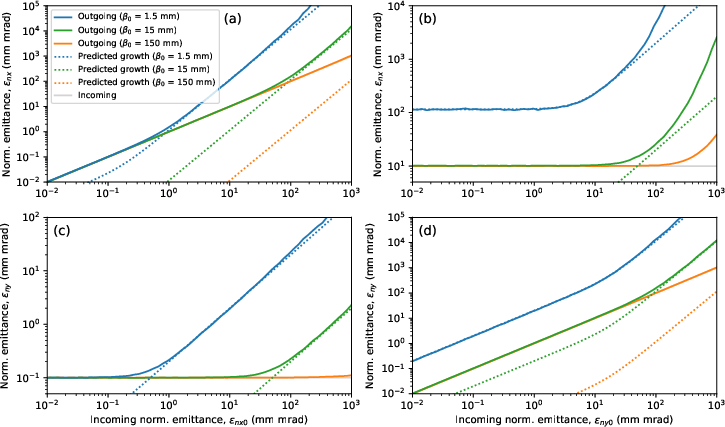
Figure 9: Emittance growth scan versus input emittance, validating analytic models of geometric aberrations.
- Alignment Tolerances: The lattice is shown to be robust; the alignment tolerance is essentially set by the initial beam size. Misalignments primarily lead to centroid offsets and angular kicks, which can be corrected by offsetting the two main plasma lenses.
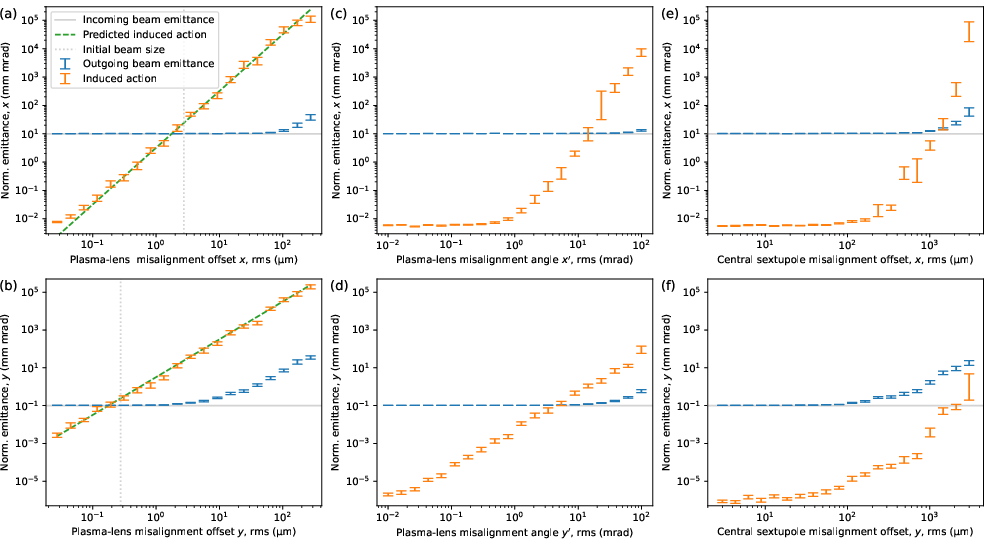
Figure 10: Achievable tolerances for plasma lens and sextupole misalignments, showing induced emittance and centroid action.
- Plasma-Specific Effects: Coulomb scattering (insignificant for the envisaged lens parameters) and plasma wakefields (manageable via parameter tuning or choice of passive lens operation) are evaluated.
Longitudinal Phase-Space Control and τx2 Tuning
A major advantage of the proposed optics is fully tunable τx3, facilitating either bunch-length preservation (τx4) or enabling intra-stage longitudinal self-correction schemes with controlled negative τx5, as needed for advanced energy stabilization techniques in multistage plasma acceleration.
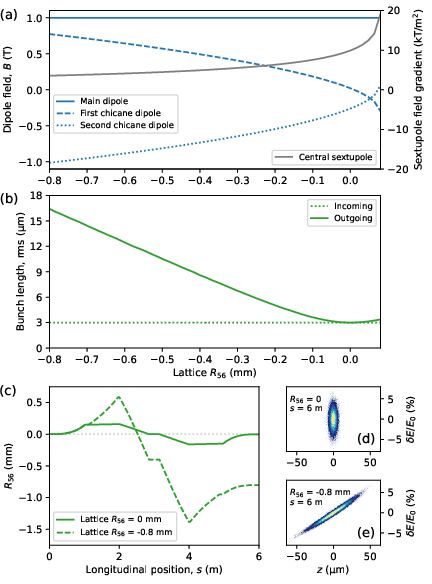
Figure 11: Lattice parameters and output beam properties as a function of τx6 tuning, demonstrating the achromatic optics' flexibility.
Synchrotron Radiation, Energy Scaling, and Application to Multi-TeV Machines
Scaling analyses and simulations consider synchrotron-radiation effects, including both coherent (CSR) and incoherent (ISR) components, across four decades of energy. At high energies, ISR-induced emittance growth can be inhibited by scaling down dipole fields as τx7 and adjusting lens nonlinearities. At low energies, CSR can be suppressed by limiting the beam's peak current.
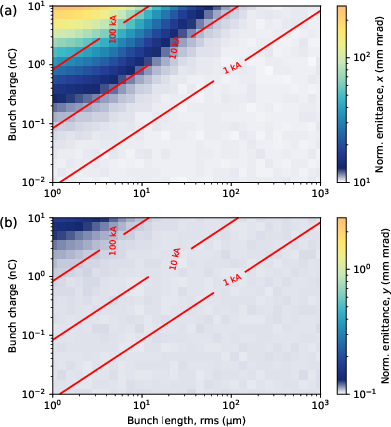
Figure 12: CSR-induced emittance growth as a function of bunch length and charge, indicating current limitations at low energy.
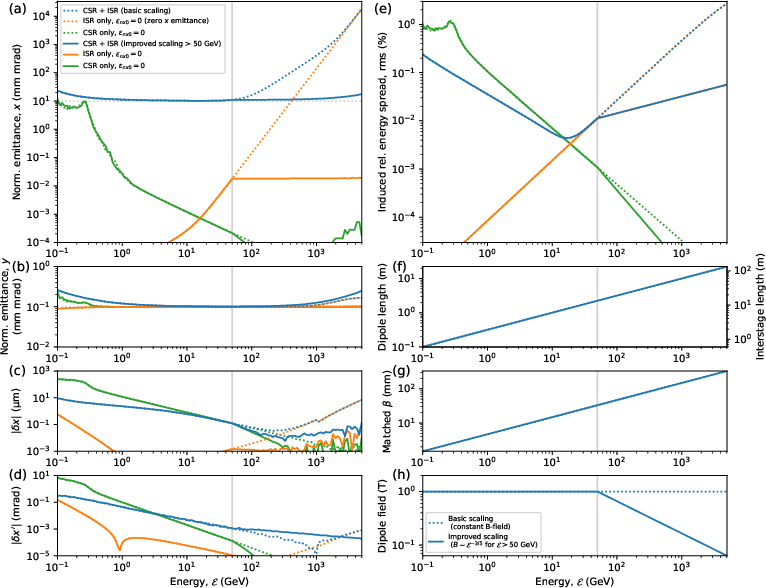
Figure 13: Comprehensive simulation of beam parameter evolution vs. beam energy, including ISR and CSR, for both basic and improved energy scalings.
The lattice concept is shown to be robust and effective for beam energies from sub-GeV through multi-TeV, with adaptability to colliders and high-field QED applications.
Conclusion
This paper presents a formal demonstration that nonlinear plasma-lens-based achromatic optics can resolve the beam transport bottleneck between plasma accelerator stages. The solution provides compact, high-gradient, broadband transport with minimal emittance dilution—surpassing quadrupole-based counterparts in both energy bandwidth and layout compactness. The analytic and numerical treatments collectively reveal the mechanisms and limits for emittance preservation, tolerance, and scaling, affirming the viability of this approach for next-generation plasma-based collider designs. The principle—combining the strong, symmetric focusing of plasma lenses with local chromatic correction—establishes a new paradigm for the beamline design of plasma accelerators, enabling practical multi-stage acceleration towards ultra-high energies.