- The paper introduces a mechanism where oblique p-polarized illumination in symmetric 2D photodetectors generates zero-bias photocurrent proportional to sin(theta).
- It employs detailed electrodynamic modeling and plasmon-enhanced spectroscopy to quantitatively reconstruct the incidence angle via dipole-passive mode analysis.
- The study provides a route for direction-sensitive optoelectronics with implications for coherent imaging and phase-sensitive metrology in compact devices.
Photocurrent Directionality and Wavefront Reconstruction in 2D Photodetectors
Introduction and Motivation
This paper presents a theoretical study of wave vector sensitivity in metal-contacted 2D electron system (2DES) photodetectors, proposing an electrodynamic mechanism for zero-bias photocurrent generation under oblique illumination and establishing a route for quantitative reconstruction of the illumination direction. Conventional photodetectors typically resolve only intensity, wavelength, and polarization. However, the direct measurement of propagation direction—encoded in the light wave vector—remained unrealized at the single-pixel level for reconstructive detectors. This work addresses this gap and advances the field toward true direction-sensitive optoelectronics.
Mechanism of Zero-Bias Photocurrent at Oblique Incidence
The system of interest comprises a uniform 2DES channel (length L) sandwiched between two large, symmetric metal contacts and supported by a dielectric substrate. When illuminated with p-polarized light at an oblique angle θ, the structure exhibits a zero-bias photocurrent even if the source and drain contacts are nominally identical. This is traced to an electrodynamic effect wherein spatial phase gradients in the incident field translate—via diffraction and dynamic screening—into strong, asymmetric local field amplitudes at the two junctions.
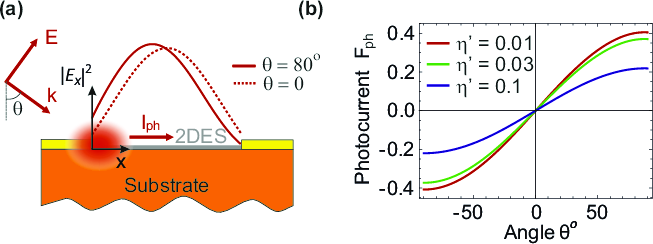
Figure 1: Zero-bias photocurrent in a 2D photodetector at oblique incidence; both schematic and computed photocurrent merit as a function of angle and conductivity.
The local field asymmetry, quantified by the difference ∣Es∣2−∣Ed∣2, induces a nonzero net photocurrent whose sign encodes the quadrant of incidence. The effect persists independently of the underlying microscopic rectification mechanism (e.g., PTE, PVE, or direct Schottky rectification). Detailed electrodynamic modeling reveals that the photocurrent is proportional to kxL=k0Lsinθ, with k0 the free-space wave number. This photocurrent increases monotonically with θ (odd symmetry, saturates as θ→±π/2) and as the conductivity decreases, consistent with enhanced field localization in low-conductivity regimes.
Plasmonic Enhancement and Dispersive Angle Reconstruction
To move beyond a mere quadrant-classification, the paper investigates quantitative reconstruction of the incidence angle via photocurrent spectroscopy in the plasmonic regime, where the 2DES supports standing-wave 2D plasmons. The key controllable parameter is the complex 2DES conductivity η=η′+iη′′, which is gate-tunable in high-mobility platforms.
Absorption spectra under normal and oblique incidence were compared as the imaginary component η′′ (essential for plasmonic response) is varied. Oblique illumination excites an otherwise-dark palisade of spatially odd (dipole-passive) plasmon modes, yielding additional absorption peaks directly sensitive to the incident direction.
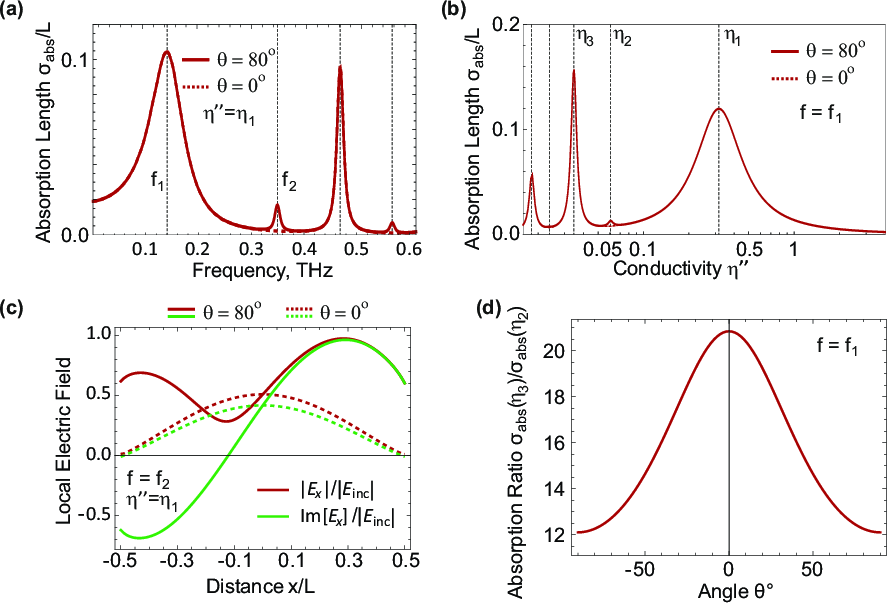
Figure 2: Direction-sensitive absorption in 2DES supporting plasmon resonance; emergence and characterization of dipole-passive plasmon resonances at inclined incidence.
The amplitude ratio of these dipole-passive to dipole-active modes exhibits a robust, monotonic dependence on p0. This feature enables quantitative extraction of the incidence angle from the absorption or photocurrent data, establishing a full wavefront reconstruction protocol.
Photocurrent Spectroscopy and Phase Demodulation
The zero-bias photocurrent exhibits a nontrivial dependence on system parameters and plasmon resonance conditions. Unlike electromagnetic absorption, which shows peaks at resonance, the photocurrent merit p1 displays strong dispersive features and sign changes at each resonance. The extrema of p2 reflect optimal local field asymmetry, just off-resonance, due to the phase relationship between carrier-like and signal-like field harmonics.
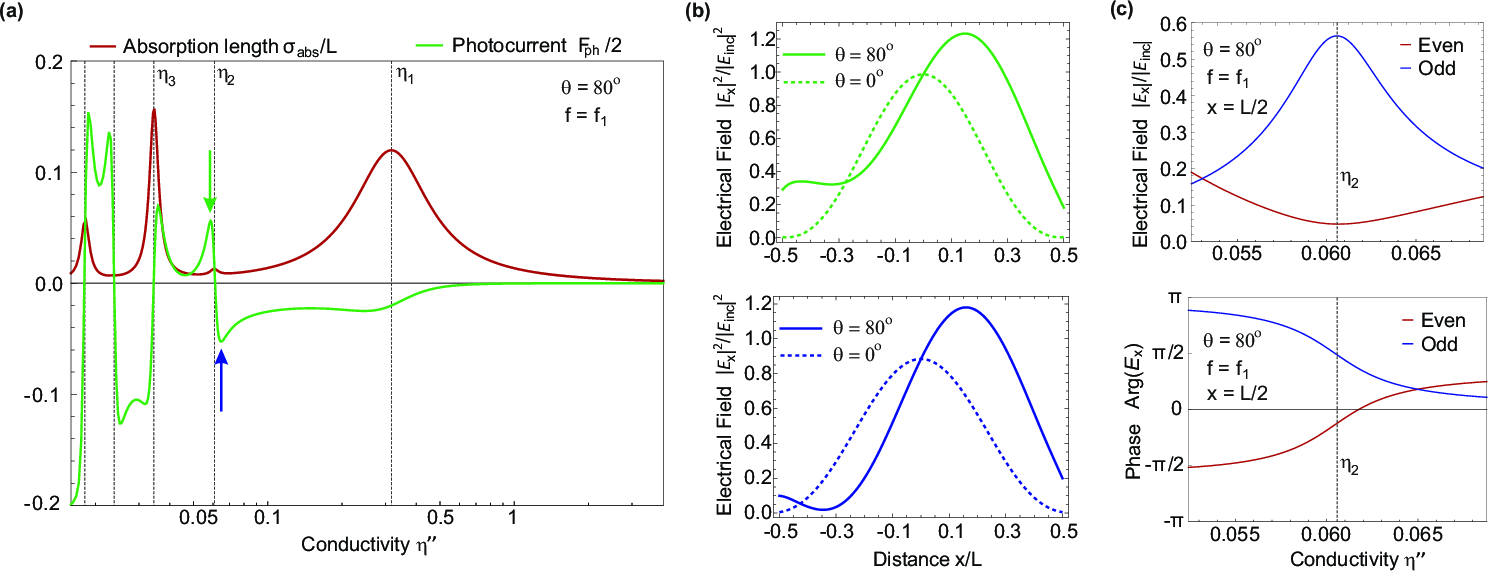
Figure 3: Zero-bias photocurrent at oblique incidence in 2DES supporting plasmon resonance; absorption and photocurrent spectra and associated field profiles.
The physical picture aligns with complex phase demodulation principles: incident phase gradients, by dynamic screening and radiative losses (yielding a complex screening matrix), are mapped to localized field intensity differences. This mechanism delivers strong, sign-reversing photocurrent signatures with each plasmonic order, providing ample spectroscopic information to reconstruct both the incidence angle and possibly the illumination profile.
Theoretical and Practical Implications
This work establishes a purely electrodynamic route to wave vector-sensitive photoresponse in symmetric 2D photodetector junctions, in contrast to conventional photon drag mechanisms, and robustly links photocurrent sign and magnitude to the direction and angle of incidence. Its rigorous matrix solution of the Maxwell-Ohm system with appropriate mode decomposition enables accurate prediction of device behavior across frequency and conductivity regimes.
The plasmon-enhanced regime provides an experimentally tractable method for high-resolution angular reconstruction, with direct implications for coherent imaging, lensless detection, phase-sensitive metrology, and holographic phase recovery within compact device architectures. Gate-tunable 2DES platforms—such as high-mobility III-V interfaces or 2D material heterostructures—are identified as suitable candidates for experimental realization.
Conclusion
The study theoretically demonstrates that symmetric metal-2DES photodetectors inherently support oblique-incidence-sensitive zero-bias photocurrent due to electrodynamic field asymmetry, independent of the microscopic details of the rectification process. Quantitative angle reconstruction is attainable by leveraging odd-mode plasmon resonances and their absorption amplitude ratios. These findings open avenues for single-pixel, direction-sensitive optoelectronic sensors and suggest further exploitation of plasmonic and phase-manipulating strategies in next-generation photodetector architectures.