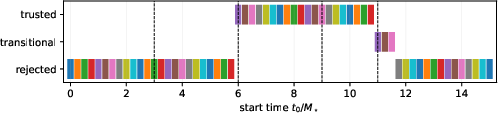
- The paper introduces a deterministic framework for assessing the reliability of multimode ringdown fits in finite data windows of GW250114.
- It employs rigorous error decomposition and diagnostic tests to quantify stability, conditioning, and systematic biases in quasi-normal mode frequency extraction.
- The study demonstrates that trusted finite windows, identified between 6M_f and 10.75M_f post-peak, robustly validate a common Kerr remnant interpretation.
Deterministic Trust Regions for Finite-Window Black-Hole Spectroscopy in GW250114
Overview
The paper "Deterministic Trust Regions for Finite-Window Black-Hole Spectroscopy in GW250114" (2604.17558) addresses the reliability of black-hole spectroscopy in gravitational wave (GW) data analysis, specifically focusing on the event GW250114. The main goal is to precisely characterize the conditions under which a multimode ringdown fit from a finite data window robustly supports a common-remnant Kerr black hole interpretation. The work provides a deterministic, quantitative framework that moves beyond simple detectability of quasi-normal modes (QNMs) to formalize the reliability and stability of such spectral decompositions—especially in "loud" events like GW250114, where variance is no longer the dominant concern.
Finite-Window Spectroscopy: From Detectability to Reliability
Classically, black-hole spectroscopy exploits the expectation that, after coalescence, a merging black hole's GW signature becomes a sum of damped sinusoids with frequencies determined solely by the remnant’s mass and spin. In practice, finite windows must be selected from post-merger GW data to carry out this analysis. While established methods ensure that (statistical) detectability of multiple QNMs is possible in high-SNR events, this paper rigorously examines when such finite-window fits are robust and physically interpretable as signatures of a common Kerr remnant.
The central methodological challenge is that window selection, fitting family specification, omitted physical content, and early-time signal structure can all conspire to obscure or even invalidate nominally successful multimode fits. The authors mechanistically quantify all these aspects by defining window-by-window trust criteria based on stability, conditioning, and rigorous error decomposition.
Model Families and Diagnostic Classes
The analysis operates with a strictly defined hierarchy of model families:
- M0: Dominant $220$ mode only,
- M1: $220$ and overtone $221$,
- M2: $220$, $221$, and $440$,
with additional larger reference families to delineate omitted-Kerr content and fixed extensions for nuisance analysis (e.g., direct-wave and quadratic-mode diagnostics). The separation between physical model, model completion, and nuisance diagnostics is held rigid to avoid post-hoc interpretational drift.
A deterministic Prony/matrix-pencil pipeline is developed and rigorously analyzed for extracting complex ringdown frequencies. The extraction is subject to explicit error budget decomposition into four components: statistical, algorithmic, omitted-tail, and mismatch errors. The analysis emphasizes that the extraction and labeling of frequencies becomes unstable (and thus unreliable) when modes are near-coalescent or the fitting window is not well-conditioned for the chosen model family.
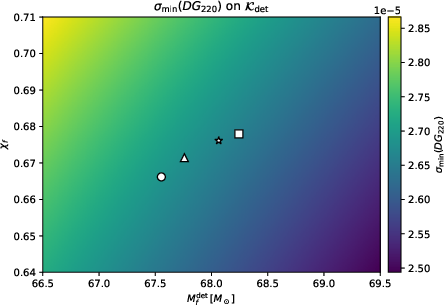
Figure 1: Minimum singular-value field p↦σmin(DG220(p)) on the GW250114-local detector-frame box, quantifying local invertibility of the dominant Kerr map.
Local Kerr Inversion: Condition Number Atlas
After frequency extraction, the dominant QNM ($220$0) is inverted via a local chart on the $220$1 parameter box, constructed explicitly from high-accuracy Kerr QNM tables. Auxiliary ($220$2, $220$3) modes are then subject to deterministic forward consistency tests; that is, a window supports a Kerr remnant only if all measured frequencies are compatible within the transported inversion error bounds.
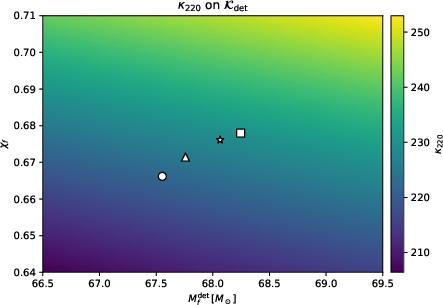
Figure 2: Pointwise condition number $220$4 for the Kerr $220$5 map, showing the local variation in inverse problem stability for GW250114.
Synthetic and Empirical Calibration
A synthetic GW150114-like bank is constructed, based on public surrogate waveforms and actual detector noise (using H1/L1 data), to calibrate mismatch and colored noise radii. This establishes conservative, empirically-grounded error tolerances for the windowed inverse problem—normalized by the spread in the public detector-frame remnant posteriors.
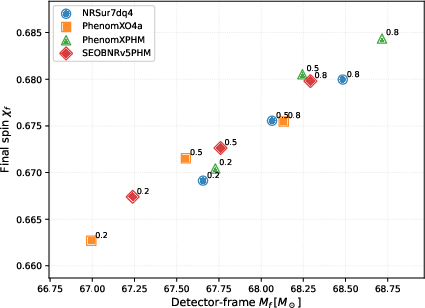
Figure 3: Representative public posterior anchors (in mass, spin) used to span the synthetic bank parameter space.
The analysis quantifies the relative contribution of zero-noise bias (omitted-mode/systematic bias) and colored noise variance in remnant parameter recovery across model families. It is shown that only the full Kerr family ($220$6) consistently achieves a remnant bias within the envelope defined by public posteriors.
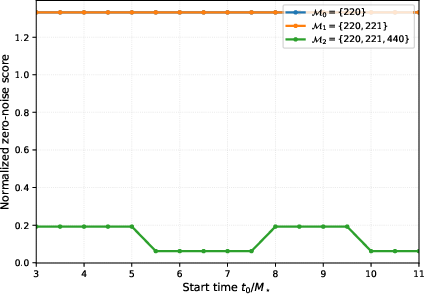
Figure 4: Normalized zero-noise bias ratio for each fitted family, indicating that $220$7 achieves minimal deterministic bias across the synthetic bank.
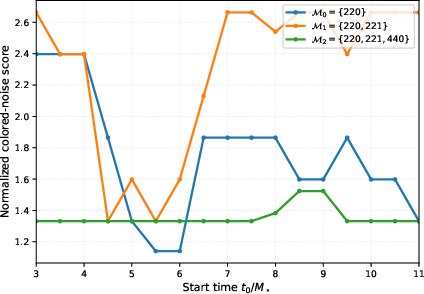
Figure 5: Normalized colored-noise ratio (at the synthetic bank level) for fitted families, illustrating the distinct role of detector noise floor in trust region boundaries.
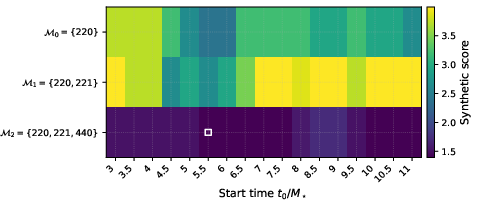
Figure 6: Synthetic trust map for start-time grid, showing trusted regions (low values) for each model family—$220$8 providing the widest stable region.
Event-Level Analysis: GW250114 Window Classification
On the real H1/L1 strain data for GW250114, the authors perform a dense start-time scan with fixed window length. They fit the $220$9-mode frequency (allowing detector-dependent amplitudes) and invert for remnant mass/spin on the local parameter box previously established. The resulting sequence is compared with the public posteriors, showing that:
- The dominant-mode track passes through the core of the public posterior envelope at intermediate start times.
- Both earlier and later windows drift towards less robust, variance- or bias-dominated estimates.
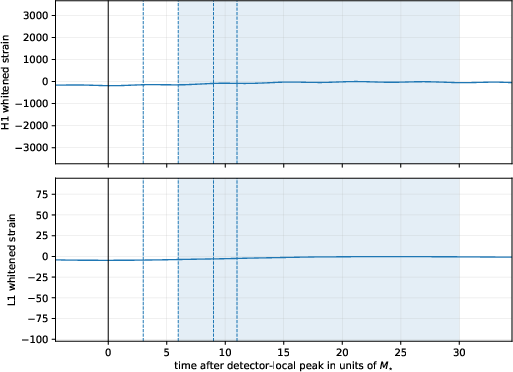
Figure 7: Conditioned H1/L1 strain around the event's detector-local peaks, with public anchor windows marked for context.
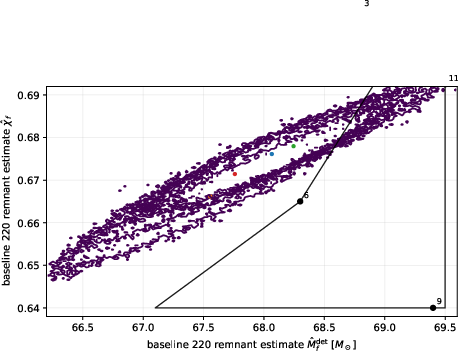
Figure 8: Public detector-frame posterior contours (from four public PE products), overlaid with the real-data baseline M10 track. Public anchor points are additionally marked.
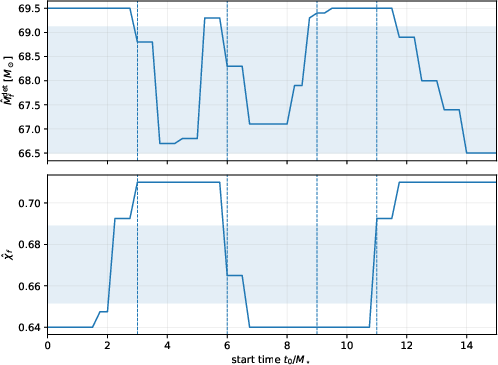
Figure 9: Detector-frame baseline M11 track vs. start time, with public 90% confidence intervals shaded. Vertical lines indicate public anchor windows.
An explicit nuisance analysis (direct-wave, quadratic) is performed per window. The majority of the early and late windows are found to be excessively sensitive to such alternatives, while an intermediate post-peak band (roughly M12--M13 after the peak) remains robust under all diagnostic tests.
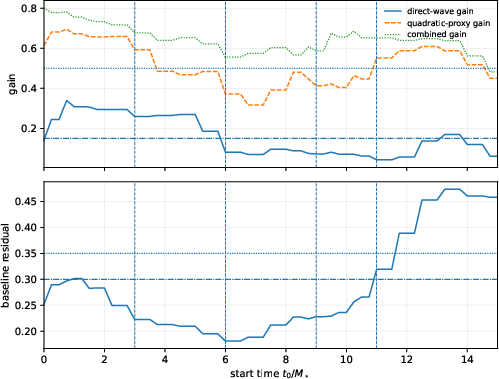
Figure 10: Nuisance diagnostics across the post-merger scan, with direct-wave, quadratic, and combined gains above—baseline residual below. Trust region numerical cutoffs are indicated.
The final trust classification assigns:
Theoretical and Practical Implications
This rigorous finite-window analysis demonstrates that, even in loud GW events where multimode fits are always mathematically possible, the windowed interpretation is tightly constrained by conditioning, start-time sensitivity, omitted content, and diagnostic robustness. The primary practical implication is that overtone-based spectroscopy statements must be tied to explicit, well-audited windows. Theoretical implications include:
- The reliability of ringdown tests of general relativity depends both on systematic window-by-window control and on well-calibrated error budgets.
- Low-SNR or short-duration future signals may yield no trusted windows under similar criteria, indicating the conservatism of the prescribed approach.
Future Developments
As GW detectors improve in sensitivity, more events will become amenable to detailed finite-window spectroscopy. The deterministic trust-region methodology outlined here is directly applicable to new events once the public parameter estimation and detector noise products are available. The framework could be extended to embrace additional physical effects (e.g., non-Kerr or eccentric mergers) and more complex noise models, provided the underlying deterministic conditioning analysis is preserved.
Conclusion
The paper establishes a rigorous, deterministic framework for asserting common-remnant Kerr compatibility via multimode ringdown fits in finite post-merger windows. For GW250114, a clear, nonempty band of trusted windows is identified that reconcile the recovered remnant with public parameter estimation, verifying that claimed overtone consistency is contingent on robust window selection and diagnostic scrutiny. This methodology provides a template for future high-fidelity GW ringdown analyses.