- The paper uses a tailored NMR spin-echo technique to directly detect a glassy orbital state that masks the expected magnetic entropy in Ba₂NaOsO₆.
- Results reveal a transition from a disordered orbital glass to an orbital nematic state, which precedes and possibly triggers magnetic long-range order.
- The study provides a robust experimental paradigm that disentangles intertwined orbital and magnetic degrees of freedom in a relativistic Mott insulator.
Orbital Glass and Entropy in Ba2NaOsO6: A Comprehensive Analysis
Introduction
The study presents an in-depth experimental and theoretical investigation of orbital and magnetic order in the 5d1 relativistic Mott insulator Ba2NaOsO6 (BNOO), focusing on the interplay between spin-orbit coupling (SOC), orbital order, and magnetism. By developing and applying a symmetry-selective nuclear magnetic resonance (NMR) spin-echo technique, the authors directly detect an orbital glass state and uncover its critical role in hiding the missing magnetic entropy. The work rigorously separates the contributions of spin and orbital degrees of freedom (DOF) to complex ordering phenomena, providing evidence for an orbital glass phase, the emergence of an orbital nematic state, and the origin of the observed entropy deficit at the magnetic transition.
Experimental Approach and Phase Identification
A major technical achievement is the implementation of a bi-modal, phase-sensitive NMR spin-echo protocol that independently resolves magnetic (Iz) and orbital/quadrupolar (Iz2) contributions via tailored pulse sequences. This method allows spatially resolved measurement of both the mean and distribution of the orbital order parameter, exploiting the electric field gradient (EFG) at 23Na sites as a local probe of orbital/lattice distortions, and providing access to previously hidden order parameters.
Measurements reveal a phase diagram where, at low temperatures, BNOO exhibits magnetic long-range order (LRO) concomitant with broken local point symmetry (BLPS). The BLPS, indicating local orbital ordering/distortions, survives to temperatures significantly above the magnetic transition, denoted Tc, up to another characteristic temperature T∗.
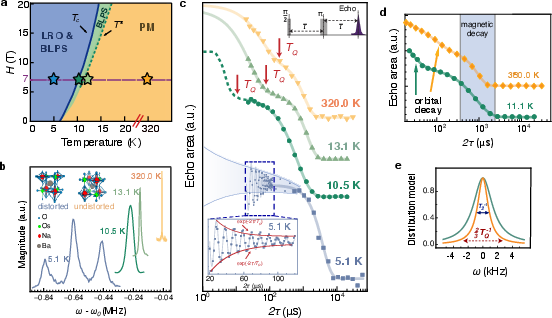
Figure 1: Phase diagram of BNOO, with coexistence and evolution of magnetic LRO and BLPS detected by NMR spectra and spin-echo spectroscopy.
Characterization of Orbital Glass and Nematicity
Analysis of the 60Na NMR spectra across temperature and magnetic field orientations shows that, above 61, the distribution of the quadrupolar interaction parameter, 62, is broad and centered at zero mean, signifying a glassy state of orbital order parameter with no preferred axis. This is the orbital glass phase: spatially disordered, with essentially static, short-range orbital order that evades detection by conventional techniques due to its zero mean.
Upon cooling toward 63, the variance of the distribution increases, and just below 64, the system transitions into a state where the mean of 65 becomes finite, indicating the spontaneous selection of a global nematic axis while retaining spatial disorder in magnitude/direction. This corresponds to an orbital nematic glass: nematic in direction but glassy in amplitude.
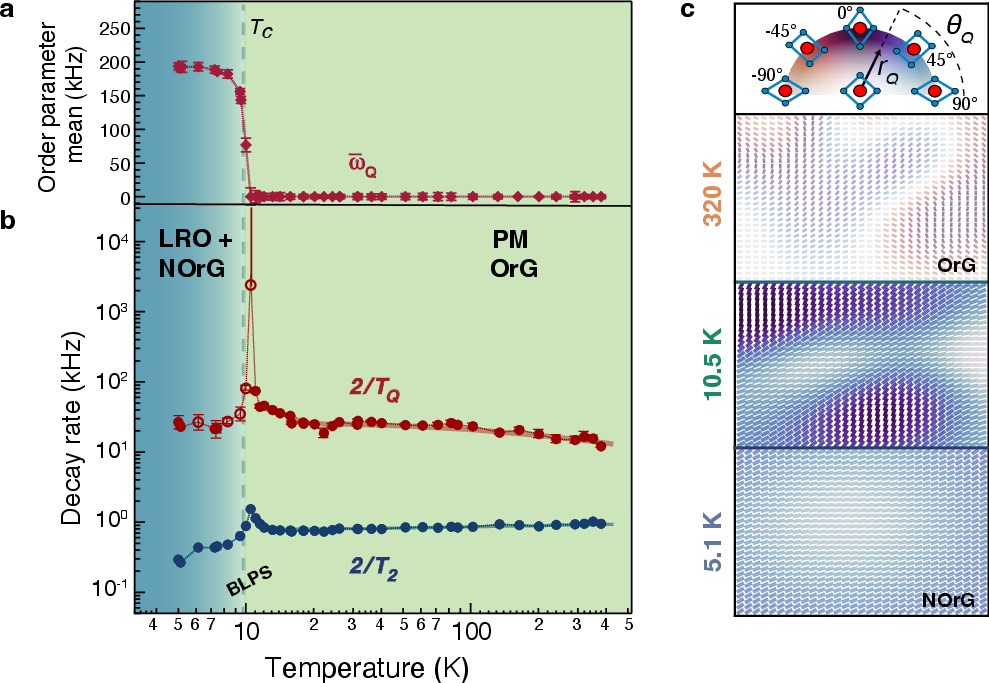
Figure 2: Temperature dependence of the mean and variance of the orbital order parameter, evidencing the transition from glassy disorder to nematic order, and comparison of dephasing rates in orbital and magnetic channels.
The magnetic LRO sets in only after the formation of nematic orbital order, with magnetism emerging as a consequence of the orbital nematic phase breaking rotational symmetry. The NMR signature includes clear triplet splittings at low temperatures due to finite EFG, confirming the onset of orbital nematicity prior to magnetism.
Quantitative Evidence: Echo Decays and Angle Dependence
The detailed time-domain studies of spin-echo decays provide further evidence for orbital glassiness. In the glassy phase, echo modulations vanish and the decay is ruled by a Lorentzian distribution; below 66, oscillations emerge, supporting the establishment of preferred nematic orientation.
The techniques are further validated by systematic variation of both the radiofrequency tip angle and the sample tilt angle relative to the applied field. Tip-angle dependence matches theoretical predictions for selective refocusing of quadrupolar terms, and tilt angle studies reveal that amplitude variations stem from predominantly angular variation of the orbital order, not just magnitude.
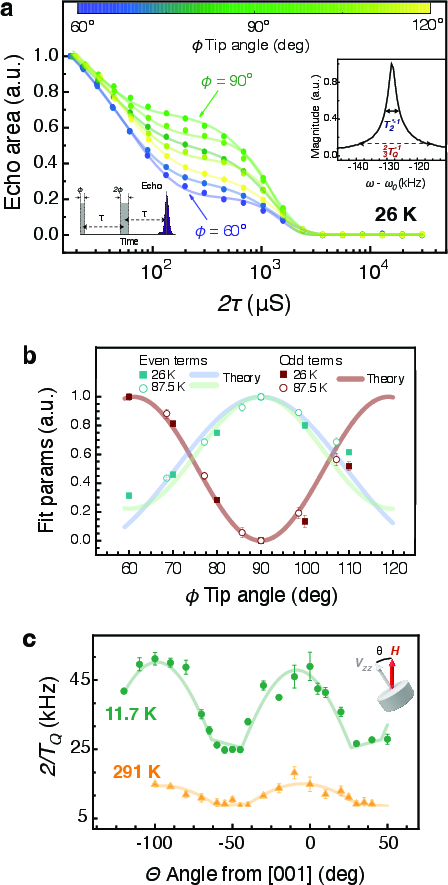
Figure 3: Echo decay as a function of tip angle and tilt angle, confirming the orbital origin and spatial/angular distribution of the quadrupolar interaction.
Resolution of the Missing Entropy Problem
A longstanding puzzle in BNOO and similar systems has been the observation of "missing entropy": the magnetic transition at 67 only accounts for entropy loss corresponding to the breaking of a two-fold, rather than four-fold, degeneracy; inconsistent with expectations for a 68 system. This study definitively attributes the hidden entropy to the configurational entropy of the orbital glass: above 69, the entropy is stored in the high degeneracy of glassy orbital configurations, which are invisible to probes sensitive only to the magnetic order parameter. The transition to nematic order and subsequent magnetic LRO only partially lifts the total degeneracy, accounting for the observed entropy loss.
Theoretical and Practical Implications
The identification of glassy and nematic orbital phases significantly advances the understanding of how SOC and multiple coupled DOF generate complex phases in Mott insulators. The results impose strict symmetry-based constraints on candidate Hamiltonians for such systems, demonstrating that orbital order—not purely magnetic interactions—can be the primary driver of magnetism when strong SOC is present. The finding that an orbital nematic state induces magnetic LRO provides a mechanism for the sequence of symmetry-breaking transitions not previously resolved in these materials.
On a practical level, the phase-sensitive NMR methodology opens pathways for disentangling intertwined order parameters in other quantum materials where multiple DOFs are active, especially in cases with frustrated lattices, hidden order, or where missing entropy is observed. This approach is adaptable to a wide range of strongly-correlated systems, including spin-orbital liquids, frustrated magnets, and molecular magnets, and will be crucial for constructing experimental maps of complex phase diagrams.
Conclusion
This work conclusively demonstrates that in Ba5d10NaOsO5d11, the missing magnetic entropy at the magnetic transition is concealed in the configurational entropy of a glassy orbital phase, which persists to high temperatures and preempts the nematic and magnetic orders at low temperature. The development of a phase-sensitive, symmetry-selective NMR probe is instrumental in disentangling magnetic and orbital responses, providing both qualitative and quantitative evidence for the existence, sequence, and interrelation of orbital glass, orbital nematic, and magnetic phases. These findings offer a robust experimental paradigm and a new route for the understanding and control of coupled order parameters in complex quantum materials (2604.17540).