- The paper systematically derives a hydrodynamic model for chemically active emulsions, connecting microscopic chemical kinetics with macroscopic active phase separation.
- It demonstrates that non-equilibrium gradient corrections generate microphase structures, dynamic filaments, and reversed ripening phenomena validated by numerical simulations.
- Measurements of entropy production reveal how chemical driving forces quantify energy dissipation and instabilities in soft, dissipative materials.
Hydrodynamic Theory for Chemically Active Emulsions: Non-equilibrium Phase Behavior and Coarse-grained Modelling
Introduction and Context
Chemically active emulsions, prevalent in soft matter and biological systems, display diverse non-equilibrium phenomena driven by energy-dissipating reactions. The interplay of diffusion, phase separation, and chemical reactions creates a range of behaviors, including microphase formation, arrested coarsening, and dynamic patterns. A unified, thermodynamically consistent coarse-grained theory to describe such emulsions at hydrodynamic scales enables direct connections to the established framework of active matter field theories, notably Active Model B+ (AMB+). This paper presents a detailed derivation of the hydrodynamic limit for ternary mixtures with chemical reactions, systematically reducing the full Cahn-Hilliard-reaction dynamics to a single conserved field with non-equilibrium gradient corrections. Numerical implementation for a Flory-Huggins-type ternary solution directly validates the theoretical predictions.
Model and Theoretical Advances
The study focuses on an incompressible ternary solution consisting of solvent (S) and two solutes (A and B) interconverted by first-order chemical reactions. Critically, the A↔B reactions are mediated by both passive (equilibrium, detailed balance-satisfying) and active (fuel-consuming, driven out of equilibrium) pathways. The active reaction is controlled by a chemostatted fuel, e.g., ATP, characterized by a driving chemical potential Δμ.
Two collective fields are identified: the total solute density, ψ=ϕA+ϕB, is conserved and slow, while the reaction extent, ξ=ϕB−ϕA, relaxes rapidly via reaction kinetics. A systematic expansion exploits this separation of timescales, adiabatically eliminating ξ to derive an effective hydrodynamic equation for ψ. The nonequilibrium character is encoded in a composition-dependent activity coefficient α(ψ,ξ) associated with the active reaction pathway.
The resulting macroscopic dynamics generalize the form of AMB+. The current for ψ includes, beyond standard diffusive terms, non-equilibrium gradient-dependent contributions with coefficients (λeff, ζeff, ηeff) determined explicitly from the underlying microscopic parameters:
- λeff: multiplicative term in ξ=ϕB−ϕA0
- ξ=ϕB−ϕA1: nonlinear, non-variational term proportional to ξ=ϕB−ϕA2
- ξ=ϕB−ϕA3: cubic gradient ξ=ϕB−ϕA4 term, recently identified as relevant in non-equilibrium coarse-graining
- ξ=ϕB−ϕA5: stabilizing higher-order gradient correction (ξ=ϕB−ϕA6), crucial when effective interfacial tension becomes negative
The crucial interfacial energy coefficient is renormalized by activity, ξ=ϕB−ϕA7, where ξ=ϕB−ϕA8 is explicitly computed from the reaction thermodynamics and the functional form of ξ=ϕB−ϕA9. When ξ0, the system can develop regular mesoscale structure via a finite-wavelength instability, a defining signature of active phase separation.
Numerical Implementation and Phase Phenomenology
A Flory-Huggins bulk free energy with specifically chosen interactions and activity parameters serves as a testbed. The dependence of the active coefficient ξ1 on solvent density generates a scenario where activity favors microphase separation at high dilution and destabilizes interfaces at higher densities.
Emergence of Microphases and Novel Dynamical States
Systematic simulations span both deterministic and stochastic regimes:
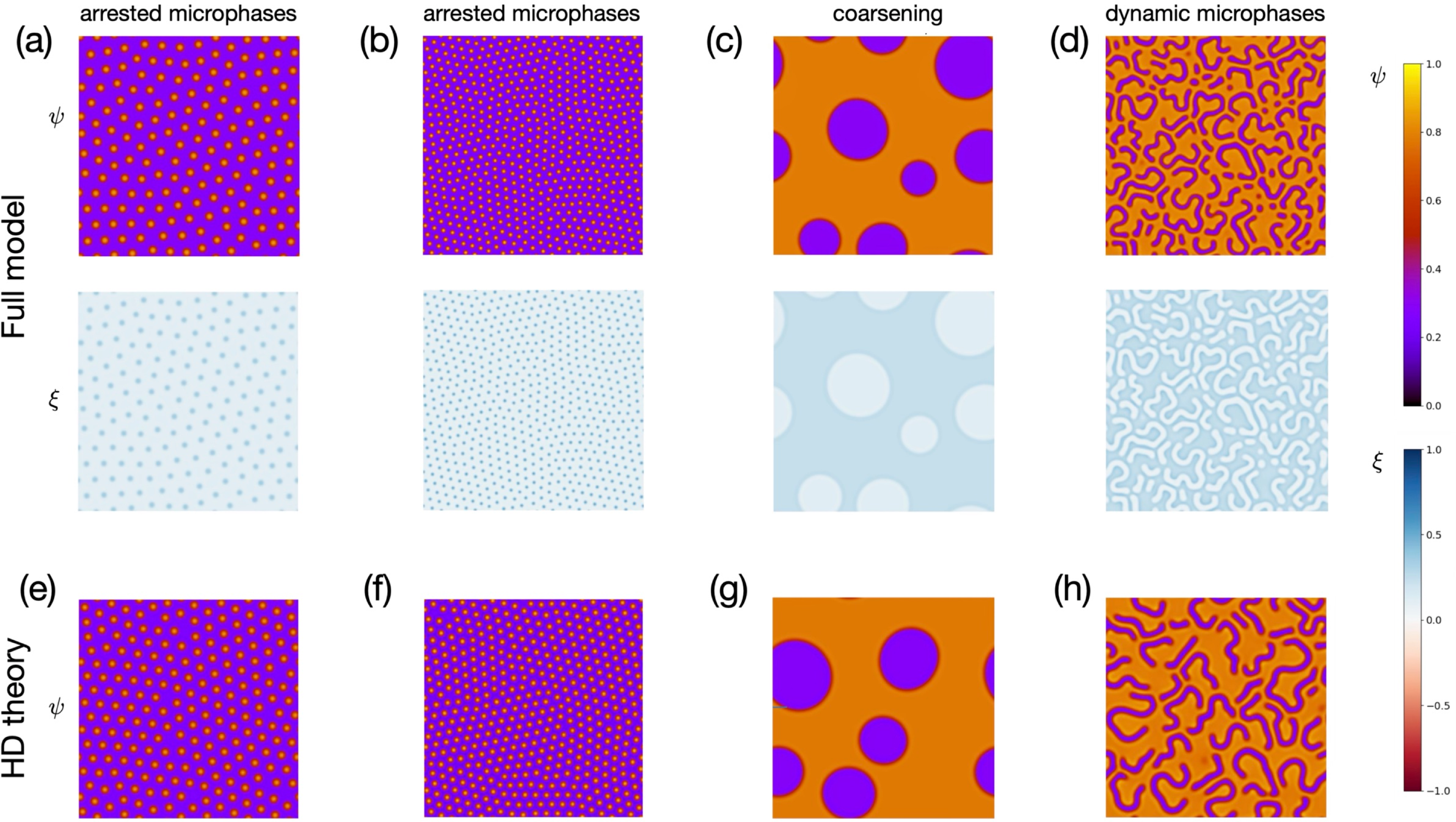
Figure 1: Snapshots at long times reveal microphase-separated states (dense droplets in dilute background), macrodroplet coarsening, and novel dynamic filamentous patterns depending on control parameters.
When ξ2, arrested microphases with periodic, monodisperse droplets emerge and persist (panel a, b, e, f in Figure 1). The droplet spacing and morphology are well predicted by the hydrodynamic theory. For higher global densities, the same conditions can result in dynamic, filament-like structures where interfaces undergo continuous elongation, fission, and migration (panel d, h in Figure 1). These patterns are reminiscent—but not identical—to active foam phases in AMB+, underlining the extended phenomenology due to higher-order nonlinearities in the hydrodynamic limit.
Asymmetric Ripening and Exotic Coarsening
Detailed ripening diagrams elucidate the conditions under which Ostwald ripening is suppressed or even reversed, producing two droplets of distinct size or stabilized microstructures (analogous to "reversed ripening"):
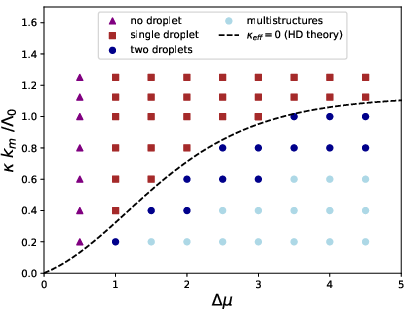
Figure 2: Ripening diagram showing the fate of size-asymmetric droplets for varying effective interfacial tension and chemical driving Δμ; microphase and reverse-Ostwald regimes are controlled by ξ3.
The precise location of the transition lines is matched by the analytically obtained criterion ξ4.
Nonequilibrium Entropy Production
Analysis of entropy production rates quantifies energy dissipation from both reaction and diffusive processes. The overall entropy production grows with increasing chemical driving and exhibits a pronounced kink at the onset of dynamic microphase formation (akin to a singularity in transport at a nonequilibrium phase transition):
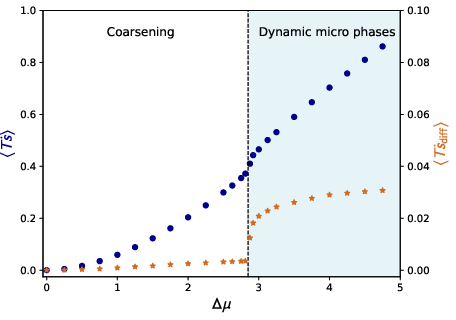
Figure 3: Entropy production per unit area as a function of chemical driving Δμ, showing a clear kink at the transition to dynamic microphase/filament behavior, particularly visible in the diffusive contribution.
This result provides a direct, measurable link between non-equilibrium thermodynamics and emergent collective phase behavior in active emulsions.
Practical and Theoretical Implications
The developed framework establishes how the coarse-grained, field-theoretic description of active emulsions, parameterized directly by microscopic thermodynamic and kinetic inputs, reproduces the canonical nonequilibrium phases seen in AMB+ and extends them due to higher-order corrections.
- Direct connection to chemical/biological context: The identification of active coefficients with explicit reaction rates and energy transduction enables material-specific predictions for systems such as ATP-driven biomolecular condensates.
- Generality beyond traditional criticality: The existence of micro- and macro-phase separation, bubbly, and filamentous structures is shown to not require proximity to equilibrium critical points, nor a specific quartic free energy expansion.
- Design of dissipative soft materials: Control over reaction-diffusion length, chemical driving force, and interaction strength offers routes to engineer materials with robust, tunable self-organized architectures.
- Thermodynamic consistency and entropy accounting: The model enables calculation of the full entropy production along with its partition into diffusive and reaction channels, linking emergent dynamics to energy dissipation.
Outlook and Future Directions
Future developments include exhaustive mapping of the phase diagram for varied models of chemical activity, incorporation of additional thermodynamic fields (e.g., for multi-step biochemical networks or mechanochemical couplings), and investigation of spatiotemporal instabilities beyond stationary patterns. The approach lays the foundation for predictive modeling of non-equilibrium droplets in biological cells, synthetic active emulsions, and other complex fluids with coupled transport and reactions.
Conclusion
This paper systematically derives the hydrodynamic theory for chemically active emulsions, demonstrating that the generic features of active phase separation as captured by AMB+ emerge naturally from microscopic chemical kinetics and thermodynamics. The theory reproduces and extends the known landscape of exotic non-equilibrium phases, offers quantitative agreement with numerical simulations, and provides direct connections to measurable thermodynamic quantities such as entropy production. These advances open new avenues for understanding and controlling the self-organization of dissipative materials at mesoscopic and macroscopic scales.