- The paper empirically isolates recurring abnormal gate patterns on NISQ devices using statistical delta debugging to pinpoint segments causing unexpected excess hardware noise.
- It applies targeted commuting swaps at compile time to disrupt these patterns, achieving up to 45% reduction in excess noise on specific quantum backends.
- The study demonstrates that traditional calibration-based noise models are insufficient, emphasizing the need for empirical, backend-specific error mitigation techniques.
Isolating Execution-Dependent Abnormal Gate Patterns on NISQ Devices: The QRisk Framework
On NISQ quantum hardware, context-dependent error mechanisms such as crosstalk and correlated scheduling noise remain major obstacles to reliable computation. Standard calibration-derived noise models, which are central to modern quantum compilers, only capture independent per-gate and per-qubit error rates, and fail to account for these context-specific errors. This failure can cause two compiled circuit variants—identical under the compiler's noise model—to manifest dramatically different fidelity on hardware due to the presence of subtle, recurring abnormal local gate patterns.
The motivating example (Figure 1) demonstrates this effect: a Grover circuit compiled for ibm_marrakesh contains a four-gate subsequence that induces a 44.5% hardware error reduction after a commuting gate swap disperses the pattern, despite the noise model predicting identical error for both versions.
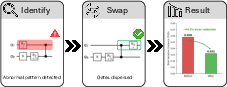
Figure 1: A Grover circuit on ibm_marrakesh where a 4-gate local subsequence causes excess hardware error; a commuting swap eliminates 44.5% of the error, undetected by the noise model.
The QRisk Approach
QRisk addresses the compiler's blindspot by isolating compact, recurring abnormal patterns empirically from hardware, then applying lightweight semantic-preserving circuit transformations to avoid these patterns during compilation. The system comprises two core stages:
- Offline Stage: Delta debugging isolates minimal circuit segments (grouped by circuit moments to capture multi-gate effects) that are responsible for persistent excess hardware noise, validated by repeated discovery across independent calibration windows. Pattern extraction is robust against shot noise and drift by requiring statistically significant recurrence.
- Online Stage: At compile time, QRisk scans for known abnormal patterns in compiled circuits and applies targeted commuting gate swaps to disrupt contiguous instances of these patterns without changing circuit semantics. This post-compilation pass is implemented as a Qiskit transformation.
Pattern Isolation via Statistical Delta Debugging
The pattern isolation mechanism adapts delta debugging to quantum circuits by using a statistical oracle based on the ratio of hardware error (total variation distance, TVD, between quantum hardware and noise simulation) over the simulated noise model error. Segment removal is guided by drops in this ratio beyond a noise-calibrated threshold, thereby determining the minimal set responsible for the excess error. Only patterns rediscovered in multiple calibration windows—including over months—are retained in the backend-specific QRisk database, filtering out transient artifacts.
Empirical Evaluation
Experiments were conducted on ibm_fez and ibm_marrakesh (both 156-qubit IBM Heron backends) using Grover search circuits mapped to small qubit subsets. QRisk consistently isolated 4-gate abnormal patterns that:
- Persisted across calibration windows: The ibm_fez pattern was flagged in 8/10 runs over four months; the ibm_marrakesh pattern in 10/10 runs over five months.
- Were backend specific: Cross-hardware testing on ibm_kingston, using the same circuits and qubit positions, showed no effect, confirming hardware specificity.
For both ibm_fez and ibm_marrakesh, circuit families with up to three occurrences of the discovered abnormal pattern were constructed. Using commuting swaps, variants were created that reduced the count of contiguous pattern instances from 3 to 0, without affecting logical functionality. Targeted empirical measurement reveals:
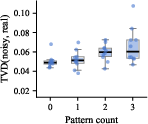
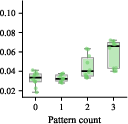
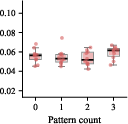
Figure 3: Eliminating all abnormal patterns on ibm_fez via commuting swaps results in a 24% reduction in excess hardware noise (TVD), not predicted by the noise model.
- ibm_fez: Eliminating all three pattern instances yielded a 24% mean reduction in TVD(noisy, real), with a significant Spearman correlation (ρ=0.515, p=0.0007) between surviving pattern count and excess noise.
- ibm_marrakesh: Fully eliminated patterns reduced excess hardware noise by 45% (ρ=0.711, p<0.0001).
- The noise model predicted identical error for all circuit variants, confirming the excess was invisible to per-gate models.
- No effect was observed when running the pattern on an "innocent" backend (ibm_kingston).
- The effect compounds non-linearly: while a single occurrence marginally impacts noise, multiple occurrences result in substantial fidelity loss.
Theoretical and Practical Implications
QRisk's empirical, pattern-guided approach introduces an orthogonal axis of quantum compiler robustness compared to classical noise-aware layout and routing. By capturing recurring, execution-dependent noise sources undetectable by calibration, QRisk bridges a fundamental gap between modeled and real hardware error.
The theoretical implication is clear: Markovian, context-free noise models are insufficient for robust NISQ compilation. Compilation must be supplemented by empirical, persistent, hardware-specific “risk” patterns extracted directly from device behavior. This empirically grounded augmentation could be extended to deeper compiler stages (e.g., mapping and routing heuristics) and to richer classes of patterns (beyond those disruptable by commuting swaps).
On the practical front, QRisk can be injected as a lightweight post-compilation pass—its transformation overhead is negligible. However, database maintenance is necessary as patterns are backend- and time-specific. The methodology could inform online health monitoring for new hardware or dynamically adapt to hardware upgrades and recalibrations.
The approach offers a general framework for future AI-driven quantum compilation: learning and leveraging backend-specific, persistent, high-fidelity “bugs” and mitigation strategies in response to hardware evolution. The methodology of cross-window and cross-hardware statistical verification, robust to stochastic quantum process noise, provides a template for similar tools in quantum program analysis and error mitigation.
Conclusion
QRisk demonstrates that recurring, backend-specific abnormal gate patterns are a significant source of unexpected hardware noise unaddressed by calibration-based noise models. By statistically isolating these fragments and disrupting them via commuting swaps, QRisk achieves substantial reductions in excess error (up to 45%) with no cost to circuit depth or composition. The framework underscores the necessity of empirical, persistent error pattern learning for NISQ compilers, setting the stage for future hybrid statistical-analytical compilation pipelines as quantum hardware matures.