- The paper establishes a quantum battery using ~10^12 87Rb atoms at room temperature, showing coherence-enabled capacity enhancement and real-time operational measurement.
- It employs optical pumping and RF manipulation to achieve >99% polarization and long coherence times, validating the battery's performance against tomographic methods.
- The study quantitatively links engineered decoherence with entropy–capacity trade-offs, paving the way for scalable macroscopic quantum energy storage.
Room-Temperature Thermal Vapor Quantum Battery Based on Collective Atomic Spins
Overview and Motivation
The paper "Thermal vapor quantum battery based on collective atomic spins" (2604.17518) presents the experimental realization and operational characterization of a quantum battery based on a macroscopic ensemble of 87Rb atomic spins at room temperature. This platform implements a scalable, long-lived quantum battery architecture, establishes direct operational measurement protocols for battery capacity, and systematically explores the interplay of quantum coherence, entropy, and energy storage. The study demonstrates coherence-enabled capacity enhancement, validates information-theoretic bounds, and directly elucidates the effects of engineered decoherence on quantum battery performance.
Experimental System and Battery Model
The quantum battery consists of ∼1012 alkali atoms in a paraffin-coated vapor cell, collectively controlled via optical pumping and RF fields to manipulate and read out the ensemble spin state with high fidelity.
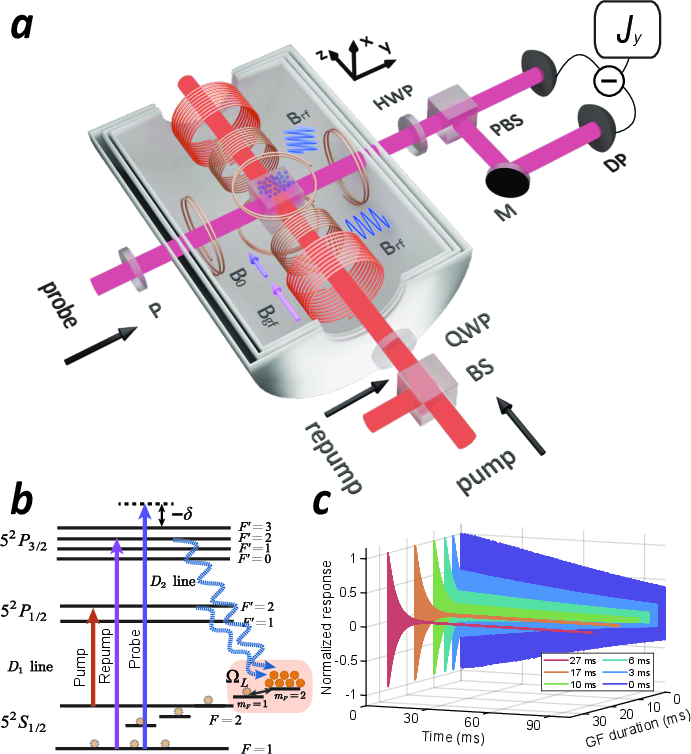
Figure 1: Experimental schematic showing the paraffin-coated 87Rb vapor platform, optical pumping, and non-destructive Faraday spin readout. The two-level battery operates between Zeeman states ∣F=2,mF=2⟩ and ∣F=2,mF=1⟩ with tunable coherence via a gradient field.
The effective two-level quantum battery is defined by the Zeeman subspace, where energy gap controllability, excellent spin polarization (>99%), and coherence times T2>110 ms are achieved (Figure 1c). RF and gradient coils, combined with optical pulses, enable finely tunable unitary evolution and controlled dephasing, underpinning capacity manipulation and quantum state engineering.
Operational Characterization and Charging Protocols
The operational framework characterizes battery capacity via the maximal and minimal internal energies accessible under cyclic unitary transformations. The cycle comprises (i) state preparation to set the charge, (ii) unitary spin rotations for charging/discharging, and (iii) partial or full decoherence via magnetic-field gradient, with Faraday rotation readout at all stages.
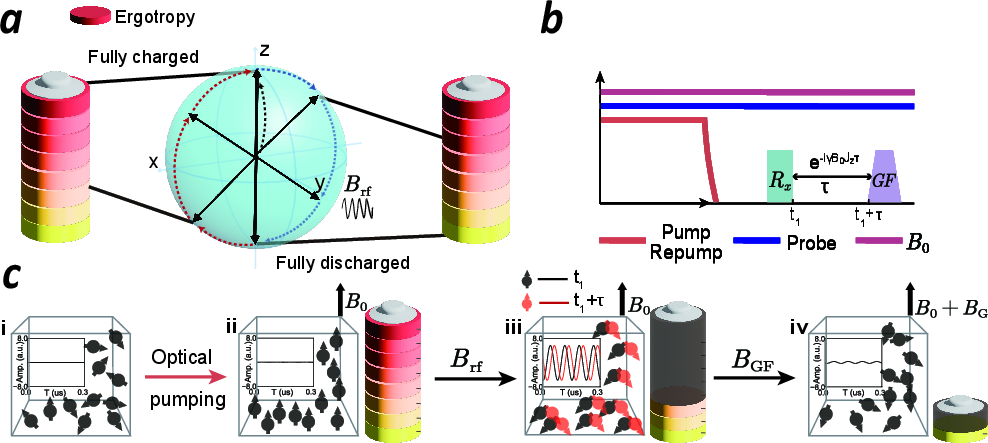
Figure 2: a) Bloch sphere depiction of microscopic quantum battery cycles; b) Experimental pulse sequencing and rotations; c) Evolution of battery charge, capacity, and ergotropy through charge/discharge/dephasing.
Crucially, this tomography-free protocol maps directly onto the physical definition of capacity, enabling real-time, scalable measurements. The approach is validated against complete state tomography, with sub-2% agreement between the operational and tomographically inferred battery capacities.
Quantum Coherence and Entropic Constraints
The study rigorously establishes the contributions of population imbalance (incoherent) and quantum coherence (off-diagonal) terms to battery capacity. The experimentally accessible decomposition is confirmed by direct capacity measurements and density-matrix reconstruction, verifying the quadratic (Pythagorean) addition of coherent and incoherent capacity components.
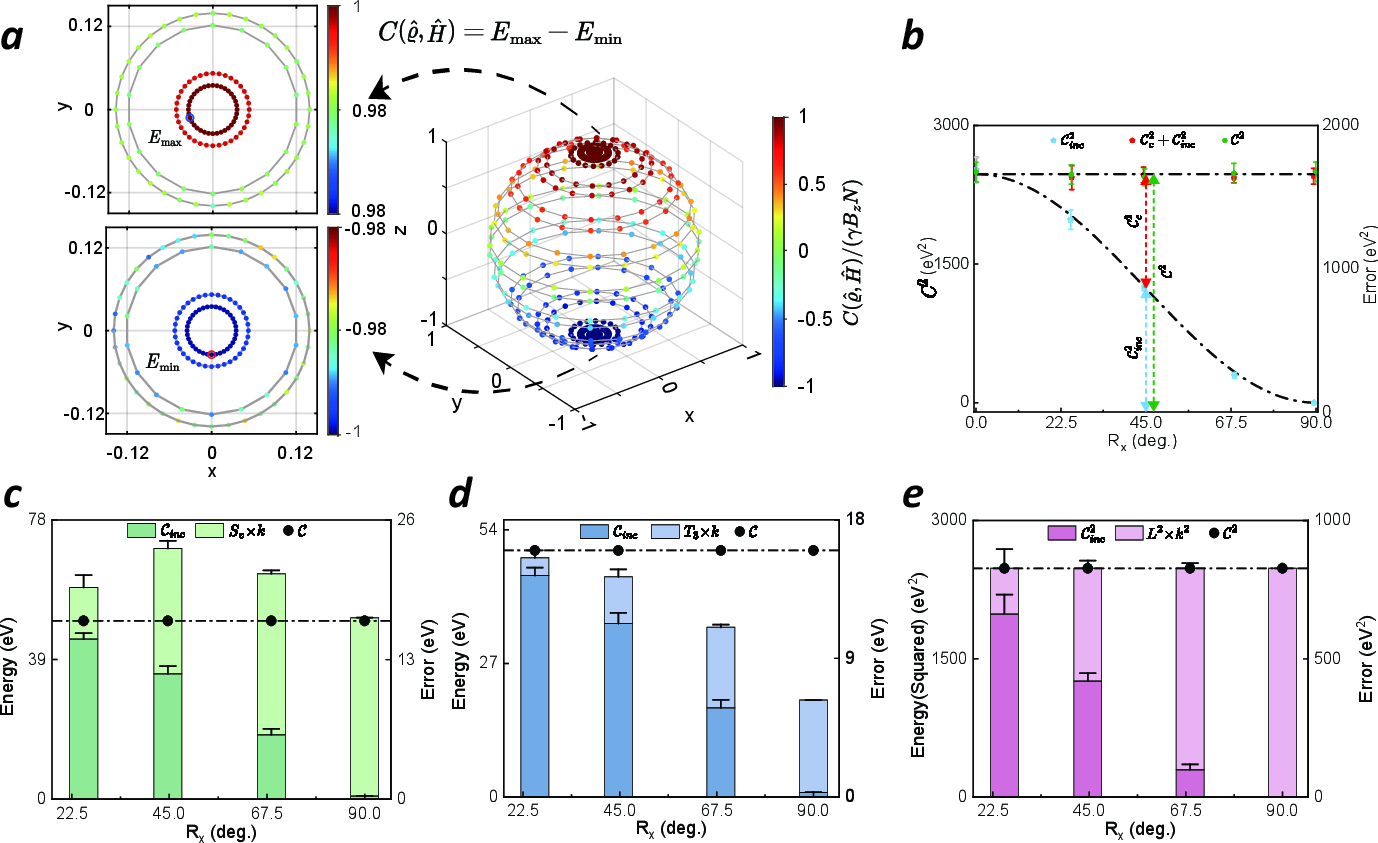
Figure 3: a) Hierarchical energy extremization (capacity measurement) trajectory; b) Comparison of operational versus tomographic and decomposed coherent/incoherent capacities; c-e) Experimentally measured relations between capacity and von Neumann, Tsallis, and linear entropies for both coherent and decohered states.
It is demonstrated that maximal capacity can be achieved solely via coherence, independent of population distribution, a regime entirely inaccessible classically. Furthermore, the experiment verifies explicit, quantitative entropy–capacity trade-offs predicted by information theory for quantum systems, including tight inequalities for von Neumann, Tsallis, and linear entropies.
Coherence Degradation and Capacity Loss
The environment-induced degradation of quantum coherence, realized via controlled magnetic-field gradient-induced dephasing, leads to a deterministic, monotonic reduction in the quantum battery capacity. Different initial pure and superposed states exhibit characteristic nonlinear or linear coherence–capacity decay profiles.
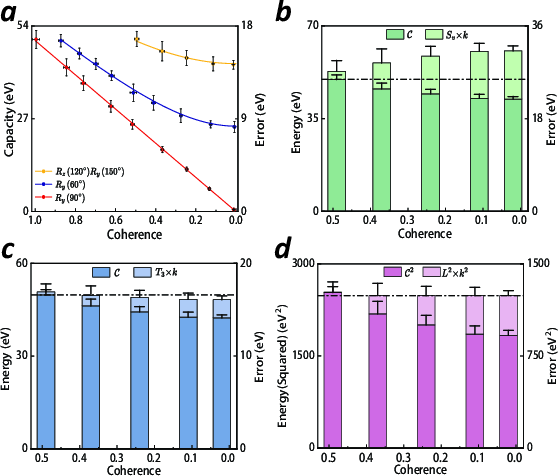
Figure 4: a) Capacity decay as function of coherence for various prepared initial states; b-d) Evolution of entropy–capacity relations (for von Neumann, Tsallis, and linear entropies, respectively) under controlled dephasing.
This section quantitatively establishes that, under decoherence, the saturation of entropy–capacity bounds weakens, with nontrivial dependence on the nature of incoherent and coherent resources. The experimental protocol further demonstrates that the presence of coherence systematically suppresses entropy production and maintains tighter capacity bounds, enhancing thermodynamic efficiency.
Practical and Theoretical Implications
This realization of a room-temperature, high-N, long-coherence-time quantum battery provides a scalable testbed for addressing macroscopic quantum resource management, operational thermodynamics, and information–energy relations in quantum devices. The direct experimental demonstration of coherence-enabled energy storage and entropy–capacity relations consolidates the physical link between quantum information and thermodynamics, with meaningful implications for:
- Macroscopic quantum technology: The platform's scalability, ambient operation, and operational control may inform quantum networked energy devices, persistent quantum memories, and next-generation quantum-enhanced transduction circuits.
- Quantum thermodynamics: Experimental quantification of coherent and incoherent thermodynamic resources probes the boundary between classical and quantum energy storage, enabling verification of generalized second-law-like bounds and resource theory predictions.
- Future directions: Coherence/entanglement enhancement, high-dimensional or multilevel quantum batteries, environment engineering for dissipation/dynamical control, and integration with non-equilibrium or feedback-driven charging protocols are identified as promising directions for advancing fundamental and applied quantum energy science.
Conclusion
This work demonstrates a scalable, room-temperature quantum battery based on collective atomic spins, introducing direct measurement protocols, validating quantum coherence–capacity enhancement, and confirming tight information-theoretic entropy–capacity constraints. The platform achieves strong agreement between operational and state-based definitions and systematically characterizes capacity degradation under decoherence. The results establish a robust framework for experimentally exploring macroscopic quantum thermodynamics and pave the way for practical, scalable quantum energy storage and management systems.

