- The paper introduces a cyclic scheduling framework that guarantees hard packet deadlines while optimizing throughput.
- It analytically derives feasibility conditions and tradeoffs between queue stability and deadline requirements using interference-aware models.
- A polynomial-time Weighted Greedy Coloring heuristic is proposed, validated through extensive simulations in diverse network topologies.
Scheduling in Multi-Hop Wireless Networks with Deadlines: A Technical Overview
This essay presents a comprehensive analysis of the paper "Scheduling in Multi-Hop Wireless Networks With Deadlines" (2604.17493), focusing on its formulations, theoretical developments, algorithmic strategies, and empirical findings in the context of end-to-end QoS enforcement via throughput and hard packet deadline guarantees in multi-hop wireless networks.
The core objective addressed in this paper is to schedule transmissions in wireless networks with arbitrary topology and interference models so as to satisfy both hard end-to-end deadline and throughput constraints for multiple, possibly overlapping, flows. The authors employ a network slicing abstraction to decouple the queueing dynamics for different flows, which is critical under resource slicing paradigms such as those standardized in 5G.
Queue Stability vs. Deadline Satisfaction
A central theoretical insight is that queue stability—ensured when the long-term service rate for each flow/route exceeds the arrival rate—is a necessary but insufficient condition for meeting per-packet deadlines. The paper provides detailed constructions showing that stabilizing schedules may induce packet delays that systematically violate deadline constraints, especially under adverse schedule permutations within a cyclic schedule.
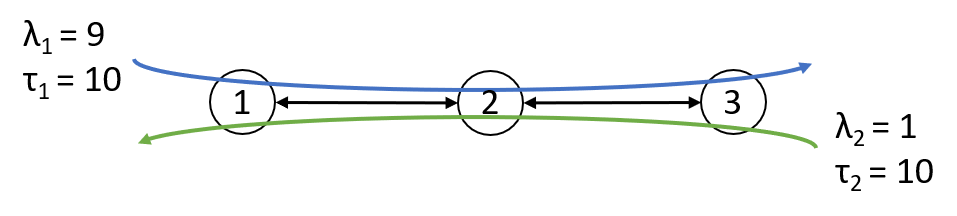
Figure 1: Illustrative Two-Hop Example demonstrating that queue-stabilizing policies can still miss deadlines if the schedule ordering is suboptimal.
Hence, the authors develop necessary and sufficient conditions that strengthen stability with explicit schedule order constraints, employing cyclic scheduling policies.
Single Flow: Throughput/Deadline Optimality and Policy Design
Focusing initially on the solitary flow case, the paper derives closed-form characterizations of the achievable throughput and deadline regions as a function of slicing and interference constraints. The central parameters are the link activation rates and inter-scheduling times determined by the interference model (captured via the conflict graph and independent sets).
Key results include:
- The throughput-optimal policy for a single flow on a route is constructed by maximizing the minimum time-average activation rate multiplied by slice width across all links, subject to interference cliques.
- The deadline-optimal policy—the Ordered Round Robin (ORR)—is proved to minimize the maximal inter-scheduling time, achieving minimally feasible per-packet delays (tight in both lower and upper bounds) when all slice widths are equal. In general, a tradeoff between deadline and throughput optimality arises if slice widths are unequal.
This framework yields precise statements on the interplay between activation order and hard-delay guarantees, as well as the limitations of myopic policies such as greedy link activation under non-trivial interference.
Multi-Flow Setting and Complexity Analysis
When multiple flows traverse the network, schedule orderings must be coordinated to prevent conflicting demands from creating bottlenecks or deadline violations due to cross-flow interference. The authors develop an explicit formulation linking per-flow, per-link slice allocations to the schedule's maximal inter-scheduling times, establishing a set of feasibility constraints encompassing deadline, rate, and interference.
Crucially, the schedule construction problem becomes equivalent to an instance of the pinwheel scheduling problem (and its generalization, pinwheel coloring), both of which are proven NP-hard. The pinwheel problem requires constructing a cyclic schedule in which every task (link) is activated with an inter-scheduling time less than or equal to a specified bound, respecting interference constraints.
Polynomial-Time Heuristic: Weighted Greedy Coloring (WGC)
To address the combinatorial complexity for practical network instance sizes, the paper introduces the Weighted Greedy Coloring (WGC) algorithm, a decentralized and computationally efficient heuristic:
- WGC leverages conflict graph colorings to partition links into activation sets (colors), assigning inter-scheduling times that satisfy all flows' deadlines if possible.
- For each color, a maximum allowable activation interval (pinwheel bound) is determined using a relaxation followed by integer programming.
- Schedule construction is delegated to the Sxy algorithm, a highly efficient polynomial-time pinwheel scheduler, guaranteeing a valid slot assignment for the generated pinwheel vectors when possible.
Empirically, WGC combined with Sxy effectively achieves near-optimal throughput/deadline tradeoffs across diverse topologies and random traffic scenarios, outstripping the best-known heuristics in this domain.
Empirical Evaluation and Numerical Results
The efficacy of the scheduling framework is validated through extensive simulation experiments. Results demonstrate:
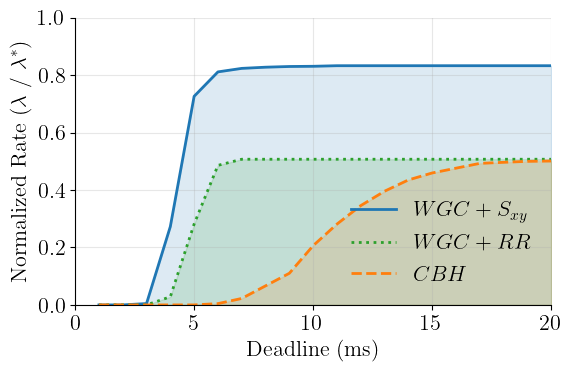
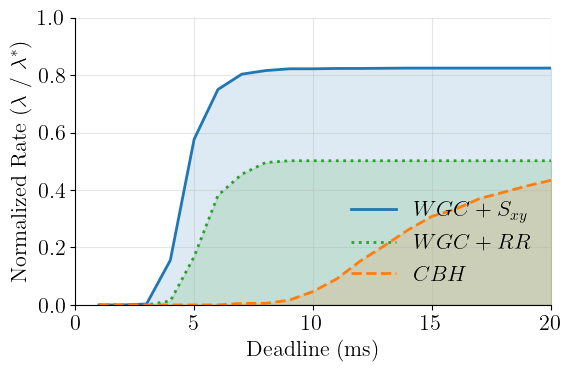
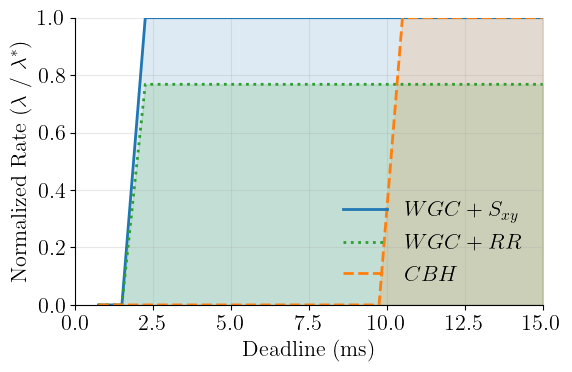
Figure 3: Average feasibility regions for sink tree, mesh grid, and random topologies, showing the normalized maximum feasible rate for given deadlines.
- Performance degrades gracefully under increased interference radius, reduced link density, or increased number of flows, with the schedule construction overhead remaining polynomial.
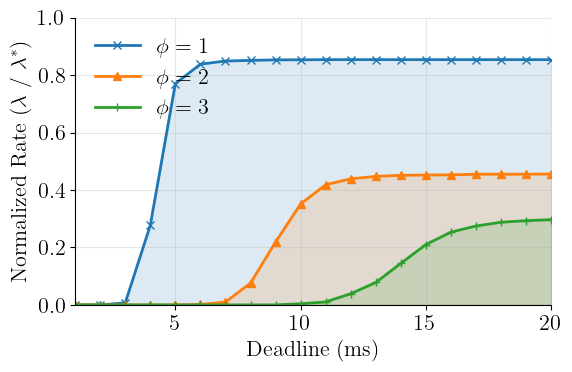
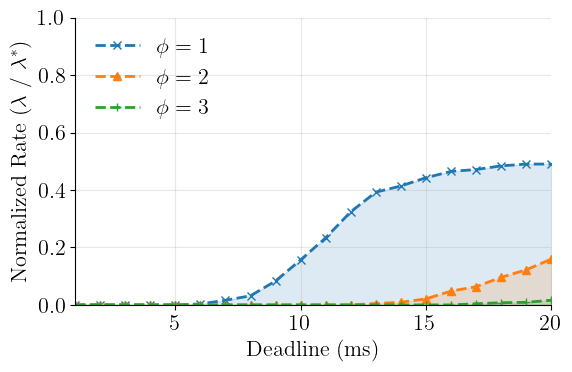
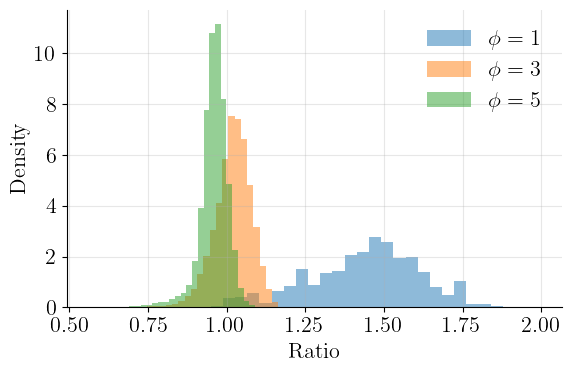
Figure 4: Average feasibility regions for a mesh grid under variable interference radius ϕ, showing clear performance separation between WGC+Sxy and CBH.
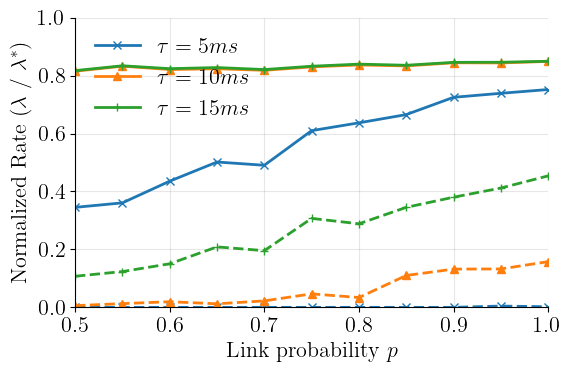
Figure 5: Average feasible normalized rate as a function of link presence probability and deadline, demonstrating robustness to random topology failures.
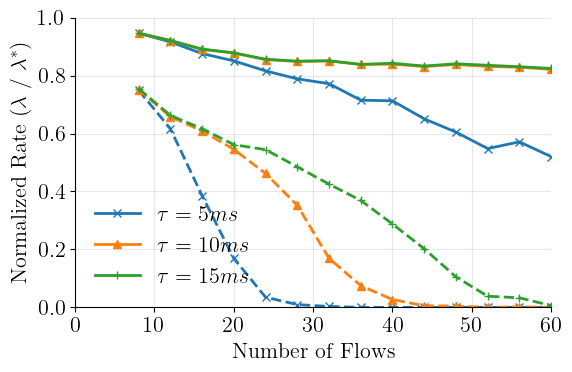
Figure 6: Average feasible normalized rate as the number of flows increases, with deadlines and saturation effects characterized.
Implications and Future Research Directions
This work provides a rigorous basis for designing scheduling algorithms capable of meeting strict deadline guarantees in highly resource-constrained multi-hop wireless networks. The results significantly advance the state of the art in the analysis and practical synthesis of schedules for deterministic traffic with per-flow deadlines under general interference models.
Practical implications are immediate for networked control, URLLC in 5G/6G, and real-time distributed inference over wireless, where end-to-end deadlines must be met under stochastic topology and interference scenarios. The modularity of the WGC+Sxy algorithm enables straightforward deployment within modern network slicing frameworks.
Theoretically, the reduction to pinwheel scheduling and coloring not only connects wireless network scheduling to classical combinatorial problems but also reveals opportunities for cross-pollination with recent advances in approximation algorithms and parameterized complexity.
Future work directions include:
- Joint optimization of routing and scheduling under the pinwheel coloring abstraction.
- Extensions to networks with unreliable links, time-varying topology, or stochastic traffic envelopes.
- Distributed schedule construction with only local information, leveraging advances in distributed graph coloring.
Conclusion
By integrating queueing theory, combinatorial scheduling, and approximation algorithms, the paper presents a robust methodology and practical algorithms for enforcing hard QoS guarantees in wireless multi-hop settings. These contributions materially advance the theory and practice of reliable, real-time wireless network scheduling with deadlines.