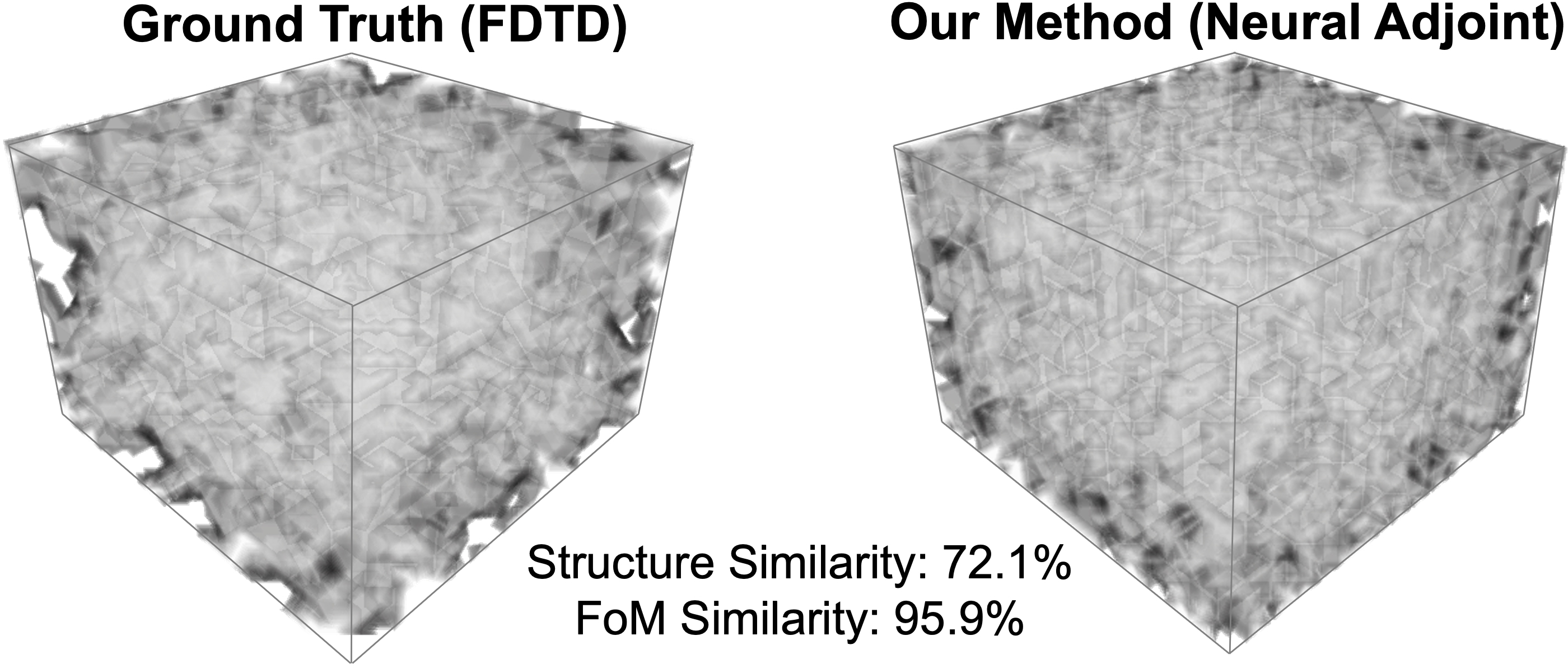
- The paper introduces a neural adjoint method that uses a multi-stage Fourier Neural Operator to accurately predict volumetric adjoint gradients for rapid inverse design.
- It employs stage-wise spectral decomposition to capture low, mid, and high-frequency details, achieving cosine similarities up to 99% compared to full-wave simulations.
- The approach drastically reduces design times for complex devices like color routers, metalenses, and waveguide mode converters, enabling real-time prototyping.
Introduction
The paper "Neural Adjoint Method for Meta-optics: Accelerating Volumetric Inverse Design via Fourier Neural Operators" (2604.17425) addresses the considerable computational bottleneck posed by iterative full-wave electromagnetic simulations for large-scale 3D meta-optics inverse design. Specifically, it proposes a surrogate modeling approach utilizing neural operators—namely, a multi-stage, frequency-aware Fourier Neural Operator (FNO)—to infer per-voxel adjoint gradient fields, which are critical for enabling rapid gradient-based iterative optimization without the repeated invocation of high-fidelity Maxwell solvers.
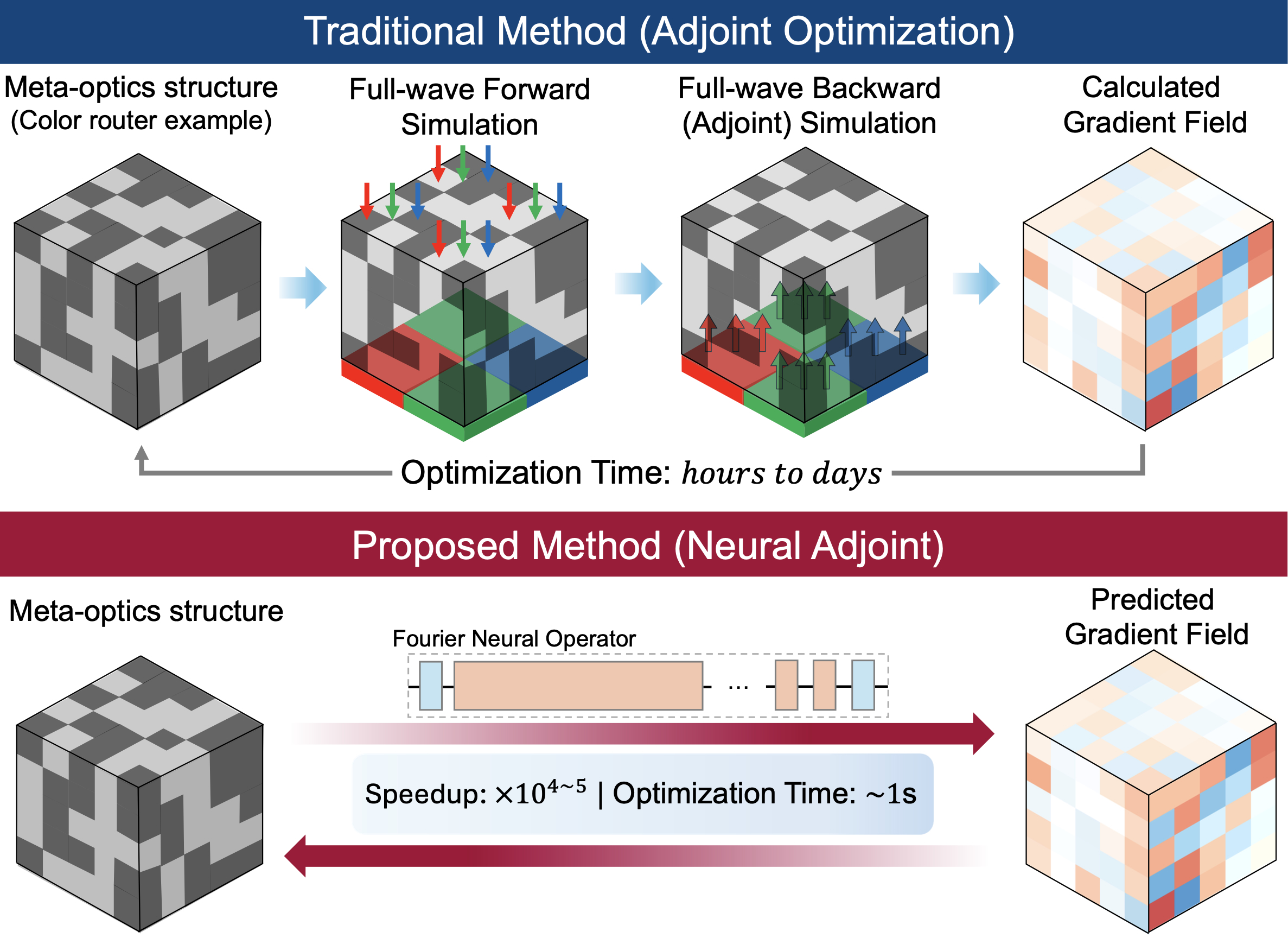
Figure 1: Traditional 3D meta-optics optimization requires computationally expensive iterative full-wave simulations, while the proposed Neural Adjoint Method replaces these with a Fourier Neural Operator surrogate for volumetric gradient inference within seconds.
Problem Setting and Motivation
High-performance meta-optical devices, including color routers for CMOS sensors, achromatic metalenses, and waveguide mode converters, rely on controlling electromagnetic fields within volumetric scatterers. The mapping from target device performance to physical structure under Maxwell constraints is high-dimensional and non-convex. Although the adjoint method enables efficient gradient evaluation, the brute-force cost remains prohibitive due to the necessity of repeated forward and adjoint full-wave solves (typically FDTD) over large grid-based domains and often over many wavelengths. Industrial-scale deployment is blocked by iterative design cycles spanning days to weeks.
The neural adjoint paradigm aims to relieve this cost by inferring the volumetric adjoint sensitivity fields directly from structural parameterizations—specifically, predicting the dense gradient ∇xJ from voxelized permittivity volumes—thereby decoupling the optimizer from the full electromagnetic solver.
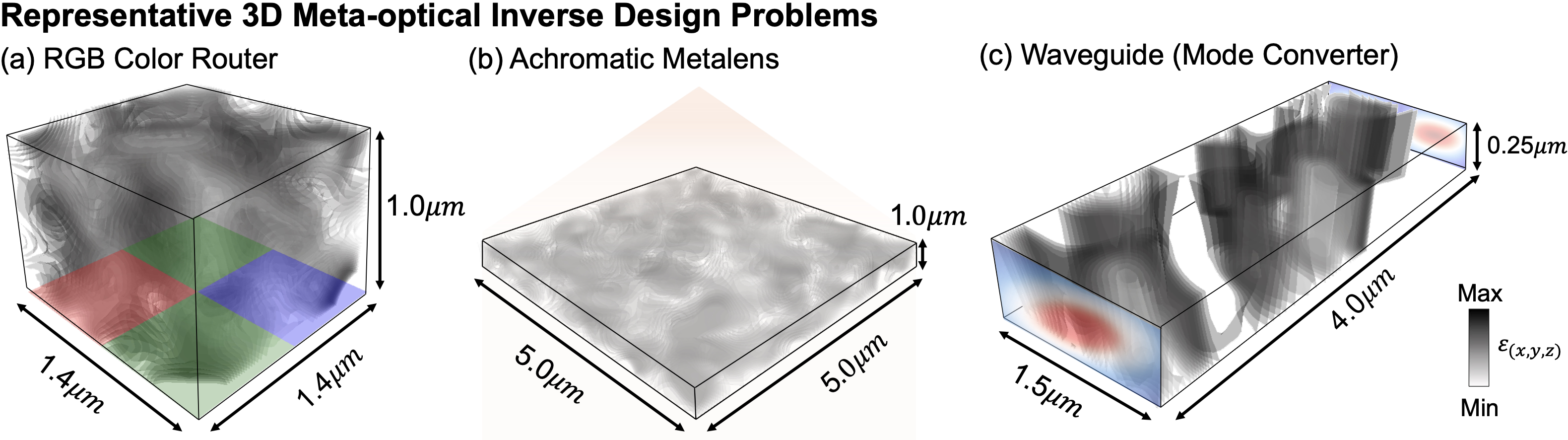
Figure 2: The study tackles three classes of volumetric meta-optical design: (a) spectral sorting (color router), (b) light focusing (metalens), (c) guided-wave mode conversion (waveguide).
Methodology: Stage-wise Fourier Neural Operator (SW-FNO)
A key challenge is the multi-scale structure of volumetric adjoint gradients. Standard neural field surrogates, constrained by low-mode Fourier representations or CNN-induced spectral bias, excessively smooth the learned gradients—obliterating high-frequency, localized sensitivity peaks essential for accurate topology optimization. The proposed solution is a multi-stage, frequency-boosted FNO (SW-FNO):
- Stage-1 FNO: Captures global, low-frequency components corresponding to large-scale field interactions.
- Stage-2 FNO: Refines boundary- and interface-aligned, mid-frequency content by residual learning atop Stage 1.
- Stage-3 FNO: Adds highly localized, high-spatial-frequency corrections, restoring physically meaningful, sharp sensitivity peaks.
Each subsequent stage takes as input both the original structure and outputs from all previous stages, with the total volumetric gradient prediction an additive aggregation across stages.
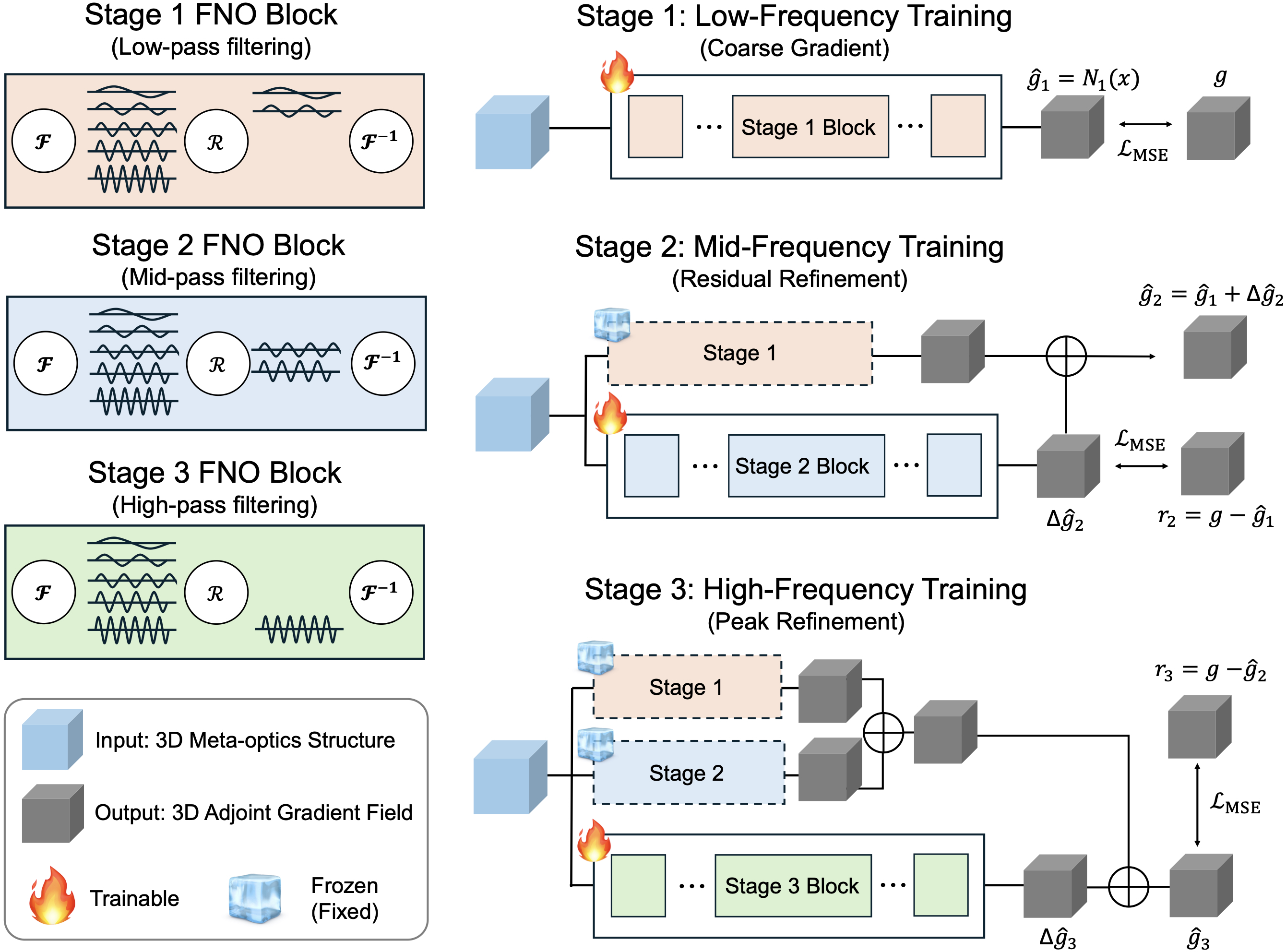
Figure 3: The SW-FNO architecture uses sequential frequency-selective FNO blocks, progressing from low to high frequencies with stage-wise residual learning for sharp, accurate gradient field recovery.
Supervised training utilizes paired data: synthetic voxelized designs as input and ground-truth adjoint gradients computed via full FDTD simulations as targets. The dense regression loss optimizes for close matching of predicted and rigorous gradients on a per-voxel basis.
Experimental Evaluation
The SW-FNO is evaluated across three representative 3D meta-optics design tasks covering diverse physical objectives:
- RGB color routers (spectral sorting)
- Achromatic metalenses (focal spot intensity maximization)
- Waveguide mode converters (modal overlap maximization)
The baseline methods include direct FDTD adjoint optimization (reference standard), single-stage FNOs, and U-Net surrogates. Metrics are cosine similarity between predicted and FDTD gradients (gradient field fidelity), final figure-of-merit (FoM) for device functionality, and wall-clock optimization time.
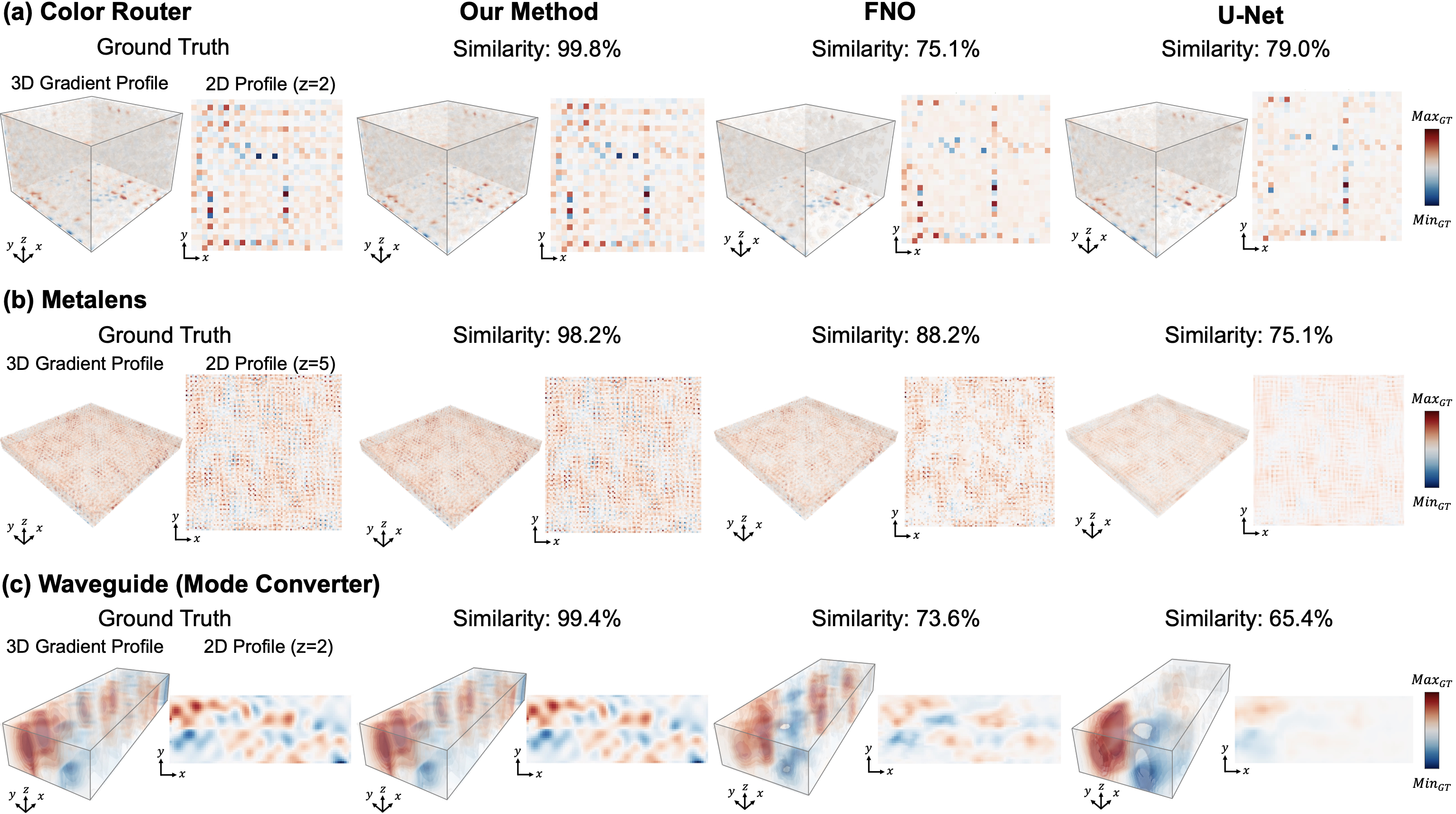
Figure 4: Ground-truth gradient fields (FDTD) versus predictions from SW-FNO, single-stage FNO, and U-Net. Standard baselines fail to capture high-frequency detail; SW-FNO reconstructs sharp peaks and localized features, with cosine similarities exceeding 98%.
The SW-FNO achieves maximum cosine similarity scores upward of 99% across tasks, with substantially better fidelity than U-Net (max 86%) or single-stage FNO (max 90%).
The computational savings are striking: the neural adjoint approach accelerates optimization by 95.9%3 to 95.9%4, shifting runtimes from hours/days to seconds.
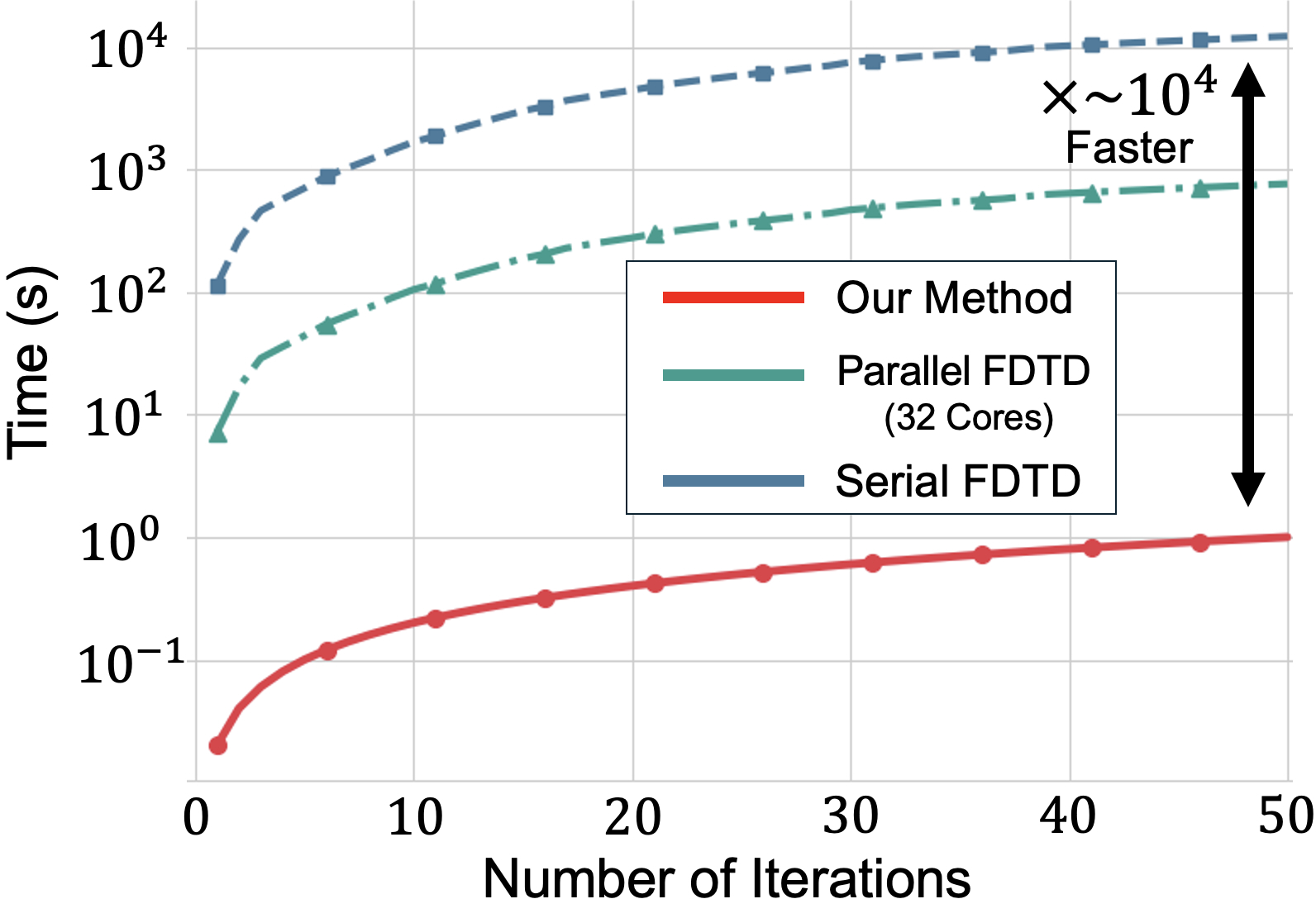
Figure 6: Wall-clock time throughout optimization for both FDTD-based adjoint and neural surrogate optimization, illustrating orders-of-magnitude speedup.
A stage ablation study shows that three-stage SW-FNO provides an optimal trade-off between inference latency and design accuracy; a fourth stage yields diminishing returns.
Implications, Limitations, and Theoretical Perspectives
This work substantiates the feasibility of replacing the adjoint electromagnetic solver in volumetric optical design with task-generic neural surrogates, provided the architecture is tailored for multi-scale, frequency-sensitive field recovery. The preservation of high-frequency detail enables physically meaningful, solver-compatible gradient-based optimization in a fraction of the time.
From a practical standpoint, this directly enables real-time and high-throughput volumetric device design pipelines, critical for rapid prototyping and industrial deployment in imaging, display, and photonic integration. From a theoretical perspective, the approach highlights the importance of spectral decomposition and residual refinement for mitigating neural operator spectral bias, suggesting a modeling principle applicable to broader PDE-based inverse design.
Limitations include the covariance with training data distributions (e.g., material model, domain size, and topology variety) and lack of demonstrated generalization to arbitrary, non-similar structures or out-of-distribution physics. Scaling to massive domains and cross-material adaptation presents both an opportunity and a challenge for future neural-PDE surrogate research.
Conclusion
The Neural Adjoint Method demonstrates that stage-wise, multi-frequency FNOs can deliver solver-level adjoint gradient fidelity for 3D meta-optical inverse design, reducing computation from hours to seconds and yielding task-transferrable optimization capabilities. This result serves as a reference point for integrating neural operator surrogates into large-scale scientific computing workflows, particularly where high-resolution, multi-scale gradient inference is required.